Page 2 :
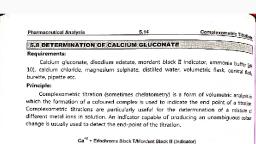
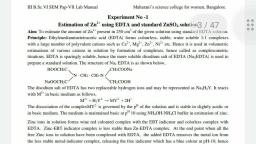
Complexometric Titrations, Titration between metal ion and complex forming agent or ligand., , The complex forming agent or ligand are organic compound which donate electron that forms multiple covalent bond with metal ion the metal ion coordinates to two or more donor group with single ligand., , Eg: EDTA, , EDTA can form complex with a large number of metal ion.
Page 3 :
Principle: metal ion and indicator form complex during titration EDTA reacts with free metal and at end point EDTA brakes metal indicator complex release in free indicator to obtain colour change , , M.In + EDTA M.EDTA + In, , pM indicator: , It must form a stable complex with metal but less stable than metal EDTA complex., Indicator must produce different colour in free and in complex form , Colour change must be specific., Eg. Murexide, xylenol ornge.

Page 4 :
Types of Complexometric Titrations:, Direct Titration: metal ion is directly titrated vs EDTA at desired pH., In this titration standard EDTA solution is added to given sample containing metals using burette till the end point is achieved. , Eg- Copper, barium, zinc, mercury, aluminum, lead, bismuth, chromium etc. are metals which can be determined by using direct complexometric titration., , Back Titration – It is called back titration as in this type of titration we perform back titration for excess amount of EDTA., In this excess amount of standard solution of EDTA is added to the metal solution being examined. Then excess amount of EDTA is back titrated by solution of second metal ion.
Page 5 :
Replacement Titration – It is used when direct titration or back titration is not possible bec endpoints not sharp. , In this analyte (containing metal) is added in metal-EDTA complex. Metal present in analyte displaces another metal from metal-EDTA complex. , , Indirect Titration – Some anions form precipitate with metal cations. These anions do not react with EDTA. So, these can be analyzed by indirect titration with EDTA. For example barium ions can be determined by indirect titration. , , Application: , Determination of cations and hardness of water
Page 6 :
Redox Titrations, Involves gain or loss of electron., , It involves change in oxidation sate of reactants., , Oxidation and reduction reaction occurs simultaneously. One substance is oxidized and other is reduced at time., , Addition of Oxygen:, SO2 + O SO3