Page 1 :
Chapter 3, , (TRIGONOMETRIC FUNCTIONS), , 3.1 Overview, , 3.1.1 The word ‘trigonometry’ is derived from the Greek words ‘trigon’ and ‘metron’, which means measuring the sides of a triangle. An angle is the amount of rotation of a, revolving line with respect to a fixed line. If the rotation is in clockwise direction the, angle is negative and it is positive if the rotation is in the anti-clockwise direction., Usually we follow two types of conventions for measuring angles, 1.e., (i) Sexagesimal, system (ii) Circular system., , , , In sexagesimal system, the unit of measurement is degree. If the rotation from the, , initial to terminal side is =~ th of a revolution, the angle is said to have a measure of, , 360, , 1°. The classifications in this system are as follows:, 1° = 60’, 1’ = 60”, In circular system of measurement, the unit of measurement is radian. One radian is, , the angle subtended, at the centre of a circle, by an arc equal in length to the radius of the, circle. The length s of an arc PQ of a circle of radius r is given by s = 70, where @ is the, angle subtended by the arc PQ at the centre of the circle measured in terms of radians., , 3.1.2 Relation between degree and radian, , The circumference of a circle always bears a constant ratio to its diameter. This constant, , 2, ratio is a number denoted by 1 which is taken approximately as 7 for all practical, , purpose. The relationship between degree and radian measurements is, as follows:, , 2 right angle = 180° = x radians, , Oo, , , , 1 radian = = 57°16 (approx), T™, 1°= = radian = 0.01746 radians (approx), , Scanned by TapScanner
Page 2 :
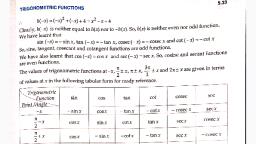
TRIGONOMETRIC FUNCTIONS — 35, , 3.1.3 Trigonometric functions, , Trigonometric ratios are defined for acute angles as the ratio of the sides of a right, angled triangle. The extension of trigonometric ratios to any angle in terms of radian, measure (real numbers) are called trigonometric functions. The signs of trigonometric, , functions in different quadrants have been given in the following table:, , , , , , , , , , , , , , , , , , , , , , , , I | I Il IV, sin x + ~ = cos x + 3 | = | e, tan x 7 — + _, cosee x + + — —, sec x + — - ;, cot x + - +e —, , , , , , 3.1.4 Domain and range of trigonometric functions, , , , , , , , , , , Functions Domain Range, sine R [—-1, 1], cosine R [-1, 1], , R — {(2n+ 1) 5 ine Z}, , , , , , , , cot R- {nt : ne Z}, , Tl, sec R—iGat 1) ae Z}, cosec R—- {nt :ne Z}, , , , , , , , 3.1.5 Sine, cosine and tangent of some angles less than 90°, , , , 0° 15° 18° 30° 36° 45° 60° 90°, , _ i ” 1, in |G os V5-1 | 1 | Jto-2V5 | _L, , 4 2 4 2, , , , |B, , Scanned by TapScanner
Page 3 :
36 EXEMPLAR PROBLEMS — MATHEMATICS, , , , l 1, cosine | 1 V6 +2 Vi0+2v5 N3 V5+1 I 0, , 4 4 Z +t 2 2, , , , l not, , tan O| 2-4/3 ¥25 Vs Tr 5-2/5 l V3 | defined, , BB, , , , 3.1.6 Allied or related angles The angles “ @ are called allied or related angles, and @+ n x 360° are called coterminal angles. For general reduction, we have the, , nt, following rules. The value of any trigonometric function for ; +0) is numerically, , equal to, , (a) the value of the same function if n is an even integer with algebaric sign of the, function as per the quadrant in which angles lie., , , , (b) corresponding cofunction of 8 if n is an odd integer with algebraic sign of the, function for the quadrant in which it lies. Here sine and cosine; tan and cot; sec, and cosec are cofunctions of each other., , 3.1.7 Functions of negative angles. Let 0 be any angle. Then, sin (-8) =— sin 8, cos (—9) = cos®@, tan (—8@) =— tan 8, cot (-—6) =-— cot 6, sec (—9) =sec 8, cosec (—9) = — cosec 8, , 3.1.8 Some formulae regarding compound angles, , An angle made up of the sum or differences of two or more angles is called a, compound angle. The basic results in this direction are called trigonometric identies, as given below:, (i) sin(A+B)=sinAcos B+cos AsinB, (ii) sin(A—B)=sin Acos B-—cosA sin B, (11) cos(A+B)=cosA cos B—-sinA sin B, (iv) cos (A—B)=cos Acos B+ sinA sin B, , — tan A + tan B, +B) _—_———, ey Han ) l1—tan AtanB, , A_® _ tan A — tan B, (ny ae (a — 2a) = 1+ tanA tan B, , Scanned by TapScanner
Page 5 :
38 EXEMPLAR PROBLEMS — MATHEMATICS, , + if & lies in I or IV quadrants, : A 1+cosA 2, (XxIV) eS =+ > A, —if 7 lies in II or IL quadrants, , , , +if = lies inI or III quadrants, , A l-—cosA 2, (xxv) a - a A, ae - if > lies in Ilor IV quadrants, , Trigonometric functions of an angle of 18°, Let 6= 18°. Then 20 = 90° — 30, , Therefore, sin 20 = sin (90° — 38) = cos 30, or sin 20 = 4cos* 0 — 3cos 8, , Since, cos 8 #0, we get, 2sin 8 = 4cos?8@-—3=1-4sin?6@ or 4sin? 0+ 2sin 6—-1=0., , 24 JM 2145, , H in 9@= _, ence, sin 3 ri, , , , V5 -1, , , , Since, 6 = 18°, sin 68> 0, therefore, sin 18° =, , 4, Also, cos18° = ¥1—sin? 18° =" = _ io aN, , Now, we can easily find cos 36° and sin 36° as follows:, , 6-25 _ 2+2V5 _V5+1, 8, , 8 4, , , , , , cos 36° 1 — 2sin? 18° = 1, Hence, cos 36° = ua, , Also, sin 36° = 1 —cos? 36° = _ fn _ sO, , 3.1.9 Trigonometric equations, , , , , , Equations involving trigonometric functions of a variables are called trigonometric, equations. Equations are called identities, if they are satisfied by all values of the, , Scanned by TapScanner