Page 1 :
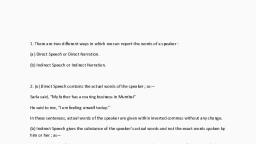
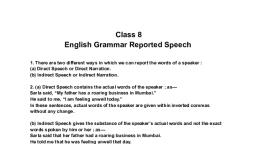
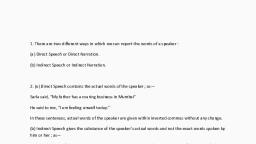
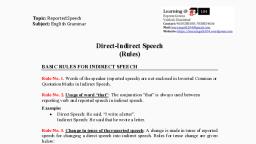
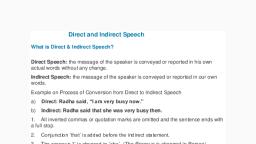
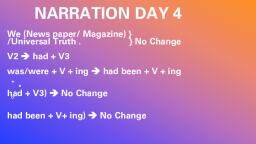
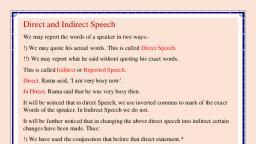
General Foundation Course ENGLISH (NARRATIONS), , se, , , , Narrations, , , , , , , , Definition: V/Vhen we express someone's words in our own words, it is, , , , called - "Indirect Speech" and when we express someone's words as it is,, is called - "Direct Speech"., For examples- He said to me, "I write a letter". (Direct), , He told me that he wrote a letter. (Indirect), Rules for changing "Direct Speech" into "Indirect Speech"., , , , 1. Reporting verb is changed according to the form and sense of the, sentence., , 2. Inverted commas are removed in the indirect-speech., , 3. Connective word is used in the beginning of the reported speech., , 4. Verb of the reported speech is changed according to the form and, sense of the sentence., , 5. Persons of the reported speech are changed., , 6. VVords showing nearness, time or place are changed., For example: 'yesterday' is changed into "the previous day"., , 1. Assertive Sentences, , , , , , , , , , , , , , , , , , , , , , , , , , , , , , , , , , , , , , , , , , , , , , , , , , , , , , , , , , , , , , , , , , , , , , , , Rule 1: Rules for changing reporting verb, Direct Indirect, Say, says (without object) No Change, Say to, Says to (with object) Tell, Tells, Said (without object) No change, Said to (with object) Told, , Rule 2: Comma and inverted commas are removed in the indirect, speech and connective word ‘that’ is used in the indirect, speech., , Rule 3: If reporting verb is written in the present or future tense then, the tense of the reported verb is not changed in the indirect, speech., , Rule 4: Rules for changing “Helping Verb"., , Direct Indirect Direct Indirect, Is, am VWas Do, Does Did, Are Were Did Had, Has, Have Had Must No Change, Shall, Will Would Should No Change, Can Could Had No Change, May Might Would No Change, Could No Change, Rule 5: Rules for change of words showing nearness., Direct Indirect Direct Indirect, This That Yesterday The previous day, These Those Tomorrow The next day, Here There Tonight That night, Now /just Then Last night The previous night, Today That day Hence Thence, Rule 6: Pronoun changes according to the following rule., , The Pronoun of reported speech changes according to the, subject and the object of the reporting verb, , , , , , , , Sub Obj No, 1st Person 2nd Person || 3rd Person, I, we you he, she, it, they, , , , , , , , , , , , , , , , , , , , , , , , 15|Page, CREATIVE CIRCLE _H.0.: KONUNG MAMANG WANGKHEI ROAD NEAR TRAFFIC POINT
Page 2 :
General Foundation Course ENGLISH (NARRATIONS), , , , Case l: The first person of reported speech changes according to the, , subject of reporting verb, Ex— He said, "I play cricket." (Direct), He said that he played cricket (Indirect), Subject of reported speech 'I' (first person) is changed according, to the subject of reporting verb 'He' (third person), , Case Il: The second person of reported speech changes according to, , the object of reporting verb, Ex — He said to me, “you play cricket" (Direct), , He told me that | played cricket (Indirect), In the above case the subject 'you’ (second person) of reported, speech is changed according to the object of reporting verb, 'me' (first person), , Case III: The third person of reported speech remains unchanged, , 10., , 11., , 12., , 13., , 14., , 15., , Ex — You said to me, "He will play cricket" (Direct), You told me that he will play cricket (Indirect), In the above case the subject 'he' (third person) of reported, speech is not changed, Forexample, He says, "| take coffee". (Direct), He says that he takes coffee. (Indirect), He is saying, "| was suffering from fever". (Direct), He is saying that he was suffering from fever. (Indirect), My friend said, "| am fine”., My friend said that he was fine., She said to me, "You are right"., She told me that I was right., Mohan said, "I am doing work"., Mohan said that he was doing work, Radha said, "I have finished her work"., Radha said that she had finished her work., You said to me, "| went to Mumbai"., You told me that you had gone to Mumbai., He said, “The bus had left"., He said that the bus had left., He said, "| shall bring your book tomorrow"., He said that he would bring my book the next day., The teacher said to me, "The boy will go on a picnic”., The teacher told me that the boy would go ona picnic., He said, "Man is mortal"., He said that man is mortal., You say, "lam doing work"., , You say that you are doing work., , | say to him, "You cannot win the match"., , | tell him that he cannot win the match., , They say to me, "Ve shall help you”., , They tell me that they will help me., , She says to me, "I did not break your pen"., , She tells me that she did not break my pen., 2. Interrogative Sentences, , Rule 1: Connective word 'that' is not used in the indirect speech., Rule 2: Reporting verb is changed into 'ask' or 'asked' in the indirect, , speech., , Rule 3: Mark of interrogation [?] is removed in the indirect speech., , 1., , Forexample:, He said to me, "Are you studying?", , 16|Page, CREATIVE CIRCLE _H.0.: KONUNG MAMANG WANGKHEI ROAD NEAR TRAFFIC POINT
Page 3 :
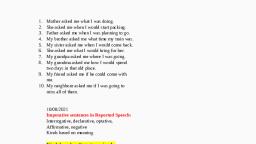
General Foundation Course ENGLISH (NARRATIONS), , Rule 2: Reporting verb is changed into 'ask' or 'asked' in the indirect, speech., Rule 3: Mark of interrogation [?] is removed in the indirect speech., Forexample:, 41. He said to me, "Are you studying?", He asked me if | was studying., 2. Hesaid to me, “Have you done your work?", He asked me if | had done my work., 3. She said to me, "Do you take tea?", She asked me if | took tea., , , , 4. Hesaid to me, "Did you take lunch?", He asked me if | had taken lunch., 5. She said to me, "Can you do it?", She asked me if | could do it., 6. Hesaid to me, "What are you doing?", He asked me what | was doing., 7. She said to me, "How old are you?", She asked me how old | was., 8. Hesaid to me, "Why do you play cricket?", He asked me why | played cricket., 9. She said to me, "Where do you come from?", She asked me where I came from., 10. | said to Ram, "Which is your pen?", | asked Ram which his pen was., 3. Imperative Sentences, Rule 1: Reporting verb is changed into -ordered, requested, advised,, proposed, suggested or forbade etc., Rule 2: Connective word 'that' is not used., Rule 3: 'To' is used before the verb of the reported speech., Forexample:, 1. He said to the servant, "Open the door, He ordered the servant to open the doo, 2. My father said to me, "Study hard"., My father advised me to study hard., 3. Hesaid to me, "Please give me your pen., He requested me to give him my pen., 4. | said to him, "Let me do it"., | requested him to let me do it., 5. | said, "Let me speak first"., | requested to let me speak first., 6. Teacher said to students, "Do not talk.", Teacher forbade students to talk., 4. Exclamatory and Optative Sentences, Rule 1: Reporting verb is changed into -exclaimed with joy or with, sorrow or with surprise, applauded, wished, prayed etc., Rule 2: Words of exclamations, i.e., Hurrah, alas, ah, Oh! Etc. are, removed., Rule 3: Mark of exclamation (!) is removed., Rule 4. Connective word ‘that’ is used., Forexample, 1. Hesaid, "Alas! |am ruined.", He exclaimed with sorrow that he was ruined., 2. My friend said, "Hurrah! | have won the match.", , 17|Page, CREATIVE CIRCLE H.0.: KONUNG MAMANG WANGKHEI ROAD NEAR TRAFFIC POINT
Page 4 :
General Foundation Course ENGLISH (NARRATIONS), , , , My friend exclaimed with joy that he had won the match., 4. She said, "What a beautiful scenery!", , She exclaimed with surprise that it was a very beautiful scenery., 5. The Caption said, "Bravo! Well done.", , The Caption applauded saying that they had done well., 6. He said, "Good morning, boys!", , He wished good morning to boys., , —__________(xereise}——________, , Direction: Find out the error in each of the following sentences, if there, is no error, answer is (e). Avoid punctuation mistake (if any)., 1. (a) They /(b) said that/(c) they will go/(d) next day./(e) No error, 2. (a) They said /(b) that! /(c) shall work hard/ (d) if | want to pass./, (e) no error, 3. (a) He asked her / (b) that if / (c)she was going / (d) to attend the, meeting. / (e) No error, 4. (a)Shweta asked Harish / (b) that what / (c) had not / (d) happened, . / (e) Noerror, 5. (a) Seema asked / (b) me / (c) what did | say / (d) about her. /, (e) No error, , 6. (a) Teacher told to / (b) me that / (c) thesun / (d) isthe nearest, star to the earth / (e) No error., , 7. (a) The Judge /(b) asked Ravi/ (c) if he Knew the/ (d) thief or not /, (e) Noerror., , 8. (a) Ramesh wastelling that /(b) everyone was / (c) satisfied with/, (d) the incentive. / (e) No error., , 9. (a) My teacher said /(b) that a bird in hand/(c) is worth two/(d) in, the bush./(e) No error., , 10. (a) She ordered/ (b) her son shut/ (c) the door and/(d) close the, window./ (e) Noerror., , 11. (a) The police asked / (b) the little boy if /(c) he knows the who/(d), killed his mother./(e) No error, , 12. (a) My father allowed / (b) meto/(c) do whatever /(d)Il want./ (e), No error., , 13. (a) The mother forbade/ (b) his son not to/(c) go outside / (d) after, the dark./ (e) No error., , 14. (a) She exclaimed with/ (b) sorrow that her mother/(c) died just, two/ (d) months before./ (e) No error., , 15. (a) He requested his father /(b) to take him to/(c) the doctor as he/, (d) has very high fever./(e) No error., , 16. (a) When my teacher said that/(b) she was coming to see me the, next week/(c) | wondered what problems/(d) she will have with, me. / (e) No error., , 17. (a) She suggested that/ (b)| should stay at/(c) home if it rained but, I do not /(d) give any answer/(e) No error., , 18. (a) He asked his son why had he /(b) gone to school when/(c) he, knew that there would be fewer/(d) buses on road that day/(e) No, error., , 19. (a) She said that you/(b) studied hard so/(c) that you may get/(d), good marks. /(e) No error, , 20. (a) She said that she/(b) was going to temple and /(c) wanted to, Know that/(d) I could accompany her. /(e) No error., , 18|Page, CREATIVE CIRCLE H.0.: KONUNG MAMANG WANGKHEI ROAD NEAR TRAFFIC POINT