Page 1 :
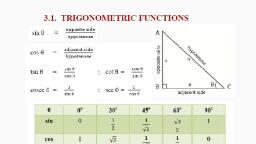
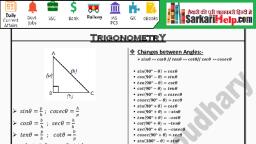
Unit 2, Trigonometry, , Course Outcome: Utilize basic concepts of trigonometry to solve elementary engineering, problems., , Unit outcome:, , a. Apply the concept of compound angle, allied angle, and multiple angles to solve the given, , simple engineering problem(s)., , b. Apply the concept of Sub- multiple angle to solve the given simple engineering related, , problem(s)., Employ concept of factorization and de-factorization formulae to solve the given simple, , engineering problem(s)., d. Investigate given simple problems utilizing inverse trigonometric ratios., , Introduction: Trigonometry is a study of relationships in Mathematics involving lengths,, heights and angles of different triangles. Presently Trigonometry finds wide applications in, engineering faculties like Applied Mechanics, Electrical Technology, Basic Electronics, and, Computer Enginecring etc., , Subtopic: Compound angles, Allied angles, Multiple and Submulttiple angles., , Significance : This sub-topic is used to find trigonometric ratios of angles other than standard, , angles. *, Some important formulae:, I. Fundamental Identities:, , > sin?@ + cos?@ =1, > 1 + tan?@ = sec@, > 1 + cot?@ = cosec?6, , ll. Fora right-angled triangle, , i id hypot, > sind= opposite side > sec Q= ae enuse, hypotenuse adjacent side, j ide hypot, > gos 6 _ adjacent si > cosec = YP. ene, hypotenuse opposite side, opposite side _ adjacent side, > tan 8 =———_ > cot § ==, adjacent side opposite side, , Also we have,
Page 2 :
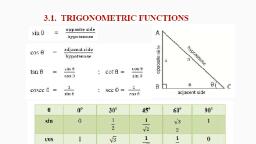
1, > cosec @ =——, , , , , , , , sin®, 1, > secO=, cos @, 1, > cotd=, tan @, > tang=<28, cos @, , cos®, , cot 0=, 9 sin @, , >, , > cosec 6 X sin@ = |, > sec@xcosO=1, > cot@xtand=1, , III. Measures of an angle: In practice we use two systems to measure the angle., a) Sexagesimal system (Degree) : In this system , the unit of measurement is degree., b) Circular systems (Radian) : In this system , the unit of measurement is radian., Relation between degrees and radians:, Notation: Any angle can be measured in degrees = 6° and_ in radians = 0°, 1. Conversion of angle in degrees to angle in radians, , , , , , , , , , , , , , , , , , ee = x =, 180, 2. Conversion of radians to degree, @° = ex 2, The following table shows the conversion of degree measure to radian measure of standard, angles, @° oe, 30 bid, 6, 45 %, 4, 60 ze, 3, 90 bd, 2, 180 1, 270 3a, 2, 360 2x
Page 3 :
1V. Negative Angle:, Y-axis, , 6 X-axis, , -6, , Definition: The angle is said to be negative if it is measured in the clock-wise, direction., V. Sign Convention:, , , A - All trigonometric ratios are positive, S — Sine ratio is positive, T — Tangent ratio is positive, 4. C-—Cosine ratio is positive, Table for values of six trigonometric ratios of 0°, 30°, 45, 60°, 90°, 180°., , wine, , , , , , , , , , , , , , , , 8 0° a a n 1 180°(r), Rae 30° (] as(2] wo( 90° a, J = v3, sin@ 0 2 V2 2 1 0, & i]t, cos0 | 2 V2 2 0 -1, a v3, tan 0 V3 1 ea 0, eo, cotd © B 1 WE 0 a, A., sec 1 V3 afi 2 0 a, cosecO 20 2 V2 2, V3 1 o
Page 4 :
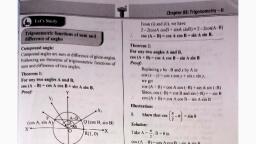
Content of the Compound Angle and Allied angle:, , Compound angle:, Definition: The angle obtained by addition or subtraction of given angles is called compound, , angle., For e.g. A+B, A-B are called compound angles, e.g. A= 45°, B= 30° then, , A+ B= 45° + 30° = 75° and, A-B = 45° — 30° = 15° are compound angles., Trigonometric ratios of compound angles (Without proof) :, 1) sin(A + B)=sin A-cosB+cosA-sinB, 2) sin(A- B) =sin A. cos B—cos A sinB, 3) cos(A+B)=cosA+cosB-sinA-sinB, 4) cos (A -B)=cos AcosB+sinA sinB, tan A + tanB, a) ran B= 1-tanA-tanB, , tan A —tanB, , Cyan BIG +tanA-tanB, , SOLVED EXAMPLES:, Without using calculator, find the value of, 1) sin 15° 2) cos 75°, , Solution : 1) 15° = 45° — 30°, “. sin 15° = Sin (45° — 30°), sin 45° - cos 30° — cos 45° - sin 30°, 2G 8) _ (4), ~ (fz 2 V2 2, Ne, ~ anf2” 22, see Ot, “sin 15°= Zi, 2) 75°= 45° + 30°, , 08 75° = cos (45°+30°), cos 45° - cos 30° — sin 45° - sin 30°, , 3, , i, , , , - 8
Page 5 :
4 fiestas, ~ 227 2/2, cos 75° Aaa, , 2v2z, , 1, 3) Iftan A=, tan B= 5 find tan (A + B), , , , tan A +tanB, Solution: tan(A + B)= T-tanA-tanB, , NI, a, Wl, , fl, , , , |, , oe, Wh NIE, wii, , ll, ae, , a wm, 1] a}+ I, — NV Al, Il, In, , |, , =I, , 8 qa, 4) Iftan (x + y) = a and tan (x — y) = 15 then show that tan 2x = 36, , Solution :, As 2x=(x+y)+(x-y), “. L.H.S.= tan 2x = tan[(x + y) + (x — y)], tan (x + y) + tan (x — y), ~] —tan (x + y)- tan (x-y), 3. 8, , 4715