Page 1 :
UNIT, , Chapter..1, PARTIAL FRACTION, OBJECTIVES, completion of the learning of this chapter students, polynomial" and classify it, , On successful, , Define, , should, , be able to:, , Write rational functions as the sum of functions by the process of partial t, , decomposition., Evaluate integral using partial fraction., , 1.1 INTRoDUCTION, Splitting up of a a given fraction into simpler fractions called partial fractions., Let us, , consider, , a, , 2x+5, , fraction(x+ 2) (x 3), +, , We can write the given fraction as, , 2x+ 5, , i2'3, , ( 2)x 3) * 2 * 3, +, , The fractions2 and, , are called the partial fractions of the given fraction, , 2x +5, (x+2) (x+ 3), In this chapter, we study the methods of resolving a given fraction into partial fractions., , 1.2 POLYNOMIAL, An algebraicexpression of the form P) = ax+ a , x a ax, , . . a , is a polynomial, , of degree n (highest power of x) inx. Where ag=0, ay a2.. B, are real constants., , Example: fx) = * + 2* +5x + 9 is a polynomial of degree 3 in, , 1.3RATIONAL FRACTION, PO), , The quotient o o f two polynomials P(X) and Q), Qx) = 0 is called a rational fraction., , (1.1)
Page 2 :
Remedial Mathematics, , Partial Fraction, , 1.2, , Example:, , i s a rational fraction., , Here. P(x) = x - 2x, , 3 and Q) =*, , 3x, , 3x 1 and Q ), , 0 also., , 1.4 PROPER AND IMPROPER FRACTIONS, The rational fraction s, the, , degree, , of denominator, , said to proper, if the degree of numerator P(x) is less than, , Q)., , Example:, Example, -6x1 5, Here,, , Px) = 2x+ 1. degree of P(x) 1, Q) = *+6x + 5, degree of Q)=2, , and, , 6 xx, 51, i s a properfraction., If the degree of numerator is greater than or equal to the degree of denominato, then, the fraction is known as improper fraction., , Example 1:, Here,, and, , P(x) =, , + 3x +2, degree, , 2, , Qx) = * - 3x + 9, degree, , 2, , Degree of numerator P(x) is equal to the degree of denominator Q(x)., T h e given fraction is improper., Example 2 : 5 + 6 x 9, , Example 2:, , 2x1, , Here degree of numerator 3 and degree of denominator, , 2., , .Thegiven fraction is improper., Note: Improper fraction can be convert into proper fraction by dividing numerator by, denominator., , 1.5 PARTIAL FRACTION, Any proper rational fractionacan be expressed as the sum of rational fraction, each, gx), having a simple factor of gt). Each such fraction is called a partial fraction and the process, , of obtaining them is called the decomposition or resolution of af, , gx), , into partial fractions., , 9.6 METHODS OF RESOLVE INTO PARTIAL FRACTIONS, The, , decomposition of ainto partial, , denominator i.e. g(x)., , fractions depends, , on, , the nature of the factors of
Page 3 :
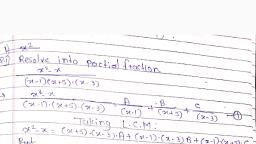
Remedial Mathematics, , 1.3, , Case I: When denominator is, Let gox) = (x-a) (x-a).., , expressible as, , Partlal Fraction, the, , product of non-repeating, , linear, , (x- an). Then we assume, , factors., , that, AL,A+ . . +X, + Ap, X-a x-a2 x-at, , f), 90, , an, , where, A, Az. Asr.. An are constants and can, be determined by comparing the coefficients, of various powers of x or, by substituting x = al, az,, an in the L.H.S. and R.H.S. after, ..,, , simplification (i.e. in numerator)., , SOLVED EXAMPLES, Example 1.1: Resolve, Solution, therefore the, , Here the, , :, , given, , Let, , into partial fractions., , degree, , of numerator is lower than the, rational fraction is a proper fraction., , 3, we get, , Again, put x, , =, , -, , Ax +1) + B(x-3), , 9, , 1,, , we, , -4BB, , =, , -, , 9, , x-2x 3, , Example 1.2: Resolve, , A =2, , 4A, , get, 1, , 3, , denominator,, , (x-3)(K +1)x-3X+1, , 2x+3, , Putx, , of, , 2x+3, , -2x-3, , OR, , degree, , 1, , 4(%-3)4 (x 1), x -6x + 10x-2, into, , 5x+6, , partial fractions., , Solution: Here, the degree of numerator is, higher than the degree of denominator,, the rational fraction is, improper fraction. Therefore dividing out, we gett, x-5x +6, , -6x+10x-2 =x-1+5X+6, 4-X, -5x + 6, , NOW, , 4-X-, , So, let, , -5x+, , OR, Put, , x, , 3,, , we, , get, , 4-X, , A, , x-2) (x-3)X-2*x-3, , 6, , 4 x, =, , X-1, , S a proper fraction., , =, , A(X - 3) B(x-2), , 1 = B, , +, , B = 1, , Again, put x = 2, we get, 2 = -A A, , and, , +4x 2, , +5, X+4, , = - 2, , 4-x, , -5x-6, , x-5x+6x-6x+10x-2, , 6x+10X4, x-1--2, -5x6 =, , so
Page 4 :
Partlal Fractlon, , 1.4, , Remedial Mathematics, , Example 1.3: Find partial fractions of(x + 1) (x-1) (x+ 2), Solution, , : Here, , the, , given, , A, , x1)x-1), , +2)+1tx-1Z, , OR, , x, , Put x, , =, , =, , A(x -1) (x +, , 1 6B, , 1, we get, , Putx = - 1, we get, Putx, , fraction., rational function is a proper, , Example 1.4:, , 2), , +, , C(x, , +, , 1) (x-1), , A =, , 1, , X, , 2), , +, , 3C-C=., , -2, , x+1) (x-1) (x +, , 1) (x, , +, , B, , - 1 = - 2A, , -2, we get, , 2) +B(x, , 2, , (x, , Put , 1 1 +, , +, , 1), , *, , into, , 6 (x-1) 3, , 2, (x, , 2), , +, , partial fractions., Y_, , Solution: We put x =y., y, , Let, , (y+1)(y+4), , Puty =-1, we get, , -1, , Put y =4, we get, , -4, , Y, , y+1) y+4), , Then, , +) + 4) (y+1) (y + 4, , y+1y+4, , OR, , y, , Aly, , +4), , +, , B(y, , +, , 1), , 3A >A =, , -3BB, , =2, , 3 (y+ 1) *3(y+4), 4, , and Hence, , 1)+4) 3, , +1) *34), , Case-I: When the denominator g) is expressible as the product of linear factors such, that some of them are repeating., g ) = (x-a)" (x- a)(x-a, Let, Then asume that, , go-)-a-a, , -, , Ak, , .. ( - a ), , x-a2, , B, , x- a), , 2x, , Example 1.5: Resolve x-1 (x + 1) into partialfractions., , 2x, , B, , D, , Let-1 «+ 1)x-1*-1'-1*1, , Solution:, , OR, OR, , OR, , 2x= A(x-1) (x + 1) + B(x- 1) (x + 1) + C(x + 1) +D(x-1), 2x = A(x - x-x + 1) +B(x - 1) + Cx + 1) +D(x-1-3x+ 3x), 2x = (A + D) x* + (-A +B-3D) x* + (-A +C+3D)x+ A-B + C-D
Page 5 :
Partlal Fractlon, , 1.8, , Remedial Mathematlce, , x' and x, we get, Equating the coefficients of x', x',, A+D, , 0, ., , E-D 0, ., , 2D E+B+4A, , 0, , 2E 2D B+C, , 0, , B, X+1, , 1, , 1, , -1 +2 9-1-9 2 - 2, EXERCISE 11, Decompose the following rational functions into partial fractions:, 3x +1, , (x-1, , 2. (x-1) (x-2), , x-1) (x+2) (x-3), 1, , 5. - 1 + 1 ), , x(x + 1), , 4x16x +7, , 7 4), , ANSWERS 1.1, 2x-11, (x-1)(x+2)(-3) 6 (x-2) "3(x +2) 2(x-3, (K-1)- 2 * * 3 -, , 3, , 3x+1, , 1, , 5-1 x +3 2x-1)-1 2+ 3), 1, , 1, , 1, (- 1, , x(x+ 1), ( x - 1 2 + 1), , 2 ( x - 1 ) * 2 (x - 1 ), , 2x, , 4x4x+16x+74X +, , Gi), , .(v), , Solving those equations, we get, , 2x-1, , Gi), , 7, , 2(, , X, , +1), , +1), , (x + 3), , + 2)
Page 6 :
Chapter..2, LOGARITHMS, , OBJECTIVES, chapter, of the learning of this, On successful completion, Perfom calculations, , Solve numerical, , using, , exponents and, , logarithms to any, , and antilogarithm, problem using logarithm, , 2.1 INTRODUCTION, , tool, , Logarithms were, John Napier. A logarithm is a, number, called the base, is multiplied, Let, , us, , be able to, , base., tables., , Scottish mathematician, how many times a, , by, 17th century as a calculation, determines, mathematical operation that, , invented in, , certain, Forexample:, , students should, , by itself to reach, , 2x2x2x2, , consider, , another number., , = 16, , 4 times, Here,, , we, , have to, , multiply of the 2's to get 16, so, , We write "the number of 2's, , log2 16, So, these two things, , =, , we, , need to, , the, , logarithm is 4., , multiply to get 16 is 4" as, , 4, , are same., , 2x2x2x2, , =, , 16, , loga 16 =4, , 4 times, The number we are multiplying is called the base, so we can say., , The logarithm of 16 with base 2 is 4., OR log base 2 of 16 is 4., , sOLVED EXAMPLEs, Example2.1: What is logs 125 ?, Solution: Here, we are asking "how many 5s need to be multiplied togetherto get 125, 5x5x5 = 125, so we need 3 of the 5s, logs 125 = 3, , (2.1)
Page 7 :
Logarithms, , 2.2, , Remedial Mathematics, , Exponent: The exponent says how many times to use a number in a multiplication., , Forexample:, 2 is used 4 times in, exponent is 4., , Theform, , 2", , 2 2x 2x2x2 =16, a multiplication to get 16., , 16 is called the, , =, , In this, , example the, , exponential form and log2 16, , base is 2 and the, , 4 is called the, , logarithm, , form., Thus, the logarithm tells us what the exponent is., , 2.2 DEFINITION, The, , logarithm is the inverse operation to exponentiation., , The logarithm of any number y > 0, to a given base a > 0 and a, 1 is the exponent, (index or power) to which the base must be raised in order to equal the given number, Thus, if a, , = y, then loga y = X., , OR We can say that the logarithm of a number is the exponent to which another fixed, , number, the base, must be raised to produce that number., The, , logarithm to, , base 10 is called the, , common, , logarithm., , The logarithm to base (e = 2.718) is called the natural logarithm., , The logarithm to base 2 is called the binary logarithm which is commonly used in, computer science., , 2.3 THEOREMSIPROPERTIES OF LoGARITHMS, We assume that a > 0, a* 1, m> 0, n > 0., 1, , a = a, b' = b etc. . loga a = 1, logs b = 1., (Logarithm of a number with the same base is 1), 2. a, , 1, b° =1 etc. . loga 1 =0, log 1 0, , (Logarithm of 1 is 0, whatever the base may be), 3. loga m n, , = loga m + loga n., , 4., , l o g = log, m - log, n., , 5., , loga m" = n loga m, , log a, 6., , 7., , ao9a n =, , OR in particular case., , n (Imp.), n., , logb a loga b =l, , OR, , logb, , a, , =, , log, b, , (Note loge X 2.3030 log10 x), 8., , log a = log, x log, a, , (This is known, , as, , base, , change formula).
Page 8 :
2.3, , Remedial Mathematics, , Logarlthm, , sOLVED EXAMPLES, in the, Example 2.2: Write the following, , logarithm form., , () 43/28, (ii) 5= 1 ) z2=, Solution:(6) We have, 4 3 = 8, , 1, , 5, , log48 = 2, , 0, , logs 1, , (aa-=log,a= -, , (ii), , Example 2.3: Write the following in the exponential, 0log 32 =5, (G) loga242 - 5, () log,yg 5 =, 52, , Solution : i) here,we have, log2 32=, , form., , 32, , Ino5-5-ar =243, , (ii), , =5, , (5y5, , logs 5, , (ii), , OR, , (s3/223 =5, , Example 2.4: Evaluate log (216 V6) to the base 6., y = logs 216 V6, , Solution: Let, , loge (66, , = loge(6/ =slog, 6 - 5x1 -5, , Example 2.5 Evaluate the following, (), , logog10 m, , log10 n, , (i) 22-lo92 5, , Solution: ) Let, , 10og10, , y, =, , (ii) Let, , m, , +, , Property6, , 5, , 5, , log2, , y, =, , Civ) Let, , [Property 3, , mn, , =292 4-o92 5=20924, (11) Let, , (logos 4, , lo910 n, , 10o910 mn =, , 22-log2, , y, , g2 371, , (ii) 8, , 8, 2092 12.2 121.2, , 242, , y = Vloghs4, =, , logos 4 log12|, =, , -2, , 1 -2x1, logn=, , =, , -2
Page 9 :
Remedial Mathematics, , Logarlthms, , 2.4, , 25, 16, 81, Example 2.6: Simplify: 7 log+ 5 log 24+ 3 log 0, , 8, , 25, , Solution: We have, 7log 5, , log 24+3log 80, 4, , - 7log, , slog ( x 3 1oa, , = 7 [4 log2-log (3 x 5)]+5 [2 log 5-log 3x 2] + 3 [4 log 3- log (5 x 2)], 28 log 2-7 [log 3, , log 5]+ 10log 5-5 [log 3 +3 log2], , +12 log 3-3 [log 5-4log 2, 28 log 2-7 log 3 -7 log 5+ 10 log 5-5 log 3 15 log 2, , +12 log 3-3 log 5-12log2, (28-15-12) log 2 +(-7-5 + 12) log 3+(-7+ 10-3) log5, = log 2, , EXERCISE 2.1, 85, 70, 28., 0., 46, 69+log, g1-log, log, , |2., , Prove that:, , 2., , Evaluate:, , 3., , Show that:, , 4., , Find the value of b from the, , log2 log3 81., , Determine, , 5., , a, , =, , b., , log a, , If log|, , +, , log b], , equation logys b, , b, satisfying loge 2 Iog, 625, , =, , =, , 33, , log10 16 loge 10., , ANSWERS 2.1, 5. b 5 ., , 32, , 4. b, , 2, , 2., , 2.4 COMMON LOGARITHMS, The, , logarithm with, , base 10 is known, , the, , common, , x, , can, , be written, , or decimal logarithm., The c o m m o n logarithm of, written, natural logarithm ofx is, , a, , number, , as:, , The, , part is, , integral, , part of, , a, , the, logarithm is called, , called mantissa., , Rule to, characteristic, , determine, , of, , a, , the, , log1o (x), , decade, , or, , lg (x),, , logarithm, while the, , common logarithm of 100 is 2., characteristic, , integral part and, , a, , and the fractional (decimal), , of the logarithm of any, less, number greater than one is, , characteristic, , logarithm (base 10) of, , numbers of digits in the, , as, , or, , loge (X) orIn (x)., , 10 =2 i.e. the, Forexample:log10 100 =log10 MANTISSA, CHARACTERISTIC AND, , 2.5, , logarithm, , as, , is positive., , The, than the, , number:, , by one