Page 1 :
Cover Page, AC, Item No., , UNIVERSITY OF MUMBAI, , Syllabus for Approval, Sr., No., 1, 2, 3, 4, 5, , Heading, Title of the, Course, Eligibility for, Admission, Passing, Marks, Ordinances /, Regulations (if any), No. of Years /, Semesters, , 6, , Level, , 7, , Pattern, , 8, , Status, , 9, , To be implemented, from Academic Year, , Date: 21/12/2020, Name of BOS Chairperson / Dean :, , Particulars, FYBA : Communication Skills in English, 10+2, 40, , 1 Year (semester I and II), P.G. / U.G./ Diploma / Certificate, (Strike out which is not applicable), Yearly / Semester, (Strike out which is not applicable), New / Revised, (Strike out which is not applicable), From Academic Year 2021 -2022, , Signature :, Dr. Sudhir Nikam
Page 4 :
Course: Communication Skills in English, (80:20 Marks Examination Pattern), (Choice Based Credit System with effect from the academic year 2021-22), 1. Syllabus as per Credit Based Semester and Grading System:, i), , Name of the Programme, , :, , B.A., , ii), , Course Code, , :, , UACS 101 & UACS 201, , iii), , Course Titles, , :, , Communication Skills in English, , iv), , Semester-wise Course Content, , :, , Enclosed the copy of syllabus, , v), , References and Additional References:, , Enclosed in the Syllabus, , vi), , Credit Structure, , :, , No. of Credits per Semester – 02, , vii), , No. of lectures per Unit, , :, , 15, , viii), , No. of lectures per week, , :, , 03 lectures + 01 tutorial, , 2., , Scheme of Examination, , :, , Written Exam: 4 Questions of, 20 Marks each, Internal Assessment: 20 marks, , 3., , Special notes, if any, , :, , No, , 4., , Eligibility, if any, , :, , No, , 5., , Fee Structure, , :, , As per University Structure, , 6., , Special Ordinances / Resolutions if any, , :, , No, , 4
Page 5 :
Revised Syllabus for FYBA Communication Skills in, English Paper I and Paper II, To be implemented from 2021-22 (80:20 Marks Examination Pattern), Preamble:, The English language is the dominant medium through which one can connect to the, global community. It is, therefore, vital that all learners acquire adequate skills in this language., Communication Skills in English is a core course wherein the first year learners are guided to, acquire the four skills of communication viz., Listening, Speaking, Reading and Writing., The focus of the syllabus is on building confidence in the learners in applying these, skills while using the English language both academically and socially. Keeping this in mind,, the units will have a multi-pronged approach. The course is graded from basic to higher levels, of learning so as to help learners gradually acquire the skills. The 80:20 pattern will also help, in accomplishing this goal. The tutorial activities are designed to focus on oral skill, development, while the lectures are aimed at honing their cognitive, analytical, linguistic and, creative skills., It is hoped that by the end of the academic year, the learners will have developed, confidence in using the English language both for oral and written communication as well as, develop interest in enhancing these skills later on., Objectives:, 1. To enhance English language proficiency of students by familiarizing them with the, skills of Listening, Speaking, Reading and Writing (LSRW), 2. To introduce learners to different perspectives of looking at a text or passage, 3. To equip learners in the functional aspects of English so that they use the acquired, language skills correctly and confidently, 4. To guide learners in the effective use of the digital medium of communication., Outcomes:, 1., , The learners will learn to understand and interpret any text they are reading from, different perspectives, 2. The interest of learners in listening to and watching good quality audio and visual, media will be aroused., 3. Learners will acquire proficiency in the skills of listening, speaking, reading and, writing that will help them meet the challenges of the world., 4. The learners will develop good oral and written skills of communication in the English, language., Periods: 45 lectures + 15 Tutorials (3 lectures + 1 tutorial per week per batch) per semester, All passages, stories, articles, poems selected should help the learners develop different, communication skills. Learning through example and practice with a theoretical base is, the, intention., , 5
Page 6 :
Semester I, Communication Skills in English Paper I, Course Content, Unit 1: Introduction to Communication Skills, , No. of lectures: 08, , 1. English as an international language and varieties of English, 2. Significance and ways of effective communication in English, 3. Listening for academic and professional development, 4. Formal and informal communication in spoken English, 5. Reading for different purposes, 6. Features of effective writing skills, 7. Study skills in English, This unit shall work as theoretical base for the following units that are practical in nature., , Unit 2: Developing Comprehension Skills in English, , No. of lectures: 12, , A. Reading Skills, 1. Scanning a text for information, 2. Skimming a passage to look for main ideas, understanding text type, 3. Guessing meaning of an expression (word/phrase/clause), 4. Building inference skills, 5. Understanding language structure (such as subject verb agreement, voice, direct and, reported speech), 6. Note making, 7. Summarizing, Passages from fables, folk stories, short stories, non-fiction, history, business or environment,, of around 250- 300 words, could be chosen in this unit., , 6
Page 7 :
B. Listening Skills, 1. Listening for main ideas/Gist, 2. Listening for detail, 3. Listening for text organization features, 4. Listening for tone, accent, style and register, 5. Predicting content and guessing meaning, 6. Making inferences from the audio-visual text, 7. Listening for opinion/argument/counter-arguments etc., 8. Taking notes, A variety of relevant audio/visual texts as samples may be drawn from various sources., Listening skills in English should be developed through various activities along with the, practice done while teaching in the class., Unit 3: Speaking Skills in English, , No of lectures: 15, , A. Public Speaking in English, 1. Introduction, 2. Characteristics of an effective speech, 3. Analysis of model speeches, 4. Drafting and presenting a speech in formal and informal gatherings, B. Conversation in English, 1. Opening a conversation, 2. Introducing oneself in various contexts, 3. Introducing others formally and informally, 4. Building a conversation, 5. Leaving and closing a conversation, 6. Conversation in group in various situations, C. Speaking at an Event, 1. Anchoring/compering an event, 2. Introducing guests/ speakers/dignitaries, 3. Proposing a vote of thanks, , 7
Page 8 :
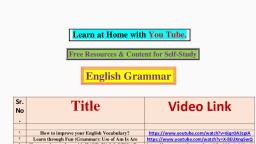
A variety of relevant texts as samples may be drawn from print and non-print sources such as, books, videos, audio files etc. Speaking skills in English should be developed through various, activities along with the practice done while teaching in the class., , Unit 4: Formal Writing Skills, A., , No. of lectures: 10, , Letters:, , 1. Job applications with bio data (solicited and unsolicited), 2. RTI applications, 3. Applications for duplicate documents (I-cards / mark sheet, etc.), B., , Emails:, , 1. Job acceptance and joining, 2. Resignation, 3. Complaints, 4. Requests for references, 5. Request for sponsorship, , Tutorial Activities:, 1. Use of YouTube videos for use of grammar study and practice that may be taken, from the list recommended or similar relevant videos., 2. Listening to audio clips/ books to enhance listening skills, 3. Reading aloud from newspapers, magazines, stories, non-fiction followed by, classroom discussion on these to enhance reading and speaking skills, 4. Making short presentations on given topics, 5. Official letter writing/ email writing exercises, , 8
Page 9 :
Semester II, Communication Skills in English Paper II, Course Content, Unit 1: English Usage in Communication, , No. of lectures: 08, , 1. Distinction between American English and British English, 2. Indianism and Indian English, 3. Appropriacy in the Use of English, 4. Non-verbal Communication, 5. Elevator Pitch, 6. Information and Communication Technology and Use of English, 7. Modes and Types of Interview, 8. Principles of Creative Writing, This unit shall work as theoretical base for the following units that are practical in nature., , Unit 2: Enhancing Reading Competencies, , No. of lectures: 12, , A variety of passages of 200-250 words may be taken such as extracts from novels,, short stories, plays, magazine, newspapers, reports, documents, academic texts. The, passages should have complex text type, function and lexis. The learners may be, encouraged to gather meaning contextually or by referring to offline and online sources, such as dictionary, thesaurus, and encyclopedia., 1. Augmenting active vocabulary, 2. Understanding relations between parts of a text, 3. Transferring information (Verbal to Non-Verbal), 4. Understanding concepts and arguments,, 5. Developing skills in analysis and interpretation, 6. Rewriting a passage from a defined perspective, 7. Reading critically (presenting a reasoned argument that evaluates and analyses, what you have read), , 9
Page 10 :
Weightage of questions on texts a., , On vocabulary, synonyms and antonyms, prefixes and suffixes, collocations,, making sentences of their own from the idioms or difficult words in the extract, (50%), , b. On writing their opinions, perspectives on the passages in longer, more descriptive, ways (50%), , Unit 3: Advanced Oral Communication Skills, , No. of lectures: 15, , A. Presentation skills: (Formal presentations and skits), 1. Planning and structuring, 2. Opening and closing a presentation, 3. Use of body language, 4. Use of technology in making a presentation, 5. Drafting a skit (Not to be tested in theory exam), 6. Reading of a skit, 7. Presenting a skit, Students are advised to prepare their own presentation scripts. Teachers should help them in, drafting, reading and presenting those scripts in the class., B. Group Discussion:, 1. Formal and informal discussion, 2. Elements of group discussion, 3. Using appropriate language: Initiating, seeking and giving opinions, suggesting,, responding to a suggestion, agreeing, disagreeing, interrupting, requesting, clarifying,, summing up, 4. Types of discussion:, Giving and sharing opinions of a given topic, making decisions, problem solving (case, study), , 10
Page 11 :
C. Interview Skills, 1. Interviewing others, , , Researching the interviewee (writer, social worker, entrepreneur, actor etc.), , , , Preparing questions, , , , Conducting interview, , 2. Attending an Interview (Job/Entrance), , , Researching the organization, , , , Reviewing job-profile and your bio-data/CV, , , , Preparing for standard questions, , , , Responding to questions, , , , Preparing your questions to ask to the interviewer/s, , 3. Analyzing Interviews, Students can be tested on forming actual interview frameworks including questions., Teachers must form the groups and conduct actual interviews involving full strength of, students., , Unit 4: Advanced Writing Skills, , No. of lectures: 10, , A. Report Writing:, 1. News report, 2. Activity/Event report, B. Creative Writing:, 1. Personal Essay, 2. Memoir, 3. Short Speech on the given occasion/ event, 4. Story writing, Tutorial Activities:, 1. Dialogue-writing exercises, 2. Writing skits and presenting them, 3. Giving speeches, 4. Group discussions, 5. Mock Interviews, , 11
Page 12 :
6. Development of stories, passages from hints given, in about 200-250 words, 7. Report writing tasks, 8. Statement of Purpose, , Evaluation Pattern:, A., , Internal Evaluation (20 Marks), , Marks Remarks, 1, , Performance in Tutorial 10, activities, , Sem I -- Learners may be asked to make, presentations, hold conversation in class, which will, be assessed, Sem II -- Learners may be asked to participate in, group discussions or mock interviews in class,, which will be assessed, , 2, , Participation in classes 05, (lectures and tutorials), , Learners’ response to teaching, timely submission, of tasks will be assessed, , 3. Overall, attendance 05, (lectures and tutorials), , Percentage of learners’ attendance in class to be, considered, , B., , Written Examination: (80 marks), , Semester I: 4 questions carrying 20 marks each, Q. Question details, No., , Marks, , 1, , Short Notes (4 out of 6) from Unit 1, , 20, , 2, , Unseen Passage (200-250 words) ( Unit 2), a. On content, the use of tenses, articles, prepositions, direct-indirect, speech and concord, voice, word meanings - (50%), b. On reading sub-skills (pointing out main ideas and supporting, details, making inferences) (50%), , 12, , 10, 10
Page 13 :
3, , Any four to be attempted from given options (based on Unit 3), a., b., c., d., e., , 4, , Preparing a speech on a given topic, Questions on introducing self and others, Develop a conversation on a given situation, Introducing speakers/guests in a given event, Drafting vote of thanks at a given event, , 20, , a. Job application with bio-data, , 08, , b. RTI letter, , 07, , c. Email writing (1 out of 2), , 05, , Semester II: 4 questions carrying 20 marks each, Q., , Question details, , Marks, , 1, , Short Notes (4 out of 6) on theory from Unit 1, , 20, , 2, , Unseen Passage (200-250 words) ( Unit 2), , No., , a. On content, synonyms and antonyms, prefixes and suffixes,, collocations, making sentences of their own from the idioms or, , 10, , difficult words in the passage (50%), b. On other sub-skills (such as writing their opinions, perspectives on, , 10, , the passages in longer, more descriptive ways (50%), 3, , Any Two out of Three to be attempted (based on Unit 3), a. Preparing a draft of presentation on a given topic, b. Preparing a draft for a mock interview based on the given, instructions, c. Preparing a draft of a group discussion on a given topic &, instructions, , 13, , 20
Page 14 :
4., , a. Report writing (1 out of 2), , 08, , b. Personal essay/Memoir, , 07, , c. Story Writing/Speech, , 05, , Recommended Reading:, , , Bellare, Nirmala. Reading & Study Strategies. Books. 1 and 2. Oxford University Press,, 1997, 1998, , , , Bellare, Nirmala. Easy Steps to Summary Writing and Note-Making. Amazon Kindle, Edition, 2020, , , , Comfort, Jeremy, et al. Speaking Effectively: Developing Speaking Skills for Business, English. Cambridge University Press, 1994., , , , Das, Bikram K., et. al. An Introduction to Professional English and Soft Skills. Cambridge, University Press India Pvt. Ltd., 2010, , , , Das, Yadjnaseni & R. Saha (eds.) English for Careers. Pearson Education India, 2012., , , , Devlin,Joseph. How to Speak And Write Correctly. New York, The Christian Herald, 1910, , , , Dimond-Bayir, Stephanie. Unlock Level 2 Listening and Speaking Skills Student's Book, and Online Workbook: Listening and Speaking Skills Student's Book+ Online Workbook., Cambridge University Press, 2014., , , , Doff, Adrian and Christopher Jones. Language in Use (Intermediate and Upper, Intermediate). CUP, 2004., , , , Glendinning, Eric H. and Beverley Holmstrom. Second edition. Study Reading: A Course, in Reading Skills for Academic Purposes. CUP, 2004, , , , Goodale, Malcolm. Professional Presentations Video Pack: A Video Based Course., Cambridge University Press, 1998., , , , Grellet, F. Developing Reading Skills. Cambridge: Cambridge University Press, 1981, , 14
Page 15 :
, , Grussendorf, Marion. English for Presentations. Oxford University Press, 2007.HampLyons, Liz and Ben Heasiey. Second edition. Study Writing: A Course in Writing Skills for, Academic Purposes. CUP, 2006, , , , Kumar, Sanjay and Pushp Lata. Communication Skills. Second Edition. New Delhi, 2011., Oxford University Press, 2015, , , , Lewis, N. How to Read Better & Faster. New Delhi, Goyal Publishers & Distributors Pvt., Ltd, 2006., , , , McCarthy, Michael and Felicity O'Dell. English Vocabulary in Use. Cambridge:, Cambridge University Press, 2001., , , , Mohan, RC Sharma Krishna. Business Correspondence and Report Writing. Third edition., Tata McGraw-Hill Education, 2002., , , , Murphy, Raymond, et al. Grammar in use: Intermediate. Cambridge University Press,, 2000, , , , Richards, Jack C., and Chuck Sandy. Passages Level 2 Student's Book. Cambridge, University Press, 2014., , , , Sadanand, Kamlesh & S. Punitha. Spoken English: A Foundation Course. (Part 1 & 2)., Orient Blackswan. 2009., , , , Sasikumar, V., et al. A Course in Listening & Speaking I. 2005. Cambridge University, Press India Pvt. Ltd. (under the Foundation Books Imprint), 2010, , , , Savage, Alice, et al Effective Academic Writing. Oxford: OUP, 2005, , , , Sethi, J. Standard English and Indian usage: Vocabulary and grammar. PHI Learning Pvt., Ltd., 2011., , , , Taylor, Grant. English Conversation Practice. 1967. Tata McGraw-Hill, 2013, , , , Turton, Nigel D. A B C of Common Grammatical Errors. 1995. Macmillan India Ltd., 1996, , , , Vas, Gratian. English Grammar for Everyone. Mumbai, Shree Book Centre, 2015, , , , Watson, T. Reading Comprehension Skills and Strategies: Level 6. Saddleback Educational, , , , Publishing, 2002, , , , Wright. Andrew, et al. Games for Language Learning: Cambridge Handbooks for, Language Teachers (Third Edition). 2006. Cambridge (UK), Cambridge University Press,, 2010, , 15