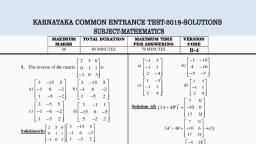
Page 2 :
State Council of Educational Research and Training (SCERT), Kerala, 2017, , XII, , CONTENTS, , 1. RELATIONS AND FUNCTIONS………………………… 3 - 9, 2. INVERSE TRIGONOMETRIC FUNCTIONS…………..10 - 13, 3. MATRICES…………………………………………………14 - 20, 4. DETERMINANTS………………………………………….21 - 32, 5. CONTINUITY AND DIFFERENTIABILITY …………..33 - 40, 6. APPLICATION OF DERIVATIVES……………………..41 - 50, 7. INTEGRALS………………………………………………..51 - 54, 8. APPLICATION OF INTEGRALS………………………...55 - 62, 9. DIFFERENTIAL EQUATIONS……………………………63 - 70, 10. VECTORS……………………………………………………71 - 79, 11. THREE DIMENSIONAL GEOMETRY…………………..80 - 84, 12. LINEAR PROGRAMMING………………………………..85 - 89, 13. PROBABILITY……………………………………..……….90 - 102, , φ
Page 3 :
Learning Outcomes, Recalls the idea of relation ; Recollects the concept of domain and range ;, Illustrates different equivalence relations, Q.1, Let R be a relation on the set A = {1, 2,3, 4,5, 6} defined as R= {( x, y) : y = 2 x − 1}, i), Write R in roster form and find it’s domain and range, (2), ii), Is R an equivalence relation ? Justify, (2), (Scores: 4 ; Time: 8 mts), Scoring Indicators, R ={(1,1), (2,3), (3,5)}, Domain = {1,2,3} ; Range ={1,3,5}, Since (2, 2) ∉ R , R is not reflexive, (2,3) ∈ R but (3, 2) ∉ R ; R is not symmetric, , i), ii), , (1), (1), , (2,3) ∈ R , (3,5) ∈ R but (2,5) ∉ R , R is not transitive, ∴ R is not an equivalence relation, , (1), (1), , Learning Outcomes, Classifies and explains different equivalence relations, Q.2, The relation R defined on the A = {−1, 0,1} as R = {(a, b) : a 2 = b}, i), Check whether R is reflexive, symmetric and transitive, ii), Is R an equivalence relation ?, , (2), (1), , (Scores: 3 ; Time: 5 mts), Scoring Indicators, , (−1, −1) ∉ R , R is not reflexive, , i), , (−1,1) ∈ R but (1, −1) ∉ R ,, R is not symmetric, (−1,1) ∈ R , (1,1) ∈ R and (−1,1) ∈ R , R is transitive, , χ, , (1), (1)
Page 4 :
ii), R is not reflexive, not symmetric and transitive., So R is not an equivalence relation, , (1), , Learning Outcomes, Classifies different types of relations ; Illustrates different types of relations, Q 3., Let A = {1, 2,3} . Give an example of a relation on A which is, i), Symmetric but neither reflexive nor transitive, (2), ii), Transitive but neither reflexive nor symmetric, (2), (Scores: 3 ; Time: 6 mts), Scoring Indicators, i) R= {(1, 2), (2,1)}, (1,1) ∉ R ⇒ R is not reflexive, (1, 2) ∈ R ⇒ (2,1) ∈ R , R is symmetric, (1, 2) ∈ R, (2,1) ∈ R but (1,1) ∉ R , R is not transitive, , (1), , (1), , ii) R= {(1, 2), (1,3), (2,3)}, (1,1) ∉ R ⇒ R is not reflexive, (1, 2) ∈ R but (2,1) ∉ R , R is not symmetric, , (1), , (1, 2) ∈ R,(2,3) ∈ R ⇒ (1,3) ∈ R , R is transitive, , (1), , Learning Outcomes, Recalls the idea of a function ; Identifies the injectivity and surjectivity of a, function, Q 4., (i)Let f be a function defined by f ( x ) =, , x is a function if it defined from, +, , +, +, ( f :N → N , f :R → R, f :R→R , f :R →R ), (ii) Check the injectivity and surjectivity of the followingFunctions, 3, a) f : N → N given by f ( x) = x, (2), b) f : R → R given by, (2), f ( x) = [ x ], , (Scores: 4 ; Time: 8 mts), Scoring Indicators, +, +, i) f : R → R, , ψ, , For x, y ∈ N ,
Page 5 :
3, 3, ii) a) f ( x) = f ( y) ⇒ x = y ⇒ x = y ⟹ f is injective, , (1), , For 2 ∈ N , there does not exist x in the domain N such that, ∴ f is not surjective, , f ( x) = x3 = 2 ., (1), , f ( x) = [ x ], b) f : R → R given by, It seen that f (1.1) = 1 and f (1.8) = 1 ;, But 1.1 ≠ 1.8 ; ∴ f is not injective, There does not exist any element x ∈ R such that f ( x) = 0.7, ∴ f is not surjective, , (1), , (1), , Learning Outcomes, Illustrates composition of functions ; Constructs new functions using, composition, Q5., a) Find fog and gof if, i) f(x) =, , x, , and g(x) =, , 3x + 4, , (2), 1, 4, , 4, ii) f(x) = 16x and g(x) = x, 4x + 3, 2, f ( x) =, x≠, 6x − 4 ,, 3 , Prove that fof ( x) = x, b) If, , (2), (2), (Scores: 6 ; Time: 12 mts), , Scoring Indicators, x, 3x + 4, a) i) f(x) =, and g(x) =, ⟹ fog ( x) = f ( g ( x)) = f ( 3 x + 4 ) = 3 x + 4 = 3 x + 4, , gof ( x) = g ( f ( x)) = g ( x ), 1, , = 3 x +4, , (1), , 1, , 4 4, ii) fog ( x) = f ( g ( x)) = f ( x 4 ) = 16( x ) = 16x, 1, 4 4, , gof ( x) = g ( f ( x)) = g (16 x4 ) = (16 x ), b), , (1), , fof ( x) = f ( f ( x)), 4x + 3, )+3, 16 x + 12 + 18 x − 12 34 x, = 6x − 4, =, =, =x, 4x + 3, 24, x, +, 18, −, 24, x, +, 16, 34, 6(, )−4, 6x − 4, , = 4x, , (1), (1), (1), , 4(, , ω, , (1)
Page 6 :
Learning Outcomes, Recalls the idea of a function and its domain and range ; Identifies the inverse, of a function, Q 6., Let S = {(1, 2), (2,3), (3, 4)}, i), Find the domain and range of S, −1, ii), Find S, iii), iv), , (1), −1, , Find the domain and range of S, Verify that S −1 is a function using the graph of S and S −1, , (1), (1), (2), , (Scores: 5 ; Time: 10 mts), Scoring Indicators, Domain = {1, 2,3} ; Range = {2,3, 4}, S −1 = {(2,1), (3, 2), (4,3)}, ii), {2,3, 4} ; Range = {1, 2,3}, iii), Domain =, iv), Plotting S and S-1 in graph paper, Yes, S-1 is a function because x coordinates do not intersect, i), , (1), (1), (1), (1), (1), , Learning Outcomes, Identifies the condition for invertible function ; finds inverse, Q 7., (3), I) Consider f :{3, 4,5, 6} → {8,10,12,13,14} and, f= {(3,8), (4,10), (5,12), (6,14)} . State whether f has inverse ? Give reason, (3), ii) Consider f : R → R given by f ( x) = 3x + 2 . Show that f is invertible., Find the inverse of f, (Scores: 6 ; Time: 12 mts), Scoring Indicators, i), , Distinct elements in set {3, 4,5,6} has distinct images., under f . ∴ f is one- one, But 13 in the codomain has no pre image. ∴ f is not onto., ∴ f has no inverse, f ( x) = 3x + 2 ; then, , ii), , f ( x1 ) = f ( x2 ) ⇒ 3x1 + 2 = 3x2 + 2 ⇒ x1 = x2, , Hence F is one - one, , For y ∈ R , let y = 3x + 2 ⟹ x =, f ( x) = f (, , ϊ, , y−2, ∈R, 3, , y−2, y−2, ) = 3(, ) + 2 = y ⟹ f is onto, 3, 3, , (1), (1), (1), , (1), (1)
Page 7 :
y−2, 3, 3x + 2 − 2, gof ( x) = g ( f ( x)) = g (3 x + 2) =, =x, 3, y−2, y−2, fog ( y) = f ( g ( y )) = f (, ) = 3(, )+2 = y, 3, 3, , Define g : R → R such that g ( y ) =, , (1), , Learning Outcomes, Identifies the composition of an operation ; Applies the concept of composition ;, Identifies and solves inverse of a function, Q 8., (1), Choose the correct answer from the bracket, x +1, is a real function, then fof (2) = ----If x ≠ 1 and f ( x ) =, x −1, ( 1, 2, 3, 4), i), What is the inverse of f, (2), −1, Find f (3) + f (3), , ii), , (1), (Scores: 4 ; Time: 8 mts), , Scoring Indicators, 2, , i), , Let g: range of f → R − {1} be the inverse of f, , ii), , Let y be any arbitrary element in the range of f , then y = f ( x) =, ⟹ xy − y = x + 1 ⟹ x( y − 1) = y + 1 ⟹ x =, , y +1, , y ≠1, y −1, , (1), x +1, x −1, , Let us define, y +1, g: range of f → R − {1} as g ( y ) =, y −1, , x +1, +1, x +1, x, −, 1, gof ( x) = g ( f ( x)) = g (, )=, =x, x +1, x −1, −1, x −1, y +1, ∴ f −1 = g ⟹ f −1 ( y ) =, , y ≠1, y −1, f (3) = 2 ,, f −1 (3) = 2 ⟹, iii), , f (3) + f −1 (3) = 2 + 2 = 4, , ϋ, , (1), , (1), , (1)
Page 8 :
Learning Outcomes, Identifies the binary operation as a function ; Illustrates various properties of a, binary operation, Q 9., i) Determine whether the following is a binary operaton or not?, (2), Justify, a * b = 2a b defined on Z, ii) Determine whether * is commutative or associative if, (2), a *b =, , ab, , a, b ∈ R, 6, , (Scores: 4 ; Time: 8 mts), Scoring Indicators, a * b = 2a b, i), If a is negative, then 2 a becomes a fraction, 3, Eg : −1*3 = 2−1.3 = ∉ Z ; ∴ * is not a binary operation, 2, ab, ba ab, a *b =, b*a =, =, = a *b, 6 ⟹, 6, 6, ⇒ * is commutative, ii), , ab, bc, .c, a., abc, abc, (a * b)* c = 6 =, a *(b * c) = 6 =, 6, 36 ⟹, 6, 36, ∴ a *(b * c) = a *(b * c) ⇒ * is associative, , (1), (1), , (1), , (1), , Learning Outcomes, Identifies the identity element of a binary operation ; Identifies that the inverse of an, element belongs to the set, Q10., Consider the binary operation *: Q → Q where Q is the set of rational numbers is, defined as a * b = a + b − ab, i), ii), iii), , Find 2*3, (1), Is identity for * exist? If yes, find the identity element, (2), Are elements of Q invertible? If yes, find the inverse of an element, in Q, (2), (Scores: 5 ; Time: 10 mts), , Scoring Indicators, , 2*3 = 2 + 3 − 6 = −1, , i), , ό, , (1)
Page 9 :
a * e = a + e − ae = a ⟹ e − ae = 0, ⟹ e(1 − a) = 0 ⟹ e = 0, , ii), , iii), iv), , ύ, , (1), , ⟹ e*a = a, ⟹ e+a-ea = a, ⟹ e-ea = 0, ⟹ e=0 is the identity element, a * a −1 = a + a −1 − aa −1 = 0, ⟹, , a−1 (1 − a) = −a ⟹, , a −1 =, , (1), −a, a, =, 1− a a −1, , (1), (1)
Page 10 :
CHAPTER – 2, INVERSE TRIGONOMETRIC FUNCTIONS, Learning Outcomes, Restates the domain and range of inverse trigonometric function, Finds principal, values, Applies the identifies, Q1., i) Choose the correct answer from the bracket, If ��� �� � � , then is equal to, ��, �, � � � � � � �� 0 � � � c� � � �� 0 �, �, �, (i), , (ii), , Find the value of ��� �� ���, , ��, �, , �, , Solve for � � � ��� ��� ! � 2� ��� �, � # 0, ��, , ��, , (1), (2), (2), , (Scores: 5 ; Time: 10 mts), Scoring Indicators, Range of ��� �� � $� %0 , �& ⟹ 0 � � �, i), ii), ��� �� ����� � � , $' � ( %0 , �& which is the, principal value branch of ��� �� �, ) ��� �� ����, iii), , ��, �, , (1), , ! � ��� �� �cos 2� , ! = ��� �� ���� ! �, �, , �, ��, , �, �, , �, �, , ,, , � ��� 1� , � ��� � � 2� � � ⟹ . � 2� ��� � � � ��� �, �, , ⟹� � � � . ⟹ � � � � . ) � � 1, ��, , �, , �, , �, �, , ( %0 , �&, , (1), (1), (1), (1), , Learning Outcomes, Formulates various identities, Applies the identities, Recalls trigonometric functions, Q2, i) Choose the correct answer from the bracket, cos � ��� �� , |�| � 1, is equal to, �, �, �, [, �� √�� 1 c� √�� 1 �� √�� 1 ], √�� 1, ii) Prove that �$��� 2 , �$��� �� � �$��� 32, ., , Scoring Indicators, , 2, , 3�, , (i) � ��� � � ��� �� �√�� 1 !⟹cos � ��� ��, , υτ, , �, , � ��� 4��� �� 5, , (1), , (3), (Scores: 4 ; Time: 8 mts), , 1, , √1 , � �, , 67 �, , 1, , √1 , � �, , (1)
Page 11 :
(ii) LHS � ��� √21, , , � ��� √��1, , ., , �.1, 9 ;, �, : <1, 9 ;, �� =, : <1, , � � ��� 8, , � �$��� �√3�1, , 3�, , 2, , > � � ��� �, , ��31, , = � ��� , � ���, , �21, , �, , ! � � ��� � !, , .?��2, �3��@, , ! = � �$��� �, , ., , 3�, , 3�, �3, , 2, , ��, , (1), (1), , ! = � �$��� � !, , √.��2, , 3�, 32, , (1), , Learning Outcomes, Finds the principal values, Applies the identities, Q 3., Match the following, (i), (ii), , (4), , �, �$��� ��!, �, ��� �� ��!, , A, � �$�, , ��, , �$��� ��$�, , (iii), , B, �, a), , �� �!, , ��, ., , !, , �, , b), c), , 3, �, �, �, , d) ., e) �, , � ��� 82�$� 5��� �� ��!, , (iv), , �, �, , �, , (Scores: 4 ; Time: 6 mts), Scoring Indicators, (i) �$��� ��! �, �, , �, 3, , (1), , (ii) ��� �� ��! � �$��� �� �! � ��� �� ��! , �$��� ��!= �, , �$��� ��$�, , �, , ��, ., , �, , ! � �$��� �sin � � . �! �, �, , �, , �, , �, ., , �, , (1), , iii) � ��� 82�$� 5��� �� � !6> � � ��� �2sin �!= � ��� �2 =, � � ��� C√3E �, , �, �, , �, �, , �, �, , (1), , √�, !, �, , (1), , Learning Outcomes, Formulates various identities, Applies the identities, Q 4., i) Choose the correct answer from the bracket, �, , [, , ��FGH, ��� ���FGH, �, , � ,, ., , �, , !is equal to, , �� . � � c� . �, �, , ii)Express � ��� �, , ��IJH, KLI, , �, , �, , �� � � . ], , (1), , �, , ! , � � � � � � in the simplest form., �, , �, , (3), , (Scores: 4 ; Time: 8 mts), , υυ
Page 12 :
Scoring Indicators, (i) � ��� �, , (ii) � ��� �, , ��FGH, ��FGH, , ! � � ��� 5� � � � �!6 �, �, ., , �, ., , � �, , M, M, M, M, IJH1 � ! � KLI1 � ! � �IJH� !KLI� !, ��IJH, 1, 1, 1, 1, ��, M, M, KLI, KLI1 � ! � IJH1 � !, 1, 1, 1, M, M, M, M, 5KLI� !�IJH� !6, KLI� !�IJH� !, 1, 1, 1, 1, ��, ��, M, M, M, M, M, M, 5KLI� !�IJH� !6, 5KLI� !�IJH� !65KLI� !�IJH� !6, 1, 1, 1, 1, 1, 1, , � �, , N, , � � �, , ��, , !�� �, , 8, , 8, , M, 1, M, ��FGH� !, 1, , ��FGH� !, , O� � �, , 4, , > � � ��� 5� � � � !6 �, �, ., , �, , >�, , �, , ., , �, , 7, , (1), (1), (1), , �, , (1), , Learning Outcomes, Formulates various identities, Applies the identities, Q5, , Prove that � ��� ��! � � ��� �2! � � ��� ���!, �, , �, , �, , (2), (Scores: 2 ; Time: 4 mts), , Scoring Indicators, < 1, �, 1 ;, < 1, �� =, 1 ;, <, �� <Q, <1, <Q, , � ��� 8, , � � �, , ;P9, , <Q, > � � ��� 8 <QR1, >, , (1), , <Q, , 8 > � � ��� ���!, �, , (1), , Learning Outcomes, Sketches the graphs of inverse T – functions, Formulates various identities,, Applies the identities, Q6., (i), (ii), , In which quadrants are the graph of ��� �� � lies, � ( % �1, 1 ], Choose the correct answer from the bracket, �, If ��� �� � , ��� �� � � , then �$��� � , �$��� = ……, [, , (iii), , υφ, , �, , ��, �, , ��, , �, �, , c�, , �, 3, , �� � ], , If � ��� � + � ��� �, , �, ., , then prove that � ,, , (1), , (1), , ,� �1, (2), (Scores: 4 ; Time: 8 mts)
Page 13 :
Scoring Indicators, (i), (ii), , First and Second quadrants, �, �, � �$��� � , � �$��� �, �, , �, , ⟹�$��� � , �$��� � � �, , (iii), , � ��� �, ⟹, , υχ, , �S, , �� S, , �S, , �� S, , !�, , �, , ., , ⟹, , �, �, , �, , �S, , �� S, , �1 ⟹ �,, , �, , �, ��, �, , �� �, , (1), (1), �, , ., , ,� �1, , (1), (1)
Page 14 :
CHAPTER - 3, MATRICES, Learning Outcomes, Interprets and classifies the concept of a Matrix ; Identifies the properties of, Matrices, Q .1, If, , x − y − z 0, − y + z = 5, then find the values of x, y and z, , , , 3, z, , (2), (Scores: 2 ; Time: 5 mts), , Scoring Indicators, z= 3, −y+z =5, ⇒y = z −5 = 3 −5 =−U, V − W + X = Y ⇒ V = y − z =−U +3, z = 1, , (1), (1), , Learning Outcomes, Identifies and compares the order of Matrices for finding the product, Q.2, , U, i) If B = Z, \, x, ii) If A = , 1, , [, ] find B2, Y, 1, and A2 is the identity matrix, then find x, , 0, , (2), (2), (Scores: 4 ; Time: 8 mts), , Scoring Indicators, U [ U [, i)^U = Z, ]Z, ], \ Y \ Y, =, bb), , _+[, U+Y, , `+Y, ], [+Y, , a `, Z, ], U [, , cU = Z, , ∴ V=Y, , =Z, , V \ V \, ]Z, ], \ Y \ Y, , (1), (1), , U, = dV + \, V, , Ve = Z \ Y ], Y \, \, , (1), (1)
Page 15 :
Learning Outcomes, Identifies and compares the order of matrices for finding their product, Q.3, Let the order of a matrix A is 2×3, order of a matrix B is 3 × 2 and order of a, matrix C is 3 ×3 , then match the following, Matrix, i), ii), , CB, AC, , iii ), , BAC, , Order, 3×3, , (1), , 3×2, 3×2, , (1), (1), (Scores: 3; Time: 5 mts), , Scoring Indicators, i) Order of matrix CB is 3×2, , (1), , ii) Order of matrix AC is 2×3, iii), Order of matrix BAC is 3×3, , (1), (1), , Learning Outcomes, Differentiates different types of Matrices ; Identifies the properties of Matrices, Q.4, [, i) If U =%U �[ _& , f � gUh, \, U, i � %Y U [& , j � gUh , then find UV , XY , UV +XY, (3), _, 1 2 3 8 , ii) What must be the matrix X if 2X + , (2), =, ,, 3 4 7 2, iii) If, , 1 2 3 x , [ 1 x 1] 0 5 1 1 = 0, 0 3 2 − 2, , then find the value of x, , (2), , (Scores:7; Time: 10 mts), Scoring Indicators, i), , XY = %Y, , υω, , [, UV =%U �[ _& gUh = %` � ` , _& � %_&, \, , U, , U, [& gUh = %Y , _ , \U& � %\`&, _, , (1), , (1)
Page 16 :
UV +XY =%_& , %\`& = %UY&, [ l, \ U, U, kk� U i � Z, ]�Z, ]� Z, [ _, a U, _, \ [, T i� Z, ], U �\, , `, ], �U, , (1), (1), (1), , 1 2 3 x , iii) [ 1 x 1] 0 5 1 1 = 0, 0 3 2 −2 , , V,U�`, [ 1 x 1] g Y , m � U h=0, Y,[�_, V�_, %\ V \& g [ h =0, �\, [x -4 +3x -1] =[ 0 ], 5, T x -4 +3x -1 = 0 T � �, 4, , i), , (1), , (1), , Learning Outcomes, Interpret and classify the concept ; Identifies the properties of transpose of a, Matrices, Q.5, Choose the correct answer from the bracket, i)If A = nokp q, , UrU, , where a ij = i + j, then A is equal to, , 1 2 , 1 2, 2 3, 1 1, a) , b), c), d), , 1 2 , 3 4, 3 4, 2 2, , , , , , , 2, 3, , , ii) , , 3 4 is a, a) symmetric matrix, b) skew- symmetric matrix, c) null matrix, d) identity matrix, , iii) If c � Z, , [ �U, a l, ] stu ^ � Z, ], U m, �` [, , (1), , (1), , then A + B is equal to, , U\ � \`, \Y `, \ Y, \ \, ], b) Z, ] c) Z, ], d) Z, ], (1), �\U \m, �_ l, Y \, \ \, \Y `, \ Y, iv ) If A = Z, ] and vU = Z, ] then AvU is equal to, �_ l, Y \, \Y `, U\ � \`, \ Y, \\, a)Z, ], b) Z, ] c) Z, ], d) Z, ], (1), �_ l, �\U \m, Y \, \ \, \, v) . If A is square matrix, A ′ , is its transpose, then U c � A ′ � is, a) a symmetric matrix, b) a skew-symmetric matrix, c) a unit matrix, d) a null matrix, (1), (Scores:5; Time: 10 mts), a) Z, , υϊ
Page 17 :
Scoring Indicators, i), , A=, , ��, , ��, , = 1+1 =2 ,, , ��, , = 1+2 =3,, , ��, , = 2+1 = 3, , 2 3, = 2+2 = 4 , A = , , 3 4, , (1), , 2 3, wx = , = A is symmetric matrix, 3 4, , ii), , 3 �2, 7 8, w,y �Z, ],Z, ], 2 5, �6 3, , iii), , =, , \Y ` \ Y, \Y `, ]Z, ] = Z, ], �_ l Y \, �_ l, , iv), , If A vU = Z, , v), , a skew-symmetric matrix, , (1), , 10 6, Z, ], �4 8, , (1), (1), (1), , Learning Outcomes, Identifies matrix multiplication is not commutative ;Identifies the properties of, transpose of a matrix, Q.6, Let A and B be two symmetric matrices of same order. Then show that AB – BA, is a skew- symmetric matrix, (2), (Scores: 2; Time: 5 mts), Scoring Indicators, Given A = AT , B = BT, (AB –BA)T = (AB)T – (BA)T, = BTAT - ATBT = BA – AB = - (AB - BA), Therefore AB – BA is a skew- symmetric matrix, , Learning Outcomes, Identifies and compares the order of a matrix for finding their product, , υϋ, , (1), (1)
Page 19 :
(Scores:5; Time: 10 mts), Scoring Indicators, U, U, k, k e , i) AB =d , , U, k, k k, kU , , =, , =d, , =d, , (1), , U U , k k U k , kkU , , k U , kU k k , kU kU , , , k k�, k , k k�, (1), , (1), , k , k k�, e, kk , k k�, , � � k � �, e, k � � kk � �, , � � k � �, Y, e=Z, k � � kk � �, Y, T � � � Y, T � � is a multiple of π/2, ii) Given d, , Y, ], Y, , (1), (1), , Learning Outcomes, Identifies and compares the order of Matrices for finding their product, Q.9, Y o, ], Y, i) Find cU, ii) If c_ = vU , then show that ab = 1, Let A = Z, , (1), (2), (Scores:3; Time: 6 mts), , Scoring Indicators, Y o, Y o, o Y, cU � Z, ] Z, ] �Z, ], Y, Y, Y o, , U U, o Y, o Y, ] Z, ] � d o UY U e, i) c_ � Z, Y o, Y o, Y, o , � �, 1 0, �, 0, Z, �=1, � � ] = Z0 1] T, 0, �, , Learning Outcomes, , Identifies the properties of transpose of a Matrix, , υύ, , (1), , (1), (1)
Page 20 :
Q.10, 2 1 3 , If the matrices A = , and B, 4 1 0, , i) Find c^ , ^ , c^� , ii) Show that c^� = ^ c , , 1 −1, , , 0 2 , then, 5 0 , , (3), (2), (Scores: 5; Time: 8 mts), , Scoring Indicators, , \ �\, U \ [, \a Y, cB = Z, ]gY, ], Uh = Z, _ \ Y, _ �U, m Y, , ^ = Z, , \ Y m, ], �\ U Y, , \a _, ], Y �U, U _, \ Y m, ii) ^ c = Z, ] g\ \ h, �\ U Y, [ Y, c^� =Z, , 17 4, ]= wy� x, = Z, 0 �2, , φτ, , (1), , (1), (1), (1), , (1)
Page 21 :
CHAPTER-4, DETERMINANTS, Learning Outcomes, Identifies the properties of determinants and verifies them through examples., Identifies the methods of evaluating a determinant., Q.1, 1 −3 2, , (i) Choose the correct answer from the bracket. If 4 − 1 2 = 40 , then, 3, , 5, , 2, , 1, 4 3, − 3 −1 5, 2, , 2, , { (a) 0 , (b) – 40 , (c) 40 , (d) 2 }, −a, ∆ = ba, ac, , 2, , (ii), , Show that, , ab, − b2, bc, , =?, , 2, , (1), , ac, bc = 4a 2 b 2 c 2, − c2, , (3), (Scores: 4; Time: 8 mts), Scoring Indicators, (i) (c) 40, , (1), −a a, b −b, , (ii) ∆ = abc, , c, , = a 2b 2c 2, , 1, , 1, 1, , −1 1, 1 −1, , b c, , 0, , 0 2, , 0, , 2 0, , = a 2 b 2 c 2 (− 1), , (1), , 1, , −1 1 1, , =a, , take a,b,c from C1 , C 2 , C 3, , −c, , c, , −1, , 2 2 2, , a, b, , take a,b,c from R1 , R 2 , R3, R2 → R 2 + R1, R3 → R3 + R1, , 0 2, = − a 2 b 2 c 2 (0 − 4 ) = 4a 2 b 2 c 2, 2 0, , (1), (1), , Learning Outcomes, Identifies the properties of determinants and verifies them through examples., Identifies the methods of evaluating a determinant, , φυ
Page 22 :
Q.2, (i) Choose the correct answer from the bracket. Let the value of a determinant is ∆ ., Then the value of a determinant obtained by interchanging two rows is, { (a) ∆ , (b) − ∆ , (c) 0 , (d) 1 }, (1), , (ii) Show that, , a+b b+c c+a, a b c, b+c c+a a+b = 2 b c a, c+a a+b b+c, , (3), , c a b, , (Scores:4; Time: 8 mts), Scoring Indicators, (i), , (b) − ∆, , (1), , (ii) Operating C1 → C1 + C 2 + C 3 , we have, a +b b+c c+a, 2(a + b + c ) b + c c + a, b + c c + a a + b = 2(a + b + c ) c + a a + b, c+a a +b b+c, 2(a + b + c ) a + b b + c, , (1), , a+b+c b+c c+a, =2a +b +c c + a a +b, a+b+c a+b b+c, C 2 → C 2 − C1 , C 3 → C 3 − C1, , a+b+c −a, , −b, , c −a −b, , =2a + b + c −b − c = 2a −b −c, a+b+c, , −c, , −a, , b, , C1 → C1 + C 2 + C 3, , (1), , −c −a, , c a b, = 2(−1)(−1) a b c, b, , c, , a, , a b c, a b c, = 2(− 1)(− 1) b c a = 2 b c a, c a b, c a b, , (1), , Learning Outcomes, Identifies the properties of determinants and verifies them through examples., Identifies the methods of evaluating a determinant., Q.3, sin 10 − cos 10, 3, 1, is (a) – 1 (b), (c), (d) – 2, sin 50 cos 50, 2, 2, (ii) Using properties of determinants, show that, , The value of the determinant, , φφ, , (1)
Page 23 :
b+c, , a a2, , c + a = (b − c ) (c − a )(a − b )(a + b + c ), a +b, , 2, , b b, c c2, , (3), , (Scores:4; Time: 8 mts), Scoring Indicators, (b) Since, sin 10 cos 50 + cos10 sin 50 = sin 60 =, , (i), , a a2, ∆= b b, c, , ii), , c, , 2, 2, , a +b+c, a a2, 2, a + b + c = (a + b + c ) b b, a +b+c, c c2, , 1, 1, , (1), , a, a2, ( a + b + c) b − a b 2 − a 2, c − a c2 − a2, , =, , (1), , 1, , Let, , =, , 3, 2, , (a + b + c), , 1, R 2 → R2 − R1, 0, R → R3 − R1, 0 3, , 1 b+a, b − a b2 − a2, = (a + b + c ) (b − a )(c − a ), 1 c+a, c − a c2 − a2, , = (a + b + c ) (b − a ) (c − a ) (c + a − b − a ), = (a + b + c ) (b − a ) (c − a ) (c − b ), = (b − c ) (c − a ) (a − b ) (a + b + c ), , (1), , (1), , Learning Outcomes, Identifies the properties of determinants and verifies them through examples., Identifies the methods of evaluating a determinant. Identifies the peculiarities of odd, order skew symmetric matrix., Q.4, (i) Choose the correct answer from the bracket. The value of the determinant, 0, p−q p−r, q− p, 0, q − r is …, r− p r−q, 0, {(a) p + q + r , (b)1 , (c)0 , (d) 3 pqr, a, , a+b, , (ii) Evaluate 2a 3a + 2b, , }, , (1), , a+b+c, 4a + 3b + 2c, , (3), , 3a 6a + 3b 10a + 6b + 3c, , (Scores:4; Time: 8 mts), , φχ
Page 25 :
1 0, = − 4, = AI, 0 1 , − 2 2 5 − 2 − 4 0 , (adjA) A = , ×, =, , − 3 5 3 − 2 0 − 4, 1 0, = − 4, = AI, 0 1 , , (1), , Hence A(adjA) = (adjA) A = A I, , (1), , Learning Outcomes, Recognising the concept of minors and cofactors, Identifies the adjoint and its, properties, Identifies the methods of evaluating a determinant, Computing the, inverse of a matrix., Q.6, cos x sin x , (i) Choose the correct answer from the bracket. If A = , and, − sin x cos x , 1 0 , A(adjA) = k , , then the value of k is …, 0 1 , { (a) 0 , (b) 3, (c) 1 , (d) 2 }, , (1), , 1 − 1 2 , (ii) Find the inverse of the matrix A = 0 2 − 3, , , 3 − 2 4 , , (3), (Scores: 4; Time: 8 mts), Scoring Indicators, (i) (c) 1, , (1), A=, 1, , cos x sin x, = 1 and A( adjA) = A I, − sin x cos x, −1, , 2, , (ii) Let A = 0 2 − 3, 3 −2 4, = 1(8 − 6) + 1(0 + 9) + 2(0 − 6) = −1, C11 = 2, C12 = −9, C13 = −6, C21 = 0, C22 = −2, , (1), , C23 = −1, C31 = −1, C32 = 3, C33 = 2, 0 − 1, 2 − 9 − 6, 2, , , , adj ( A) = 0 − 2 − 1 = − 9 − 2 3 , − 1 3, − 6 − 1 2 , 2 , T, , φω, , (1)
Page 26 :
0 − 1, 2, adj( A), , A =, = (−1) − 9 − 2 3 , , , A, − 6 − 1 2 , −1, , (1), , Learning Outcomes, Recognizing the concept of minors and cofactors, Identifies the adjoint and its, properties, Identifies the methods of evaluating a determinant, Computing the, inverse of a matrix, Identifies the singular and non singular matrices., Q.7, 2 3 , (i) Choose the correct answer from the bracket. If A = , and A −1 = kA , then the, , 1 − 2 , value of ‘k’is, 1, 1, {(a)7 , (b) -7 , (c) ,(d) − }, (1), 7, 7, 1 − 1 1 , (ii)If A = 2 − 1 0 , (a) find A 2 (b) Show that A 2 = A −1, 1 0 0, (4), (Scores: 5; Time: 10 mts), Scoring Indicators, (i) (c), , 1, 7, , A=, , (1), 2, , 3, , 1 −2, , = −7 ; A −1 =, , adjA − 1 − 2 − 3 1 2 3 , =, =, A, 7 − 1 2 7 1 − 2 , , 1 − 1 1 1 − 1 1 0 0 1 , (ii) A = 2 − 1 0 × 2 − 1 0 = 0 − 1 2, , , , , 1 0 0 1 0 0 1 − 1 1 , 1 −1 1, Now; A = 2 − 1 0 = 1 ≠ 0, 2, , 1, , 0, , (1), , (1), , 0, , C11 = 0, C12 = 0, C13 = 1, C21 = 0, C22 = −1, C23 = −1, C31 = 1, C32 = 2, C33 = 1, (1), 0 0 1 , 0 0 1 , adjA , , , −1, = 0 − 1 2 = A 2, adjA = 0 − 1 2 ; A =, A, 1 − 1 1 , 1 − 1 1 , , φϊ, , (1)
Page 27 :
Learning Outcomes, Identifies the properties of determinants and verifies through examples, Computing, the inverse of a matrix, Verifying the properties of inverse of matrices., Q.8, Choose the correct answer from the bracket. If each element of a third, order square matrix ‘A’ is multiplied by 3, then the determinant of the, newly formed matrix is, { (a) 9 A , (b) 3 A , (c) 27 A , (d) ( A ) 3, (1), }, − 8 5, Consider the matrix A = , , 2 4, , (i), , (ii), , (a) Show that ‘A’ satisfies the equation x 2 + 4 x − 42 = 0, (2), −1, (b) Hence find A, (2), (c), (Scores:5; Time: 10 mts), Scoring Indicators, (i) (c) 27 A, − 8 5 − 8 5 74 − 20, (ii) (a) A 2 = , ×, =, , 2 4 2 4 − 8 26 , 74 − 20, − 8 5, 1 0, Now; A 2 + 4 A − 42 I = , + 4, − 42 , , , =0, − 8 26 , 2 4, 0 1 , , (1), (1), (1), , (b) We have; A2 + 4 A − 42I = 0, , ⇒ A × A + 4 A − 42I = 0, , Multiply both sides by A −1, ⇒ A −1 A × A + 4 A −1 A − 42 A −1 I = 0, 1, ⇒ A + 4I = 42 A −1 ⇒ ( A + 4 I ) = A −1, 42, 1 0 , 1 − 8 5, ⇒ A −1 =, + 4, , , , 42 2 4, 0 1 , ⇒ A −1 =, , 1 − 4 5 , , , 42 2 8 , , (1), , (1), , Learning Outcomes, Identifies the properties of determinants and verifies through examples, Computing, the inverse of a matrix, Verifying the properties of inverse of matrices., , φϋ
Page 28 :
Q.9, (i) If A and B are matrices of order 3 such that A = −1; B = 3 , then 3 AB is, (a)-9, , (b)-27 (c)-81, (d)9, tan x , 1, cos 2 x − sin 2 x , (ii) If A = , , Show that AT A −1 = , , , 1 , − tan x, sin 2 x cos 2 x , , (1), , (4), (Scores: 5; Time: 10 mts), Scoring Indicators, (i) (c)-81(since 3 AB = 27 A B ), 1, tan x, = sec 2 x ≠ 0 , therefore A is invertible., − tan x, 1, − tan x , − tan x , 1, 1 1, adjA = , ⇒ A −1 =, , , 2, 1 , 1 , sec x tan x, tan x, − tan x , 1, AT = , 1 , tan x, , (ii) A =, , − tan x , − tan x , 1, 1 1, AT A −1 = , ×, , , 2, 1 sec x tan x, 1 , tan x, 1 − tan 2 x, − 2 tan x , = cos 2 x , , 2, tan x + tan x − tan x + 1, sin 2 x, sin x , 1−, −2, , , 2, cos x , = cos 2 x cos x, sin 2 x , 2 sin x, −, +1, cos 2 x , cos x, cos 2 x − sin 2 x, − 2 sin x cos x cos 2 x − sin 2 x , =, =, , 2, 2 , 2, sin, x, cos, x, −, sin, x, +, cos, x, , sin 2 x cos 2 x , , (1), (1), (1), , (1), , (1), , Learning Outcomes, Identifies the properties of determinants and verifies through examples, Redefine the, area of triangle using determinants, Solving problems related to co linearity of three, points., , Q.10, 5, 1 1, , (i) If A = 0 1, 3 What is the value of 3 A ?, 0 − 1 − 2, , φό, , (1)
Page 29 :
(ii) Find the equation of the line joining the points (1,2)and (-3, -2) using, determinants., , (2), , (Scores: 3; Time: 6 mts), Scoring Indicators, 1, , 1, , 5, , (i) 3 A = 3 A = 27 0 1, 3 = 27(−2 + 3) = 27, 0 −1 − 2, 3, , (1), , (ii) Let (x,y) be the coordinate of any point on the line, then (1,2), (-3, -2) and (x, y), are collinear., Hence the area formed will be zero., 1, 2 1, (1), −3 −2 1 = 0, x, , y, , 1, , ⇒ (−2 − y ) − 2(−3 − x) + 1(−3 y + 2 x) = 0, ⇒ 4x − 4 y + 4 = 0 ⇒ x − y +1 = 0, , (1), , Learning Outcomes, Identifies the properties of determinants and verifies through examples, Identifies, the methods of evaluating determinants, Solving the system of equations, Q.11, ( i) Find the values of x in which, , 3, , x, , =, , 3 2, , x 1 4 1, (ii) Using the property of determinants, show that the points, A(a, b + c) , B (b, c + a ) , C (c, a + b) are collinear., (iii) Examine the consistency of system of following equations:, 5x − 6 y + 4 z = 15 , 7 x + y − 3z = 19 , 2 x + y + 6 z = 46, , (1), (2), (2), , (Scores:5; Time: 10 mts), , SCORING INDICATORS, (i), , 3 x 3 2, ⇒ 3 − x 2 = 3 − 8 ⇒ x2 = 8 ⇒ x = ± 8, =, x 1 4 1, , φύ, , (1)
Page 30 :
b+c 1, , a, , C 2 → C 2 + C1, , a a+b+c 1, , a + b + c 1 = (a + b + c) b 1 1 = 0, a+b+c 1, c 1 1, , c+a 1=b, a+b 1 c, , (ii) b, c, , a 1 1, , (1), , since area is zero, points are collinear, , (1), , 5 − 6 4 , iii) The coefficient A = 7 4 − 3, , , 2 1, 6 , A = 5( 24 + 3) + 6( 428 + 6) + 4(7 − 8) = 419 ≠ 0, , (1), , Since, the system is consistent and has unique solution., , (1), , Learning Outcomes, Identifies the methods of evaluating determinants, Computing the inverse of a, matrix, Solving the system of equations, Q.12, If A =, , 3 − 2 3 , 2 1 − 1, , , 4 − 3 2 , , (i) Find A, , (1), −1, , (ii) Find A, (iii) Solve the linear equations 3x- 2y + 3z = 8, 2x + y – z = 1, 4x – 3y + 2z= 4, , (2), , (2), (Scores: 5; Time: 10 mts), , Scoring Indicators, 3 −2 3, (i) A = 2 1 − 1, 4 −3 2, , = 3( 2 - 3 ) + 2 ( 4 + 4 ) + 3 ( -6 – 4 ) = - 17, , (1), , (ii) A ≠ 0 , hence its inverse exists., , 1, adj A, A, C11 = −1 , C12 = −8 ,, C13 = −10 C 21 = −5 , C 22 = −6 , C 23 = 1 , C 31 = −1 , C 32 = 9 C 33 = 7, A−1, , =, , − 1 − 5 − 1, − 1 − 5 − 1, adj A = − 8 − 6 9 , A −1 = − 1 − 8 − 6 9 , , 17 , − 10 1, − 10 1, 7 , 7 , , (iii), , The given system of linear equations is of the form, , χτ, , (1), , (1)
Page 31 :
AX = B, where, , X = A −1 .B = −, , =, , 8 , 3 − 2 3 , x, , A = 2 1 − 1 , X = y , B = 1 , 4, 4 − 3 2 , z , , − 1 − 5 − 1 8, 1 , − 8 − 6 9 1, 17 , − 10 1, 7 4, , −8−5− 4 , −1 , − 64 − 6 + 36, 17 , − 80 + 1 + 28 , , =, , − 17 , x, −1 , , − 34 ⇒ y =, 17 , − 51, z , , (1), 1 , 2, , 3, , ∴ We have, x = 1 , y = 2 , z = 3, , (1), , Learning Outcomes, Identifies the methods of evaluating determinants, Computing the inverse of a, matrix, Solving the system of equations, Q.13, ‘Arjun’ purchased 3 pens, 2 purses and 1 instrument box and pays Rs. 410. From the, same Shop ‘Deeraj’ purchases 2 pens, 1 purse and 2 instrument boxes and pays, Rs.290, while ‘Sindhu’ purchases 2pens, 2 purses, 2 instrument boxes and pays Rs., 440., (i) Translate the equation into system of linear equations, (2), (ii) The cost of one pen, one purse and one instrument box using matrix method. (4), (Scores: 6; Time: 12 mts), Scoring Indicators, (i) Let the price of one pen is Rs.x, one purse is Rs.y and one instrument box be Rs.z, 3x + 2y + z = 410; 2x + y +2z = 290; 2x = 2y + 2z= 440, (1), (ii)The system can be represented by the matrix equation AX = B, 3 2 1, x, 410, , , , , Where; A = 2 1 2 , X = y , B = 290, 2 2 2, z , 440, , (1), , 3 2 1, A = 2 1 2 = −4 ≠ 0, 2 2 2, , C11 = −2, C12 = 0, C13 = 2, C21 = −2, C22 = 4, C23 = −2, C31 = 3, C32 = −4, C33 = −1, − 2 − 2 3 , adjA = 0, 4 − 4, 2 − 2 − 1 , , χυ, , (1)
Page 32 :
− 2, 1 , adjA, A =, =, 0, A, −4, 2, Solution is given by, − 2, 1 , −1, 0, X =A B=, −4, 2, −1, , −2, , 3, 4 − 4, − 2 − 1 , , (1), , −2, , 3 410, 4 − 4 × 290, − 2 − 1 440, , (1), , − 80 20 , 1 , =, (1), − 600 = 150 , , −4, − 200 50 , Hence the cost one pen is Rs.20, one purse is Rs. 150 and one instrument box is Rs., 50., , χφ
Page 33 :
CHAPTER - 5, CONTINUITY AND DIFFERENTIABILITY, Learning Outcomes, Solves problems related to continuity of functions, solves problems using, logarithmic differentiation and finds the derivatives using parametric form, Q.1, Choose the correct answer from the bracket. If � bt and � ,, u, then, is equal to …, u, { (a) st , (b) , (c) �st , (d) � }, (1), (ii), Find the value of k such that the function f x� defined by, ̟, kx � 1 , if x � �, ̟, f x� � , (2), ̟ $s a continuous function at x � �, sinx , if x # �, (i), , (iii), , If � � , Prove that, , u, u, , �, , \��U, , , (3), , (Scores: 6; Time: 12 mts), Scoring Indicators, (c) �st , , (i), (ii), $$$�, , , , ̟, �, , (1), , � 1�1, , � ̟, � � �, ., , (1), , ��, , � � \! � �\ � W, , u V, , u W, u, , �, u, , \��U, , , (1), (1), (1), (1), , Learning Outcomes, Solves problems related to continuity of functions, solves problems using, logarithmic differentiation and finds the derivatives using parametric form, Q.2, (i), , Choose the correct answer from the bracket. If � , then the value, , of u at �, { (a) ∞ , (b) \ ,, , χχ, , u, , ¡, _, , is …, (c) Y ,, , (d) �\ }, , (1)
Page 34 :
Find the value of £a′ such that the function f x� defined by f x� �, ax , 3 , if x � 2, ¥ �, a x � 1 , if x # 2, is continuous function at x � 2, (2), , (ii), , u U, , If � s[ ¦ and � sbt[ ¦ Prove that \ , � ! � U ¦, u, , (iii), , (3), , (Scores: 6; Time: 12 mts), Scoring Indicators, (d) �\, , (i), (ii), iii�, , u, u, , (1), , 2a , 3 � 2a� � 1, a � 2, a � �1, , (1), (1), , � [sU ¦ �bt ¦ �, u¦, u, , � �st ¦, u U, , \ , �u! � U ¦, , u, , u¦, , � [sbtU ¦ ¦ �, , (1), (1), (1), , Learning Outcomes, Solves problems related to continuity of functions, solves problems using, logarithmic differentiation and finds the derivatives using parametric form, Choose the correct answer from the bracket. If � s U , � Us , then, u, the value of u at t � \ is, { (a) Y , (b) \ , (c) U , (d) ∞ }, (1), x , 3 , if x � 1, Is the function defined by f x� � ¥, a continuous function?, x � 3 , if x # 1, (2), , Q.3, (i), , (ii), Justify, , (iii) Find, , u, u, , , if � st�\ �, , !, , �bt , , �bt, , ( 3), (Scores: 6; Time: 12 mts), , Scoring Indicators, (i), , (a) \, Left limit § Right limit, It is not continuous, , (iii). � st�\ � �bt!, �bt , , � st�\ � \�st ! = st�\ ¨o � U � V! =, \�st , , χψ, , ©, , (1), (1), (1), ©, U, , �V, , (1), (1)
Page 35 :
u, u, , � �\, , (1), , Learning Outcomes, Identifies the method to find derivatives, when a function is defined implicitly,, Solves problems related to continuity of functions, solves problems using, logarithmic differentiation, Q.4, Choose the correct answer from the bracket. If U , U , U U � \ ,, u, then, at the point where � \ is equal to, u, { (a) Y ,, (b) \ ,, (c) U , (d) �\, }, (1), (ii), Find the relationship between s and ª so that the function « defined by, ax , 1 , if x � 2, f x� � ¥, is continuous at x � 2, bx � 3 , if x # 2, (2), u, , (3), (iii) If � \` , then find u at (2, 2), (Scores: 6; Time: 12 mts), (i), , Scoring Indicators, (i), (ii), $$$�, u, u, , (a) 0, 2a , 1 � 2b � 3, a � b � �2, � � , �� � log 16, , W, , \, , V, , U, U� � �\, , , V u , W u , W � Y, u, , V u, , (1), (1), (1), (1), (1), (1), , Learning Outcomes, Identifies the method to find derivatives, when a function is defined implicitly,, Solves problems related to continuity of functions, solves problems using, logarithmic differentiation, Q.5, (i), , χω, , Find the values of s and ª such that the function « defined by f x� �, 2,, if x � 1, ax , b ,, if 1 � x � 5, 14,, if x ¯ 5
Page 36 :
is a continuous function, (3), �, (ii), Verify Lagrange’s Mean Value theorem for the function f x� � 2x � 10x , 29, in [ 2, 9 ], (3), (Scores:6; Time: 12 mts), Scoring Indicators, (i), ii�, , a,b �2, 5a , b � 14, a � 3, b � �1, f 2� � 17 f 9� � 101, f � c� � 4c � 10 � 12, c�, , ��, ., , (1), (1), (1), (1), (1), , ( %2, 9&, , (1), , Learning Outcomes, Identifies the method to find derivatives, when a function is defined implicitly,, Solves problems related to continuity of functions, solves problems using, logarithmic differentiation, Q.6, (i), (ii), , <, , ��² :, log e² ���²! , , If f x� �, , , then find f � 1�, , (3), , Verify Rolle’s theorem for the function f x� � sin3x on Z0, �], ̟, , (3), , (Scores: 6; Time: 12 mts), Scoring Indicators, , (i), , ii�, , f x� � loge² , � %log 3 � x� � log 3 , x� &, �, , f � x� � 1 , � ���² �, , f � 1� �, , �, , �, ., , ��, , f 0� � 0 f ��! � 0, ̟, , f � c� � 3 cos 3c � 0, , c � 3 ( Z0, �], ̟, , ̟, , �, , ��², , !, , (1), (1), (1), (1), (1), (1), , Learning Outcomes, Identifies the method to find derivatives and finds a relation satisfying the function, , χϊ
Page 38 :
(Scores: 5; Time: 10 mts), Scoring Indicators, i)Cosx-siny, , dy, dy, =x, +y, dx, dx, , (1), , dy, (x+siny)=cosx-y, dx, dy cos x − y, =, dx sin y + x, , (1), , ii)Let y= (sin x) log x, logy=log(sinx)logx, logy=logx.log(sinx), Diff:wrt x, , (1), , 1 dy, 1, 1 , = log x, cos x + log(sin x ), y dx, x, sin x , dy, log sin x, , = y, + log x cot x , dx, x, , , dy, log, sin, x, , , log x, = (sin x ) , + log x cot x , dx, x, , , , (1), , (1), , Learning Outcomes, Identifies the method to find derivatives, when a function is defined implicitly,, Solves problems related to continuity of functions, solves problems using, logarithmic differentiation ., Q.9, Differentiate the following, i) y= sin sin x , , , , (3), , 1 + x + 1, , ii) y= tan −1 , , , x, , , 2, , (2), (Scores : 5; Time: 10 mts), , Scoring Indicators, , i), , dy, cos sin x D sin x , , , dx =, , = cos sin x , , , D sin x, 2 sin x , , χό, , 1, , (, , ), (1)
Page 39 :
= cos sin x , , , 1 , cos x , , 2 sin x , 2 x, , =, , 1, , cos sin x cos x, 4 x sin x, , (1), , Put x=tant, , (ii), , 1 + tan 2 t + 1 , , y = tan −1 , , , tan, t, , , sec, t, 1, +, , , −1 cos t + 1 , = tan −1 , = tan , , tan t , sin t , , (1), , , , 2 t, 2 cos, , 2 = tan −1 cot t , = tan −1 , 2, 2 sin t cos t , , , , , 2, 2, π t π t, = tan −1 tan − = −, 2 2 2 2, , (1), , π, , −1, , tan x, 2, 2, dy, 1, 1 , =- , , dx, 2 1+ x2 , , =, , −, , (1), , Learning Outcomes, Identifies the method to find derivatives when a function is defined implicitly ., Q.10, Let siny=xsin(a+y), i)Express x as a function of y, dy sin 2 ( a + y ), ii)Show that, =, dx, sin a, , (1), (2), (Scores:3; Time: 6 mts), , Scoring Indicators, Sin y=xsin(a+y), x=, , (1), , sin y, sin(a + y), , Diff:wrt y, dx sin(a + y )cos y − sin y cos(a + y), =, dy, sin 2 (a + y ), , χύ, , (1)
Page 40 :
=, , sin( a + y − y ), sin( a ), = 2, 2, sin ( a + y ), sin ( a + y ), , dy sin 2 (a + y ), =, dx, sin a, , (1), , Learning Outcomes, Understands the concept of continuity and differentiability and Solves problems, related to continuity of functions, Q.11, , ii), , Let f:R→R given by f(x)= [x ] ,where [x ] denotes greatest, integer less than or equal to x. Is f(x) continuous at x=0?, Let f:R→R given by f(x)= x . Is f(x) differentiable at x=0?, , (1), (2), , iii), , Let f:R→R given by f(x)= x .Is f(x) differentiable at x≠0?, , (2), , i), , (Scores: 5; Time: 8 mts), Scoring Indicators, i), ii), , f(x) is not continuous at x=0 ,since it breaks at integral values, f ( 0 + h ) − f ( 0), h, f ( 0 − h ) − f ( 0), f 1 (0−) = lim, h→0, −h, , (1), , f (0+) ≠ f (0−) so not differentiable at x = 0, At x>0,f(x)=x ,a straight line graph, At x<0,f(x)=-x, a straight line graph. So differentiable at x≠0, , (1), (1), , f 1 (0+ ) = lim, h→ 0, , 1, , ψτ, , (1), , 1
Page 41 :
CHAPTER – 6, APPLICATION OF DERIVATIVES, Learning Outcomes, Interprets rate of change of quantities as derivatives., Applies the concept in various situations, finds the intervals in which a function is, increasing or decreasing, identifies the local maximum and local minimum of, function and Derives the conditions for local maxima and local minima using first, and second derivatives., Q.1, (i), , Choose the correct answer from the bracket. The rate of change of the, area of a circle with respect to its radius r at r = 10cm is, { (a) 10�, (b) 20� (c) 30� (d) 40�}, (1), (ii), Find the intervals in which the function ' given by ' �� � � � � 6� , 5 is, (a) Strictly increasing, (b) Strictly decreasing, (2), (iii) Find the local minimum and local maximum value, if any,, of the function ' �� � � � � 6� � , 9� , 8, (2), (Scores: 5; Time: 10 mts), Scoring Indicators, (i), , (b), w � �³ �, ´µ, � 2�r, ´¶, ´µ, ´¶, , � 2� = 10 � 20�, ' � �� � 2� � 6, 2� � 6 � 0, ��3, �∞, 3 � is strictly decreasing, 3, ∞ � is strictly increasing, , (ii), , (iii) ' � �� � 3� � � 12� , 9, ' �� �� � 6� � 12, ¸�³ ¹ �$¹ , ¹$�$¹ ' � �� � 0 º 3� � � 12� , 9 � 0, 3 � � 3� � � 1� � 0, � � 3, � � 1, ��, At � � 3 ' �� � 6 = 3 � 12 � 18 � 12 � 6 # 0, ,, 'is minimum, the local minimum value of ' � 8, At � � 1 ' �� �� � 6 = 1 � 12 � �6 � 0 ,, 'is maximum, the local maximum value of ' � 12, , ψυ, , (1), , (1), (1), , (1), , (1)
Page 42 :
Learning Outcomes, Recalls the equation of straight lines and their properties,, Finds the equation of tangent and normal to a curve at a point, Applies the concept, to find approximate changes in one variable with respect to another., Q.2, Choose the correct answer from the bracket. The slope of the tangent to the, curve � � � � 2� , 3 at � � 1 is …, { (a) 0, (b) 1, (c) 2, (d) 3 }, (1), , (i), , 1, , S1, , Find points on the curve �2 + » = 1 at which the tangents are, (ii), (a) Parallel to x-axis, (b) parallel to y – axis., (iii) Use differential to approximate √25.6., , (2), (3), , (Scores: 6; Time: 12 mts), Scoring Indicators, (i) (b) 1 , since, ´, , (ii) �2 ,, ½¾, , ´, , � 3� � � 2, , � � 1� � 3 � 2 � 1, , ´S, �, , ´S, , �S . ½¾, » ½², , � 0,, , ½¾, ½², , �, , (1), �»², �2¾, , � 0 , since tangents are parallel to x- axis, , ½², �»², , � 0, � � 0, ) � ¿3, The points are (0, 3) and (0, -3), �2, , �0, ) � � ¿5, , ��2¾, »², , iii), , , since tangents are parallel to y- axis, y = 0, The points are (5, 0) and (-5, 0), , Let � √� , � � 25, ∆� � 0.6, ∆ � √� , ∆� � � � √25.6 � √25, � √25.6 � 5, , √25.6 � ∆ , 5, � ��, , �, , √, , 0.6, , � � ´ ∆�, , � � �@ 0.6 � 0.06, , ψφ, , (1), , (1), , ´S, , � �, , �, , √25.6 � 0.06 , 5, , (1), , = 5.06, , 1, 0.6, 2=5, , (1), , (1)
Page 43 :
Learning Outcomes, Finds the intervals in which a function is increasing or decreasing,, Identifies the equation of tangents, Derives absolute maxima and minima using first, and second derivatives, Q.3, (i), Choose the correct answer from the bracket. The function ' �� � ��� � is, strictly decreasing in the interval is …, � �, { � �� , !, (b) 0, 2�� , (c) 0, �� , (d) ��, �� }, (1), �, , (ii), , (iii), , �, , Find the equation of the tangent to the curve � � � � 4� , 5 which is, parallel to the line 2� , , 5 � 0, (2), Find the absolute maximum and minimum values of a function ' given, by f ( x) = x3 + 3x2 − 9x + 8 on [-4,2], (3), , (Scores:6; Time: 12 mts), Scoring Indicators, (c) 0, ��, , (i), (ii), , (1), , � 2� � 4, 2� � 4 � �2, ��1,, �2, Equation of tangent is, ´S, ´, , (1), � 2 � �2 � � 1�, , (iii) ' � �� � 3� � , 6� � 9 � 3 � � , 2� � 3�, ' � �� � 3 � , 3� � � 1�, ' �� �� � 6� , 6, , ¸�³ ¹ �$¹ , ¹$�$¹, 3 � , 3� � � 1� � 0, � � �3, � � 1, , (1), , (1), , ' � �� � 0 º 3 � , 3� � � 1� � 0, ' 1� � 21, ' �3� � 35, ' �4� � 28, ' 2� � 20, , The absolute maximum value of f [-4,2] is 35 , at x= -3, , (1), , (1), , Learning Outcomes, Finds the intervals in which a function is increasing or decreasing, Recalls the, equation of straight lines and their properties, Finds the equation of tangent and, normal to a curve at a point ., , ψχ
Page 44 :
Q.4, i)Prove that f(x)=logsinx is strictly increasing in 0, π and strictly decreasing in π ,π , , , , , , , 2, , 2, , , , (2), ii)Consider the parametric forms x = t + 1 and y = t − 1 of the curve then, t, t, dy, a)Find, dx, b)Find the equation of tangent at t=2, c)Find the equation of normal at t=2, , (2), (1), (1), (Scores: 6 ; Time:12 mts), , Scoring Indicators, i) f 1 (x ) = 1 (cos x) =cotx, , (1), , sin x, , π ,cotx>0 So f(x) is increasing, 0, 2 , , , In π ,π ,cotx <0 So f(x) is decreasing, 2 , , , , In, , (1), , 2, dx, = 1 − 12 = t 2− 1, dt, t, t, , ii)a), , 2, dy, = 1 + 12 = t 2+ 1, dt, t, t, 2, So dy = dy dt = t 2 + 1, dx dx dt, t −1, , (2), , b) At t=2 , x= 5 and y= 3, 2, , 2, , At t=2,slope of the tangent dy = 5, dx, , 3, , 3 5, 5, Equation of tangent is y − = x − , 2 3, 2, , (1), , ie , 10x-6y-16=0 , 5x-3y-8 = 0, c) At t=2,slope of the normal=, 3, 2, , Equation of normal is y − =, , −1, −3, =, slope of tan gent, 5, , −3 , 5, x− , 5 , 2, , (1), , ie, 3x+5y=15, Learning Outcomes, Applies the concept to find approximate changes in one variable with respect to, another, Apply the concept of derivatives in life situation and finds the solution, , ψψ
Page 45 :
using the conditions for local maxima and local minima, Q5, i), , Find the approximate change in volume of a cube of side x metre caused, by an increase in the side by 3%, (3), ii), A wire of length 28m is to be cut into two pieces. One of the pieces is to be, made into a square and the other into a circle. What should be the length of, the two pieces so that the combined area of the square and the circle is, minimum using differentiation?, (4), (Scores: 7; Time:12 mts), Scoring Indicators, i)Let x be the side and V be the volume of the cube, Change in side ,∆x=3% of x, = 3x, , 100, , (1), , Change in volume , ∆V= dV ∆x, dx, d ( x 3 ) 3x, =, ., dx 100, =0.09x3, (2), iii), Let x be the length of the square piece and 28-x be the length of the circular, piece, Perimetre of square=x, ie , 4a=x , a=x/4, 2, Area of square = a 2 = x, , 16, , (1), , Circumference of circle =28-x, ie , 2 π r= 28-x, , ∴ r=, , 28 − x, 2π, , Area of Circle= πr 2 = π 28 − x , 2π, , =, , (28 − x ), , 2, , , , 4π, 2, x 2 (28 − x ), Total area A =, +, 16, 4π, dA 2 x 2(28 − x), x 28 − x, =, +, (−1) = −, dx 16, 4π, 8, 2π, d2y 1 1, = −, ( −1) , which is + ve, dx 2 8 2π, , So Area is minimum, For a min imum ,, , ψω, , dA x 28 − x, = +, =0, dx 8, 2π, , (1), , 2, , (1)
Page 46 :
∴, , πx − 4(28 − x ), =0, 8π, , 112, π +4, 112, So length of square piece =, π +4, ∴x =, , Length of other piece = 28 −, , (1), , 112, 28π, =, π +4 π +4, , Learning Outcomes, Identifies the extreme values of f(x) as local maximum and local minimum of the, function and Derives the conditions for local maxima and local minima using first, and second derivatives., Q.6, log x, ,x > 0, x, i)Find the extreme points of f(x), ii)find the maximum or minimum value if any, , Consider the function y =, , (2), (2), (Scores: 4; Time:8 mts), , Scoring Indicators, 1, x − log x(1), dy, 1 − log x, x, = 2, =, dx, x, x2, , i), , (1), , At extreme points, dy, = 0 ⇒ 1-logx=0, dx, , ⇒ logx=1, ⇒ x=e ,x>0, , When x=e,, , y=, , log e = 1, e, e, , (1), , So the extreme point is (e,1/e), d2y, =, dx 2, , ii), =, , 1, x 2 − − (1 − log x )2 x, − 3 x + 2 x log x, x, =, x4, x4, , 2log x − 3, x3, , When x=e,, , ∴ y is maximum at x=e, Maximum value is 1/e, , ψϊ, , (1), , d2y, <0, dx 2, , (1)
Page 47 :
Learning Outcomes, Applies the concept of derivatives in life situation and finds the solution using the, conditions for local maxima and local minima ., Q.7, A rectangle sheet of tin with adjascent sides 45cm and 24cm is to be made into a, box without top,by cutting off equal squares from the corners and folding up the, flaps, Taking the side of the square cut off as x, express the volume of the box as, i), the function of x, (2), ii), For what value of x,the volume of the box will be maximum, (3), (Scores: 5; Time: 10 mts), Scoring Indicators, Length of the box, Breadth of the box, Height of the box, VolumeV, , =45-2x, =24-2x, =x, =(45-2x)(24-2x)x, =(1080-138x+4x2)x, =4x3-138x2+1080x, dy, = 12 x 2 − 276 x + 1080, dx, d2y, = 24 x − 276, dx 2, , For maxima,, , (1), , (1), , (1), , dy, =0, dx, , 12x2-276x+1080=0, x2-23x+90=0, x = 18, 5, x=18 is impossible ∴ x=5, 2, when x=5, d 2y < 0, , (1), , dx, , The volume of the box is maximum at x=5, , (1), , Learning Outcomes, Recalls the equation of straight lines and their properties,, Finds the equation of tangent and normal to a curve at a point. Applies the concept, to find approximate changes in one variable with respect to another., Q.8, i) The slope of the tangent to the curve y=x3 inclined at an angle 60o to x-axis is, ……......., (1), , ψϋ
Page 48 :
ii) Consider the function y2 =4x+5, a) Find a point on the curve at which the tangent is parallel to the line y=2x+7 (1), b) Find the equation of the tangent at the point of tangency, (2), 0.037, c) Find the approximate value of, (2), (Scores: 6; Time: 12 mts), Scoring Indicators, Slope=tan60= 3, , i), ii), , a), , y2, , (1), , =4x+5, , dy, 2y, =4, dx, , ⇒ dy = 4 = 2, dx, , 2y, , y, , (1), , Given tangent is parallel to y=2x+7, Slope of the tangent =slope of the line, 2, = 2 ⇒ y=1, y, , When y=1, 1=4x+5 ⇒ x=-1, So the point of contact is (-1,1), b) Equation of tangent at (-1,1) is, y-1=2(x+1), y=2x+3, , (1), , (1), , c) Let f(x)= x ., Let x=0.04 and ∆x= - 0.003, We have, f(x+∆x) - f(x) = f1(x) ∆x, f(0.037) - f(0.04)=, , 1, 2 0.04, , (1), , (− 0.003 ), , ∴ 0.037 = 0.04 - 0.003, 2( 0 . 2 ), , =0.1925, , (1), , Learning Outcomes, Identifies the local maximum and local minimum of function and estimate the, Absolute maxima and Absolute minima., Q.9, Consider the function f(x)=x2 in[-2,1], i)Find the local maximum or minimum if any, ii)Find the absolute maximum and minimum, , ψό, , (2), (2), (Scores: 4; Time: 8 mts)
Page 49 :
Scoring Indicators, f 1(x)=2x, f11(x)=2>0 So f(x) has local minimum, For maximum or minimum f 1(x)=0, 2x=0 so x=0, Local minimum value of f at x=0 is f(0)=0, At the end points we have, x=-2,, f(-2)=4 and, x=1 ,, f(1)=1, Absolute maximum value of f, =max{4,1,0}=4, Absolute minimum value of f, =min{4,1,0}=0, , i), , ii), , (1), , (1), (1), , (1), , Learning Outcomes, Applies the concept of derivatives in life situation and finds the solution using the, conditions for local maxima and local minima., Q10., Of all the Cylinders with given surface area, show that the volume is maximum, when height is equal to the diameter of the base (4), (Scores: 4; Time: 8 mts), , Scoring Indicators, Let r be the radius,h be the height ,, V be the volume and S be the surface area, S= 2πr 2 + 2πrh, 2, ∴ h= S − 2πr, 2πr, , (1), , Now V= πr h, 2, , 2, = πr 2 S − 2πr =, , , , , 2πr, , , , , rS − 2πr 3, 2, , dV S − 6π r 2, d 2V, and, =, = −6π r < 0, dr, 2, dr 2, , For a maximum,, , ψύ, , dV, =0, dx, , (2 )
Page 55 :
CHAPTER – 8, APPLICATION OF INTEGRALS, Learning Outcomes, Recalls the concept of definite integral as the area under the curve, Interprets and, transforms the concept of area in different cases, Evaluating area under a curve, using integration., Q.1, Consider the following figure., , (i) Find the point of intersection (P) of the parabola and the line., (ii) Find the area of the shaded region., , (2), (2), , (Scores: 4; Time: 8 mts), Scoring Indicators, (i) We have, y = x 2 and y = x ⇒ x = x 2 ⇒, ⇒ x 2 − x = 0 ⇒ ⇒ x(x − 1) = 0 ⇒ x = 0,1, , (1), , When x = 0, y =0 and x = 1, y = 1., Therefore the points of intersections are (0,0) and (1,1)., 1, , 1, , 0, , 0, , 1, , x , , , 2 0, , (ii) Required area= ∫ xdx − ∫ x 2 dx = , , 2, , x, −, 3, , , 3, , (1), , 1, , , , , 0, , 1, 2, , 1, 3, , = − =, , 1, 6, , (2), , Learning Outcomes, Recalls the concept of definite integral as the area under the curve, Interprets and, transforms the concept of area in different cases, Evaluating area under a curve, using integration., Q.2, Consider the following figure:, , ωω
Page 56 :
i) Find the point of Intersection P of the circle x 2 + y 2 = 32 and the line y = x. (1), (ii) Find the area of the shaded region., (3), (Scores: 4; Time: 8 mts), Scoring Indicators, x 2 + x 2 = 32 ⇒ 2 x 2 = 32 ⇒ x 2 = 16,, x=4, , (i), Therefore the point of intersection P is (4,4)., (ii) We have x 2 + y 2 = 32 ⇒ y = 32 − x 2 ., The required area, , 4, , 32, , 0, , 4, , ∫ xdx + ∫, , x2, 32 − x 2 dx = , 2, , , 4, , , , + x 32 − x 2 + 32 sin −1, , 2, 0 2, , x , , 32 4, , 32, , 4, 4 , 16 , −1, 32 − 16 − 16 sin −1, + 16 sin 1 −, , 2, 2 , 32 , , =, =, , =, , (1), (1), (1), , π, 1 , 8 + 16 − 2 × 4 − 16 sin −1, , 2, 2, =, 8 + [8π − 8 − 4π ] = 4π, , (1), , Learning Outcomes, Recalls the concept of definite integral as the area under the curve, Interprets and, transforms the concept of area in different cases, Evaluating area under a curve, using integration, Identifies the area bounded by the curve y = f ( x); y = g ( x) as, b, , ∫ [ f ( x) − g ( x)]dx, a, , Q.3, (i) Draw the graph of the function y = x 2 and x = y 2 in a coordinate axes., (ii) Find the point of intersection of the above graphs., (iii) Find the area of the region bounded by the above two curves., , (2), (1), (2), , (Scores: 5; Time: 10 mts), , ωϊ
Page 57 :
Scoring Indicators, (i) The two functions are parabolas as shown in the figure., , (2), (ii) We have, y = x and x = y, 2, , ( ), , x = x2, , 2, , 2, , ⇒ x − x 4 = 0 ⇒ x(1 − x 3 ) = 0 ⇒ x = 0,1, , When x = 1, y = 1 and x = 0, y = 0., Therefore the point is (0,0) and (1,1)., 1, , (iii), , The required area =, , (1), , 1, , ∫, , x dx − x 2 dx, , 0, , ∫, 0, , 32, x, = , 3, 2, , (1), , 1, , 3 1, 2 1 1, x , − 3 = 3 − 3 = 3, 0 0, , (1), , Learning Outcomes, Recalls the concept of definite integral as the area under the curve, Interprets and, transforms the concept of area in different cases, Evaluating area under a curve, using integration, Identifies the area bounded by the curve y = f ( x); y = g ( x) as, b, , ∫ [ f ( x) − g ( x)]dx, a, , Q.4, (i) Consider the figure below., , Find the area of the triangle using, (i) Integration, (ii) Determinant method, compare the results., , ωϋ, , (4), (2)
Page 58 :
(Scores: 6; Time: 12 mts), Scoring Indicators, Integration method., Equation of BC is, , y −5, x−0, =, 1 − 5 −1 − 0, , ⇒ y = 4x + 5, Equation of AB is x + y – 5 = 0 ⇒ y = 5 − x, x 5, Equation of AC is x – 4y + 5 = 0 ⇒ y = +, 4 4, The required area =Area of the region PABCQP-Area of the region PACQP, ⇒ y − 5 = 4x ⇒ 4 x – y + 5 = 0, , 0, , 3, , 3, x 5, = ∫ (4 x + 5)dx + ∫ (5 − x)dx − ∫ + dx, 4 4, −1 , −1, 0, , (, , (1), , = 2 x + 5x, 2, , ), , 0, −1, , = − 2 + 5 + 15 −, , (1), , 3, , 3, , x 2 , 2 5 , + 5 x −, − 2x + x , 2 , 4 −1, , , 0, , (1), , 9 9 15 1 5 27, 15, − + − + =, − (6 ) =, 2 8 4 8 4 2, 2, , (1), , (ii) Determinant method., 1 3 2, 1, Area of the triangle = 1 0 5, 2, 1 −1 1, , (1), , 1, {1(0 + 5) − 1(3 + 2) + 1(15 − 0)}, 2, 1, 15, = {5 − 5 + 15} =, 2, 2, , =, , (1), , Learning Outcomes, Recalls the concept of definite integral as the area under the curve, Interprets and, transforms the concept of area in different cases, Evaluating area under a curve, using integration, Identifies the area bounded by the curve y = f ( x); y = g ( x) as, b, , ∫ [ f ( x) − g ( x)]dx, a, , Q.5, Consider the functions f ( x) = sin x and g ( x) = cos x in the interval [0,2π ], (i) Find the x coordinates of the meeting points of the functions., (ii) Draw the rough sketch of the above functions., (iii) Find the area enclosed by these curves in the given interval, , ωό, , (1), (2), (3)
Page 59 :
(Scores: 6; Time: 12 mts), Scoring Indicators, (i) f ( x) = sin x and g ( x) = cos x meet at multiples of, x=, , π 5π, 4, , ,, , π, 4, , ., (1), , 4, , (ii), , (iii) Area = 2{ Area under f ( x) = sin x from, to, , π, , π, 4, , (2), to π - Area under g ( x) = cos x from, , π, 4, , }, (1), 2, π, π, , π, 2, , , , 1 , 1 , , , = 2 ∫ sin xdx − ∫ cos xdx = 2 [− cos x ]ππ − [sin x ]π2 = 2− − 1 −, − 1 −, (1), 2 , 2 , π, , , 4, 4 , π, , 4, 4, , =2 2, , (1), , Learning Outcomes, Recalls the concept of definite integral as the area under the curve, Interprets and, transforms the concept of area in different cases, Evaluating area under a curve, using integration, Identifies the area bounded by the curve y = f ( x); y = g ( x) as, b, , ∫ [ f ( x) − g ( x)]dx, a, , Q.6, Using the figure answer the following questions, , ωύ
Page 60 :
(i) Define the equation of the ellipse and circle in the given figure., (1), (ii) Find the area of the ellipse using integration., (3), (iii) Find the area of the shaded region (Area of the circle can be found using, direct formula)., (2), (Scores: 6; Time: 12 mts), Scoring Indicators, (i) Equation of the ellipse is, , x2 y2, +, = 1 and circle is x 2 + y 2 = 1, 4, 1, , x2 y2, +, =1, 4, 1, x2, 1, ⇒ y 2 = 1−, ⇒y=, 4 − x2, 4, 2, , (1), , (ii) We have ,, , (1), , 2, , Area of the ellipse = 4 ∫ y dx, 0, 2, , = 4, , 1, , ∫2, , 2, , 4 − x 2 dx = 2, , 0, , ∫, , 4 − x 2 dx, , 0, 2, , =, , 4, x, x, 2, 4 − x 2 + sin −1 , 2, 2, 2, , 0, , =, , 2, , 2, 4 − 4 + 2 sin −1 1 − 0 − 2 sin −1 0, 2, , , =, , π, , , 2 0 + 2 − 0 = 2π, 2, , , , (iii) Area of the circle = π r 2 = π ×1 = π, Required area = Area of ellipse – area of the circle = 2π − π = π, , (1), , (1), (1), (1), , Learning Outcomes, , Recalls the concept of definite integral as the area under the curve, Interprets and, transforms the concept of area in different cases, Evaluating area under a curve, using integration, Identifies the area bounded by the curve y = f ( x); y = g ( x) as, b, , ∫ [ f ( x) − g ( x)]dx, a, , ϊτ
Page 61 :
Q.7, (i) Area of the shaded portion in the figure is equal to, c, , (a) ∫ f ( x ) dx, d, , d, , d, , ∫, , (b), , f ( x ) dx, , x = f(y), , c, c, , (c), , ∫ f ( y)dy, , c, , d, d, , (d), , ∫ f ( y)dy, , 1, , c, , 2, , 3, , 4, , (1), (ii), , Shade the area enclosed by, x =4y, y =2, y =4 and the y- axis in the first quadrant., (iii), Find the area of the enclosed area in the first quadrant., 2, , (2), (2), , (Scores: 5; Time: 12 mts), Scoring Indicators, d, , (i) (d), , ∫ f ( y)dy, , (1), , c, , (ii), , (2), (iii), , Area, 4, , y 32 , , =, = ∫ 4 y dy = 2, , 3, , 2, 2 2, 4, 8, = 8 − 2 2 = (4 − 2 ), 3, 3, 4, , (, , ), , 3, 4 32, 4 − 2 2 , , 3, , (1), (1), , Learning Outcomes, Recalls the concept of definite integral as the area under the curve, Interprets and, , ϊυ
Page 62 :
transforms the concept of area in different cases, Evaluating area under a curve, using integration, Identifies the area bounded by the curve y = f ( x); y = g ( x) as, b, , ∫ [ f ( x) − g ( x)]dx, a, , Q.8, Find the area of the circle, x 2 + y 2 = 16 which is exterior to parabola y 2 = 6 x ., (6), (Scores: 6; Time: 12 mts), Scoring Indicators, Given, x 2 + y 2 = 16 and y 2 = 6 x, ⇒ x 2 + 6x = 16 ⇒ x 2 + 6 x − 16 = 0 ⇒ ( x + 8)( x − 2) = 0 ⇒ x = −8,2, , (1), , (1), Area = Area of the circle – Interior area of the parabola., 4, 2, , = 16π − 2 ∫ 6 x dx + ∫ 16 − x 2 dx , 2, 0, , , , , , , , , 3 , , 0, , 3, 2, , , , (1), , , , 2, , 4, = 16π − 2 6 2 x + x 16 − x 2 + 16 sin −1 x , , 2, , 2, , (1), , 4 2 , , , 3, , 2, 2, ×, 2, 2, , = 16π − 2 6, + 0 + 8 sin −1 (1) −, 12 − 8 sin −1, 3, 2, , , , = 16π − 2 8 + 8 π − 2 3 − 8 sin −1 1 , , , 2 , , 4 , , , (1), , 2 , 3 2, = 16π − 2 8 + 4π − 2 3 − 8 π , 6 , 3 , , , , = 16π − 2 2 3 + 8π = 16π − 4 3 + 16π, , 3, , , 48, 4, 3, 16, π, −, −, π, = 32π − 4 3, =, 3, 3, , ϊφ, , 3, , (1)
Page 63 :
CHAPTER – 9, DIFFERENTIAL EQUATIONS, , Learning Outcomes, Identifies the order and degree of a Differential Equation. Identifies the arbitrary, constants. Form Differential equation., Q.1, (i) Consider the differential equation given below, , Write the order and degree of the DE (if defined), (1), (ii) Form the differential equation of the family of curves represented by the equation, y 2 = a(b 2 − x 2 ) , a and b are arbitrary constants., (3), (Scores: 4; Time: 8 mts), Scoring Indicators, (i), , 4 ; degree is not defined, dy, dy, 2y, = −a2 x ⇒ y, = −ax, dx, dx, Differentiating (2) with respect to x, , (ii), , d 2 y dy dy, 2, +, = −a, dy d 2 y dy , 2, ⇒y, = y, +, dx dx, dx, x, dx dx 2 dx , Which is the differential equation., ⇒y, , (1), (1), (1), (1), , Learning Outcomes, Identifies the order and degree of a Differential Equation. Identifies the arbitrary, constants. Form Differential equation., Q.2, i), ii), , ϊχ, , Find the Differential equation satisfying the family of curves,, y = ae3 x + be −2 x , a and b are arbitrary constants., (3), Hence write the degree and order of the DE, (1), (Scores: 4; Time: 8 mts)
Page 66 :
Integrating on both sides,, 2x 2 + x, dy, =, ∫ ∫ ( x 2 + 1)( x + 1) dx, Splitting into partial fractions we have,, 1, 1 3x − 1, ∫ dy = ∫ 2( x + 1) + 2 ( x 2 + 1) dx, , (1), , 1, 3, 2x, 1, 1, log( x + 1) + ∫ 2, dx − ∫ 2, dx, 2, 4 ( x + 1), 2 ( x + 1), 1, 3, 1, y = log( x + 1) + log( x 2 + 1) − tan −1 x + c, 2, 4, 2, Given y = 1, when x = 0., 1, 3, 1, 1 = log(1) + log(1) − tan −1 0 + c ⇒1 = c, 2, 4, 2, Hence,, 1, 3, 1, y = log( x + 1) + log( x 2 + 1) − tan −1 x + 1, 2, 4, 2, y=, , (1), , Learning Outcomes, Solving the DE of the form variable separable. Distinguishing the general and, particular solution of a DE., Q.5, dy, = ( x + 2)( y + 2) ,, dx, (i) Find the equation of the family of curves, (ii) Find equation of the curve passing through the point(1,-1), , Consider the DE xy, , (3), (2), , (Scores: 5; Time: 10 mts), Scoring Indicators, y, x+2, dy, dx =, dx, = ( x + 2)( y + 2) ⇒, dx, y+2, x, Integrating on both sides,, y, x+2, 2, 2, ⇒∫, dy = ∫, dx ⇒ ∫ 1 −, dy = ∫ 1 + dx, y+2, x, y+2, x, ⇒ y − 2 log y + 2 = x + 2 log x + c …..(1), (i) xy, , (1), , (1), (1), , (ii) Since (1) passes through (1,-1), we have;, ⇒ −1 − 2 log − 1 + 2 = 1 + 2 log 1 + c ⇒ −2 = c, , (1), , (1) ⇒ y − 2 log y + 2 = x + 2 log x − 2, , (1), , ϊϊ
Page 67 :
Learning Outcomes, Distinguishing the general and particular solution of a DE. Identifies the, homogeneous DE. Solve the homogeneous DE., Q.6, Consider the differential equation xdy − ydx = x 2 + y 2 dx, (i) Find, , dy, dx, , (1), , (ii) Solve the above differential equation, , (3), , (Scores: 4; Time: 8 mts), Scoring Indicators, (i) xdy − ydx = x 2 + y 2 dx, 2, 2, dy y + x + y, =, xdy = ( y + x + y ) dx ⇒, dx, x, (ii)This is Homogeneous DE,, 2, , 2, , Hence put, y = v x and, , dy, dv, =v+ x, dx, dx, , dv vx + x 2 + v 2 x 2, dv, dv, =, ⇒x, = v + 1+ v2 − v ⇒ x, = 1+ v2, dx, dx, dx, x, dv, dx, ⇒, =, x, 1+ v2, Integrating on both sides,, dv, dx, ⇒∫, =∫, ⇒ log v + 1 + v 2 = log x + log c, 2, x, 1+ v, , (1), , (1), , ⇒v+x, , ⇒ v + 1 + v 2 = cx ⇒, ⇒ y+, , y, y2, + 1 + 2 = cx, x, x, , x 2 + y 2 = cx 2, , Learning Outcomes, Identifies linear DE. Solves linear DE., Q.7, i.Choose the correct answer from the bracket, , ϊϋ, , (1), , (1)
Page 68 :
dy, = e x − y is, dx, y, x, (b) e − e = c, (c) e− y + e− x = c, , The general solution of the DE, [ (a) e y + e x = c, (ii) Solve the DE, , (1), (d) e− y − e − x = c ], , dy 2 xy, −, = x2 + 2, dx 1 + x 2, , (3), (Scores: 4; Time: 8 mts), , Scoring Indicators, (i) e y − e x = c, dy 2 xy, (ii), −, = x2 + 2, dx 1 + x 2, 2x, ⇒P=−, ,Q = x2 + 2, 2, 1+ x, 2x, 2x, −∫, dx, −∫, dx, 2, Pdx, ∫, 1+ x 2, 1+ x 2, IF = e = e, =e, = e− log(1+ x ) =, , (1), , (1), 1, 1 + x2, , Solution is; y ( IF ) = ∫ Q ( IF )dx, 1, 1, ) = ∫ ( x 2 + 2)(, )dx, 2, 1+ x, 1+ x2, y, y, x2 + 2, 1, ⇒, =, dx ⇒, dx, = ∫1 +, 2, 2, 2, ∫, 1+ x, 1+ x, 1+ x, 1 + x2, y, ⇒, = x + tan −1 x + c, 1 + x2, ⇒ y = (1 + x2 ) x + tan−1 x + c, , ⇒ y(, , (, , ), , (1), , (1), , Learning Outcomes, Solving the DE of the form variable separable. Distinguishing the general and, particular solution of a DE., Q.8, (i), Choose the correct answer from the bracket, Determine the order and degree of the differential equation,, (1), [ (a). Fourth order, first degree(b) Third order, first degree, (c) First order, fourth degree(d)First order, third degree ], (ii) The population of a country doubles in 50 years. How many years will, (3), it be five times as much? Assume that the rate of increase is proportional to, the number inhabitants. (hint: log 2 = 0.6931; log 5 = 1.6094 ), (Scores: 4; Time: 8 mts), , ϊό
Page 69 :
Scoring Indicators, i), , (a) Fourth order, first degree, dP, ii), α P , where P-population of the country, dt, dP, dP, dP, = kP ⇒, = kdt ⇒ ∫, = k ∫ dt, dt, P, P, ⇒ log P = kt + c, When t = 0; P = Po, , (1), , (1), , ⇒ log Po = k (0) + c ⇒ log Po = c, When t = 50; P = 2 Po, ⇒ log 2Po = k (50) + log Po ⇒ log 2 + log Po = k (50) + log Po, 0.6931, ⇒ 0.6931 = k (50) ⇒ k =, = 0.01386, 50, When population is P = 5Po, , (1), , ⇒ log 5Po = 0.01386t + log Po ⇒ log 5 + log Po = 0.01386t + log Po, 0.01386, ⇒ 1.6094 = 0.01386t ⇒ t =, = 116.12 years, 1.6094, , (1), , LEARNING OUTCOMES, Solving the DE of the form variable separable. Distinguishing the general and, particular solution of a DE, Q.9, The volume of spherical balloon being inflated changes at a constant rate. If, initially its radius is 3 units and after 3 seconds it is 6 units. Find the radius of, balloon after t seconds, (3), (Scores: 3; Time: 6 mts), Scoring Indicators, Let the rate of change of the volume of the balloon be k (where k is a constant)., 4, , d πr 3 , dv, 3, = k ⇒ 4π 3r 2 dr = k, (1), ⇒, =k ⇒ , dt, dt, 3, dt, ⇒ 4πr 2 dr = kdt, Integrating both sides, we get:, , ϊύ
Page 70 :
T 4̟ × = 3 (k × 0 + C), T 108̟ = 3C, T C = 36̟, At t = 3, r = 6:, T 4̟ × 63 = 3 (k × 3 + C), T 864̟ = 3 (3k + 36̟), T 3k = 252̟, T k = 84̟, Substituting the values of k and C in equation (1), we get:, , (1), , Thus, the radius of the balloon after t seconds is, , (1), , 33, , ϋτ
Page 76 :
iv)Find CosA, , (1), (Scores: 4; Time: 8 mts), , Scoring Indicators, i) AB =(i-j-2k)-(0i-2j+1k)=i+j-3k, AC =-i+3j-k, i, j k, ii) AB X AC = 1 1 − 3 =8i+4j+4k, −1 3, , (1), , (1), , −1, , iii)Unit vector perpendicular to the plane=, =, , AB. AC, , iv)cosA =, , =, , AB . AC, , AB × AC, AB × AC, , 8i + 4 j + 4 k, , 82 + 42 + 42, 1, =, (2i + j + k ), 6, 1(−1) + 1(3) + (−3)(−1), , 1+1+ 9 1+ 9 +1, =, , (1), =, , 5, 11 11, , 5, 11, , (1), , Learning Outcomes, Concepts of dot, cross and triple products of two vectors, Q.9, Let a =7i-2j+k, b =i-2j+2k and c =3i-8j, i)Compute a x b and a x c, , (2), , ii)Are the products a .( b x c ) and ( a x b ). c obtained are same?, , (2), , (Scores: 4; Time: 8 mts), Scoring Indicators, i), i, , j, , k, , axb = 7, , −2, , 1 =-2i-13j-12k, , 1, , −2, , 2, , i, , j, , k, , bx c = 1 − 2 2 =16i+6j-2k, 3 −8 0, , ϋϊ, , (1), , (1)
Page 77 :
ii) a .( b x c )=(7i-2j+k).(16i+6j-2k), =7.16+-2.6+1.-2=98, ( a x b ). c =(-2i-13j-12k).(3i-8j), =-2x3+13x8+0=98, , (1), (1), , Learning Outcomes, Identifies the scalar projection and vector projection, finds the sum and differences, of two vectors, Solves different problems using vector product of two vectors, Q.10, Let a =i+j+k, b =2i+3j , c =3i+5j-2k and d =-j+k, i)Find b - a, ii)Find the unit vector along b - a, iii)Prove that b - a and d - c are parallel vectors, , (1), (1), (2), (Scores: 4; Time: 8 mts), , Scoring Indicators, i) b - a =(2i+3j)-(i+j+k)=i+2j-k, b−a, ii)Unit vector along b - a =, b−a, , =, , i+2j−k, , =, , (1), , (1), , i+2j−k, , 1+ 4 +1, 6, iii) d - c =(-j+k)-(3i+5j-2k), =-3i-6j+3k, =-3(i+2j-k)=-3( b - a ), So b - a and d - c are parallel vectors, , (1), (1), , Learning Outcomes, Identifies the scalar projection and vector projection, finds the sum and differences, of two vectors, Solves different problems using vector product of two vectors., , Q.11, Given the position vectors of, , ϋϋ
Page 78 :
three points A(i-j+2k),B(4i+5j+8k) and C(3i+3j+6k), i), Find the Projection of AB on AC, ii), Prove that A,B and C are Collinear, , (2), (2), (Scores: 4; Time: 8 mts), , Scoring Indicators, I), AB =(4i+5j+8k)-(i-j+2k)=3i+6j+6k, , (1), , AC =2i+4j+4k, , Projection of AB on AC =, , AB. AC, AC, , =, , ii), , 3.2 + 6.4 + 6.4, 2 +4 + 4, 2, , 2, , 2, , =, , 54, =9units, 6, , (1), , AB = 3(2i + 4 j + 4k ), , (1), , 2, 3 AC, = 2, , AB, , A,B and C are collinear, , (1), , Learning Outcomes, Identifies the scalar projection and vector projection, finds the sum and differences, of two vectors, Solves different problems using vector product of two vectors, Q.12, i) If a is any vector,Prove that a = ( a .i)i +( a .j)j +( a .k)k, ii) If a and b are unit vectors inclined at an angle θ ,then Prove that, θ 1, sin = a − b, 2 2, , (2), , (3), , (Scores: 5; Time: 10 mts), Scoring Indicators, i), Let a =ai+bj+ck, a .i=(ai+bj+ck).i=a, b .j =(ai+bj+ck).i=b and c .k=(ai+bj+ck).i=c, Thus ( a .i)i +( a .j)j +( a .k)k =ai+bj+ck = a, , ii), , ϋό, , a−b, , 2, , =( a - b ).( a - b ), , (1), (1)
Page 79 :
= a .a -a .b -b .a +b .b, 2, , = a -2 a . b + b, , 2, , (1), , , a and b are unit vectors, , =2-2 a . b, = 2(1- a b cos θ ), , (1), , =2(1-cosθ), θ , =(2)2 sin 2 , 2, θ , a − b =2 sin , 2, , (1), , ϋύ
Page 80 :
CHAPTER – 11, THREE DIMENSIONAL GEOMETRY, Learning Outcomes, Establishes the relation between direction cosines and direction ratios. Forms the, vector and Cartesian equations of the line. Form the equation of a line., Q.1, Choose the correct answer from the bracket., (i) If a line in the space makes angle α, β and γ with the coordinates axes, then, ��� � + ��� � + ��� � ë is equal to, {(a) 1 , (b) 2, (c) 0 , (d) 3 }, (1), ii ) The direction ratios of the line x − 6 = 2 − y = z − 2, 1, , 2, , 2, , are, { (a) (6 , - 2 , -2) , (b) (1 , 2 , 2) , (c) (6 ,1 , -2) , (d) (0 , 0 , 0) }, (1), î, î, iii) If the vector equation of a line is ì³ = Ð̂ + Ò̂ + + ï 2Ð̂ -3 Ò̂- 4�,then the Cartesian, equation of the line is, ��, S��, ð��, ��, S��, ð��, ��, S��, ð��, ��, S��, =, =, , ��, =, =, , (c), =, =, , ��, =, { (a), , =, , ð��, �., , }, , �, , ., , �, , �, , ��, , �., , �, , ., , �, , �, , �, , (1), iv ) If the Cartesian equation of a plane is x + y + z =12 , then the vector equation, of the lane is, { (a) ³ñ .(2 Ð̂ + Ò̂ +î ) =12, (b) ³ñ .( Ð̂ + Ò̂ +î ) =12 , (c) ì³.( Ð̂ + Ò̂ +2î ) = 12, (d) ³ñ .( Ð̂, +3 Ò̂ +î ) =12 }, (1), (Scores: 4; Time: 8 mts), Scoring Indicators, i) (a) 1, ii) (b) (1 , -2 , 2), ��, S��, ð��, ( iii) (b) � = �� = �., (iv) (b) ³ñ .( Ð̂ + Ò̂ +î ) =12, , (1), (1), (1), (1), , Learning Outcomes, Forms the vector equation of a line. Applies the concept of shortest distance between, two lines., Q.2, Cartesian equation of two lines are, , ότ, , ��, �, , =, , S��, ., , =, , ð��, �, , ,, , ��, �, , =, , S��, ��, , ð��, , = �.
Page 82 :
between a point and line., Q.4, , Let the vector equation of a plane be ³ñ .(2 Ð̂ +4Ò̂ +3î ) =12, i) write the Cartesian equation of the plane, ii) find the distance from the point (2,1,3) to the plane, , (1), (4), , (Scores: 4; Time: 8 mts), Scoring Indicators, ��, �, ß� �, µ < �õS< �öð< �÷, Disò √µ1 1 1 ò, �ø �ö, , i) 2x +4 y + 3z = 12, ii) Distance of the point, Ax+By + Cz =, , ò, , �.��..���.����, √�1 �.1 ��1, .�.�»���, , =ò, , = ò, , √.��3�», , ò =ò, , 2, , ò, , √�», , (1), to the plane, (1), (1), (2), , Learning Outcomes, Forms the equation of any plane perpendicular to two planes. Applies the concept of, distance between the planes., Q.5, i)Find the equation of the plane through the point(1,2,3) and perpendicular to the, plane x-y+z=2 and 2x+y-3z=5, (2), ii)Find the distance between the planes x-2y+2z-8=0 and 6y-3x-6z-57=0, (2), (Scores: 4; Time: 8 mts), Scoring Indicators, i)Required equation is, x −1 y − 2, 1, −1, 2, , 1, , z −3, 1 =0, −3, , (x-1)(3-1)-(y-2)(-3-2)+(z-3)(1+2)=0, 2(x-1)+5(y-2)+3(z-3)=0, 2x+5y+3z-2-10-9=0, 2x+5y+3z-21=0, ii)The planes are, , όφ, , ( 1), , (1)
Page 83 :
x-2y+2z-8=0 and3x-6y+6z+57=0, ie, 3x-6y+6z-24=0 and3x-6y+6z+57=0, Distance=, , (1), , d1 − d 2, , a 2 + b2 + c 2, 57 − (−24), 81, = 9 + 36 + 36 = 81 =9, , (1), , Learning Outcomes, Forms the vector equation of a line, any point on a line and the intersecting point, .Applies the concept of angle between a plane and a line., Q.6, Consider the Cartesian equation of a line, x − 3 y +1 z − 5, =, =, 2, 3, −2, , i)Find the vector equation of the line, ii)Find the intersecting point of the line with the plain 5x+2y-6z-7=0., iii)Find the angle made by the line with the plane 5x+2y-6z-7=0, , (1), (2), (2), , (Scores: 5; Time: 10 mts), Scoring Indicators, i)The vector equation is, r = (3i − j + 5k ) + λ ( 2i + 3 j − 2k ), , (1), , ii) Any point on the line is, x − 3 y +1 z − 5, =, =, =λ, 2, 3, −2, , x=2λ+3,y=3 λ -1 ,z=-2λ+5, Since this lies on the plane ,it satisfies the plane, 5(2λ+3)+2(3λ-1)-6(-2λ+5)-7=0, 10λ+6λ+12λ+15-2-30-7=0, 28λ=24, λ=6/7, The point of intersection is (33/7,11/7,23/7), iii)Let θ be the angle between the line and the plane, The direction of the line and the plane, m1=2i+3j-2k and m2=5i+2j-6k, sin θ =, , (1), , (1), , m1.m 2, m1 m 2, , 2(5) + 3(2) + (−2)(−6), 28, 28, = 4 + 9 + 4 25 + 4 + 36 = 17 65 = 1105, , όχ, , (1), , (1)
Page 84 :
Learning Outcomes, Forms the Cartesian equation ,Applies the concept of equation of planes passing, through the intersection of two planes, Q.7, Consider the vector equation of two planes, r.( 2i + j + k ) = 3, , r.(i − j − k ) = 4, , i)Find the vector equation of any plane through the intersection of the above two, planes, (2), ii)Find the vector equation of the plane through the intersection of the above planes, and the point (1,2,-1), (1), (Scores: 3 ; Time: 6 mts), Scoring Indicators, i)The cartesian equation are, 2x+y+z-3=0 and x-y-z-4=0, Required equation of the plane is, (2x+y+z-3) +λ(x-y-z-4)=0, (2+ λ)x+(1- λ)y+(1- λ)z+(-3-4 λ )=0, r.[(2 + λ )i + (1 − λ ) j + (1 − λ )k ] + (−3 − 4λ ) = 0, ii)The above plane passes through (1,2,-1), (2+ λ)1+(1- λ)2+(1- λ)(-1)+(-3-4 λ )=0, 3=3+4 λ, λ=0, Equation of the plane is, 2x+y+z-3=0, r.( 2i + j + k ) = 3, , όψ, , (1), (1), , (1)
Page 85 :
CHAPTER – 12, LINEAR PROGAMMING, Learning Outcomes, Identifies the concept of LPP. Recalls the method of solving linear inequalities., Identifies the objective function, constraints and non negativity restrictions., Q.1, i), , Choose the correct answer from the bracket. If an LPP is consistent, then, its feasible region is always, { (a) Bounded , ( b) Unbounded, (c) Convex region , (d) Concave region} (1), ii), Maximize Z = 2 x + 3 y subject to the constraints, ,, , ,, , (3), (Scores: 4 ; Time: 8 mts), , Scoring Indicators, (c) Convex region, , i), , (1), , A(0,4), , O(0,0), , B(4,0), , (2), Corner points of the feasible region are as follows, Corner points, Z=2x+3y, , όω
Page 86 :
O(0,0), A(0,4), B(4,0), , 0, 12 → Maximum, 8, , ∴ the maximum value of Z is 12 attained at (0,4), , (1), , Learning Outcomes, Formulates the linear programming problems, Identifies the decision variables, constraints, objective function, non negative, constraints., Recalls the solution of the linear inequalities. Infers solutions of LPP, Q.2, A manufacturer makes tea cups A and B. Three machines are needed for the, manufacturing and the time in minutes required for each cups in the machine is, given below, Machines, I, II, III, A, 12, 18, 6, B, 6, 0, 9, Each machine is available for a maximum of 6 hours per day. If the profit on each, cup A is 75 paise and that on each cup B is 50 paise. How many cups of types A and, type B manufactured in a day to get maximum profit?, (5), (Scores: 5 ; Time: 10 mts), Scoring Indicators, Let x and y be the number of tea cups of types A and B, Then the LPP is , Maximize Z = 75 x + 50 y subject to the constraints, 12 x + 6 y ≤ 360, 18x + 0 y ≤ 360, 6 x + 9 y ≤ 360, , x, y ≥ 0, , όϊ
Page 87 :
Draw the graph, Corner Point, O(0,0), A(0,40), B(15,30), C(20,20), D(20,0), , (2), (2), Z=75x+50y, 0, 2000, 2625 → Maximum, 2500, 1500, , 15 tea cups A and 30 tea cups B required to get maximum profit, , (1), , Learning Outcomes, Recalls the method of solving the system of inequalities, Formulates LPP. Identifies the decision variables, constraints, objective function and, the non negativity restriction. Identifies the solution of LPP, Q.3, A diet is to contain at least 80 units of vitamin A and 100 units of minerals. Two, foods F1 and F2 are available. Food F1 costs Rs 4 per unit food and F2 costs Rs 6 per, unit. One unit of food F1 contains 3 units of vitamin A and 4 units of minerals. One, unit of food F2 contains 6 units of vitamin A and 3 units of minerals. Formulate this, as a linear programming problem. Find the minimum costs for diet that consists of, mixture of these two foods and also meets the minimal nutritional requirements (6), (Scores: 6 ; Time: 12 mts), Scoring Indicators, Let x units of food F1 and y units of food F2 be in the diet, Z = 4x + 6 y, Total cost, Then the LPP is, Z = 4x + 6 y, Minimize, Subject to the constraints, 3x + 6 y ≥ 80, 4 x + 3 y ≥ 100, x, y ≥ 0, , όϋ
Page 88 :
The feasible region is unbounded, Corner, Point, 100, A(0,, ), 3, 4, B (24, ), 3, 80, C ( , 0), 3, , (2), , Z=4x+6y, 108.67, 104, , → Smallest, (2), , 200, , As the feasible region is unbounded, 104 may or may not be the minimum value of, Z. For this we draw a graph of the inequality 4 x + 6 y < 104 or 2 x + 3 y < 52 and, check whether the resulting half plane has points in common with the feasible region, or not. It can be seen that the feasible region has no common points with, 2 x + 3 y < 52 Therefore minimum cost of the mixture will be 104, (2), Learning Outcomes, Recalls the method of solving the system of inequalities, Formulates LPP. Identifies the decision variables, constraints, objective function and, the non negativity restriction. Identifies the solution of LPP, Q.4, The graph of a linear programming problem is given below. The shaded region is, the feasible region. The objective function is Z = px + qy, , όό
Page 89 :
2x+y=10, C, , B, x+3y=15, , O, , i), ii), ii), iii), iv), , A, , What are the co-ordinates of the corners of the feasible region, (1), Write the constraints, (1), If the Max. Z occurs at A and B, what is the relation between p and q?, (2), If q= 1, write the objective function, (1), Find the Max Z, (1), (Scores: 6 ; Time: 12 mts), , Scoring Indicators, Corner points are (0,0) , (5,0) , (3,4) , (0,5), i), ii), Constraints are 2 x + y ≤ 10 , x + 3 y ≤ 15 ,, , iii), iv), , όύ, , x≥0 , y ≥0, , At (3,4), Z=3p+4q, At (5,0), Z=5p, ⇒ 3p+4q = 5p, ⇒ p = 2q, If q=1, p=2, Then the objective function is , Maximize Z = 2x+y, At (3,4) Z=2x3+4 = 10 is the maximum value, , (1), (1), (1), (1), (1), (1)
Page 90 :
CHAPTER – 13, PROBABILITY, , Learning Outcomes, Applies the idea of conditional probability in life situation, Q.1, A coin is tossed three times , where the events A: occurring at most two heads , B :, occurring at most one tail, (i) Write P( A ) , P( B ), (1), (i) Find P( A|y) and P( B|w�, ( 2), (Scores: 3 ; Time: 6 mts), Scoring Indicators, (i) S = { TTT,TTH,THT,HTT,THH,HHT, HTH,HHH }, A = { TTH,THT,HTT,THH,HHT, HTH, TTT } ; B = { HHH,HHT,THH,HTH }, �, ., ù w � � ? , ù y� � ?, (1), (ii) A ú B = { HHT, HTH, THH }, �, P(A ú B ) = ?, û üúõ�, , P( A|y) =, , û õ�, , and P( B|w� =, , �, , ., û üúõ�, , =, , û ü�, , =, , �, �, , (1), (1), , Learning Outcomes, Solves different life oriented problems in probability, Q.2, In a hostel 50 % of the girls like tea , 40 % like coffee and 20% like both tea and, coffee ., A girl is selected at random., (i) Find the probability that she likes neither tea nor coffee, (2), (ii), If the girl likes tea ,then find the probability that she likes coffee., (1), (iii) If she likes coffee then find the probability she likes tea., (1), (Scores: 4 ; Time: 8 mts), , ύτ
Page 91 :
SCORING INDICATORS, Let T denotes the set of girls who like tea and C denotes who like coffee ., 2@, �, .@, �, i), P( T ) = 50% = �@@ � � ; P( C ) = 40% = �@@ � 2 ; P( Tú è ) = 20% =, �@@, , �, , �, , �, , �@, , �, 2, , P T ∪ è �| = 1 - P( T ∪ è ) = 1 – [ P(T� ) + ( P(è )- P( Tú è )], �, �, �, �, = 1–( + � �, ii), , 2, �@, û �ú��, �, , P( C|þ) =, , iii) P( T|è� =, , û �ú � �, û ��, , û ��, , = ;=, , =, , =, , �, ;, 1, ;, , <, 1, , �, , (1), (1), , �, 2, , (1), , �, , (1), , Learning Outcomes, Solves problems using Baye’s theorem, Q.3, Vineetha and Reshma are competing for the post of school leader . The probability, Vineetha to be elected is 0.6 and Reshma is 0.4 Further if Vineetha is elected the, probability of introducing a new pattern of election is 0.7 and the corresponding, probability is 0.3 ,if Resma is elected .Find the probability that the new pattern of, election is introduced by Reshma ., (4), (Scores: 4 ; Time: 8 mts), Scoring Indicators, Let �� and �� be the respectively probability that Vineetha and, Reshma will be elected . Let Abe the probability that a new pattern, of election is introduced ., P(�� � = 0.6 ; P(�� � = 0.4, P(w|�� � = 0.7 ; P(w|�� � = 0.3, P(�� |w�, , û �1 �û µ|�1 �, �ûC, ห �ܧE�û ா1 �û µ|ா1 �, w, <, , =û�, =, , @.. ² @.�, , @.3 ² @.� � @.. ² @.�, , �, , �, », , (1), (1), (1), (1), , Learning Outcomes, Forms probability distribution of random variables, Q.4, Find the probability distribution of the number of success in two tosses of a die, where the success is defined as getting a number less than 5, (5), , ύυ
Page 92 :
(Scores: 5 ; Time: 10 mts), Scoring Indicators, Here success refers to the number less than 5 ., Therefore the Random variable can take the values 0 , 1, 2, P(X = 0) = P(getting the number greater than or equal to 5 on both tosses ), � �, �, = . =, 3 3, », P(X = 1) = P(getting the number greater than or equal to 5 on first toss or, getting the number less than 5 on second toss ), � ., . �, ., = . , . =, 3 3, 3 3, », P(X = 2) = P(getting the number less than 5 on first toss, or getting the number greater than or equal to 5 on second toss ), . �, � ., ., =3 . 3 , 3 . 3 = », Probability distribution, X, P(X = x), , 0, , 1, , 2, , 1, 9, , 4, 9, , 4, 9, , (1), , (1), , (1), , (2), , Learning Outcomes, Recalls the concept of probability, Explains conditional probability and its representation, Applies the idea of conditional probability to life situations, Q.5, i), , ii), , Given that E and F are events such that P(E) = 0.6 , P(F) = 0.4, P( E ), F, P( E ∩ F ) = 0.2 . Then, and, is, F, P(, ), E, 1, 1 3 2, ( ,, ,, ,, ), 2, 3 2 3, , (1), , A die is thrown and the sum of the numbers appearing is observed to be, greater than 9. What is the conditional probability that the number 5 is, appeared at least once, (2), (Scores: 3 ; Time: 6 mts), , Scoring Indicators, 3, i), 2, , ύφ, , (1)
Page 93 :
ii), , Let E → Event that sum is greater than 9, F → Event that 5 appears at least once, E ∩ F = {(5,5), (6,5), (5, 6)}, 3, P( E ∩ F ) =, 36, F = {(1,5), (2,5), (3,5), (4,5), (5,5), (6,5),, , (1), , (5,1), (5, 2), (5,3), (5, 4), (5, 6)}, P( F ) =, , 11, 36, , 3, P( E ) =, F 11, , (1), , Learning Outcomes, Recalls the basic concept of probability, Solves problems related to probability using multiplication theorem, Q.6, 1, 2, and P ( A ∪ B ) = . Find, 5, 5, 1 2 3, 4, P( B) if they are mutually exclusive (, ,, , ,, ), (1), 5 5 5, 5, , i), , A and B are two events such that P ( A) =, , ii), , A box contains 3 red and 4 blue balls. Two balls are drawn one by one, without replacement. Find the probability of getting both balls red, (2), , iii), , Three cards are drawn successively without replacement from a pack of 52, cards. What is the probability that first two cards are queen and the third, is king ?, (3), (Scores: 6 ; Time: 12 mts), , Scoring Indicators, i), ii), , ύχ, , 1, 5, (1), Let A be the event that the first ball drawn is red and B be the event of, drawing red ball in the second draw, 3, P ( A) =, 7, (1), P ( B ) = Probability of getting one red ball in the second draw, A
Page 94 :
2, 6, P( A ∩ B ) = P ( A).P ( B ), A, 3 2 1, = . =, 7 6 7, =, , iii), , (1), , Let Q denote the event that the card drawn is Queen and K denote the, event of drawing a King, 4, P (Q ) =, 52, (1), 3, P (Q ) =, Q 51, P( K, ) is the probability of drawing the third card is a king, QQ, 4, )=, P( K, QQ 50, (1), Q, P (QQK ) = P (Q ) P (, ) P( K, ), Q, QQ, 4 3 4, 2, = . . =, 52 51 50 5525, (1), , Learning Outcomes, Explains independent events, Solves different life oriented problems in probability using independence of events, Q.7, i), , Find P( A ∩ B) if A and B are independent events with P ( A) =, P( B) =, , ii), , iii), , 5, 6 33 1 5, (, ,, , ,, ), 8 13 40 8 8, , 1, and, 5, (1), , An unbiased die is thrown twice. Let the event A be getting prime, number in the first throw and B be the event of getting an even number, in the second throw. Check the independence of the events A and B, (2), 1, The probability of solving a problem independently by A and B are, 3, 1, and, respectively. Find the probability that exactly one of them solves, 4, the problem, (2), (Scores: 5 ; Time: 10 mts), , ύψ
Page 95 :
Scoring Indicators, i), ii), , iii), , 1, 8, 18, 1, =, 36, 2, 18, 1, P( B) =, =, 36, 2, P( A ∩ B) = P( prime number in first throw and even number in, the second throw), 9 1, =, =, 36 4, 1 1, P ( A) P ( B) = ., 2 2, 1, = = P( A ∩ B), 4, ∴ A and B are independent events, P ( A) =, , (1), , (1), , 1, 3, 1, P( B) =, 4, P ( A) =, , P ( B ') = 1 − P ( B) =, , 3, 4, , 2, 3, Probability of exactly one of them solves the problem, = P( A) P( B ') + P( B) P( A '), 1 3 1 2, = . + ., 3 4 4 3, 1 1 5, = + =, 4 6 12, P ( A ') = 1 − P ( A) =, , (1), (1), , (1), , Learning Outcomes, Forms the partition of sample space, Applies the total probability theorem in life situations, Q.8, i), , ύω, , A set of events E1,E2,.....En are said to be a partition of the Sample Space ,, then which of the following conditions is always not true, (1), [ E1 ∪ E2 ∪ ........ ∪ En = S , E1 ∩ En = φ , P( E1 ) > 0, P( E1 ) ≥ P( En ) ]
Page 96 :
ii), , iii), , A person has undertaken a business. The probabilities are 0.80 that there, will be a crisis, 0.85 that the business will be completed on time if there is, no crisis and 0.35 that the business will be completed on time if there is a, crisis. Determine the probability that the business will be completed on, time., (2), A box contains 5 red and 10 black balls. A ball is drawn at random, its, colour is noted and is returned to the box. More over 2 additional balls of, the colour drawn are put in the box and then a ball is drawn. What is the, probability that the second ball is red?, (3), (Scores: 6 ; Time: 12 mts), , Scoring Indicators, i), P( E1 ) ≥ P( En ), ii), , (1), , Let A be the event that the business will be completed on time and B be, the event that there will be a crisis, P( B) = 0.80, P(no crisis) = P( B ') = 1 − P( B), , = 0.20, P( A ) = 0.35, B, P( A ) = 0.85, B', By theorem on total probability, P ( A) = P( B ) P( A ) + P ( B ') P ( A ), B, B', , = 0.8 × 0.35 + 0.20 × 0.85, = 0.45, , iii), , (1), , (1), , Let a red ball be drawn in the first attempt, 5 1, P(drawing a red ball ) =, =, 15 3, If two red balls are added to the box, then the box contains 7 red balls and, 10 black balls, 7, P(drawing a red ball ) =, 17, (1), Let a black ball be drawn in the first attempt, 10 2, =, 15 3, If two black balls are added to the box, then the box contains 5 red and 12, black balls, 5, P(drawing a red ball ) =, 17, (1), , P(drawing a black ball ) =, , Probability of drawing the second ball red is, , ύϊ
Page 97 :
1 7 2 5 1, . + . =, 3 17 3 17 3, , (1), , Learning Outcomes, Solves problems using Bayes’ Theorem, Q.9, i), , ii), , Bag I contains 5 red and 6 black balls. Bag II contains 7 red and 5 black, balls. One ball is drawn at random from one of the bags and it is found to, be red. Find the probability that it was drawn from bag I, (3), A card from a pack of 52 cards is lost. From the remaining cards of the, pack, two cards are drawn and are found to be both diamonds. Find the, probability of the lost card being diamond., (3), , (Scores: 6 ; Time: 12 mts), Scoring Indicators, Let E1 be the event of choosing Bag I and E2 be the event of choosing Bag, i), II, A be the event of drawing a red ball, 1, P ( E1 ) = P( E2 ) =, 2, (1), 5, P( A ) =, E1 11, 7, P( A ) =, E2 12, Using Bayes’ Theorem, (1), A, P( E1 ) P(, ), E1, E1, P(, )=, A P( E ) P( A ) + P( E ) P( A ), 1, 2, E1, E2, , 1 5, ., 2, 11, =, 1 5 1 7, . + ., 2 11 2 12, =, , ii), , ύϋ, , (1), , 60, 137, , Let E1 be the event of choosing a diamond and E2 be the event of choosing, a non diamond card, A be the event that a card is lost
Page 98 :
P ( E1 ) =, , 13 1, =, 52 4, , 39 3, =, 52 4, When a diamond card is lost, there are 12 diamond cards in 52 cards., Then, 12, C, 22, A, P(, ) = 51 2 =, E1, C2 425, (1), P ( E2 ) =, , When a non diamond card is lost, there are 13 diamond cards in 51 cards., Then, 13, C, 26, A, P(, ) = 51 2 =, E2, C2 425, (1), Then by Bayes’ Theorem, , P(, , E1, , P( E1 ) P( A ), E1, )=, A P( E ) P( A ) + P( E ) P( A ), 1, 2, E1, E2, 1 22, ., 4 425, =, 1 22 3 26, ., + ., 4 425 4 425, =, , (1), , 11, 50, , Learning Outcomes, Describes random variable, Forms probability distribution of a random variable, , Q.10, i), , ii), iii), , ύό, , If X denotes number of heads obtained in tossing two coins. Then which, of the following is false, ( X(HH) = 2 , X(HT) = 1 , X(TH) = 0 , X(TT) = 0 ), (1), Find the probability distribution of the number of heads in the, simultaneous toss of two coins, (3), A coin is tossed so that the head is 3 times as likely to occur as tail. If the, coin is tossed twice, find the probability distribution of number of tails (3)
Page 99 :
(Scores: 7 ; Time: 14 mts), Scoring Indicators, i), X(TH) = 0, ii), Sample space is, S = {HH , HT , TH , TT }, Let X denote the number of heads, then, X ( HH ) = 2, X ( HT ) = 1, X (TH ) = 1, X (TT ) = 0, Therefore X can take the values 0, 1, 1, P ( HH ) = P ( HT ) = P (TH ) = P (TT ) =, 4, 1, P ( X = 0) =, 4, 1, P( X = 1) =, 2, 1, P ( X = 2) =, 4, , 0, 1, 4, , P(X), , iii), , 1, 1, 2, , (1), , or 2, , Then the Probability distribution is, X, , (1), , (1), (1), , 2, 1, 4, , Let the probability of getting a tail in the biased coin be x ., , P(T ) = x, P( H ) = 3 x, P(T ) + P( H ) = 1, , ⇒ x + 3x = 1, x=, , (1), 1, 4, , 1, 3, ,, P( H ) =, 4, 4, Let X denote the random variable representing the number of tails, P( X = 0) = P( HH ) = P( H ).P( H ), 9, =, 16, P( X = 1) = P( HT ) + P(TH ), 3 1 1 3, = . + ., 4 4 4 4, P (T ) =, , ύύ, , (1)
Page 100 :
3, 8, P( X = 2) = P(TT ) = P(T ).P(T ), 1, =, 16, =, , Then the Probability distribution is, X, , 0, , 1, , 2, , P(X), , 9, 16, , 3, 8, , 1, 16, , (1), , Learning Outcomes, Find the mean and variance of a probability distribution, Q.11, i), , Fill in the blank of a probability distribution of a random variable X, X, P(X), , 0, , 1, , 2, , 0.2, , 0.4, , ......., , ( 0.2 , 0.3 , 0.4 , 0.6 ), (1), ii), Find the mean and variance of the number of heads in three tosses of a, coin, (3), (Scores: 7 ; Time: 14 mts), Scoring Indicators, i), 0.4, (1), ii), Let X denote the number of heads in three tosses of a coin, Sample space is, S = {HHH , HHT , HTH , HTT , THH , THT , TTH , TTT }, (1), Then X can take the values 0, 1, 2 or 3, , P( X = 0) = P(TTT ), = P(T ) P(T ) P(T ), 1 1 1, = . ., 2 2 2, 1, =, 8, P( X = 1) = P( HTT ) + P(THT ) + P(TTH ), , υττ
Page 101 :
1 1 1, = + +, 8 8 8, 3, =, 8, P( X = 2) = P( HHT ) + P( HTH ) + PTHH ), 1 1 1, = + +, 8 8 8, 3, =, 8, P( X = 3) = P( HHH ), 1, =, 8, Required probability distribution is, , 0, X, P(X), , 1, 8, , (1), , 1, , 2, , 3, , 3, 8, , 3, 8, , 1, 8, , Mean of X ,, E ( X ) = ∑ xi p( xi ), 1, 3, 3, 1, = 0. + 1. + 2. + 3., 8, 8, 8, 8, 3, = = 1.5, 2, E ( X 2 ) = ∑ xi 2 p ( xi ), , 1, 3, 3, 1, = 0 2. + 12. + 2 2. + 32., 8, 8, 8, 8, , =3, Var ( X ) = E ( X 2 ) − [ E ( X )]2, = 3 − (1.5)2, = 0.75, , (1), , Learning Outcomes, Recognizes Bernoulli trials, Solves problems using binomial distribution, Q.12, i), , υτυ, , The probability that a student is not a sportsman is 1/5. Then the, probability that out of 6 students , 4 are sportsman is ....
Page 102 :
6, 4 1, ( C4 ( ) 4 ( ) 2, 5 5 ,, , ii), , 6, 4 1, 4 1, 4 1, ( ) 4 ( ) 2 C4 ( ) 2 ( ) 4 ( ) 2 ( ) 4 ), 5 5 ,, 5 5 , 5 5, , (1), , Find the probability of getting atmost 2 sixes in 6 throws of a single die, (Scores: 4 ; Time: 8 mts), , Scoring Indicators, 6, , i), ii), , 4 1, C4 ( ) 4 ( ) 2, 5 5, , (1), , The repeated tossing of the die are Bernoullis trails, Let X represents the number of times of getting sixes in 6 throws of the die., 1, p=, 6, 5, q = 1− p =, 6, P ( X = x ) = nC x q n − x p x, , (1), , 5, 1, = 6C x ( ) 6 − x ( ) x, 6, 6, P(atmost 2sixes) = P( X ≤ 2), = P( X = 0) + P( X = 1) + P( X = 2), , (1), , 5, 5 1, 5 1, = 6C0 ( ) 6 + 6C1 ( )5 ( ) + 6C2 ( ) 4 ( ) 2, 6, 6 6, 6 6, (1), 35 5 4, = ( ), 18 6, , υτφ