Page 1 :
Unit — 2, , , , , , , , Pronouns, , Structure, , 2.0 Objectives, , 2.1 Introduction, , 2.2 Definition, , 2.3. Kinds of Pronouns, 2.3.1 Personal pronouns, 2.3.2 Possessive pronouns, 2.3.3 Reciprocal pronouns, 2.3.4 Demonstrative pronouns, 2.3.5 Reflexive pronouns, 2.3.7. Relative pronouns, 2.3.8 Interrogative pronouns, 2.3.10 Indefinite pronouns, , 2.4 Pronouns: Number, , 2.5 Pronouns: Gender, , 2.6 Pronouns :Persons, , 2.7. Summary, , 2.8 Exercises, , 2.0 Objectives, , , , In this unit we shall discuss Pronouns as used in English
Page 2 :
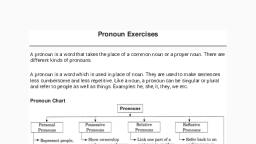
2.1 Introduction, , , , Pronouns are what you understand as adam in Hindi. They are not open ended., , The list of pronouns in every language is limited., , , , 2.2 Definition, , , , Pro means 'for' or ‘acting as.' A pronoun is used as a substitute for a noun or a noun, phrase. In other words, it has all the characteristics of a noun: it can function as a, , subject/object/complement in a sentence., , A pronoun is used to avoid the repetition of nouns or noun phrases:, , 1: Suresh went to the market because Suresh wanted to buy a pen., i.e. Suresh went to the market because he wanted to buy a pen., , 2. Walking is a form of exercise. Walking is easier than swimming., i.e. Walking is a form of exercise. It is easier than swimming., , But a pronoun is different from a noun in that it cannot take a premodifying, adjective nor can it take a determiner or a prefix/suffix. The form of a pronoun is, fixed., , 2.3 Kinds of Pronouns, , , , There are nine kinds of pronouns:, i) Personal Pronouns, , li) Possessive Pronouns, , iv) Demonstrative Pronouns, v) Reflective Pronouns, , vii) Relative Pronouns, , viii) Interrogative Pronouns, ix) Indefinite Pronouns, , 2.3.1 Personal pronouns, , I, we, you, he, she, it, they, , 10
Page 3 :
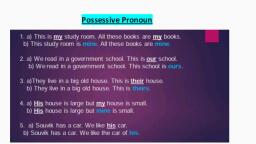
These seven pronouns are called personal pronouns. On the basis of their role in a, speech act, these can be divided into three:, , First Person, Second Person, Third Person, , 2.3.2 Possessive pronouns, , my, our, your, his, her, their, its (determiners), , mine, ours, yours, his, hers, theirs, its (predicative use), , They are used to express ownership/possession/relationship., , Determiners are followed by a noun., , This is my room., , The possessive pronoun in its predicative use cannot be followed by a noun., , We don't say:, , This is mine room., , We say:, , The room is mine., , Note: Its is always used as a determiner, never as a predicative., This is a lock and that is its key. (not, ... that key is its.), , 2.3.3 Reciprocal pronouns, , each other, one another, , These are used to express mutual/reciprocal relationship:, , They love each other/one another., , Like any other pronoun, each other and one another have no intrinsic reference;, therefore they have to have an antecedent. But unlike other pronouns, these cannot, normally appear as the subject of a main clause because the antecedent should be, in the sentence itself. Typically these occur as object of a verb or a preposition in a, , sentence that has a plural subject., 1. No two artists approve of each other's works., , But we cannot say:, , 11
Page 4 :
2. If there are two children of the same age it is always good to put them in the, same class. Each other can help in doing the homework., , But we can say:, The children can help each other in doing the homework., , Even though there are enough contextual clues in (2) as to the antecedent of each, other the sentence is not possible., , Note: Traditional grammar makes a distinction between each other and one, another. It requires that each other be used of only two people/things and one, another of more than two. In current English both are used interchangeably, with a, slight preference for each other., , 2.3.4 Demonstrative pronouns, , this, that, these, those, , They are used to point to (demonstrate) people or things they stand for:, 1. This is our new house., , 2. That is the bridge built by the British., , Demonstrative pronouns have number contrast:, , this these, , that those, , The basic function of demonstratives is to indicate the nearness or distance of the, , person or object referred to, from the speaker., Some of the uses of demonstrative pronouns are shown below:, a) When pointing:, This is my brother, Ravi., That is his new car., b) When a specific category is implied:, Those who apply late will not be considered., , c) When there is a reference to a previous statement or a statement that, follows:, 12
Page 5 :
This is what I told them., That is my opinion on the matter., Note: Difference between it and this, , It is a personal pronoun, whereas this is a demonstrative pronoun. As a, demonstrative pronoun this indicates nearness and also identifies a person or thing., The use of it does not convey these shades of meaning, so this is preferred to it for, , making a formal announcement or introduction:, , This is All India Radio giving you the news. (not, it), , Mum, this is Iaya, my friend. (not, it), , In an answer, however, it is preferred to this when a contracted form is used., What's this?, , It's a new electronic device. (not, this), , But when a contracted form is not used, this is okay., , What is this? This is a new electronic device., , 2.3.5 Reflexive pronouns, , Form:, , A reflexive pronoun is formed by attaching self/selves to the objective form of the, pronoun:, , myself, ourselves, yourself/selves, himself, herself, themselves, itself, , a) A reflexive pronoun is used as a substitute for a noun in the objective case i.e.,, as a direct object:, , Govind saw Govind in the mirror., , Govind saw himselfin the mirror., , This is used to avoid an awkward construction 'Govind ... Govind’ ., Gayatri laughed at Gayatri., , Gayatri laughed at herself., , 13