Page 1 :
Unit —5, , , , Adverbs, , , , , , Structure, , 5.0 Objective, , 5.1 Introduction, , 5.2 Definition, , 5.3. Kinds of Adverbs, , 5.4 Formation of Adverbs, , 5.6 Degrees of Comparison:, 5.6.1 Formation of comparatives and superlatives, 5.7 Adverbs: Usage, 5.7.1 Adverbs of time, 5.7.2 Adverbs of place, 5.7.3 Adverbs of degree, 5.7.4 Ever and Never, 5.7.5 Interrogative adverbs, 5.7.8 No any, none, , 5.8 Conclusion, , 5.9 Unit end Questions, , 5.0 Objective, , , , In this unit we shall describe Adverbs in English., , , , 5.1, , Introduction, , , , Adverbs are equivalents to ffrat faster in Hindi. However we should not be misled, by the terms as it does not simply modify or verb., , 62
Page 2 :
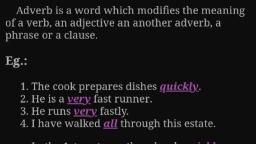
5.2 Definition, , , , @ adverb adds something more to the meaning of the verb:, @ Sheetal sang sweetly. (modifying a verb), , © They secretly decided to get married. (modifying a verb), @ It can also modify an adjective or another adverb., , @ He is purposely late. (modifying an adjective), , e she works extremely slowly. (modifying an adverb), , e@ It can also modify a pronoun, preposition, conjunction and a sentence as, well:, , @ Nearly everybody was late. (modifying a pronoun), @ The grapes are well within reach. (modifying a preposition), , @ They don't help me just because I suffer in silence. (modifying a, , conjunction), e@ Fortunately he did not hurt himself. (modifying a sentence), , © An adjective too is a modifier, but it does not modify words other than, , nouns nor is it used to express time, or place., , 5.3 Kinds of Adverbs, , , , , , Adverbs are often kinds:, , i) Adverbs of time, , ago, since, back, before, early, soon, already, yet, still, today,, tomorrow, then, lately, recently, once, one of these days, some, , day, now, by now, right away, nowadays, , They indicate the time of an action and answer to the question when., When did you buy this car? I bought it a week ago., , 63
Page 3 :
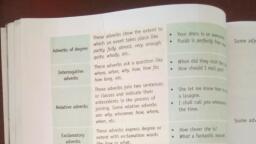
When will you do this work? Ihave done it already., , ii) Adverbs of place/position, , here, there, near, by, up, down, in, out, everywhere, nowhere,, , somewhere, anywhere, nowhere else, hither and thither, , They are used to indicate the place of an action and characteristically answ, the question where., , Where is your watch? It's here., , Where is your mother? She has gone out., , Note: Hither/thither used in isolation is archaic but the phrase hither and thither is, idiomatic., , iii) Adverbs of manner, , boldly, bravely, quickly, slowly,, , easily, badly, hard, fast, well, , They express the manner of an action and answer to the question how?, , How is she typing? She is typing carefully., , How is he working? He is working slowly., , iv) Adverbs of frequency, , always, ever, never, often, seldom, everyday,, , sometimes, occasionally, usually, normally,, , frequently, rarely, hardly, scarcely, once/twice a week etc., , They express the frequency of an action. They answer the question how often?, She has always helped me., , Thad never told a lie., , We rarely talk to each other., , Note: In traditional grammar they are called Adverbs of Number, but in current, English they are called Adverbs of Frequency., v) Adverbs of degree (Intensifiers), , 64
Page 4 :
almost, very, very much, too, enough, so such, just,, , of course, quite, rather, fairly, hardly, scarcely, much,, , more, most, barely, absolutely, extremely, perfectly,, , really, totally, utterly, a lot, a great deal, a bit, , They express degree/intensity, so they answer the question how much/how, far/to what extent?, , He is too ill to go to work., , He is rich enough to maintain a car., , In current English they are called intensifiers because they have a heightening or, lowering effect on the words they modify., , vi) Relative adverbs, when, where, why, whenever, wherever, , Relative adverbs, like relative pronouns, relate or refer back to their antecedent and, also join clauses. A relative adverb plays a double role because it functions as an, adverb as well as a conjunction., , Relative adverbs are used to introduce relative clauses and noun clauses as well,, , not only adjective clauses:, , I don't know the place where she works. (adjective clause), T don't know where she works. (noun clause), , vii) Interrogative adverbs, , when, since when, where, why, how,, , how many, how much, how often,, , how far/long, how tall/high etc., , whenever, wherever, whyever, however, , They are used for asking questions about time/place etc.:, a) time, , 65
Page 5 :
When do you have lunch, usually?, Since when has he been living in the hostel?, How long did you wait there?, b) place, Where are you going?, , Where do you come from?, , Note: whence meaning 'from where’ is archaic. It is now replaced by where ..., , from., c) manner/method/means, How did he do this sum?, How do you wash your clothes?, How did you go to France?, How do you get a phone?, d) degree/to what extent, How deep is this river?, How far is it to the station?, How often do you go to the cinema?, How fast can you type?, e) cause/reason, Why are you so angry?, Why is the baby crying?, Note: wherefore meaning 'why' is archaic. It is now replaced by why., viii) Exclamatory adverbs, How!, What!, They are used in exclamations to express degree/extent:, , How dirty this place is!, , 66