Page 1 :
unit 2, , ACIDS, BASES AND BUFFERS,, , MAJOR EXTRA AND INTRA, , CELLULAR ELECTROLYTES, AND, , 24, 2.2, , 23, , 23, , DENTAL PRODUCTS, , , , SYNOPSIS +, , Introduction, , Theories of Acids and Bases, , 2.2.1 Arrhenius Concepts of Acids and Bases, 2.2.2 Bronsted-Lowry Concepts of Acids and Bases, 2.2.3 Lewis Concepts of Acids and Bases, Buffers, , 2.3.1 Buffer Solutions, , 2.3.2 Buffer Action, , 2.3.3 Buffer Equations, , 2.3.4 Buffer Capacity, , 2.3.5 Factors Affecting pH of Buffer Solutions, 2.3.6 Importance of Buffer Solutions, , 2.3.7 Role of Buffers in Pharmacy, , 2.3.8 Butfers in Pharmaceutical System, , 2.3.9 Preparation of Buffers, , 2.3.10 Stability of Buffers, , 2.3.11 Buffered Isotonic Solutions, , 2.3.12 Measurement of Tonicity, , 2.3.13 Methods of Adjusting Tonicity and pH, Major Extra and Intracellular Electrolytes, , 2.4.1 Introduction, , 2.4.2 Functions of Electrolytes, , , , 24, , Scanned with CamScanner
Page 2 :
Acids, Bases and Buffers, Malo,, Pharmaceutical Inorganic Chemistry ;, 2.4.3 Electrolytic Imbalance and its Cause? on, 24 4 Major Physiological lons and their Func, 4, ., 2.4.5 Electrolytes Used for Replacement Therapy, , 2.5 Dental Products, 2.5.1 Dental Products, 2.5.2 Dentifrices, 2.5.3 Calcium Carbonate, 2.5.4. Role of Fluorides, 2.5.5 Role of Phosphates, 2.5.6 Anti-caries Agents, 2.5.7 Desensitizing Agents, , , , (, 2.5.8 Strontium Chloride, 2.5.9 Zinc Oxide Eugenol Cement, , e Exercise, , , , , , Pharmaceutical Chemistry is a branch of chemistry that deals with the chemig, biochemical and pharmacological aspects of drugs. It includes synthesis or isolatic, identification, structural elucidation, structural modification, Structure - Activity Relationst: ‘, , (SAR) studies, study of chemical characteristics, biochemical changes after dy!, administration and their pharmacological effects., , Acid and Base, , According to an old concept, acids and bases are defined as:, , Acid is a substance whose aqueous solution possesses the following characters, Properties:, , (i) Can conduct electricity., , (ii) Reacts with active metals like zi, (iii) Turns blue litmus red,, (iv) Has a sour taste,, , (V) Whose acidic Properties, Base is i, , : ae ae ieee Solution possess the following characteristics:, (ii) Turns red litmus blue., , (iii) Has a bitter taste., , (iv) Has a Soapy touch,, , disappear on reaction with base,, , (v) Whose basic Properties are destrovad an on., —— se asic pr, , Scanned with CamScanner
Page 3 :
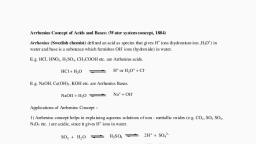
hi armaceutical Inorganic Chemistry, , PI, , , , , , , , , Ls, , 2.2.4 Arrhenius Concepts o Acids and Bases, , ane the ¥ zi 1884 put fowards a theory, popularly known as ‘Arrhenius theory of, Ionization qT e mally (dea contained in this theory was that when the electrolyte is dissolved, in water, it dissociates into positively and negatively charged ions., , pased on this theory, Arrhenius gave the definition of acids and bases as follows:, , An acid is defined as a substance which contain hydrogen and which when dissolved into, water give hydrogen ions (H*)., , eg. Substances like HCl, HINO, and H2SO,, containing hydrogen, when dissolved in water, dissociate completely into H* ions and the negative ions are as follows:, , Hcl —+ H* + a, Hydrochloric acid Hydrogen ion Chloride ion, , HNO; —>» H* + NO;, Nitric acid Hydrogenion Nitrate ion, , Such acids are called strong acids., , Substances like acetic acid (CH;COOH), carbonic acid (HzCO3), phosphoric acid (H3PO,), etc. when dissolved in water dissociate into ions to small extent. Hence, equilibrium is set up, between the ions and un-dissociated molecules as, , CH;COOH = CH;COO- + +H", Acetic acid Acetate ion Hydrogen ion, + 3H;PO, = 3H* + PO,, , ~ Phosphoric Hydrogen _- Phosphate, acid ion ion, , A base is defined as a substance which contains hydroxyl group and which when, dissolved in water gives hydroxide ions (OH’)., Substances like NaOH and KOH containing the OH" groups, when dissolved into water, dissociate completely to give OH” ions as follows:, NaOH —> Na” + OH, , Sodium Sodium Hydroxide, hydroxide ion ion, KOH —> K* + OH, Potassium Potassium Hydroxide, hydroxide ion ion, , These are called strong bases., 2.3, , Scanned with CamScanner
Page 4 :
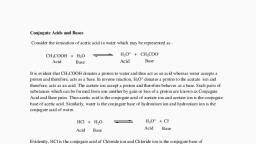
Acids, Bases and Butters,, , Pharmaceutical Inorganic Chemistry Major 5,, , Substances like NHsOH, Ca(OH)2, Al(OH), etc. dissociate to small extent as follows:, , + NHOH —> NH, + OH, Ammonium Ammonium Hydroxide, hydroxide ion ion, Such bases are called weak bases. _ ., Arrhenius has also given the concept of neutralization. According to him, Neutralizatg,, , may be defined as the process in which hydrogen ions given by an acid and hydroxide ion, , given by the base combine to form unionized molecules of water., Or, h It may also be defined as a chemical reaction between an acid and a base in solution they, ' produces salt and water., HCl + NaOH — H20 + NaCl, , Phenomena's like salt hydrolysis and strength of acids and bases were also explaineq by, Arrhenius concept of acids and bases., , Limitations of Arrhenius theory:, , 1. The acidic and basic properties of various substances were explained only in aqueoy, , solution. For example, dry HCl shall not act as as acid. HCI is regarded as an acid only, when dissolved in water and not in any other solvent., , The concept does not explain the acidic and basic characters of substances in nor, aqueous solvents., The neutralization process is limited to those reactions that can occur in aqueous, solutions only, although reactions involving salt formation do occur in absence ¢, solvents., , 4. It cannot explain the acidic characters of certain salts like AICI; in aqueous solution., 2.2.2 Bronsted-Lowry Concepts of Acids and Bases, , To overcome the limitations of Arrhenius conce, Lowry (an English chemist) inde, broader concept of acids and ba, , pt, Bronsted (a Danish Chemist) and, pendently and simultaneously in the year 1923, proposed?, ses. According to this concept:, , An acid is defined as a substance which has the tendency to give a proton (H*) and a bas, , is defined as a substance which has a tendency to accept a proton. In other words, an acid is4, proton donor whereas a base is proton acceptor., , The above definition may be explained with the help of following examples:, HCl + H,0 == H30* + Clr wl, NH; + HO = NH; + OH", , HCl + NH3 = NHf + cr, , 24, , Scanned with CamScanner, , \~o
Page 5 :
wr a, , pramaceutical Inorganic Chemistry, , The following important results may be derived from these equations:, , 1, 2, 2, NHs and CO3 are bases because they accept a proton from water., , 3, , 4, In the first reaction, water is accepting a proton and hence is a base. But in the, , HCl and CH3COOH are acids because they donate a proton to water., , Not only molecules but even the ions can act as acids or bases, , second eat water is donating a proton and hence it is acting as an acid. Thus,, water ae , joth as an acid as well as a base and hence, is called amphoteric or, amphiprotic., , The last r eaction indicates that Bronsted-Lowry definitions of acids and bases are not, restricted to aqueous solution. In this reaction, HCl is acting as acid because it gives a, proton and NH; is a base because it accepts the proton., , The presence of hydroxy! group is not essential for a substance to act as a base. The, only requirement is that it should have a tendency to accept a proton., , The above reaction indicates that a substance act as an acid ie. gives a proton only, when another substance to accept a proton ie. a base is present. For example, acetic, acid does not act as an acid in benzene solution because the latter does not accept, the pattern., , The reverse reactions are also acid-base reactions. For example, in first reaction, the, reverse process, H30* can give a proton and hence is an acid while CI” ion can accept, the protons and hence is a base. Thus, these are the acid-base pairs and are called, , conjugate acid-base pairs., , A conjugate pair of acid and a base differs by a proton only., , Note: According to this concept, if two acids are mixed, the we, , Conjugate Pair-!, , Conjugate Pair-II, , Acid, Bases Acidg Base,, + =, HCI + H,0 = H30 + cl, a 2, CH,COOH + H,0 == _~—s—i+H0 + CH,COO, — + + OH “, H,0 + NH, =——~ NM, H,0 + CO,7- —, HCO, + OH™, HCl + NH ——_ os + cl, , aker acid will act as base with, , respect to the stronger acid. e.g., , HClO, + H:SOs * H3S0, + ClO,, , Acid 1 Base2 Acid2 Basel, 2.5, , Scanned with CamScanner, , Acids, Bases and Buffers, Major ....++