Page 1 :
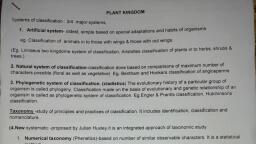
Ll., 2. Natural System, , , , Artificial System, , , , , 3. Phylogenetic System, , 1. Artificial Classification Systems, , | + Earliest systems of classification., , | + They were based on vegetative characters, , | or superficial morphological characters, such as habit, colour, number and shape, of leaves, etc., , + Linnaeus’s artificial system of, , classification was based on the, androecium structure.
Page 2 :
Systems of Biological Classification, , , , , , , , , , , , , , , , 1. Artificial Classification Systems, , Carl Linnaeus, , Drawbacks:, , * They separated the closely related species, since they were based on a few, characteristics., , + Equal weightage to vegetative & sexual, characteristics. This is not acceptable, since the vegetative characters are more, easily affected by environment., , + These are based on natural affinities, among organisms., , + It considers external features and, internal features (ultrastructure,, anatomy, embryology &, phytochemistry)., , + E.g. Classification for flowering plants, given by George Bentham & Joseph, | Dalton Hooker., George Bentham Jospeh Dalton Hooker, bankofbiology.com, , , , , , , , Systems of Biological Classification, , eAlda, , , , 3. Phylogenetic Classification Systems, , * These are based on evolutionary, relationships among the organisms., , * This assumes that organisms in the, same taxa have a common ancestor., , , , bankofbiology.com
Page 3 :
Systems of Biological Classification, , Characters Other sources to resolve the problems in, 910 classification, , +, , ae + Numerical Taxonomy: It is based on all, , ia © observable characteristics. It is carried, out using computers. Number & codes, are assigned to all the characters and the, data are processed. Thus hundreds of, characters can be equally considered., , * Cytotaxonomy: It is based on cytological, information like chromosome number,, structure, behaviour etc., , + Chemotaxonomy: It uses the chemical, constituents of the plant., , , , * Simple, thalloid, autotrophic,, chlorophyll-bearing and aquatic, (fresh water & marine) organisms., , | + They also occur in moist stones, soils, & wood., , * Some occur in association with fungi, (lichen) and animals (e.g. on sloth, bear)., , : eG ee es, , isicih Uke
Page 4 :
ALGAE }, , , , , , , , , The form and size of algae is highly, variable., , o Microscopic unicellular forms: E.g., Chlamydomonas., , © Colonial forms: E.g. Vo/vox., , o Filamentous forms: E.g. U/othrix and, Spirogyra., , , , , , , , , , , , , , + Vegetative reproduction:, , By fragmentation. Each fragment, develops into a thallus., , Asexual reproduction:, , By the production of spores. E.g., zoospores (most common). They are, flagellated (motile). They germinate to, give rise to new plants., , + Sexual reproduction:, Through fusion of two gametes., , bankofbiology.com, , ALGAE, , & & lsogamy, + z, , occ, , Sexual reproduction is many types:, , + Isogamous: Fusion of gametes similar in, size. They may be flagellated (e.g., Ulothrix) or non-flagellated (non-motile,, e.g. Spirogyra)., , + Anisogamous: Fusion of two gametes, , , , & Anisogamy dissimilar in size. E.g. Some species of, Eudorina., female male ., + Oogamous: Fusion between one large,, non-motile (static) female gamete and a, & Oogamy smaller, motile male gamete. E.g. Vo/vox,, , Fucus.
Page 5 :
Benefits of algae, , , , , , , , , , 1. Through photosynthesis, they fix half, of the total CO, on earth and increase, the level of dissolved oxygen,, , 2. They are primary producers and the, basis of the food cycles of all aquatic, animals., , , , Benefits of algae, , 3. About 70 species of marine algae are, used as food. E.g. Porphyra, Laminaria, &Sargassum., , 4. Agar (from Gelidium & Gracilaria) is, used to grow microbes and in icecreams & jellies., , i Agar products, bankofbiology.com, , ALGAE, , , , its of algae, , 5. Some marine brown & red algae, produce hydrocolloids (water holding, substances). E.g. algin (brown algae) &, carrageen (red algae). These are used, commercially., , 6. Protein-rich unicellular algae like, Chlorella & Spirullina are used as food, supplements by space travellers., , bankofbiology.com