Page 1 :
HUMAN, ANATOMY &, PHYSIOLOGY, Course Code : 101T
Page 2 :
UNIT 1, Cellular level of, organization, , ● Structure and function of cell, ● Transport across cell membrane, ● Cell junction, ● Cell division, , ● General principles of cellular, communication, ● Intracellular signalling pathways, and forms
Page 3 :
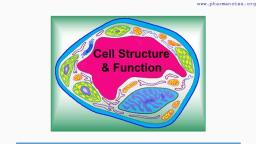
What is a cell ?, , Cells, the smallest structures capable, of maintaining life and reproducing., , The human body, which is made up of, numerous cells, begins as a single,, newly fertilized cell.
Page 4 :
STRUCTURE AND FUNCTION OF CELL, , ★ The cell is the living , structural and functional unit of all, organisms., ★ Cells are the building blocks of all living organisms., ★ Cells contain structures specialised for particular functions called, organelles ., ★ Specialised functions of cell include : Fat cell - for the storage of, fat, Muscle cell for movement, Secretory cells - for secretion and, Nerve cell - to generate and transmit nerve impulses., ★ Almost all human cells are microscopic in size., , ★ average-sized adult body, consists of 100 trillion cells!
Page 5 :
A cell consists of three parts:, the cell membrane,, , the nucleus, and,, between the two, the cytoplasm., , Within the cytoplasm lie intricate arrangements of fine fibers, and hundreds or even thousands of miniscule but distinct, structures called organelles., There are many different types, sizes, and shapes of cells in the body.
Page 7 :
CELL MEMBRANE, , Covers Every cell in the body is, The cell membrane separates the material outside the, cell, extracellular, from the material inside the cell,, intracellular., 7.5 - 10 nm thick.
Page 8 :
CELL MEMBRANE, ● It maintains the integrity of a cell and, ● Controls passage of materials into and out of the cell., ● The cell membrane is a double layer of phospholipid molecules and, Proteins, ●, , Proteins in the cell membrane provide structural support, form, channels for passage of materials, act as receptor sites,, function as carrier molecules, and provide identification, markers.
Page 9 :
CELL MEMBRANE
Page 10 :
NUCLEUS AND NUCLEOLUS, ★ The nucleus, formed/ covered by a nuclear membrane around a fluid, nucleoplasm, is the control center of the cell., ★ Threads of chromatin in the nucleus contain deoxyribonucleic acid, (DNA), the genetic material of the cell., ★ The nucleolus is a dense region of ribonucleic acid (RNA) in the, nucleus and is the site of ribosome formation., , ★ The nucleus controls how the cell will function
Page 11 :
Nucleolus is a component of the eukaryotic, nucleus., The nucleolus is considered as occupying, 25% of the volume of the nucleus., The nucleolus is composed of dense fibrillar, component , fibrillar center, granular, component and nuclear vacuole., Nucleolus is the largest structure in the cell, nucleus., The nucleolus is responsible for the, production of ribosomes (ribosome, biogenesis.), assembling the signal recognition particles, and, generating the cells’ response to stress
Page 12 :
The nucleus is a membrane enclosed, large, spherical organelle found in the eukaryotic cells., The nucleus is composed of a nuclear envelope,, nuclear pores, nucleoplasm, nuclear lamina,, chromosomes, nucleolus and other subnuclear, bodies., This is enclosed by the nuclear envelope., The nucleus consist of chromosomes, main function is controlling the gene expression, and DNA replica, , During the life time of a cell, some cell nuclei are, broken down in the process of nuclear division.
Page 13 :
CYTOPLASM, ★ The, , ★, ★, ★, , ★, , cytoplasm is the gel-like fluid inside the cell., It is the medium for chemical reaction., It provides a platform upon which other organelles can operate, within the cell., All of the functions for cell expansion, growth and replication are, carried out in the cytoplasm of a cell., Within the cytoplasm, materials move by diffusion, a physical, process that can work only for short distances.
Page 15 :
CYTOPLASMIC ORGANELLES, ● little organelles that are suspended in the, cytoplasm of the cell., , ● each type of organelle has a definite structure, and a specific role in the function of the cell., ● examples of cytoplasmic organelles are, mitochondria, ribosomes, endoplasmic, reticulum, golgi apparatus, and lysosomes.
Page 16 :
MITOCHONDRIA
Page 17 :
● Mitochondria are oxygen-consuming ribbon-shaped cellular organelles of immense, importance floating free throughout the cell., ● They are known as the “powerhouse of the cell” since these organelles supply all, the necessary biological energy to the cell by oxidizing the substrates available., ● The enzymatic oxidation of chemical compounds in the mitochondria releases, energy., ● Since mitochondria act as the power-houses, they are abundantly found on those, sites where energy is earnestly required such as sperm tail, muscle cell, liver cell, (up to 1600 mitochondria), microvilli, oocyte (more than 300,000 mitochondria), etc., , ● Typically, there are about 2000 mitochondria per cell,, representing around 25% of the cell volume
Page 18 :
Mitochondria are mobile, plastic organelles that have a doublemembrane structure., It ranges from 0.5 to 1.0 micrometer in diameter., It has four distinct domains: the outer membrane, the inner, membrane, the intermembrane space, and the matrix., , The organelle is enclosed by two membranes—a smooth outer membrane and a markedly, folded or tubular inner mitochondrial membrane, which has a large surface and encloses the, matrix space.The, , number and shape of the mitochondria, as well as the numbers, , of cristae they have, can differ widely from cell type to cell type.
Page 19 :
FUNCTIONS OF MITOCHONDRIA, , ★ The most important function of mitochondria is, to produce energy., ★ Mitochondria produce the molecule adenosine, triphosphate (ATP), providing the energy for, number of cellular reactions and mechanisms, , ★ charged molecules from nutrition molecules, combine with oxygen and produce ATP, molecules., ★ This process is known as oxidative, phosphorylation
Page 20 :
★ Mitochondria may also produce heat (brown fat),, and accumulate iron-containing pigments (Heme, ferritin), ions of Ca2+ and HPO42– (or phosphate;, e.g., osteoblasts of bones or yolk proteins., , ★ Plays an important role in Apoptosis, ★ Helps maintain concentration of calcium within, cellular compartments., ★ help in building certain parts of blood and, hormones like testosterone and estrogen.
Page 21 :
RIBOSOMES, A ribosome is a complex molecular machine found, inside the living cells that produce proteins from amino, acids during the process called protein synthesis or, translation., , Ribosomes can be found floating within the cytoplasm, or attached to the endoplasmic reticulum
Page 22 :
There are two types of ribosomes,, , free and fixed (also known as membrane bound)., , They are identical in structure but differ in locations, within the cell., Free ribosomes are located in the cytosol and are able, to move throughout the cell,, whereas fixed ribosomes are attached to the, Rough ER
Page 23 :
Ribosomes are important for all living cells because they build proteins., Depending on the type of cell, any given cell contains between several thousand and a, few million ribosomes., Since they are the protein-synthesizing machines of the cell, cells that require lots of, proteins simply have more ribosomes., Eukaryotic ribosomes have two unequal subunits, designated small subunit (40S) and, large subunit (60S) according to their sedimentation coefficients., Both subunits contain dozens of ribosomal proteins arranged on a scaffold composed of, ribosomal RNA (rRNA).
Page 26 :
The endoplasmic reticulum, (ER) is a large organelle, made of membranous, sheets and tubules that, begin near the nucleus and, extend across the cell, .The endoplasmic reticulum, , creates, packages, and, secretes many of the, products created by a, cell.
Page 27 :
The entire structure can account for a large proportion of the, , endomembrane system of the cell., For instance, in cells such as Liver hepatocytes that are, specialized for protein Secretion and and detoxification, the ER, can account for more than 50% of the total lipid bilayer of the cell., Similarly, the ER membrane system is particularly prominent in, pancreatic beta cells that secrete insulin, or within activated Blymphocytes that produce antibodies.
Page 28 :
There are two major types of ER within each cell – smooth endoplasmic reticulum, (SER) and rough endoplasmic reticulum (RER)., , Each has distinct functions, and often, differing morphology., The SER is involved in lipid metabolism and acts as the calcium store for the cell., This is particularly important in muscle cells that need Ca2+ ions for contraction., , The SER is also involved in the synthesis of phospholipids and cholesterol. It is, often located near the periphery of the cell., , RER is commonly seen close to the nucleus, It contains membrane-bound ribosomes that give it the characteristic ‘rough’ appearance., , These ribosomes are creating proteins that are destined for the lumen of the ER and, are moved into the organelle as they are being translated.
Page 29 :
Endoplasmic Reticulum Function, The ER plays a number of roles within the cell, from, , protein synthesis and lipid, , metabolism to detoxification of the cell., Cisternae, each of the small folds of the endoplasmic reticulum, are commonly associated, with lipid metabolism., They also appear to be important in maintaining the Ca2+ balance within the cell and in the, interaction of the ER with mitochondria., ER sheets appear to be crucial in the response of the organelle to stress,, occasionally, apoptosis is induced by the ER in response to an excess of unfolded protein, within the cell.
Page 30 :
GOLGI, APPARATUS
Page 31 :
The Golgi apparatus, also called Golgi complex or, Golgi body, is a membrane-bound organelle found in, eukaryotic cells (cells with clearly defined nuclei) that, is made up of a series of flattened stacked pouches, called cisternae., it is located in the cytoplasm next to the endoplasmic, reticulum and near the cell nucleus., A major function is the modifying, sorting and, packaging of proteins for secretion., It is also involved in the transport of lipids around, the cell, and the creation of lysosomes.
Page 32 :
Lysosomes
Page 33 :
They have a simple structure; they are spheres made, up of a lipid bilayer that encloses fluid that, contains a variety of hydrolytic enzymes. ..., , Lysosomes are formed by budding off of the Golgi, apparatus, and the hydrolytic enzymes within them, are formed in the endoplasmic reticulum
Page 34 :
Lysosomes have Multiple functions, , Such functions are influenced by their positioning and motility., Primary function is degradation,, And lysosomes participate in other cellular functions., Endocytic, phagocytic and autophagic degradation, antigen, presentation, killing of target cells by cytotoxic T-cells and NK cells,, metabolic signaling, cell adhesion and migration, tumor invasion and, metastasis, as well as plasma membrane repair.
Page 36 :
CILIA, , Motile cilia are usually, present on a cell's, surface in large, numbers and beat in, coordinated waves., , In humans, for, example, motile cilia, are found on the, respiratory epithelium, lining the respiratory, tract where they, function in the, mucociliary clearance, of sweeping mucus, and dirt out of the, lungs.
Page 37 :
In multicellular organisms, cilia function to, ★ move a cell or group of cells or, , ★ to help transport fluid or materials past them., ★ The respiratory tract in humans is lined with cilia that keep, inhaled dust, smog, and potentially harmful microorganisms, from entering the lungs.
Page 38 :
FLAGELLA, Flagella are microscopic hair-like structures involved in the locomotion of a cell., The word “flagellum” means “whip”., , The flagella have a whip-like appearance that helps to propel a cell through the, liquid. ..., A shaft exists between a hook and a basal body passing through the protein rings in, the cell membrane.
Page 39 :
Flagellum is primarily a, motility organelle that, enables movement and, chemotaxis., The, , only cell in the human, body that has flagella is the, sperm cell.
Page 40 :
The cytoskeleton is, , a structure that helps cells, maintain their shape and internal, organization, , CYTOSKELETON, , it also provides mechanical support that, enables cells to carry out essential functions, like division and movement., , There is no single cytoskeletal component., Rather, several different components work, together to form the cytoskeleton.
Page 41 :
What Is the Cytoskeleton Made Of?, The cytoskeleton is made of filamentous proteins, and it provides mechanical, support to the cell and its cytoplasmic constituents., , All cytoskeletons consist of three major classes of elements that differ in size and in, protein composition., Microtubules are the largest type of filament, with a diameter of about 25 nanometers, (nm), and they are composed of a protein called tubulin., Actin filaments are the smallest type, with a diameter of only about 6 nm, and they, are made of a protein called actin., , Intermediate filaments, as their name suggests, are mid-sized, with a diameter of, about 10 nm., , Unlike actin filaments and microtubules, intermediate filaments are, constructed from a number of different subunit proteins.
Page 42 :
Cytoskeletal filaments, , provide the basis for cell movement., , For instance, cilia and (eukaryotic) flagella move as a result of microtubules sliding, along each other., In fact, cross sections of these tail-like cellular extensions show organized arrays of, microtubules., , The cytoskeleton of a cell is made up of microtubules, actin filaments, and, intermediate filaments., These structures give the cell its shape and help organize the cell's parts., In addition, they provide a basis for movement and cell division.
Page 43 :
Overall function of a cell, include, ●, , Movement / Transportation of substances across, the cell membrane, , ●, , Cell division, , ●, , DNA replication and protein synthesis