Page 1 :
HUMAN, ANATOMY &, PHYSIOLOGY, Course Code : 101T, ANATOMICAL TERMINOLOGIES
Page 2 :
ANATOMICAL TERMINOLOGIES, The, , most basic anatomy concept, and equally the most important, is orientation., All structures and the relationships between them are referenced to the standard, anatomical position., In this orientation,, , the person is considered to be standing, upright, with the arms hanging by the side, palms facing, forward, and thumbs pointing away from the body., The feet are slightly parallel, and toes oriented to the front.

Page 3 :
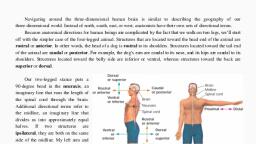
To compare the location of body parts relative to each other, anatomy uses some, universal directional terms:, ●, ●, ●, ●, ●, ●, ●, ●, ●, ●, ●, ●, , Anterior, Posterior,, Ventral, Dorsal,, Distal, Proximal,, Medial, Lateral,, Median,, Superior, Inferior,, External, Internal,, Frontal, Occipital, Rostral, Caudal,, Superficial, Deep,, Central, Peripheral,, Ipsilateral, Contralateral,, Cranial, And Cephalic.
Page 6 :
IPSILATERAL, the same side (the spleen and descending colon areipsilateral ), , CONTRALATERAL :, Refers to the opposite side (the spleen and gallbladder are contralateral ).
Page 7 :
•Proximal : is used to describe a part that is closer to the trunk of the body, or closer to another specified point of reference than another rpart (the elbow, is proximal to the wrist).Vs.Vs., , Distal: it means that a particular body part is farther from the trunk or, farther from another specified point of reference than another part (fingers, are distal to the wrist).•, Superficial: means situated near the surface., Peripheral also means outward