Page 1 :
SUGGESTED DISTRIBUTION OF MARKS, , Topic No., , Time Allotted, , Marks Allotted, , (Periods), , (%), , 1., , 08, , 14, , 2., , 08, , 14, , 3., , 06, , 11, , 4., , 08, , 14, , 5., , 06, , 11, , 6., , 08, , 14, , 7., , 12, , 22, , Total, , 56, , 100
Page 2 :
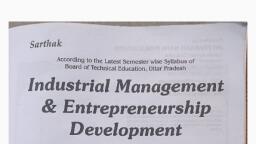
6.3INDUSTRIAL MANAGEMENT AND ENTREPRENEURSHIP DEVELOPMENT, L T P, 5, - RATIONALE, In the present day scenario, it has become imperative to impart entrepreneurship and, management concepts to students so that a significant percentage of them can be directed, towards setting up and managing their own small enterprises. It may be further added that, an entrepreneurial mindset with managerial skills helps the student in the job market. This, subject focuses on imparting the necessary competencies and skills of enterprise set up and, its management., LEARNING OUTCOMES, After undergoing this course, the students will be able to :, •, •, •, •, •, •, •, •, •, •, •, •, , Know about various schemes of assistance by entrepreneurial support agencies, Conduct market survey, Prepare project report, Explain the principles of management including its functions in an organisation., Have insight into different types of organizations and their structures., Inculcate leadership qualities to motivate self and others., Manage human resources at the shop-floor, Maintain and be a part of healthy work culture in an organisation., Use marketing skills for the benefit of the organization., Maintain books of accounts and take financial decisions., Undertake store management., Use modern concepts like TQM, JIT and CRM., DETAILED CONTENTS, SECTION – A, , ENTREPRENEURSHIP, 1., , Introduction, 1.1, 1.2, 1.3, , (04 Periods), , Concept /Meaning and its need, Qualities and functions of entrepreneur and barriers in entrepreneurship, Sole proprietorship and partnership forms and other forms of business, organisations
Page 3 :
1.4, , 2., , Market Survey and Opportunity Identification/Ideation, 2.1, 2.2, 2.3, 2.4, 2.5, 2.6, 2.7, , 3., , Schemes of assistance by entrepreneurial support agencies at National, State,, District –level, organisation: NSIC, NRDC, DC, MSME, SIDBI, NABARD,, NIESBUD, HARDICON Ltd., Commercial Banks, SFC’s TCO, KVIB, DIC,, Technology Business Incubators (TBI) and Science and Technology, Entrepreneur Parks, , Scanning of the business environment, Salient features of National and Haryana State industrial policies and resultant, business opportunities, Types and conduct of market survey, Assessment of demand and supply in potential areas of growth, Identifying business opportunity, Considerations in product selection, Converting an idea into a business opportunity, , Project report Preparation, 3.1, 3.2, 3.3, 3.4, 3.5, , (04 Periods), , (06 Periods), , Preliminary project report, Detailed project report including technical, economic and market feasibility, Common errors in project report preparations, Exercises on preparation of project report, Sample project report, SECTION –B, , MANAGEMENT, 4., , Introduction to Management, 4.1, 4.2, 4.3, 4.4, 4.5, 4.6, 4.7, 4.8, , 5., , (06 Periods), , Definitions and importance of management, Functions of management: Importance and process of planning, organising,, staffing, directing and controlling, Principles of management (Henri Fayol, F.W. Taylor), Concept and structure of an organisation, Types of industrial organisations and their advantages, Line organisation, staff organisation, Line and staff organisation, Functional Organisation, , Leadership and Motivation, , (08 Periods)
Page 4 :
5.1, 5.2, , 6., , Management Scope in Different Areas, 6.1, , 6.2, , 7., , 8., , 9., , Leadership: Definition and Need, Qualities and functions of a leader, Manager, Vs leader, Types of leadership, Case studies of great leaders, Motivation: Definition and characteristics, Importance of self motivation,, Factors affecting motivation, Theories of motivation (Maslow, Herzberg,, Douglas, McGregor), (14 Periods), , Human Resource Management: Introduction and objective, Introduction to Man, power planning, recruitment and selection, Introduction to performance, appraisal methods, Material and Store Management: Introduction functions, and objectives, ABC, Analysis and EOQ, , 6.3, , Marketing and sales: Introduction, importance, and its functions, Physical, distribution, Introduction to promotion mix, Sales promotion, , 6.4, , Financial Management: Introductions, importance and its functions, knowledge, of income tax, sales tax, excise duty, custom duty, VAT, GST, , Work Culture, , (08 Periods), , 7.1, 7.2, , Introduction and importance of Healthy Work Culture in organization, Components of Culture, , 7.3, , Importance of attitude, values and behavior, , 7.4, , Behavioural Science – Individual and group behavior., , 7.5, , Professional ethics – Concept and need of Professional Ethics and human values., , Basic of Accounting and Finance, , (10 Periods), , 8.1, , Basic of Accounting:Meaning and definition of accounting, Double entry system of book, keeping, Trading account, PLA account and balance sheet of a company, , 8.2, , Objectives of Financial Management: Profit Maximization v/s Wealth Maximization, , Miscellaneous Topics, 9.1, , (10 Periods), , Total Quality Management (TQM): Statistical process control, Total employees, Involvement, Just in time (JIT)
Page 5 :
9.2, , Intellectual Property Right (IPR) : Introduction, definition and its importance,, Infringement related to patents, copy right, trade mark, , INSTRUCTIONAL STRATEGY, Some of the topics may be taught using question/answer, assignment, seminar or case study, method. The teacher will discuss stories and case studies with students, which in turn will, develop appropriate managerial and entrepreneurial qualities in the students. In addition,, expert lecturers may also be arranged from outside experts and students may be taken to, nearby industrial organisations on visit. Approach extracted reading and handouts may be, provided., , MEANS OF ASSESSMENT, , •, •, •, , Assignments and quiz/class tests, Mid-term and end-term written tests, Model/Prototype making., , RECOMMENDED BOOKS, 1. A Handbook of Entrepreneurship, Edited by BS Rathore and Dr JS Saini; Aapga, Publications, Panchkula (Haryana), 2. Entrepreneurship Development and Management by J.S.Narang; Dhanpat Rai &, Sons, Delhi., 3. Entrepreneurship Development by CB Gupta and P Srinivasan, Sultan Chand and, Sons, New Delhi, 4. Handbook of Small Scale Industry by PM Bhandari, 5. Entrepreneurship Development and Management by MK Garg, 6. E-books/e-tools/relevant software to be used as recommended by AICTE/ NITTTR,, Chandigarh., , Websites for Reference:, http://swayam.gov.in