Notes of FE Degree-Physics, Engineering Physics-I Numerical Problems - Study Material
Page 1 :
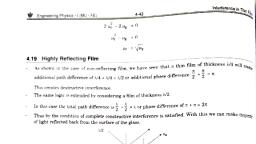
Interference in Thin, , Fn, , 4-43, , Engineering Physics1(MUFE), 2 -2 g, , = 0, , -4=0, 4.19, , Highly Reflecting Film, , As shown in, , additional, , the, , case, , of, , non-reflecting film,, , path difference of i/4, , +, , W4, , =, , /2, , we, , or, , have, , seen, , that, , a, , thin film, , additional phase difference, , of thickness, , 2, , 4, , will, , cre, , Create, , -., , This creates destructive interference., The same logic is extended by considering a film of thickness wZ., , Inthis, , case, , the total, , path difference, , is, , =à, , or, , + t, , phase difference of n, , =2r, , Thus by the condition of complete constructive interference is satisfied. With this we can make majorty, , of light reflected back from the surface of the, , glass., , w2, , w2, , Film, , Glass, , Fig. 4.19.1, , This, , 4.20, , principle is, , used in all kind of sun control films used, , Solved Problems, , on, , car,, , sunglasses,, , Application of Newton's Rings, , Newion's rings experiment, the diameter of the ring was 0.336, cm and that of, 5, 15 ing was, plano convex lens 100 cm, calculate the, wavelength of, , radius of curvature of the, , Formula, , 0.59 cm. ft, , light, , MU-May 13, May 14, 3Marks, , Soln., , Given, , etc., , Application, , Problems on, , Ex. 4.20.1in a, , on, , R, , 100 cm,, , Dis, , =, , 0.59 cm,, , Ds, , =, , 0.336, , cm, , Dis-D, , 4XnxR, , 0.59-(0.336), 4x 10 x 100, 0.2352, , 4000, , 5.88 x 10, , cm, Ans., , cKaewla, uDlit3tign*
Page 2 :
Engineering, , Physics -, , Newton's rings, New, , Ex.4.20.2, , are observed, , diameter of the, di, wavelength of, , th bright, , 15, , by keeping, , a, , surtace of 100, , spherical, , cm, , is 0.590 cm and the diameter of the, , ring, , radius on, , a, , 5" bright ring, , plane glass plate., , If the, , the, is 0.336 cm, what is, , light used?, 2, , soln., , DR-Dn (0.590)2-(0.336), =, , 4PR, , 4 x 10x 100, , = 5.880 x 10- cm, Ans., , 5880 Å, 1.4 cm to 1.27, ring changes from, , dark, , Ex., , diameter of the 10, the liquid., Newton's ring experiment the, uid., the refractive index of, Calculate, and, plate., the, lens, introduced between the, , 4.20.3: In a, , Soln., , D, (air), , =, , 1.4, , D, liquid), , =, , 1.27, , cm when a, , MU-Dec., , liquid is, , 12,5Marks, , cm, , cm, , ..Ans., , 1.42, , D(air), , 1.272 1 . 2 1 5, , D (liquid), A in reflected light, , with a liquid placed, , between, , plane, , refractive, wavelength 5896, m. Find the, formed using light of, curvature is 1, of, are, radius, rings, Ex. 4.20.4:Newton's, MU -Dec. 12, 5 Marks, fringe is 0.4 cm and, diameter of 7 bright, The, surface., and curved, , index of liquid., , Soln., For, , Newton's, , and with, , rings, , diameter, , with, of nth dark ring, , air, , medium, , as, , D =4nRA, , liquid having, , R.I. u is, , given by, , D, , 4nRA, , =, , D, ., , 4x7 x1, , x 5896 x 10-10, , (0.4 x 10⁻²)2, , Ans., 1.038, , Ex., , 4.20.5, , are, , Newton's rings, , mm., , by light, , reflected, , them., , glass plate with, Is 4.5, , formed, , a, , liquid in, , Calculate, , the, , normally, , The, , diameter, , between, , refractive, , from a, , the liquid., index of, , of, , n", , Given, , convex, , dark, , :, , =, , ring, , 6000, , curvature 90, lens of radius of, , is 2.25, , mm, , and that of, , (n, , +, , 9), , cm, , and, , dark, , a, , ring, , Å., , Soln., , Given, , R= 90 cm,, , D,, , =, , 2.25, , mm,, , Tech, , Dntp, , 4.5mm, , Knowledge, , PubIIC a t i o n
Page 3 :
=, , 6000 A = 6000 x 10-8 cm, , Formula, , H(D-D), 4pR, 4 pR, , (D,,-D, 4x9x90x 6000 x10(0.45)-(0.225), = 1.28, , .Ans., , Ex. 4.20.6: In a Newton's rings arrangement if a drop of water (u = 4/3) is placed in between the lens and the plate, the, diameter of 10, , ring, , is found to be 0.6, , cm., , Obtain the radius of curvature of the face of the contact with the, , plate. The wavelength of light used is 6000 Å., , Soln., Given, , = 4/3, D, , = 0.6 cm.,, , A= 6000 =, , Formula:, , 6000 x 10-8 cm, , Diameter of nth dark ring is, , D, , 4nR, , R, , D, 4n, , 4x (0.6), , Ex. 4.20.7:, , 3x4x 10 x 6000 x 10-8, , = 200 cm., , R, , 200 cm., Ans., , Newton's rings, 0.5, , cm., , are, , observed in reflected light of, , wavelength, , Soln., We, , Given, , 6000 A°. The diameter of, the 10" dark ring is, air, corresponding film., , Find the radius of curvature of the lens and, the thickness of the, , have, the diameter, , of dark, , ring,, , D=, , 4nRA,, , R, , n, , =, , 10,, , D, , =4nA, , Da= 0.5 x 10² m, ^= 6x 10⁻⁷m, R, , =Radius of curvature, , 0.5 x10²)2, 4x 10 x6x 10, , R, , =, , 1.04, , m, , =, , 104, , 24, , cmn, , Tech, , Knowledge, , Publications
Page 4 :
Thickness, , of air film,, , t, , D2, , 8R, , =0.5 x, , D, , tt, , 102 m, R= 1.04 m, , (0.5, x102-3.0x10 m, 8 x 1.04, Ans., , = 3.0 umn, , Ex. 4.20.8 :, , In, , a, , Newton's, , square of, , ring, , arrangement with, , diameters of successive, , film observed with, , a, , rings, , are, , light of wavelength, , 0.125 cm. What will, , happen, , to this, , 6, , x, , 10, , of, cm, the difference, , quantity if, , to 4.5 x 10, Wavelength of light changed, ), between the lens and the plate., refractive index is 1.33 introduced, of, A, liquid, (i), lens is doubled., surface of plano-convex, radius of curvature of convex, The, (ii), cm., , Soln., Using equation (4.15.2), , with *1., , i) We have,, , D.-D p R, For, , successive, , rings p, , =, , 1,, , so,, , D.-D, to, When wavelength changes, , 7',, , we, , 1), , 4AR, , have,, ..(2), , D1-D=R, Divide equation (2), , by equation (1),, , we, , get,, , D.-Pa, , Given, , A'= 4.5, , x, , 10-5 cm, a, , =, , 6, , x, , 10° cmn,, , D1-D, , =, , 0.125 em, , 4.5x10x0.1255, , So, D.1Dg 6.0 x10, , = 0.0937 cm3, , i) When liq, liquid, en, , Divide, , between, introduced, , "Ide equation, , and plate,, the lens, , D - D -R, , equation (1),, (3) by, , we, , we, , Ans., , have,, ., , (3), , get,, TechKnesledge, Pubiitatlons
Page 5 :
4-47, , E n g i n e e r i n g Physics - I (MU - FE), , Interference in Thin Film, , D-D, , D.-D2, 1,, , Given:, , = 1.33,, , 1, , D.1-D, , = 3*0.125 =0.094 cm2, , Ans, , (ii) When radius curvature (R) is made doubled, we can write,, , 4AR, , D-D, , ...4), , where R = 2R, , Divide equation (4) by, , equation (1),, , D-D-E-2, D, , -D, , Da1-D, , =2x0.125, = 0.250 cm2, , Ex. 4.20.9: in Newton's ring, experiment the diameter of, Radius of curvature of lower surface of lens 2, , n and (n + 8 bright rings are, is m. Determine the wavelength of light used., , Soln., , Ans., 4.2 mm and 7, , mm, , respectively, , MU-Dec. 16. 5Marks, , Given:, (1) Diameter of nth bright ring = 4.2 mm, , (2) Diameter of (n + 8)th bright ring = 7 mm, (3) Radius of curvature of plane, To find:, , convex, , lens, , =, , 2, , m, , Wavelength of monochromatic light., , Formula, For (n +8)th, , D= 2 AR(2n-1), ring, , D, , 2AR (2(n +8) -1), = (7x 10⁻³y, , ..1), , For nth ring, , D, , 2 A R (2 n-1), =, , (4.2, , Divide equation (1), by (2), , 2 n+ 15, 2n 1, , n, , x, , 10-3)2, , .2), , -2-2.718, =5, ., , .(3), , Tec Kneule, , PubIICations
Page 6 :
e e r i n gP n y S I C S, , equation, , (2), , 2AR(2n-1) =(4.2x 10⁻³y2, , D, , in, , this, , ..Ans., , = = 4.9x 10-" mn, Problems on, , Application of Wedge-shaped, , Film, , wwww3, , M10:, , Interference, , fringes, , are produced, , refractive index, , 420.10, , whose, , is 0.25, , cm., , Calculate, , by, , monochromatic, , of wedge is 20, is 1.4. The angle, , the, , wavelength, , a, , on, light falling normally, sec, , of arc and the, , wedge shaped, , distance between, , film of cellophane, , successive, , fringes, , of light., , Soln., , B, , Given, , sec=, , 20, , 1.4,, , =, , 0.25 cm, u, , 20, 180, 60 x 60, , radians, , Formula:, A, , 2 u4B, , =, , 0.2., =, , a, , 180 x 180^, , 2x 1.4X, , 105 cm, , 6.7873 x, =, , oneover, placed, , Two, Ex 4.20.11T, , cm are, length 10, film. f, of, strips, form an air, to, planeglass, end, optically, at one, between, , introduced, , Is, , them, , ..Ans., , the, , the other., , light used, , thir foil of, A thin, , has, , thickness, , wavelength, , 0.01, , 5900, , May 17, 5, MU- May 14,, , mm, , find the, , Marks, , fringes., , bright, , consecutive, , between, , 0.01, , mm, , =, , d, , separation, , Soln., 1 0cm, Fig. P., , Let, , 4.20.11, , 10cm,, , =, , d= 0. 01, , mm,, , ^, , =, , 5900 Å, , 2 1 x 10⁴, 0.01 x 10, tan6, here,, tan, , 6, , 1 0 x 104, , 6, , angles,, or, , very, , small, , 2u®, , Now fringe width, , =, , For air film,, , :. p, , c o n s e c u t i v e, , two, between, Separation, , 6900x 10-*, =, 2 x1x104, , brightfringes, , is, , =, , 0.295 o m, , 0.295 cm, ..Ans., , Tech Knewledge, u b C a t t o n s
Page 7 :
EngineegPySKS*I(U, Ex. 4.20.12:, , of glass, Two plane rectangular pieces, , by, , are, , in contact at, , one, , edge, , and, , illuminated, film. When the film was, a wire to form a wedge-shaped, diameter of the wire., cm. Detemine the, observed, , are, , separated at, , other end 10 cm away, , by light of wavelength, , 6000, , A,, , 10 fringes, , per, , were, , Soin., , = 10 cm;, , l, , Given, , No. of fringes per, , 10 0.1, , B, , =, , 6000 Å, , 10, , =, , cm, , ^, , cm, , To find: Diameter of wire, Assuming that (i) wedge angle is very small,, (i) the medium, , as, , air (ii) incidence of light is normal., , O, , 10, , Fig. P. 4.20.12, , (for very small 0), , tan6 =e, and B 2, , d, , 28, 6000x10-8 x 10, 2x0.1, , Diameter = 3x 10⁻³ cm, , Ans., , lmportant Formulae, 1., , Intensity in interference pattern where phase difference between two waves is ö, I, , 2., , For, , maxima, ô, , =, , 2n7, , or, , For, , minima,, , 8, , =, , (2n, , -, , 1) r,, , or, , +, , 2a1 agcos8, , = nlA, , max= (a + a, , path difference, A, , 4., , a+ a, , path difference, A, , 3., , =, , = (2n- 1) /2, , nin ( a - a2, , Interference in thin parallel films, Tech, Knewledge, Pubtications
Page 8 :
Engineering Fnysi, , Refectedl i g h t, , 24t cos r, , where, 2ut, , cos r, , n, , =, , (2n, , =, , -, , 1)6(For maxima or bright fringe), , n, , 1,2,3, 4,, , à, , (For minima, , or, , dark, , Transmitted light, , fringe), , (For, 2ut cos r, , =, , maxima, , or, , nA, , (For minima, , 2utcos r, , 1, , (2n, , =, , Sin, sin r, , spacing, The fringe, , 5., , B, , For wedge-shaped, , =, , Condition, , of maxima,, , Condition, , 66., , film), , Wedge-shaped film, , Reflected system, , Newton's, , ring in, , of, , minima,, , Fornth, , Diameter, , of (n, , +, , p)th, , +, , ), , =, , (2n, , 2ut c o s (r, , +, , ), , =, , nà, , 2ut, , light, , reflected, , For, , (r, , cos, , bright ring, , D, , =, , 1) / 2, , -, , 2AR, n, , (2n, , 1), , -, , RA, , =*A, , D, nh darkring, , 4(n+p)RA, , is, dark ring, , D, D, , D, , ;, , ), , 4p R, , D., R, , 4(n + pa, 4pRA, , ( D( D , , - D ), , Interference, , in thin parallel, , fitme, , Wedge-shaped fim, 1, 2., , The fringe vpacing Wedge-shaped film, , 2, , bright fringe), , or, , dark fringe)
Page 9 :
Engineering Physics, , I (MU, , -, , -, , Interference in Thin, , 4-51, , FE), , Film, , Reflected system, Condition of maxima,, , 2ut cos (r +0), , =, , (2n, , -, , Condition of minima,, , 1) /2, , 2ut, , cos, , (r, , +, , 0), , =, , nà, , Newton's Rings, , _Da-D), 4p R, , Da, 4(n +p, , R, , 4pRA, , (D, , 2. -D), , Anti-reflecting film, Condition for, , anti-reflecting film: Thickness of the film, , =, , 4, , A Quick Revision, The, , sources, , having constant initial phase are called coherent sources., , Interference of light is the redistribution of intensity in the, region of superposition., Interference is constructive when the actual path difference between the rays is integral multiple of, wavelength ., , Interference is destructive when the actual path difference between, the rays is odd, , half the wavelength., , Interference in thin films is due, A, , to, , integral multiple of, , division of amplitude of incident beam., , path change of A corresponds to phase change of 27., , When reflection, , path change, When, , a, , occurs, , at the, , for reflection at, , beam, , a rarer, , of light travels a, , The, , boundary, , of denser medium, , a, , path change, , of, , occurs, , and there, , no0, , medium., , thickness t of a medium of, R.I., , 4,, , the, , equivalent path is t ., transmitted systems, , conditions for constructive and, destructive interference in reflected and, thin film are, , complementary., , Production of colours in thin films is a, result of interference of, light., To observe the, interference in thin films an extended source, of light is required., Newton's rings are, produced as a result of interferences at the, wedge-shaped film., Diameters of dark rings are, to, proportional the, roots, rings are, , is, , square, , proportional to square roots of odd natural, , of natural numbers and, , numbers., , diameters, , or, , of a, , DE, , TechKnowledge, DIT catio



 Learn better on this topic