Page 1 :
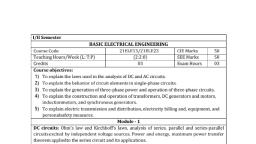
Course, Code, , Course Name, , FEC105, , Basic Electrical, Engineering, , Teaching Scheme, (Contact Hours), Theory, Pract., Tut., 3, , --, , --, , Credits Assigned, Theory, , Tut., , Pract., , Total, , 3, , --, , --, , 3, , Examination Scheme, Theory, Course, Code, , FEC105, , Course Name, , Basic Electrical, Engineering, , Internal Assessment, Test1, , Test 2, , Avg., , 20, , 20, , 20, , End, Exam., Sem. Duration, Exam. (in Hrs), 80, , 3, , Term, Work, , Pract., /oral, , Total, , --, , --, , 100, , Objectives, 1. To provide knowledge on fundamentals of D.C. circuits and single phase and three phase AC, circuits and its applications., 2. To inculcate knowledge on the basic operation and performance of 1-Φ transformer., 3. To provide knowledge on fundamentals of DC and AC machines., Outcomes: Learner will be able to…, 1. Apply various network theorems to determine the circuit response / behavior., 2. Evaluate and analyze 1-Φ circuits., 3. Evaluate and analyze 3-Φ AC circuits., 4. Understand the constructional features and operation of 1-Φ transformer., 5. Illustrate the working principle of 3-Φ machine., 6. Illustrate the working principle of 1-Φ machines., Module, , Prereq, uisite, , 01, , 02, , 03, , Detailed Contents, , Hrs., , Resistance, inductance, capacitance, series and parallel connections of resistance,, concepts of voltage, current, power and energy and its units. Working of wattmeter,, Magnetic circuits, MMF, Magnetic field strength, reluctance, series and parallel, magnetic circuits, BH Curve, Time domain analysis of first order RL and RC, circuits, DC Circuits: (Only independent source) Kirchhoff’s Laws, Ideal and practical, Voltage and current Sources, Source Transformation, Mesh and Nodal Analysis,, Star-Delta / Delta-Star Transformations, Superposition, Thevenin’s Theorem,, Norton’s Theorem and Maximum Power Transfer Theorem., , --, , 12, , AC Circuits :Generation of alternating voltage, basic definitions, average and r.m.s, values, phasor and phase difference, sums on phasors, Single-phase ac series and, parallel circuits consisting of R, L, C, RL, RC, RLC combinations, definitions real, reactive and apparent power, admittance (Y), Series and parallel resonance,, Q factor, , 10, , Generation of Three-Phase Voltages, voltage & current relationships in Star and, Delta Connections, power measurement in three phase balanced circuit(Only two, wattmeter method)., , 04, , University of Mumbai, First Year Engineering, (Common for all Branches of Engineering) REV2019 ‘C’ Scheme, , 24/61
Page 2 :
04, , Transformers: Working principle of single-phase transformer, EMF equation of a, transformer, Transformer losses, Actual (practical) and ideal transformer, Phasor, diagram (considering winding resistance and magnetic leakage), Equivalent circuit,, Open-circuit test (no-load test), short circuit (SC) test, efficiency., , 05, , Electrical Machines (Numerical not expected): Rotating magnetic field produced, by three phase ac, principle of operation of Three-phase induction motor,, constructional details and classification of Induction machines., , 02, , 06, , Principle of operation of Single-Phase induction motors, stepper motor (Single, stack variable reluctance and permanent magnet) (Numerical not expected), , 02, , Selfstudy, Topic, , Principle of operation of DC generators and DC motors, constructional details and, classification of DC machines, e.m.f equation of generator/motor, applications., (Theory question can be asked in University exam, no numericals. The percentage, of marks allotted should be maximum of 10% (max. 08marks)), , --, , 06, , Assessment:, Internal Assessment Test:, Assessment consists of two class tests of 20 marks each. The first class test is to be conducted when, approx. 40% syllabus is completed and second class test when additional 35% syllabus is, completed. Duration of each test shall be one hour., End Semester Theory Examination:, 1. Question paper will comprise of total 06 questions, each carrying 20marks., 2. Total 04 questions need to besolved., 3. Question No: 01 will be compulsory and based on entire syllabus wherein subquestions of 2 to 5 marks will beasked., 4. Remaining questions will be mixed in nature.( e.g. Suppose Q.2 has part (a) from, module3 then part (b) will be from any module other than module 3), 5. In question paper weightage of each module will be proportional to number of, respective lecture hrs as mentioned in thesyllabus., Text Books:, 1. V. N. Mittal and Arvind Mittal “Basic Electrical Engineering” Tata McGraw Hill, (Revised, Edition), 2. Vincent Del Toro “Electrical Engineering Fundamentals”, PHI Second edition, 2011, 3. Edward Hughes “Hughes Electrical and Electronic Technology”, Pearson Education (Tenth, edition), 4. D P Kothari and I J Nagrath “Theory and Problems of Basic Electrical Engineering”, PHI 13th, edition 2011., 5. M. Naidu,S. Kamakshaiah “Introduction to Electrical Engineering” McGraw-Hill Education,, 2004, 6. B.R Patil “Basic Electrical Engineering” Oxford Higher Education, References:, 1. B.L.Theraja “Electrical Engineering “ Vol-I and II., 2. S.N.Singh, “Basic Electrical Engineering” PHI , 2011Book, , University of Mumbai, First Year Engineering, (Common for all Branches of Engineering) REV2019 ‘C’ Scheme, , 25/61