Page 1 :
Chapter, exercises, , A) Taking it together, , }, , — (Assorted Questions of the Chapter for Advanced Level Practice), , 1. The property of surface tension is predominantly, , obtained in A, (a) solids, liquids and gases liquids, (c) gases (d) matter, , 2. The water droplets in free fall are spherical due to, (a) gravity, (c) surface tension, , (b) viscosity, (d) inter-molecular attraction, 8. Due to capillary action, a liquid will rise in a tube, if, the angle of contact is ,, (a) acute (b) obtuse ({c) 90°, 4. A liquid wets a solid completely. The meniscus of, the liquid in a sufficiently long tube is, (a) flat, (c) convex, 5. A glass plate is partly dipped vertically in the, mercury and angle of contact is measured. If the, plate is inclined, then the angle of contact will, , (b) remain unchanged, (d) decrease, , (d) zero, , (b) concave, (d) cylindrical, , (a) increase, (c) increase or decrease, 6. Hair of shaving brush cling together when it is, removed from water due to, (a) force of attraction between hair, (b) surface tension, (c) viscosity of water, (d) characteristic property of hair, 7. Coatings used on raincoat are waterproof because they, (a) increases angle of contact, (b) decreases angle of contact, (c) does not alters angle of contact, (d) forms a smooth surface, 8. Small droplets of liquid are usually more spherical in, shape than larger drops of the same liquid because, (a) force of surface tension is equal and opposite to the, force of gravity, (b) force of surface tension, gravity, , predominates the force of, , (c) force of gravity predominates the force of surface, , tension, (d) force of gravity and force of surface tension act in the, same direction and are equal, , 9. Water does not wet an oily glass because, (a) cohesive force of oil > adhesive force between oil and, glass, (b) cohesive force of oil > cohesive force of water, {c) oil repels water, (d) cohesive force of water > adhesive force between water, and oil molecules, , 10. Which of the fact is not due to surface tension?, (a) Dancing of a camphor piece over the surface of water, (b) Small mercury drop itself becomes spherical, (c) A liquid surface comes at rest after stirring, (d) Mercury does not wet the glass vessel, , 11. On mixing the salt in water, the surface tension of, water will, (a) increase, (©) remain unchanged, , (b) decrease, (d) None of these, , 12. If two identical mercury drops are combined to form, a single drop, then its temperature will, (a) decrease, , : (b) increase, (c) remains the same, , (d) None of these, , A water proofing agent changes the angle of contact, (a) from acute to 90°, , (b) from obtuse to 90°, , (c) from an acute to obtuse value, , (d) from an obtuse to acute value, , 14. Along a streamline., , the velocity of a fluid particle remains constant, , the velocity of all fluid particles crossing a given, position is constant, , (c) the valocity of all fluid particles at a given instant is, constant, , (d) the speed of a fluid particle remains constant, , 13.
Page 2 :
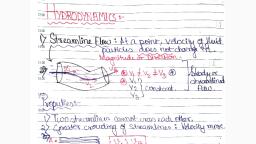
15. Ina streamline flow, , (a) the ‘peed of a particle always remains same, , (b) the velocity of a particle always i, , () the kinetic energies of all parti bdeene, point are the same, , (d) the potential energies of all the, given point are the same, , 16.A viscous fluid is flowing through a cylindrical tube., The velocity distribution of the fluid is best, represented by the diagram, , Particles arriving at a given, , Particles arriving at a, , , , , , , , (a) (b) 3 ————+, (co) (d) None of these, , , , 17, Which of the following diagrams does not represent a, streamline flow?, , () (d), , 18. A body measures 5 N in air and 2N when put in, , water. The buoyant force is, fa) 7N (b) 9N, (J 3N (d) None of these, , The reading of spring balance when a block is, suspended from it in air, is 60 N. This reading is, changed to 40 N when the block is immersed in, water. The specific gravity of the block is, , (a) 3 (b) 2, , (c) 6 (d) 3/2, , 20. A hole is made at the bottom of the tank filled with, water (density = 1000 kgm ~). If the total pressure at, , the bottom of the tank is three atmospheres, (1 atmosphere = 10° Nm~), then the velocity of, , efflux is nearest to, , (a) {400 ms”, , (b) 200 ms!, , () 600 ms” ., (@ 4500 ms, , 19,, , 21. An iron block is o, , 22., , 23., , 24,, , 25., , 26., , 27., , 28., , Chapter 13 : Fluid mechanics (oes, , na boat which floats in a’pond., The block is thrown into the water. The level of, water in the pond will be, , (a) equal to the earlier level, , (b) less than the earlier level, , (c) more than the earlier level ,, , (2) depends on how large the block is, , The correct curve between the height or depression h, , of liquid in a capillary tube and its radius r is, h dy, fa) (b) \, r aan:, h hi, {c) (a), , , , = a, , When two capillary tubes of different diameters are, dipped vertically, the rise of the liquid is, , (a) same in both the tubes, , (b) more in the tube of larger diameter, , (c) less in the tube of smaller diameter, , (d) more in the tube of smaller diameter, , The liquid in the capillary tube will rise if the angle, of contact is, , (a) 120° (b) 90°, , The surface tension of liquid at its boiling point, (a) becomes zero, , (b) becomes infinity, , (c) is equal to the value at room temperature, , (d) is half to the value at the room temperature, , (c) obtuse (d) acute, , When the temperature is increased the angle of, contact of a liquid?, , {a) increases, , (b) decreases, , (c) remains the same, , (d) first increases and then decreases, , , , The surface tension of a soap solution is, , 2x10 Nm“. To blow a bubble of radius 1 cm, the, work done is, (a) 4x 10°], , . (b) Bx 10°], () 1anx 10%}, , () 16xx 10-°J, , A liquid rises in a vertical t Fl i, E ube. The relation, pet ween the weight of the liquid in the tube, surface, sion of the liquid T and radius of the tube ris, , given by, if the angle of contact is zero, , (@) Waar (b) W =2arT, , (c) W=2r?aT @) W=2 aT, 4
Page 3 :
ez) OBJECTIVE PHYSICS Vol. 1, , 29., , 30., , 31., , 32., , 33., , 34., , 35., , 36., , When two soap bubbles of radius r, and rq (ry > 1), , coalesce, the radius of curvature of common surface, is, , (a) 1-5 (b) 2-4, We, (9 @) +4, us a, The excess pressure due to surface tension in a, , spherical liquid drop of radius r is directly, proportional to, , (ar (b) r?, (rt (d) r?, If two soap bubble of different radii are in, , communication with each other, , (a) air flows from larger bubble into the smaller one, , (b) the size of the bubbles remains the same, , (c) air flows from the smaller bubble into the large one and, , the larger bubble grows at the expense of the smaller, one, , (d) None of the above, , Assuming that the atmosphere has the same density, anywhere as at sea level (p = 1.3 kgm™) and g to be, , constant (g = 10 ms~”). What should be the, approximate height of atmosphere?, , (po =1.01« 10° Nm™®), , (a) 6km (b) 8km, , (c) 12 km (d) 18 km, , If the angle of contact is less than 90° the pressure, just inside the surface of a meniscus, , (a) is less than atmospheric pressure, , (b) is greater than atmospheric pressure, , (c) is same as the atmospheric pressure, , (d) None of the above, , The spiders and insects move and run on the surface, , of water without sinking because, , (a) elastic membrane is formed on water due to property of, surface tension, , (b) spiders and insects are lighter, , (c) spiders and insects swim on water, , (d) spiders and insects experience upthrust, , If two glass plates are quite nearer to each other in, , water, then there will be force of, , (a) attraction, , (b) repulsion, , (c) attraction or repulsion, , (d) Neither attraction nor repulsion, , A tall cylinder is filled with viscous oil, A round, , pebble is dropped from the top with zero initial, , velocity. From the plot shown in figure, indicate the, , one that represents the velocity (v) of the pebble as a, , function of time (0)., , 37., , 38., , 39., , 40., , 41., , 42,, , , , , , , , , , @)¥ (b), , =" T, © @|, , TT TT, , A tank if filled with water upto height H. When a, hole is made at a distance h below the level of water., What will be the horizontal range of water jet?, , (a) 2yh(H -h) (b) 4yaH +h), (c) 4fh(4 —h) (d) 2YA(H +h), , A tank is filled to a height H. The range of water, coming out of a hole which is a depth H/4 from the, surface of water level is, 2H BH, V3 2, , The density of ice is x g cm” and that of water is, , y gcm™ when m gram of ice melts, then the change, in volume is, , () H, , (a) (d) pH, 4, , , , (a) m (y= x) (oy) 2—*, m, (oc) my (y - x) pa, x, , Two capillary tubes P and Q are dipped in water., , The height of water level in capillary P is 2/3 to the, height in Q capillary. The ratio of their diameters is, (a) 2:3 (b) 3:2 (c) 3:4 (d) 4:3, , In a surface tension experiment with capillary tube, water rises upto 0.1 m. If the same experiment is, repeated on an artificial satellite, while is revolving, around the earth, water will rise in the capillary tube, upto a height of, , (a) 0.1 m, , (b) 0.2 m, , (c) 0.98 m, , (d) full length of the capillary tube, , Two parallel glass plates are dipped partly in the, liquid of density d keeping them vertical. If the, distance between the plates is x surface tension for, the liquid is T and angle of contact @, then rise of, liquid between the plates due to capillary will be, , (a) Ps0s® (py 27 £088 aT T cos®, xdg xdg cos ® xdg, , a ied, , eee., , =, , ESS
Page 4 :
4g. A balloon has volume of 2000 m°. It is filled with, hydrogen (P = 0.009 gL!) If the density of air is, 129 gL, it can lift a total Weight of, 1 @600kKg —(b) 2400 kg (c) 300kg (a) 1800 kg, 44. A raft of mass M = 600 kg floats in calm water with, 7cmsubmerged. When a man stands on the raft,, 8.4 cmare submerged, the man's mass is, @ 30kg —) 6Okg—() Dkg a) 120g, 43. A cylinder of mass M and density d, hanging from a, | string, is lowered into a vessel of cross-sectional area, A containing a liquid of density d, (4, < d,) until it, is fully immersed. The increase in pressure at the, bottom of the vessel is, Mdg yy M9 4g ae, , dA A (d) zero, , (a), | 46. Which of the following statements are true in case, | when two water drops coalesce and make a bigger, ' drop?, | la) energy is released, (b) energy is absorbed, \c) the surface area of the bigger drop is greater than the, j sum of the surface areas of both the drops, (d) the surface area of the bigger drop is same that of the, sum of the surface areas of both the drops, 47. A piston of cross-sectional area 100 cm? is used in a, , hydraulic pressure to exert a force of 10" dyne on, the water. The cross-sectional area of the other, piston which support a truck of mass 2000 kg is, (a) 9.8% 10? cm? (b) 9.8x 10° em?, , (c) 1.96% 10° cm? (d) 1.96 10° cm?, , 48. An ideal fluid flows through two pipes of circular, cross-section with diameters 2.5 cm and 3.75 cm, connected one after another. The ratio of the, velocities in the two pipes is, a) 9:4 (b) 3:2, (V3 : V2 (d) V2: V3, , 49. The angle of contact at the interface of water-glass is, , | 0°, ethyl alchol-glass is 0°, mercury-glass is 140° and, , ! methyliodide-glass is 30°. A glass capillary is putin a, , | trough containing one of these four liquids. It is, , observed that the meniscus is convex. The liquid in, , | the trough is, , | &) water, , | _ (mercury a, , | 50. A uniformly tapering vessel is filled with a liquid of, density 900 kgm™*. The force that acts on the base of, the vessel due to the liquid (excluding atmospheric, force) is (g = 10 ms), , , , (b) ethylalcohol, (d) methyliodide, , Chapter 13: Fluid mechanics (625, , Area = 10°? m?, , , , 0.4, 210-3 m?, ‘ 7.2N, (a) 3.6N (b), 90N (d) 12.6 N, , 51, For the arrangement shown in the figure, the force at, the bottom of the vessel is, , Py = 10 kgm, , , , , , 100 cm?, , {a) 200 N (b) 100. N (c) 20N (d) 2N, , 52. An object of uniform density is allowed to float in, water kept in a beaker. The object has triangular, cross-section as shown in the figure. If the water, pressure measured at the three points A, Band C, below the object are p,, Pg and p respectively., Then, , , , , , , , , , , , , , A B Cc, (a) Pa> Ps > Po (b) py > Pe < Pe, ©) Pa = Pa = Pc (@) pa=Pp <P, , 53. Which graph represents the variation of surface, tension with temperature over small temperature, ranges for water?, , ST st, , a) (b), , Temp 2 Temp, , sr, , ‘Temp ‘eg
Page 5 :
628), , 54., , 55., , 56., , 57., , 58., , 59., , 60,, , 61., , , , OBJECTIVE PHYSICS Vol. 1, , A cylindrical vessel of 100. em height is kept filled, upto the brim. It has four holes 1, 2, 3, 4 which are, respectively at heights of 27 cm, 30 em, 50 cm and, 80 cm from the horizontal floor. The water falling at, the maximum horizontal distance from the vessel, comes from, , (a) hole number 4, (c) hole number 2, , {b) hole number 3, (d) hole number 1, , A solid shell loses half, its weight in water. Relative, density of shell is 0.5 what fraction of its volume is, hollow?, , 3, , fa) = (b), 5, , talns, , i+ w4, , 5 5, A tank full of water has a small hole at its bottom., Let t, be the time taken to empty the first half of the, tank and 7, be the time needed to empty the rest half, of the tank, then, @4=t, (co) 4 <ty, , {b) 4 > ty, , (d) 5 =0.528¢,, , An open U-tube contains mercury. When 11.2 cm of, water is poured into one of the arms of the tube, how, high does the mercury rise in the other arm from its, initial level?, , (a) 0.82cm (b) 1.35em = (c) O41 em (d) 2.32 cm, , A small ball (mass m) falling under gravity ina, viscous medium experiences a drag force, proportional to the instantancous speed u such that, , , , Fy... = ku. Then the terminal speed of ball within, viscous medium is, i (b) ™, , , , [mg, ( ,{™@, Ve, If a capillary tube of radius r is immerse in water,, the mass of water risen in capillary is M. If the, radius of capillary be doubles, the mass of water, risen in the capillary will be, (a) M/2 (h) M, (c) 2M (d) 4M., The pressure of water in a pipe when tap is closed is, 5.5 10° Nm ~. When tap gets open, pressure, , (d) None of these, , , , reduces to 5x10° Nm *. The velocity with which, , water comes out on opening the tap is, \, , (a) 10 ms! (b) 5 ms, (c) 20 ms" (d) 15 ms |, The level of water in a tank is 5m high. A hole of, , area] cm* is made at the bottom of the tank. The rate, of leakage of water from the hole is (g = 10 ms *y, , (a) 10 m?s™ (b) 10" 1, , () 10 m’s ! (10°, , ‘—, m's, , m's!, , 62, Water is flowing through two horizontal pipes of, , 63., , 64., , 65,, , 66., , 67., , 68., , 69,, , different diameters which are connected together,, The diameters of the two pipes are 3 cm and 6 cm, respectively. If the speed of water in the narrower, tube is 4 ms~!. Then the speed of water in the wider, , tube is a, (a) 16ms7 (b) lms, (©) 4ms" (a) 2ms*, , ‘A block of wood floats in water with (4/5) th of its, volume submerged. If the same block just floats in a, , liquid, the density of the liquid is (in kgm™), , (a) 1250 (b) 600, (c) 400 (d) 800, Water flows along a horizontal pipe of non-uniform, , cross-section. The pressure is 1 cm of Hg where the, velocity is 35 cms”'. Ata point where the velocity is, 65 cms~!, the pressure will be, , (a) 0.89 cm of Hg (b) 0.62 cm of Hg, , (c) 0.5 cm of Hg (d) 1 cm of Hg, , For a body immersed in a liquid, when the weight of, the body is less than the upthrust then the body will, (a) float partially immersed (b) sink, , (c] float full immersed (d) both (a) and (c), , Three liquids of equal masses are taken in three, identical cubical vessels A, B and C. Their densities, are P 4, Pz and P¢ respectively but p , < Pg < PcThe force exerted by the liquid on the base of the, cubical vessel is, , (a) maximum in vessel C (b) minimum in vessel C, , (c) the same in all the vessels (d) maximum in vessel A, , A solid of density D is floating in a liquid of density, d.If v is the volume of solid submerged in the liquid, , and V is the total volume of the solid, then v/V equal, to, , , , , , d D, fa) 2, aD w=, —_P D+d, (, "Bea @, , An object weights m, in a liquid of density d, and, , that in liquid of density d, is m,. The density of the, object is . , (a) Mat = md,, my =m,, , () Madame,, , , , m,—m, , m, —m,, , An ice-cube of density 900 kgm”? is floating in, water of density 1000 kgm”. The percentage of, volume of ice-cube outside the water is, , (a) 20% (b) 80% (c) 10% (d) 90%, , qon, , ye, , , , , , 4




 Learn better on this topic