Page 1 :
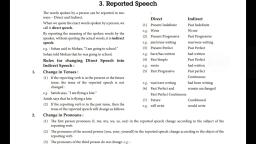
Rule 3:, i) lf the reporting verb is in Past tense, the Past Simple tense of the Direct Speech is changed into Past Perfect Tense, , Eg:, Direct: He said, "The man died in the last night"., Indirect: He said that the man had died in the last night., , li) If the reporting verb is in the Past tense, the Past Continuous Tense of the Direct Speech is changed into Past Perfect, Continuous Tense. ~, , , , , , , , , , Eg:, Direct: Jaki said, "He was playing football". 4, Indirect: Jaki said that he had been playing football. Sf, , Note: The past continuous tense of the direct speech can remain same in the indirect speech. —<.

Page 2 :
Rule 4: The shall of the Future Tense is changed into should and the will is changed into would., , eee —————_—, , Eg: ST, , Direct: Muskan said, "I shall go to Delhi the next day"., Indirect: Muskan said that she should go to Delhi the next day., , , , Direct -> Indirect, , ED, , , , Eg: now -> then, , Direct: Rahul said, "I will work hard". here -> there, , Indirect: Rahul said that he would work hard. ago -> before, thus -> so, this -> that, , today -> that day, , tomorrow -> the next day, yesterday -> the day before, last night -> the night before, these -> those
Page 3 :
Rule 5:, The tenses may or may not change if the statement is the universal truth., , , , Which always remain same, , Eg:, Direct: The teacher said, "The earth moves around the sun"., Indirect: The teacher said that the earth moves around the sun.
Page 4 :
Rule 6:, The modal auxiliaries(will, shall, can, may) of the Direct speech are changed into (would, should, could, might) in the, indirect speech. a, , —_—__, , Eg:, Direct: Raghav said, "| may stay here tonight"., Indirect: Raghav said that he might stay there that night.
Page 5 :
Rule 7:, could, might, should, ought to, would, used to etc.. remains unchanged in indirect speech, , Eg:, Direct: The teacher said to the student, "You might go now"., Indirect: The teacher told the student that he might go then.