Page 1 :
Long Walk to Freedom, Oral Comprehension Check, Page 18,19, Question 1., Where did the ceremonies take place ? Can you name any, public buildings in India that are made of sandstones?, Answer:, The ceremonies took place in the campus of the Union Building, of Pretoria, which were attended by dignitaries and leaders of, many nations. In India; Rashtrapati Bhavan and Red Fort are, buildings made of red sandstone., Question 2., Can you say how 10th May is an ‘autumn day’ in South Africa?, Answer:, As South Africa is in the Southern Hemisphere, may falls in the, autumn season. Thus 10th May is an ‘autumn day’., , Question 3., At the beginning of his speech, Mandela mentions “an, extraordinary human disaster”. What does he mean by, this? What is the “glorious human achievement” he, speaks of at the end?, Answer:, By ‘an extraordinary human disaster’ Mandela means to, state the practice of apartheid in South Africa. During, this there was a racial segregation based on colour and, the blacks suffered a lot. They were not allowed to, demand freedom or any right. Mandela himself did, spend many years on infamous ‘Robben Island’ as a
Page 2 :
prisoner where he was beaten mercilessly. He, considered it as great glorious human achievement that, a black person became the President of a country where, the blacks were not even considered human beings and, were treated badly., , Question 4., What does Mandela thank the international leaders for ?, Answer:, Mandela felt very privileged to welcome the international, leaders at the swearing – in ceremony because not too long, ago, the South Africans were considered outlaws. He thus, thanks all of them for having come to witness the historical, ceremony. This was a gesture of international recognition to a, newly born free democratic nation and it could be considered, as a common victory for justice, peace and human dignity., , Question 5., What ideals does Nelson Mandela set for the future of South, Africa?, Answer:, Nelson Mandela set the ideals of liberating people from, bondage of poverty, deprivation and suffering. He also set the, ideal for a society where there would be no discrimination, based on gender or racial origins.
Page 3 :
Page 21, Question 1., What did the military generals do ? How did their attitude, change and why?, Answer:, The highest military generals of South African defence force, saluted Mandela and pledged their loyalty which was of great, significance as during apartheid era they would have arrested, him. The change in their attitude was because of struggle and, sacrifices put in by many heroes of South Africa. This struggle, not only ensured the freedom of a nation struggling with, apartheid, bur brought a change in mindsets of many. He, believed that love can also be taught and human being is, naturally inclined towards love rather than hate., Question 2., Why were two national anthems sung?, Answer:, One the auspicious occasion of the inauguration two national, anthems: one by the Whites and the other by the Blacks, symbolising the equality of the Blacks and the Whites were, sung., Question 3., How does Mandela describe the systems of government in his, country, (i) in the first decade, and, (ii) in the final decade, of the twentieth century?, Answer:, (i) In the first decade of the century, the whites erected a, system of racial domination against the blacks, thus creating, the basis of one of the harshest and most inhumane societies, the world had ever known., (ii) In the final decade of the 20th century, the . previous system
Page 4 :
had been overturned and replaced by one which recognised, rights and freedom of all people regardless of color of their skin., Question 4., What does courage mean to Mandela?, Answer:, For Mandela courage does not mean the absence of fear but a, victory over fear. According to him brave men need not be, fearless but should be able to conquer fear., Question 5., Which does Mandela think is natural, to love or to hate?, Answer:, For Mandela, love comes more naturally to the human heart, than hate., Page 4, Question 1., What “twin obligations” does Mandela mention?, Answer:, Mandela mentions that every man has twin obligations. The, first is to his family, parents, wife and children; the second, obligation is to his people, his community and his country., Question 2., What did being free mean to Mandela as a boy, and as a, student ? How does he contrast these “transitory freedoms”, with “the basic and honourable freedoms”?, Answer:, Like any other kid, for Mandela freedom meant to make merry, and enjoy the blissful life. Once one becomes an adult, antics, of childhood looks like transitory because most of the childish, activities are wasteful from an adult’s perspective. Once you, are adult, you have to earn a livelihood to bring the bacon
Page 5 :
home. Its only then when you get an honourable existence in, the family and in the society., Question 3., Does Mandela think the oppressor is free? Why/why not?, Answer:, Mandela does not think that the oppressor is free because, according to him an oppressor is a victim of hatred who is, behind the bars of prejudice and narrow-mindedness. He, realises that both the oppressor and the oppressed are robbed, of their humanity and peace., Thinking about the Text, (Page 24), Question 1., Why did such a large number of international leaders attend the, inauguration ? What did it signify the triumph of?, Answer:, To be the part of the inauguration, international leaders showed, a gesture of solidarity from international community to the idea, of end of apartheid. It was the significance of the victory of, good over evil and triumph of a tolerant society without any, discrimination., Question 2., What does Mandela mean when he says he is “simply the sum, of all those African patriots”, who had gone before him ?, Answer:, By saying that he is simply the sum of all those African patriots,, Mandela wants to pay his tribute to all the people who have, sacrificed their lives for the sake of freedom. He says that he is, grateful to those who had gone before him because those, heroes of past had paved the path of co-operation and unity for
Page 6 :
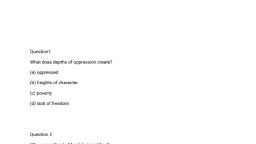
him. Therefore, he could try to come to power to bring equality, for his people with their support., Question 3., Would you agree that the “depths of oppression” create, “heights of character”? How does Mandela illustrate this? Can, you add your own examples to this argument ?, Answer:, I agree with the statement that depths of oppression create, heights of character. Nelson Mandela illustrates this by giving, examples of great heroes of South Africa like Oliver Tambo,, Walter Sisulu and others who were inspired to sacrifice their, lives in the long freedom struggle., India is full of such examples, during our freedom struggle there, was a galaxy of leaders of great characters and the oppression, of British rule created and encouraged people of noble, characters like Mahatma Gandhi, Lala Lajpat Rai, JL Nehru,, Chandra Shekhar Ajad, Sardar Bhagat Singh and many more., If we compare them with the quality of political leaders India is, having today, then Nelson Mandela seems to be absolutely, right;, Question 4., How did Mandela’s understanding of freedom change with age, and experience?, Answer:, With age and experience, Mandela understood the real, meaning of freedom. As a young boy, he thought that he was, born free and believed that as long as he obeyed his father and, abided by the customs of his tribe, he was free in every, possible manner. As he grew older, freedom to raise a family, and freedom to earn livelihood started dominating his thoughts., Gradually he realised that he was selfish during his boyhood., He slowly understood that it was not just his freedom that was, being curtailed, but the freedom of all blacks. It was the, freedom from fear and prejudice. Age and experience widened, his perspective of freedom.
Page 7 :
Question 5., How did Mandela’s ‘hunger for freedom’ change his life?, Answer:, Mandela realised in his youth that it was not just his freedom, that was being curtailed, but the freedom of all blacks. This, changed the fearfulman to a fearless rebel., He sacrificed the comforts of a settled family life to fight for a, greater cause. He joined the African National Congress and, this changed him from a frightened young man into a bold one, who fought against racial prejudice., Thinking about Language, (Page 24,25,26), Questions, 1. There are nouns in the text (formation, government) which, are formed from the corresponding verbs (form, govern) by, suffixing – (at)ion or ment. There may be change in the spelling, of some verb – noun pairs ; such as rebel, rebellion; constitute,, constitution., Make a list of such pairs of nouns and verbs in the text, Noun, , Verb, , Rebellion, , Rebel, , Constitution, , Constitute
Page 8 :
2. Here are some more examples of ‘the’ used with proper, names. Try to say what these sentences mean. (You may, consult a dictionary if you wish. Look at the entry for ‘the’), (i) Mr Singh regularly invites the Amitabh Bachchans and the, Shah Rukh Khans to his parties., (ii) Many people think that Madhuri Dixit is the Madhubala of, our times., (in) History is not only the story of the Alexanders, the, Napoleons and the Hitlers, but of ordinary people as well., 3. Match, the italicised phrases in Column A with the phrase, nearest meaning in Column B., (Hint: First look for the sentence in the text which the phrase in, column A occurs.), A, , B, , had not forgotten : was aware of the, 1. I was not unmindful of the fact., , (i), fact, , (ii), , was not careful about the fact, , (iii), , forgot or was not aware of the fact
Page 9 :
2. When my comrades and I were, (i), , pushed by the guards to the wall, , (ii), , took more than our share of beatings, , pushed to our limits, , felt that we could not endure the, (iii), suffering any longer, , 3. To reassure me and keep me going, , (i), , make me go on walking, , help me continue to live in hope in thi, (ii), very difficult situation, , (iii), , make me remain without complaining, , (i), , earning enough money to live on, , 4. The basic and honourable freedoms, of… earning my keep…
Page 10 :
(ii), , keeping what I earned, , (iii), , getting a good salary, , Answers:, 1. Ans:, Noun, , Verb, , Rebellion, , Rebel, , Constitution, , Constitute, , Formation, , Form, , Government, , Govern, , Obligation, , Oblige
Page 11 :
Transformation, , Transform, , Discrimination, , Discriminate, , Deprivation, , Deprive, , Demonstration, , Demonstrate, , Oppression, , Oppress, , Imagination, , Imagine, , 2. Ans:, (i) : This means that Mr Singh regularly invites famous, personalities as of the calibre of Amitabh Bachchan and Shah, Rukh Khan to his parties., (ii) This means that Madhuri Dixit is compared to a landmark in, acting in the form of legendary actress Madhubala., (iii) This means that history is not only the story of the great, fighters and leaders such as Alexander, Napoleon and Hitler,, but also of ordinary people., 3. Ans:
Page 12 :
A, , B, , had not forgotten;was aware of th, 1., , I was not unmindful of the fact, , (i), fact not endure the, , When my comrades and I were, 2., , felt that we could not endure, (iii), , pushed to our limits, , the suffering any longer, , help me continue to live in hope i, 3., , To reassure me and keep me going, , (ii), , this live in hope in this very difficu, situation, , The basic and honourable freedoms, 4., , (i), of… earning my keep…, , earning enough money to live on