Page 1 :
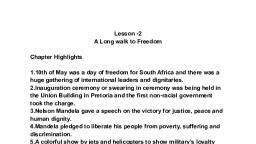
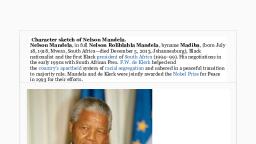
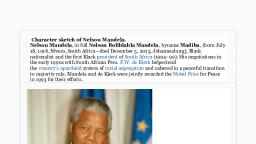
Long Walk To Freedom, Summary, This wonderful chapter titled “Long Walk to Freedom” is an, extract taken from “Long Walk to Freedom” which is the, famous autobiography of Nelson Mandela; one of the, leading figures of the world. In the autobiography, Nelson, Mandela provides thought-provoking insight into political, and social emancipation. He extensively talks about the, system of government, the strength of courage, the power, of love and the shallowness of hatred. He also says that, freedom is essential for human dignity and oppression is a, tormentor that decimates the dignity and identity of races., He believes that oppressors too must be liberated from the, chains of hatred. He explains that the oppressor like the, oppressed is not free because he too is ensnared in the bars, of hatred., Nelson Mandela was an anti-apartheid activist who later, became the president of South Africa. Apartheid is the, system in the people are separated and discriminated on, the basis of race, colour, and caste. Apartheid was legalised, by the white people who used it as a tool of colonial, imperialism., Now, let us see the main highlights and attractions of the, lesson “Long Walk to Freedom”: In the first paragraph of the, lesson, Nelson Mandela says that it was 10th May. The sun
Page 2 :
was bright and clear. It was a great occasion because the, world leaders and famous dignitaries from all over the, world were assembling for the inauguration of South, Africa’s first democratic none-racial government on the soil, of South Africa., The auspicious ceremonies took place in the lovely, sandstone amphitheatre. The amphitheatre was formed by, Union Buildings in Pretoria. Earlier, it was the site where the, white people dominated for a long time. Now the people, from all the races, colours and sorts were gathering to, launch South Africa’s democratic government., In the next paragraph of Long Walk to Freedom, Nelson, Mandela says that it was a lovely autumn day. By autumn, day, perhaps he means to say that like in autumn the trees, shed all their previous leaves and pave the way for new, leaves. Similarly in South Africa, all the previous long-lasted, discrimination and oppression, that was there existing on, the basis of race and colour, was over and a new, government was formed which was free from all, discrimination and deprivation., Mandela also mentions that he was accompanied by his, daughter Zenani. On the podium, firstly, Mr de Klerk took, oath as the second deputy then Thabo Mbeki was sworn in, as the first deputy president. Finally, it was the turn of, Nelson Mandela to be sworn as the first President of South, Africa. On the stage, Nelson Mandela pledged to obey and
Page 3 :
uphold the constitution and work with dedication for the, betterment of the Republic and its people., The main points he said to the outstanding guests who had, gathered there and the world are given as follows:, That all the people by their presence bestow glory and, hope to the newborn democracy. He further said that out of, an extraordinary human disaster should be born an ideal, society of which all mankind would be proud of. By ” an, extraordinary human disaster” he means the oppressed, society in which one race( the Blacks) was discriminated and, tortured by other race( the Whites)., ➡ Mandela added that they were considered as outlaws not, too much time before but now they were given rare, privilege to be host to all the nations of the world on their, beautiful earth. He thanked all the galaxy of international, guests for joining with the people of South Africa. He told, them that it was a common victory for justice, for peace and, for human dignity., Mandela proceeded that they have achieved political, freedom. Now it was the time to pledge themselves to free, people from the existing bondage of poverty, suffering,, deprivation, gender and other discrimination. Moreover,, they must never make it happen that the wonderful land of, South Africa would experience the oppression of one race, by the other. The sun should never set on the glorious a, human achievement. A glorious human achievement means, the emancipation that they achieved after a long lasted
Page 4 :
struggle and sacrifice. Let South Africa to be ruled by, freedom., In the next paragraph, Mandel writes that after a few, moments of his speech, there was the roar of South African, jets, helicopters and troop carriers which flew over the, Union Buildings in the perfect arrangement. On seeing the, spectacular view all the people that were present on the, occasion lifted their eyes in great respect., In the next few, Mandela writes that the wonderful view was, the demonstration of the military’s loyalty to the newborn, democracy and to the newly and freely elected government., He also writes that he was mindful of the fact that the same, highest generals of defence and police who now saluted, him and promised their loyalty to him not so much time, before unlike the occasion arrested him. Finally, the two, national anthems were respectfully played both of the, vision of Whites singing and blacks singing., In the next paragraph, Mandela writes that on the, auspicious day of the inauguration, he was surprised with a, sense of history. He writes that at the beginning of the, twentieth century when he was not born, the white-skinned, people of South Africa had erected a system of racial, superiority against the dark-skinned people of their own, nation. This was the most inhumane and the harshest, system the world has ever seen. Now in the ending decade, of the twentieth century and when he was living in the, eighties that very system was overturned and it was, replaced by the system which recognised the freedom of all, the people without any discrimination.
Page 5 :
Nelson Mandela proceeds that the day that he waited for a, long time had finally come. However, it was possible only, because of the unimaginable sacrifices of the thousands of, his people. Mandela writes that he is the product of the, people who gave their precious lives for the freedom of the, country. That means he could have not been what he, became if the large mass of South African patriots had not, sacrificed their lives. Mandela also mentions that he was, pained because he could not thank them and that they, could not see the fruits of their sacrifice., In the next paragraph, Mandela becomes more, philosophical. He says that the policy of apartheid created a, profound wound in his nation and his people. The wound is, too deep to be recovered instantly. However, the longlasted deep oppression and cruelty also resulted in what, produced the great freedom fighters of South Africa. These, include the people like the Oliver Tambos, the Walter Sisulu,, the Chief Luthuli, the Yousuf Dads, the Bram Fishers and the, Robert Sobukwes of the time. All these people were the, men of extraordinary courage, wisdom and generosity. The, people like them could never be known again perhaps, because it needs such long-lasted profound oppression that, moulds the people to achieve such heights of character., Mandela adds that his country is rich in the minerals and, gems but knows that South African people are its greatest, wealth., , In another paragraph of Long Walk to Freedom Mandela, continues his praise to the freedom fighters. He says that it
Page 6 :
is because of these extraordinary men that he learned the, real meaning of courage. He says that he had seen the men, and women put their lives in danger for a cause. He saw the, people who stood against the attacks and torture without, breaking showing unbelievable strength and resilience. He, further says that he learned that the courage was not the, absence of fear but to dominate over it. The man is not, daring and courageous if he does not fear but if he, conquers that fear., Mandela in another paragraph writes that no one is born in, this world to hate another person on the basis of race, colour or religion. But to hate others is learned in the same, way as one learns to love others. He explains that when he, was in captivation he always saw a ray of humanity in one of, the guards which affirmed his hope and keep him going., In the next paragraph, Mandela says that every man has two, main obligations in life. One is towards his family, parents,, wife and children and another obligation is to his nation,, people and community. In a peaceful society, everyone is, able to fulfil both of these obligations. But in South Africa, a, man who wanted to fulfil these obligations was separated, from his family and home and was forced to live his in, isolation and darkness. He too was deprived of fulfilling his, obligation towards his parents, wife, children and other, beloved ones., In the next paragraph of Long Walk to Freedom, Nelson, Mandela says that he was not struggling for freedom from, his childhood. At that stage, he thought that he was free as, he could wander in the fields, swim in the streams, roam
Page 7 :
around the village and roast maize etc. Till the time he, obeyed his parents and accorded to the customs of his tribe, he was not troubled by anyone. But as soon as he grew he, realized that his boyhood freedom was a false idea. He, discovered that his freedom had already been snatched, from him. At first, when his mind was nascent he wanted, freedom only for himself. That was transitory freedom. But, as he grew young in Johannesburg he longed for the, honourable freedom of living a dignified life not only for, himself but for all his people., Nelson Mandela continues that it was this desire for, freedom that animated his life. He was transformed from a, frightened young man into a bold one, from a law-abiding, person to a criminal, from a family- loving husband to a, homeless man and from a life-loving man to an ascetic, monk. He could not enjoy the poor and limited freedom, that he was allowed when he realised that his people were, not free. Freedom cannot be divided. If anyone person is, chained it means all the people are chained., In the final paragraph, Nelson Mandela says that oppressor, like the oppressed must be liberated. If a man snatches the, freedom of another man, he is a prisoner of hatred. He is, chained in the bars of ignorance and prejudice. You are not, free in the real sense if you snatch the freedom of someone, else in the same way as you are not free when someone, snatches your freedom. Thus, both the oppressors and the, oppressed must be liberated.
Page 8 :
Question: Why is May 10 autumn day in South Africa?, Ans., Ans. The months of March, April and May comprise the, autumn season in the Southern, Hemisphere while In the northern hemisphere. these, months are the time of spring., In profound meaning, autumn is the season when the, farmers reap the fruit of their hard work. Similarly, after a, long and tiring struggle for three hundred years, the African, people were ultimately free from slavery and brutality. The, Africans were given the rights and standards which they, were worthy of. That is why 10 May is an ‘autumn day’ in, South Africa., OR, May 10 is called an autumn day in South Africa probably, because of the reasons as given below:, 1. Autumn symbolises the season of harvesting. In autumn,, we obtain the fruits of long lasted toil. In South Africa, the, people had to struggle for a long time and now it was time, to get the fruits of the same., 2. In autumn, the trees shed their previous leaves and start, preparing for the new ones. Similarly, in South Africa, all the, previous discrimination was over and there was the birth of, a new democratic government on the day.
Page 9 :
Question: At the beginning of his speech, Mandela, mentions ‘ an extraordinary human disaster’.What does, he mean by this? What is the ‘glorious human, achievement’ he speaks of at the end?, Ans. By an extraordinary human disaster, Mandela means, the longtime oppression that South African people faced by, the white rule. They were victims of racial discrimination., Now they achieved freedom after sacrificing their lives. This, has been called a glorious human achievement because it, ensures peace and tranquillity, and equality of all people., OR, Ans. Nelson Mandela has rightly termed the atrocities and, brutalities on African Blacks by African Whites as ‘an, extraordinary human disaster’. Undoubtedly it is a disaster, to discriminate humans on the basis of the colour and skin., So, it is certainly narrow mindedness to give priority to the, white race over the Blacks., According to Nelson Mandela, ‘the glorious human, achievement’ is the respect, regard and freedom of the, citizens of the country. He thinks that liberation from the, oppression, abolishing of apartheid and building a free, South Africa where everyone is respected and everyone has, his own identity is the glorious achievement.
Page 10 :
Question: What ideas does Mandela set out for the, future of South Africa?, Ans. Mandela sets the following ideas for the future of, South Africa:, 1. There will be the end of the continuing bondage of, poverty, deprivation, suffering and any other discrimination, 2. The land will never again experience the oppression of, one by another., 3. Freedom will never be blown out further., OR, Ans. Mandela set standards for the future of South Africa, and they were: End of poverty, deprivation, removal of, sufferings of people. He also dreamt of a society where, there would be no discrimination based on gender or racial, origins., Question: Why did such a large number of international, leaders attend the inauguration? What did it signify the, triumph of?, Ans. A large number of international leaders attended the, inauguration because after all, it was a common victory for, all. It was a victory for justice, peace and human dignity. It, signifies the triumph of humanity over oppression and of, love over hatred. It recognizes the dignity of all the people, without any distinction of colour, race or religion etc., OR
Page 11 :
Ans. The inaugural function of democratic South Africa was, attended by a large number of International leaders and, delegates in order to pay their tribute to the newly born, democracy. They were rejoiced by the success of South, African Blacks over the Whites after a long struggle., It signified the triumph of courage, boldness, valour,, determination and patriotism over narrow mindedness and, discrimination., , Question: What does Mandela mean when he says she is, ‘simply the sum of all those African patriots’ who had, gone before him?, Ans. Mandella is deeply concerned about the people who, sacrificed their lives during the apartheid movement. He, could never have been what he has become on the day. He, becomes the first black president of South Africa only, because of the people who sacrificed their lives during the, struggle. Besides he is pained that they could not see the, fruits of their courage and suffering. That is why he calls, himself simply the sum of all those African people who had, gone before him., OR, Ans. Nelson Mandela with full confidence believes that the, newly born freedom is the precious gift bestowed to his, countrymen by the patriots who have sacrificed
Page 12 :
themselves for this cause. He feels that the zest and passion, of all those patriots have been aggregated in him and have, inspired him to work enthusiastically for the development of, his country., The brave and bold patriots of the freedom struggle had, gone before him and his becoming the first black President, of South Africa could never have been possible without, their sacrifice., Question: Would you agree that the depths of, oppression create heights of character? How does, Mandela illustrate this?, Ans. It is perfectly right that the depths of oppression create, heights of character because it is the test of fire which, makes fine steel. The deeper the oppression the higher, the character. During the apartheid struggle, the people had, to face oppression and brutality for a long time. This, produced many great men like Oliver Tambo, Walter Sisulu,, Chief Luthuli, Bram Fischer and the other people like them., like them. They showed extraordinary courage, wisdom and, generosity. Such kind of great men hardly come out from a, peaceful society. Mandela is not an exception in the above, case. He also came out as a rare gem in the struggle as he, stood up fast to the brutalities and oppression at the hands, of the whites., OR, Ans. Yes, we agree with the given statement. Nelson, Mandela also agrees with it that the decease of brutality
Page 13 :
and oppression has unintentionally created African patriots, with unimaginable heights of character. The continuous, atrocities and cruelties committed on The Blacks have, evoked their conscience and have motivated them to stand, against the oppression. This gives rise to the valiant, personalities who are extremely determined and tolerant to, withstand any brutality. Mandela illustrates this by giving, examples of the great South African heroes who have, sacrificed their lives in overthrowing the racial, discrimination and freeing their citizens and country., Question: What twin obligation does Mandela mention?, Ans. According to Mandela, every man has twin obligations, as mentioned here:, 1. The obligation towards his family, his parents, his wife, and his children., 2. The obligation towards his people, his community and his, country. In free and human society, one is able to fulfil both, these obligations according to his abilities while as in, oppressed society, it is impossible for a man to fulfil any, one of the obligations., OR, Ans. According to Mandela, every human being has two, obligations to fulfil. one is at the personal level towards his, family and the other is towards his nation, his society and, his people. A person should fulfil both the obligations with, loyalty.
Page 14 :
Question: How did Mandela’s understanding of freedom, change with age and experience?, Ans. Mandell’s concept of freedom changes with age and, experience. As a child, freedom meant to him to run in the, fields, to swim in clear streams and to roast mealies. As a, student, he thought the freedom to read what he pleased,, to stay out at night and to go where he wanted. As a young, man, his concept of freedom got matured. He now meant, freedom as living a dignified life and longed it for all., OR, Ane. During young age freedom for Mandela meant, freedom on a personal level. As a child, freedom meant to, Mandela the freedom to run un the fields. As a student, It, meant the freedom to read what he pleased and go where, he pleased. As a young man, it meant the freedom to, develop one’s potential and live a lawful life. But then he, realised that all these were transitory freedoms. Now, freedom meant to him the freedom of everyone who, looked like him., Question: How did Mandela’s hunger for the freedom to, change his life?, Ans. When Mandela realized the fact that his freedom and, the freedom of his people was curtailed, his hunger for it, changed the course of his life. He was transformed from a, frightened young man into a brave one, from a law-abiding, attorney to a criminal, from a family loving husband into a
Page 15 :
homeless person and from a life-loving man to live the life, like a monk., OR, Ans. Mandela could feel that he along with his countrymen, was in the traps of slavery of the whites. This started, increasing his hunger for freedom. In this passion, he, changed from a scared fellow or from a law-abiding, attorney to a bold rebel or criminal in the eyes of law. From, a home-sick person, he transformed into a homeless, smuggler and was forced to live the life of a monk.
Page 16 :
Extra Questions, Q. What does Mandela mean by twilight existence?, Answer. He said that in South Africa, a man who attempted, to fulfill his obligation towards his country was forced to, spend his life in prison away from his family. It was then that, his life was refereed to be of twilight existence where he, would not even know whether it was day or night. It was a, life in isolation and secrecy., Q. Who led the first non racial government in South, Africa?
Page 17 :
Answer. Nelson Mandela was the first non-White head of, state in South African history, as well as the first to take, office following the dismantling of the apartheid system, and the introduction of full, multiracial democracy. Mandela, was also the oldest head of state in South Africa’s history,, taking office at the age of seventy-five., , Q. Why has the international leaders gathered in South, Africa?, Answer. International leaders gathered on the South African, soils to support the citizens in their victory for justice,, human dignity and peace. Mandela embodied ardent hopes, for the promising future of South Africa., Q. What twin obligations is the author talking about, what does he feel of them?, Answer: The author, Mandela, says that in his life a person, has twin obligations. One is for his children, his parents and, his family, and the other is for his culture, his people and his, country. Depending on his inclination and capabilities, one, always wants to fulfil these obligations.
Page 18 :
WORD BANK OF LONG WALK TO, FREEDOM, Dawned…….. Began or started, Pleasantly…….. Cheerfully, happily, Seminal………..Very important for the development, Besieged by….. Surrounded by, Inauguration …..An official opening of an organization, Emancipation… Freedom from all chains, Discrimination… Difference, separation, Pinpoint……… Exactly the right position, Precision…….. Accuracy, Overwhelmed….. crushed, submerged, Inhumane…… Cruel, brutal, Comrade……. A person from one’s own political party, Extinguished……Put out, Ripped.……..Cut, Illusion…….A false idea, Transitory….. Temporary, Yearned……….Longed, craved, Prejudice…….Bias, Robbed of……. Plundered, took away sth by force, Curtailed……….Reduced, Dignity………… Reverence, honour, Criminal……….. Wicked, sinful, Virtuous………… Chaste, pure
Page 19 :
Sacrifice………… Endure the loss of, Oppressor………tormentor, tyrant, depression