Page 1 :
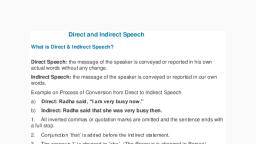
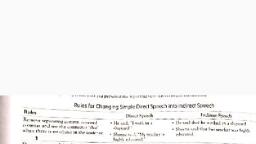
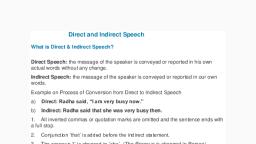
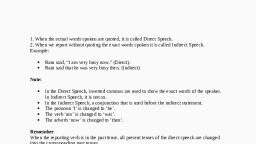
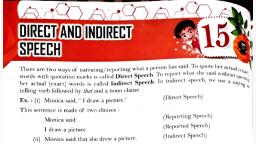
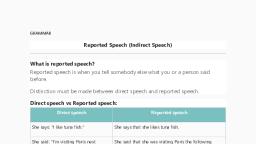
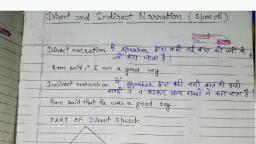
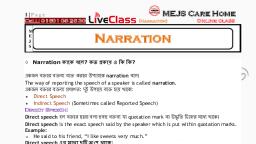
Reported Speech, (DIRECT-INDIRECT NARRATIONS), , Int {, we May choose ae are 1WO ways of telling someone, what someone ¢lse has said Often, vacthy whee aetmae i their actual wonls using a quoted speech or direct speech. Reporting, Here. what » © NAN said ts cullest dirvet speech or quoted speech ~, For “ee. “Sys appear within quotation marks (° _") and should be word for word, She sand. “1 an watching T V_~, , also called reported speech), doesn't use quotation marks to enclose, fd it doesn't have to be word for word., , However when the information that somewne conveys ty more important than the actual, MS We may want to explain what they have said using our own words, ¢.g |, , f She sand that she was getting mamed on Saturday, , - Joe asked whether she way gong to insite her father to the wedding., , Examples like these are sometimes referred to as Indirect specch or reported speech, Hiemces t8 reoperted speech contin a reporting clause with a reporting verb, like- suv orasd.c g, She sad, Joe asked, , This ty followed by a reported clause showing someone's onginal stalement. question or, echt. ¢g, , Indirect speech (, what the person said a, , (that) she was geting mamed on Saturday, whether she was going to tavite her father to the wedding, , We offen have te give information about what people say or think. In order to do this we can, rect or quoted” speech, or “indirect or repartey!” speech, , DIRECT SPEECH, , Reporting exactly what someone has said is called ‘direct speech’ (sometimes called, , qeoted* speech | j, Here what a person says, appears within qootation marks (‘*..."*) and should be word, , far word., , , , , , Scanned by CamScanner