Page 1 :
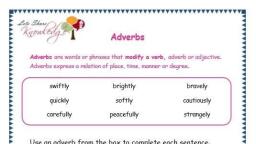
ADVERB (¿0a ascan), An adverb is a word which modifies the meaning of a verb, an adjective,, another adverb and phrase. And the adverbs, standing at the beginning of sentence, sometimes modify the whole sentence., Verb :, Savita walks quickly., He is writing neatly., Ladies speak loudly., Some students study regularly., Adverb :, They are singing very melodiously. My parents are working very hard., She is behaving very gently., Adjective :, It is too late to attend the meeting., It is very small thing., His sister is a very kind hearted woman.
Page 2 :
How do you go ?, (Inter Adverb of Manner), Howmany much children have you? (Inter Adverb of Number), (Inter Adverb of Degree), How high is Gumbaj ?, 6) Adverb of Frequency: (which show how aften), 1) We often makes mistakes? (bedod re), 2) She told me twice (d ), 3) He came here once (o ), (again, frequently, always, seldom, thrice, now & then), 7) Adverb of Affirmation and Negation, 1) Surely he is mistaken ?, 2) She certainly did it., 3) Definitly she has forgotten., 4) We do not know her, 5), She does not try to do., 6), It does not try., 8) Adverbs of-Reason (drm aa o Jdeaa), 1), He is hence unable to refuse the charge., 2), Einstein therefore left the school., 1), S. Janaki sings delightfully. (Adv of manner), 2) The weather is delightfully cool. (Adv of degree), 3) Don't go far. (Adv of place), 4) He is far better now (Adv of degree), 9) Relative Adverb (2owog O38 3oo adea), 1) This is the place where my beloved lives. ( ot aRADS Re a, 2) Why she loved me I know. ( aa nana aeBRTeodas da R), 3) Tell me the manner how he spoke. ( ot aaaadoa aae )
Page 3 :
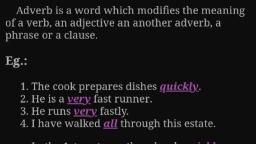
Adverb, An adverb is that word in a sentence, which modifies the meaning of verb or adjective or, mother adverb or phrase or a clause., Look at the following sentences:, (a) He ran fast., (b) These are very sweet magoes., (c) She speaks very loudly., (d) He was sitting close beside her, If an adverb is used in the beginning of a sentence, it modifies the whole sentence., For example:, (a) Unfortunately, the bank closed at two today., (b) Certainly she is right., (c) Fortunately we escaped unhurt., In the above examples, the adverb modifies the entire sentence., --Modifies the verb ran., Modifies the adjective, sweet., -Modifies the adverb, loudly., -Modifies the phrase, 'beside her'., NOTE As you will see, adverbs often tell when, where, why, or under what conditions some action takes place, or took place. Adverbs usually end in -ly; however, many words and phrases not ending in -ly serve an, adverbial function and an-ly ending is not a guarantee that a word is an adverb. The words; friendly,, lovely, lonely, motherly, for instance, are adjectives., Adverb Clause : If a group of words containing a subject and verb acts as an adverb, (modifying the verb of a sentence), it is called an Adverb Clause :, (a) When this class is over, we''re going to market., Adverbial Phrase :When a group of words not containing a subject and verb acts as an, adverb, it is called an Adverbial Phrase. Prepositional phrases generally act as adverb, (telling place and time, modifying the verb):, (a) She went to the market., (b) He works on holidays., (c) They lived in USA during the war., And Infinitive phrases can also act as adverbs (usually telling why):, (a) She hurried to the railway station to see her mother., (b) Ram ran to catch the train., NOTE Adverbs can modify adjectives, but an adjective cannot modify an adverb.
Page 4 :
(d) Tell me the time when the train will arrive.(Relative Adverb-when, Antecedent-time), to the antecedent 'house'. Antecedent means-'which comes before.", Look at the following sentences :, 7. Adverb of Reasons : Therefore', 'hence', 'on account of etc. are adverbs of reason. These, When Adverbs introduce a question, they are called interrogative adverbs., etc. These adverbs show positivity or negativity':, 6. Adverb of affirmation and negation : Certainly, surely, seldom, never, always, definitely, (b)I know the hotel where she lives.(Relative adverb - where, Antecedent-hotel), (c) This is reason why she left. (Relative Adverb-why, Antecedent-reason), Such most commonly used adverbs are; What, When, Where, Why, How, Whatever,, (a) Surely you are wrong., (c) I certainly do not like her., (e) She will definitely help the poor., (b) She certainly cooked., (d) He never refuses., adverbs show "reason or cause':, (a) It is hence proved., Myerb of contrast : However', "though', 'yet', 'even if, 'all the same' etc. are the, examples. These adverbs refer the contrast or contradiction :, (a) He is poor though he is honest., (b) She is very rich however she refused to donate anything., 9. Adverb of condition : Had, if, unless, provided that,as long as', so long as, etc. are the, examples. These adverbs refer conditions:, (a) Had he come to me I would have helped him., (b) If it rains we will go for a picnic., 10. Adverb of extent : "So far as,as far as', etc, are adverbs of extent. These adverbs show the, (b) He therefore went to hospital., extent:, (a) So far as I could see there was nothing but dead bodies., (b) As far as I can judge she is an intelligent girl., 11. 'Yes' and 'no', Adverbs : When they(Yes or No) are used by themselves, they are, equivalents of a sentence as shown below:, (a) Have you completed your work? Yes., (Here 'yes' stands for the sentence-'I have completed my work".), (b) Are you going to market? No., (Here 'no' means-I am not going to market'.), RELATIVE ADVERBS, Relative Adverb not only modifies verbs but also refers back to the antecedent., Look at the following sentence:, (a) I remember the house, where he lived., e the word 'where' is a relative adverb, which modifies the verb lived' and refers back, Whither, Wherever, Whence etc., See more examples:, INTERROGATIVE ADVERBS
Page 5 :
S.S.K. English Grammar, Phrases:, Has she read all through the novel ? The PE Teacher well dressed all in white., Sentence:, Unfortunately no one was present there. Luckily he passed PUC., Probably she was pushed in to well., Kinds of Adverbs, Adverbs may be classified according their meaning of following.gota adeararida, 1) Adverb of Time (bob arid gcom deatro), It is an answer for the question 'when' ?, 1) His sister came yesterday. e o DE 20otes., 2) She comes soon., 3) They still live in Bombay., before, after, lately, now, then, daily, already, since, formerly, late, ago,, never, ever., 2) Adverb of Place (e oe ,coo odeam), These answer for the question "where' ?, 1) They have come here. (On) 2) Children played there. (), 3) God is everywhere. (o), 3) Adverb of Manner (besaess godto odeatro), These show how or in what manner., 1) Indians work neatly. ( A) 2) Ladies speak loudly. (locan), 3) She walks beautifully. (bottdann), clearly, slowly, easily, soundly, sadly, so, bravely., Note : Usually these are formed from adjectivesand ended in'y., 4) Adverb of Degree ( oda ddeadeo), These show howmuch or in what degree or to what extent., Some parents are too careless for their children., I was fully prepared. She is quite wrong., 5) Interrogative Adverbs ( Fs ote eatro), He is rather busy., Where is he ?, (Inter Adverb of Place), When do you help?, (Inter Adverb of Time), Why are laughing?, (Inter Adverb of Reason)