Page 1 :
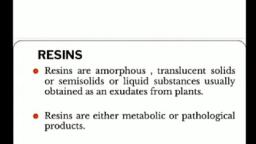
RESINS, , @ Resins are amorphous , translucent solids, or semisolids or liquid substances usually, obtained as an exudates from plants., , @ Resins are either metabolic or pathological, products., , e@ These are mixtures of essential oils,, oxygenated products of _ essential oil,, oxygented products of terpene and, carboxylic acids found as exudations from, the trunk of various trees., , ——s- Mosvof the resins are heavier than water
Page 2 :
PROPERTIES, , They are amorphous, non —crystalisable, , transparent solids or semi solids., , They are insoluble in water and soluble in, , organic solvents., , When heated they melt and burn with sooty, flame., , They are produced in plants in special type, of glands., , They are non nitrogenous compound., , e@-They-are hards———

Page 3 :
CLASSIFICATION, , Depending upon the function group present ,, resins are classified as:, , Acid Resins: e.g., colophony myrrh., Ester Resins: e.g., Benzoin, storax., , Resin Alcohols e.g., Balsam of peru.
Page 4 :
combinations):, , i. Gum -resins: Canada balsam, , ii. Oleo-resins: capsicum, iii. Oleo-gum-resin: Asafoetida, guggul, , iv. Glycoresins: Combination of sugar and, resin., , v. Balsams: They are the derivatives of acids, like benzoic acid and cinnamin acid, e.g., balsam of peru, balsam of Tolu.
Page 5 :
*, , &, , *, , ?, , THERAPEUTIC USES AND, PHARMACEUTICAL APPLICATIONS:, , Expectorant, Antiseptic, Flavoring agents, , Used as perfumery.