Page 1 :
Part 1st – Union and it’s Territory, Article 1 – Describes India, that is Bharat as 'Union of States’, India is classified into three categories:, 1. Territories of the states, 2. Union territories, 3. Territories that may be aquired by the Government of India at any time., Note: 5th and 6th Schedule contain separate provisions with respect to the, administration of scheduled areas and tribal areas within the states., • The states share distribution of powers with the centre while the union territories, and aquired territories are directly administered by the Central Govt.

Page 2 :
Article 2 – admission or establishment of new state., Article 3 – formation of or changes in the existing states of the Union of, India., It includes;, Separation of territory from any state, increase or diminish the area of any, State, alter the boudaries and name of any State., Notes: bills contemplating the above changes can be introduced in the, Parliament only with the prior recommendation of the President.
Page 3 :
Evolution of States and Union Territories:, In 1950, the Constitution contained the four-fold classification of the indian, territories:, Part A – Nine earstwhile gorvernor provinces, Part B – Nine earswhile princely states, Part C – Earstwhile chief commissioner’s provinces(centrally administered), Part D – Andaman and Nicobar Islands, Reorganisation of States:, Dhar Commission- In June 1948, the Govt. Of India appointed the Linguistic, Province Commission under the chairmanship of S.K. Dhar, • It recommended the reorganisation of States on the basis of administrative, convenience rather than liguistic factor.
Page 5 :
JVP Committee- Another Linguistic Province Committee was appointed by, the Congress in December 1948. Members – JawaharLal Nehru, VallabhBhai, Patel and Pattabhi Sitaramayya., • Submitted its report in April 1949 and rejected the laguage as the basis for, reorganisation of States., , However, in October 1953, the GOI was forced to create the first linguistic, atate, known as Andhra Pradesh (by separating the Telugu speaking areas, from Madras)., Fazl Ali Commission – Three member States Reorganisation Commission was, appointed under the chairmanship of Fazl Ali in December 1953, Other two members – K.M. Panikkar & H.N. Kunzru
Page 6 :
• Commission submitted its report in September 1955 and accepted, language as the basis of reorganisation of States., • Commission also suggested abolition of four-fold classification, • GOI accepted the suggestions with minor modifications, By the States Reorganisation Act(1956) and the 7th Constitutional, Amendment Act(1956), the distinction between Part A and Part B states was, done away with and Part C states were abolished., , As a result, 14 states and 6 Union Territories were created on 1st November,, 1956.
Page 8 :
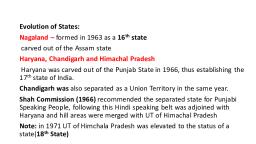
New States and Union Territories Created after 1956:, Maharashtra and Gujarat in 1960, Dadra and Nagar Haveli – liberated in 1954 from Portuguese control., • It was converted into an union territory by 10th Constitutional, Amendment Act, 1961, Goa, Daman and Diu – acquired these territories from the Portuguese in, 1961., • Through 12th amendment act 1962, they were constituted as a union, territories, • In 1987, Goa was conferred a statehood., Pondicherry – French handed over this territory in 1954., Constituted as a union territory in 1962 (14th amendment)