Page 1 :
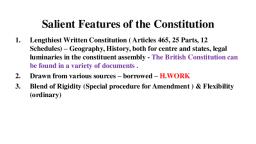
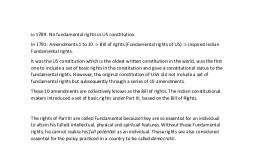
Salient Features of the constitution, Lengthiest written Constitution, 395 articles, 22 parts, and 8 schedules originally, Borrowed From Various Sources:, • Government of India Act 1935 is known as the blue print of the Indian, Constitution. More than half of the provisions are drawn from 1935 Act only., • Fundamental Rights – American const., • Directive principles of State Policy – Irish Const., • Political part (i.e. cabinet form, parliamentary system) – Britain., • Amendment Process – South Africa, • Fundamental Duties - USSR
Page 2 :
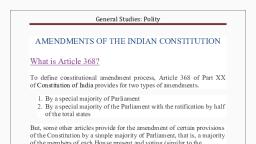
Rigid as well as Flexible constitution, Rigidity, • Amendment with special majority ( presence and voting of the two-third, majority in the each house, and passage with the majority of total, membership of each house., • Some provisions can be amended by a special majority and with the, ratification of half of the total states., • However basic structure of the constitution can not be amended at all., Flexibility, • some provisions of the constitution can be amended by a simple majority of, the parliament.
Page 3 :
Federal System with Unitary Bias, • Described as quasi-federal (federal in form but unitary in spirit) by K.C., Wheare, • Bargaining federalism – Morris Jones, • Co-operative federalism – Granville Austin, • Federal features- Two govts, Bicameralism, division of powers, supremacy, of constitution, independent judiciary., • Unitary fratures – Strong centre, Single constitution, Single citizenship,, appointent of the state governor by the centre, All india services etc.
Page 4 :
Parliamentary form of govt., • Principle of coordination between legislative and executive organs, • Also known as Westminster model, • Opted from British parliamentary system., Features:, • Nominal head, • Majority Party rule, • Collective responsibility, • Leadership of PM or CM, • Dissolution of lower house
Page 5 :
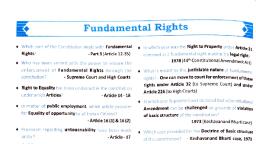
Judicial Supremacy:, The Supreme Court can declare the parliamentary laws as unconstitutional, through its power of judicial review., Integrated and independent Judiciary, , The judicial system of India has been set up in a integrated approach with a, hierarchy., There is Supreme court at the top, then the high courts and after that there is, series of subordinate courts(district courts and & session courts), Fundamental Rights, Directive Principles of State Policy, Fundamental Duties
Page 6 :
Secular state, Universal adult Franchise, Single citizenship, Independent Bodies – Election Commission, CAG, UPSC, SPSC, Emergency Provisions, Three tier Government, Co-operative Societies, Criticism – Borrowed constitution, a carbon copy of the 1935 Act,, Elephantine size.