Page 1 :
HYPOTHESIS TESTING, Definition of terms:, 1. Hypothesis – a claim or statement either about the value of a single population character or about, the values of several population characteristics., 2. Test of hypothesis – method of using sample data to decide between two competing claims about, population characteristics. It concerns itself with the decision-making rules for, choosing alternatives while controlling and minimizing the risks of wrong decisions., The decision is whether the characteristic is acceptable or not., 3. Null hypothesis – denoted by Ho, is a claim about a population characteristic that is initially, assumed to be true., - A statement that there is no difference between a parameter and a specific value,, or that there is no difference between two parameters., 4. Alternative hypothesis – denoted by Ha, is the competing claim., - A statement that there is a difference between a parameter and a specific value,, or that there is a difference between two parameters., 5. Test procedure – decision rule used to evaluate the sample data to determine whether Ho should, be accepted or rejected. In doing the test, null hypothesis will be rejected in favor of, the alternative hypothesis only if the sample evidence strongly suggests that Ho is, false. If the sample does not contain such evidence. Ho will not be rejected., 6. One-tailed test – the alternative hypothesis specifies a one-directional difference from the, parameter of interest (ex. Ha: µ1<µ2), 7. Two-tailed test – specifies a difference that can fall in either of the two tails of the distribution, (ex. Ha: µ1≠µ2), - Non-directional, 8. Type I error – considers a conclusion that is drawn stating that a null hypothesis is false when in, fact it is true., 9. Type II error – occurs when the null hypothesis is not rejected when in fact it is false, 10. Significance level (𝛼) – related to the degree of certainty we require in order to reject the null, hypothesis in favor of the alternative hypothesis., 11. Test statistic – quantity calculated from the sample data. Its value is used to decide whether or not, the null hypothesis should be rejected in a hypothesis test. (ex. Z-test, t-test, F-test,, chi-square test, and ANOVA), 12. Critical or Tabular value – a threshold to which the value of the test statistic in a sample is, compared to determine whether or not the null hypothesis is rejected., 13. Critical region – the rejection region. A set of values of the test statistic for which the null, hypothesis is rejected in a hypothesis test; that is, the sample space the test statistic, is partitioned into regions., , Statement of Hypothesis:, Every hypothesis testing situation begins with the statement of a hypothesis. To state, hypothesis correctly, researchers must translate the conjecture or claim from words into, mathematical symbols. The basic symbols used are as follows:, >, <, Is greater than, Is above, Is less than, Is below, Is higher than, Is longer than, Is lower than, Is shorter than, Is bigger than, Is increased, Is smaller than, Is decreased or reduced from, ≥, ≤, Is greater than or equal to, Is at least than or equal to, Is at least, Is at most, Is not less than, Is not more than, =, ≠, Is equal to, Is not equal to, Is exactly the same as, Is different from, Has not change from, Has changed from, Is the same as, Is not the same as
Page 2 :
The null and alternative hypotheses are stated together, and the null hypothesis contains the equal signs,, as shown (where k represents a specified number)., , Two-tailed test, H0:µ=k, Ha:µ≠k, , Right-tailed test, H0:µ≤k, Ha:µ>k, , Left-tailed test, H0:µ≥k, Ha:µ<k, , Examples:, 1. The average TV viewing time of all five-year old children is 4 hours daily., Tailed-test, Statement, Symbol, Two - tailed Ho: The TV viewing time of all five-year old children is equals to 4 hours daily., H0:µ=4, Ha: The TV viewing time of all five-year old children is not equals to 4 hours daily Ha:µ≠4, 2. A medical researcher is interested in finding out whether a new medication will have any, undesirable side effects. The researcher is particularly concerned with the pulse rate of the, patients who take the medication. Will the pulse rate increase, decrease, or remain unchanged, after a patient takes the medication? If the mean pulse rate for the population under study is 82, beats per minute, then the hypotheses for this situation are:, Symbol, Tailed-test, Statement, Two - tailed H0: The pulse rate of the patients who take the medication is 82 beats per minute. µ=82, Ha: The pulse rate of the patients who take the medication is not 82 beats/minute. µ≠82, 3. A chemist invents an additive to increase the life of an automobile battery. If the mean lifetime of, the automobile battery without the additive is 36 months, then the hypotheses are:, Symbol, Tailed-test, Statement, One – tailed H0: The lifetime of the automobile battery with additive is at most 36 months., µ≤36, Right-tailed Ha: The lifetime of the automobile battery with additive is more than 36 months., µ> 36, 4. A contractor wishes to lower heating bills by using a special type of insulation in houses. If the, average of the monthly heating bills is $78, the hypotheses about heating cost with the use of, insulation are:, Symbol, Tailed-test, Statement, H, :, The, monthly, heating, bills, of, those, who, use, the, special, insulation, is, at, least, $78., One – tailed, 0, µ≥78, Left-tailed Ha:The monthly heating bills of those who use the special insulation is cheaper than $78., µ<78, , Exercises: State if the given problem is two-tailed or one-tailed. If one-tailed, identify if it is right-tailed or, left-tailed. State the null and alternative hypotheses of the following in symbols and statements., 1. A researcher thinks that if expectant mothers use vitamin pills, the birth weight of the babies will, increase. The average birth weight of the population is 8.6 pounds., Tailed-test, Statement, Symbol, Ho:, Ha:, , 2. An engineer hypothesizes that the mean number of defects can be decreased in a manufacturing, process of compact disks by using robots instead of humans for certain tasks. The mean number of, defective disks per 1000 is 18., Tailed-test, Statement, Symbol, Ho:, Ha:, , 3. A psychologist feels that playing soft music during a test will change the results of the test. The, psychologist is not sure whether the grades will be higher or lower. In the past, the mean of the, scores was 73., Tailed-test, Statement, Symbol, Ho:, Ha:
Page 3 :
4. The average age of community college students is 24.6 years., Tailed-test, Statement, Ho:, , Symbol, , Ha:, , 5. The average income of accountants is ₱ 51,497., Tailed-test, Statement, Ho:, , Symbol, , Ha:, , 6. The average age of lawyers is greater than 25.4 years., Tailed-test, Statement, Ho:, , Symbol, , Ha:, , 7. The average score of 50 high school basketball games is less than 88., Tailed-test, Statement, Ho:, , Symbol, , Ha:, , 8. The average pulse rate of male marathon runners is less than 70 beats per minute., Tailed-test, Statement, Ho:, , Symbol, , Ha:, , 9. The average cost of a DVD player is ₱79.95., Tailed-test, Statement, Ho:, , Symbol, , Ha:, , 10. The average weight loss for a sample of people who exercise 30 minutes per day for 6 weeks is 8.2, pounds., Tailed-test, Statement, Symbol, Ho:, Ha:, , Type I Error vs Type II Error, Reject H0, Accept H0, H0 is true, Type I error, Correct Decision, H0 is false Correct Decision, Type II error, 1. If the null hypothesis is true and accepted, or if it is false and rejected, the decision is correct., 2. If the null hypothesis is true and rejected, the decision is incorrect and this is TYPE I ERROR., 3. If the null hypothesis is false and accepted, the decision is incorrect and this is TYPE II ERROR., • In an ideal situation, there is no error when we accept the truth and reject what is false.
Page 4 :
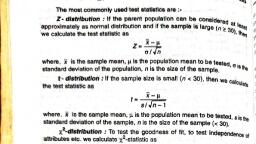
Examples: Identify what type of error is committed?, 1. Mary insists that she is 30 years old when, in fact, she is 32 years old. What error is Mary committing?, 2. A man plans to go hunting the Philippine monkey-eating eagle believing that it is a proof of his mettle., What type of error is this?, •, •, •, •, , The level of significance is the maximum probability of committing a type I error., The critical value(s) separates the critical region from the noncritical region., The critical or rejection region is the range of values of the test value that indicates that there is a, significant difference and that the null hypothesis should be rejected., The noncritical or acceptance region is the range of values of the test value that indicates that the, difference was probably due to chance and that the null hypothesis should be accepted., , Procedure for finding the critical values for specific α values, using table (z-table or t-table), 1. Draw the figure and indicate the appropriate area., a. If the test is left-tailed, the critical region, with an area equal to α, will be on the left side of the, mean., b. If the test is right-tailed, the critical region, with an area equal to α, will be on the right side of the, mean., c. If the test is two-tailed, α must be divided by 2; half of the area will be to the right of the mean,, and the other half will be to the left of the mean., 2. For a one-tailed test, subtract the area equivalent to α in the critical region from 0.5000. For a twotailed test, subtract the area equivalent to α/2 from 0.5000., 3. Find the area in the table corresponding to the value obtained in step 2. If the exact value cannot be, found in the table, use the closest value., 4. Find the z/t value that corresponds to the area. This will be the critical value., 5. Determine the sign of the critical value for a one-tailed test., a. If the test is left-tailed, the critical value will be negative., b. If the test is right-tailed, the critical value will be positive., For a two-tailed test, one value will be positive and the other negative., Example: Find the critical value(s) for each situation and draw the appropriate figure, showing the, critical region., a. A left-tailed test with α=0.10, __________________________________________________, b. A two-tailed test with α=0.02, __________________________________________________, c. A right-tailed test with α=0.005, __________________________________________________, d. A right-tailed test with d.f.=28 and α=0.05, __________________________________________________, e. A two-tailed test with d.f.=18 and α=0.10, __________________________________________________, f. A left-tailed test with d.f. = 6 and α=0.01, __________________________________________________, Steps in solving hypothesis testing problems:, 1. State the hypotheses and identify the claim., 2. Specify the level of significance and decide whether a one-tailed test or a two-tailed test shall be, used., 3. Find the critical values from the appropriate table., 4. Compute the test value., 5. Make the decision to reject or not to reject the null hypothesis., 6. Summarize the results., Test Statistics which are commonly used:, z-test, Used for testing when the sample is at least 30;, 𝜎 is known; normally distributed, Z-test using one-sample mean:, (𝑥̅ −𝜇)√𝑛, , (𝑥̅ −𝜇)√𝑛, , t-test, Used when the sample size is less than 30; 𝜎 is, unknown; approximately normally distributed, t-test using one-sample mean:, (𝑥̅ −𝜇)√𝑛, , z=, or z=, 𝜎, 𝑠, where: µ=established population mean, , t=, 𝑠, where: µ=established population mean, , 𝑥̅ = sample mean, s = sample standard deviation, n = number of samples, , 𝑥̅ = sample mean, s = sample standard deviation, n = number of samples, , 𝜎 = population standard deviation
Page 5 :
Examples:, 1., , A manufacturer claims that the average life of batteries used in their electronic games is 150 hours. It is known that, the standard deviation of this type of battery is 20 hours. A consumer wishes to test the manufacturer’s claim and, accordingly tests 100 electronic games using this battery and found out that the mean life is equal to 169 hours. Test, the hypothesis by using a level of significance (∝) =5%., , Steps, Solution, 1. State the hypotheses Ho: The life of batteries used in electronic games is 150 hours., and identify the claim., Ha: The life of batteries used in electronic games is not 150 hrs., 2. Specify the level of, significance and decide, whether a one-tailed test or a, two-tailed test shall be used., 3. Find the critical values from, the appropriate table., , 4. Compute the test value., , 5. Make the decision to, reject or not to reject the, null hypothesis., , Significance level (∝) = 5 % =0.05, , Two-tailed test, , n=100, 𝞼=20 hrs, 𝑥̅ = 169 ℎ𝑟𝑠, 𝜇 = 150 ℎ𝑟𝑠, Normal curve:, , µ=150, µ≠150, , critical values = 1.96 and – 1.96, z=, , (𝑥̅ −𝜇 )√𝑛, 𝜎, , =, , (169−150)√100, 20, , = 9.5, , computed value = 9.5, Decision:, Reject the null hypothesis., , 6. Summarize the results. The life of batteries used in electronic games is not 150 hrs., 2. The personnel department of a company developed an aptitude test for a certain group of semiskilled workers. The individual test scores were assumed to be normally distributed. The, department 5 a tentative hypothesis that the arithmetic mean grade obtained by this group of, semi-skilled workers is 100. It was agreed that this hypothesis would be subjected to a two-tailed, test at 5% level of significance. The aptitude test was given to a sample of 16 semi-skilled workers, and the results are: 𝑥̅ =94; s=5; n=16; µ=100. Is the personnel department’s tentative hypothesis, correct at α=5%?, Steps, Solution, 1. State the hypotheses Ho:, and identify the claim., Ha:, 2. Specify the level of significance and, decide whether a one-tailed test or a, two-tailed test shall be used., , 3. Find the critical values from the, appropriate table., , 4. Compute the test value., , Significance level (∝) =________________, , Tailed test: ____________________, , n=, , critical values = ±____________, , 𝞼=_________, 𝑥̅ = ________, 𝜇 = ________, Normal curve:, , z=, , (𝑥̅ −𝜇 )√𝑛, 𝜎, , =, computed value =, Decision:, , 5. Make the decision to, reject or not to reject the, null hypothesis., 6. Summarize the results., 3. A job placement director claims that the average starting salary for nurses is Php24,000. A sample, of 10 nurses has a mean of Php23,450 and a standard deviation of Php400. Is there enough, evidence to reject the director’s claim at α=0.05?, Steps, Solution, 1. State the hypotheses Ho:, and identify the claim., Ha:, 2. Specify the level of significance and, decide whether a one-tailed test or a, two-tailed test shall be used., , 3. Find the critical values from the, appropriate table., , 4. Compute the test value., , 5. Make the decision to, reject or not to reject the, null hypothesis., 6. Summarize the results., , Significance level (∝) =________________, , Tailed test: ____________________, , n=, , critical values = ±____________, , 𝞼=_________, 𝑥̅ = ________, 𝜇 = ________, Normal curve:, , z=, , (𝑥̅ −𝜇 )√𝑛, 𝜎, , =, computed value =, Decision:
Page 6 :
4. A machine is designed to fill jars with 16 ounces of coffee. A consumer suspects that the machine is, not filling the jars completely. A sample of 8 jars has a mean of 15.6 ounces and a standard, deviation of 0.3 ounce. Is there enough evidence to support the consumer’s conjecture at α=0.10?, Steps, Solution, 1. State the hypotheses Ho:, and identify the claim., Ha:, 2. Specify the level of significance and, decide whether a one-tailed test or a, two-tailed test shall be used., , 3. Find the critical values from the, appropriate table., , 4. Compute the test value., , Significance level (∝) =________________, , Tailed test: ____________________, , n=, , critical values = ±____________, , 𝞼=_________, 𝑥̅ = ________, 𝜇 = ________, Normal curve:, , z=, , (𝑥̅ −𝜇 )√𝑛, 𝜎, , =, computed value =, Decision:, , 5. Make the decision to, reject or not to reject the, null hypothesis., 6. Summarize the results., 5. A physician claims that jogger’s maximal volume oxygen uptake is greater than the average of all, adults. A sample of 15 joggers has a mean of 43.6 milliliters per kilogram (ml/kg) and a standard, deviation of 6 ml/kg. if the average of all adults is 36.7 ml/kg, is there enough evidence to support, the physician’s claim at α=0.01?, Steps, Solution, 1. State the hypotheses Ho:, and identify the claim., Ha:, 2. Specify the level of significance and, decide whether a one-tailed test or a, two-tailed test shall be used., , 3. Find the critical values from the, appropriate table., , 4. Compute the test value., , Significance level (∝) =________________, , Tailed test: ____________________, , n=, , critical values = ±____________, , 𝞼=_________, 𝑥̅ = ________, 𝜇 = ________, Normal curve:, , z=, , (𝑥̅ −𝜇 )√𝑛, 𝜎, , =, computed value =, Decision:, , 5. Make the decision to, reject or not to reject the, null hypothesis., 6. Summarize the results., 6. A researcher reports that the average salary of assistant professors is more than Php 42,000. A, sample of 30 assistant has a mean salary of Php 43,260. At α=0.05, test the claim that assistant, professors earn more than Php42,000 a year. The standard deviation of the population is, Php5,230., Steps, Solution, 1. State the hypotheses Ho:, and identify the claim., Ha:, 2. Specify the level of significance and, decide whether a one-tailed test or a, two-tailed test shall be used., , 3. Find the critical values from the, appropriate table., , 4. Compute the test value., , Significance level (∝) =________________, , Tailed test: ____________________, , n=, , critical values = ±____________, , 𝞼=_________, 𝑥̅ = ________, 𝜇 = ________, Normal curve:, , z=, , (𝑥̅ −𝜇 )√𝑛, 𝜎, , =, , computed value =, 5. Make the decision to, Decision:, reject or not to reject the, null hypothesis., 6. Summarize the results., 7. A national magazine claims that the average senior high school student watches less television, than the general public. The national claims that the average is 29.4 hours per week, with a, standard deviation of 2 hours. A sample of 30 senior high school students has a mean of 27 hours., Is there enough evidence to support the claim at α=0.01?, “If you are not willing to learn, no one can help you. If you are determined to learn, no one can stop you.”