Page 1 :
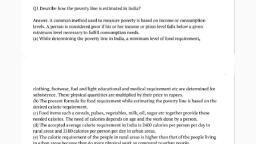
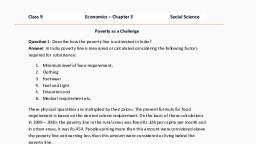
wl. Describe how the poverty line is estimated, = in India., , Or, , Explain some ways by which the poverty, line is estimated in India., , Ans. A person is considered below the poverty line if, his/her income or consumption level falls below a, ‘minimum level’ necessary to fulfil basic needs., While determining the poverty line, a minimum, level of food requirement, clothing, footwear,, fuel, light, educational and medical requirements,, etc are determined for subsistence., , Estimating the poverty line is also based on the, desired calories requirement. It is 2400 calories per, , person per day in the rural areas and 2100 calories, in the urban areas., , Shot on YSO, , Al Quad camera 2022.01.25
Page 2 :
2. [HOTS! Do you think that present ethodolc, of poverty estimation is appropriate? vay, Ans. The Present methodology of poverty estimation i, appropriate because it takes into account only the —, € bas;, , needs of food, clothing, fuel, etc. The quality of these, , basic necessities is the lowest quality available, which ;, not appropriate. a, , The amount which is fixed as the poverty line does no, include the margin for price fluctuations and, which is constantly occurring., , The poverty line should include some correction for, inflation and to take care of the market fluctuations., , Price rise 4, , 3. Describe the poverty trends in India since 1973. |, , Beri a, , Ans. The trends in poverty since 1973 are, (2) There is substantial decline in poverty ratio from, , 55% in 1973 to 44.3% in 1993 and 21.9% in, 2011-12., , (72) Rural poverty has declined sharply from 56% in 1973 °, to 25.7% in 2011-12 and the numbers from a, , 261 million to 216.5 million, 4, , (111) The latest estimates indicate a significant reduction in, the total urban and rural number of poor to be abou, 269.3 million, down from 321 million in 1973., , FF | A Te Le eK ASSAY PAA OANNA FAT WATTOPY in India
Page 3 :
ABNF DY eet Mee ee ees ae, The amount which is fixed as the poverty line doe ', include the margin for price fluctuations and pric Z Nor, which is constantly occurring. over tise a, The poverty line should include some correction fo, inflation and to take care of the market fluctuations, , , , , , , , , , , , , , , , , , , pe, , 8. Describe the poverty trends in India since 197 :, , Ans. The trends in poverty since 1973 are, , () There is substantial decline in poverty ratio from, 55% in 1973 to 44.3% in 1993 and 21.9% in, , 2011-12., , (iz) Rural poverty has declined sharply from 56% in | of, to 25.7% in 2011-12 and the numbers from ‘, , 261 million to 216.5 million., , (177) The latest estimates indicate a significant reduction J, the total urban and rural number of poor to be about, 269.3 million, down from 321 million in 1973. |, , AY 4. Discuss the major reasons for poverty in India. !, Ans. The major reasons of poverty in India are, (1) Low level of economic development under the Britis ,, colonial administration The policies of the colonial ©, , government ruined traditional handicrafts and, discouraged development of industries like textiles., , (i7) Low rate of India’s economic growth after ., independence This resulted in less job opportunities, and low growth rates of incomes, accompanied by a ’, high growth rate of population hence increasing, poverty., , (iii) Lack of land resources Land reforms aimed at ;, redistribution of assets in rural areas have not been {, implemented effectively. ', , (iv) Backwardness in agriculture People mostly use old, ©, traditional and subsistence methods of farming. This ;, requires much labour and time. Effects of irrigation ©, and the Green Revolution were limited to only somey, parts of India. ’
Page 4 :
17, , F, , 45. Identify the social and economic groups which, , Ans. The major reasons of poverty in India are, , , , , , , , , , , , , , , , , , , , , , , , , , , , , , 2011-12. | |, , (i) Rural poverty has declined sharply from 56% /, to 25.7% in 2011-12 and the numbers from in 197, 261 million to 216.5 million,, , (ii2) The latest estimates indicate a significant reductio, the total urban and rural number of poor to be a it, 269.3 million, down from 321 million in 1973, Out, , 4. Discuss the major reasons for poverty in India |, , (:) Low level of economic development under the Briri,, , colonial administration The policies of the colonia}, government ruined traditional handicrafts and, , discouraged development of industries like textiles,, , (17) Low rate of India’s economic growth after, independence This resulted in less job opportunities, and low growth rates of incomes, accompanied by q —, high growth rate of population hence increasing, , poverty., (iii) Lack of land resources Land reforms aimed at, redistribution of assets in rural areas have not been, , implemented effectively., , (iv) Backwardness in agriculture People mostly use old,, traditional and subsistence methods of farming. This, requires much labour and time. Effects of irrigation, , and the Green Revolution were limited to only some |, , parts of India., , are most vulnerable to poverty in India., Or, , Mention the social and economic groups which, , are more vulnerable to poverty in India., , Ans. The social groups more vulnerable to poverty are the, , Scheduled Castes and Scheduled Tribes households. The |, Scheduled Castes are not allowed to avail the facilities, , , , given to others due to |, leading to poverty., , > prevailing caste system,




 Learn better on this topic