Page 1 :
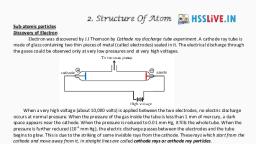
Structure of Atom, , This experiment shows that nature of charged, particles present in matter may be different. The, electrical nature of two pieces of glass are similar to, each other but opposite to those of the two pieces of, resin., , The smallest particle of an element that can exist, chemically is an atom. Dalton assumed that the atom, is indivisible. But experiments in late 1800s and early, 1900s revealed that the atom is made up of three, subatomic particles-electrons, protons and neutrons., The atom is neutral in nature since it has equal, number of negatively and positively charged particles., , Production of Cathode Rays, - The existence of electrons in an atom was shown by, J. J. Thomson in 1897 by passing electricity at high, voltage through a gas at very low pressure in a, discharge tube., - A common discharge tube is a long glass tube having, two metal plates sealed at its two ends. These metal, plates are known as electrodes. The electrodes which, is connected to the positive terminal of the battery is, known as anode (positive electrode), and the, electrode which is connected to the negative terminal, of the battery is called cathode (negative electrode)., - When air inside the discharge tube is at the, atmospheric pressure and a high electric voltage of, 10,000 volts (or more) is applied to the electrodes, no, electricity flows through the air in the discharge tube., - If the pressure of air inside the discharge tube is, reduced to about 1 mm of mercury and high voltage is, applied again, electricity begins to flow through air, and a light is emitted by the air inside the tube. The, colour of light changes with the nature of gas taken in, the discharge tube., , Electrical Nature of Matter, The electrical nature of matter was known in 600 BC., Then William Gilbert observed production of weak, electricity by rubbing material such as glass rod with, silk cloth and during combing of dry hairs., The first important and experimental evidence of, electrical nature of matter was established by Faraday, in 1833. He showed that the flow of electricity is due, to the flow of charged particles. The term electron, was first suggested by G.J. Stoney for unit charge on a, monovalent negative ion. Existence of electrons was, later proved by J.J. Thomson., , Experiment I, • Take one piece of glass and resin., (1) Bring them in contact and separate after some, time., (2) Rub these two pieces, bring them m contact and, try to separate., • Observation:, (1) No effect, we can separate easily., (2) Two pieces attracts each other., Thus, initially there was no charge. So no attraction,, but by rubbing, electrical charge generated. This,, experiment shows the electrical nature of matter., , - When the pressure of air in the discharge tube is, reduced to about 0.001 mm of mercury and a high, voltage is applied to the electrodes, the emission of, light by air stops. Though the inside of the discharge, tube now appears to be dark, the walls of the, discharge tube at the end opposite to the cathode, begin to glow with a greenish light called, fluorescence. It is now known that some invisible rays, are formed at the cathode and when these rays strike, the glass tube, they emit a greenish light. Since these, rays are formed at the cathode, they are known as, cathode rays., , Experiment II, • Take two pieces with or glass or two pieces of resin., (1) Rub glass pieces with each other, bring in contact., (2) Rub resin pieces with each other, bring in contact., • Observation, (1) Both glass pieces repel each other., (2) Both resin pieces repel each other., 2
Page 2 :
Origin of Cathode Rays, The gas in the discharge tube is made up of atoms. All, the atoms contain electrons when high voltage is, applied, the electrical energy knocks out some of the, electrons from the atoms. These electrons constitute, the cathode rays., - On striking against walls of the discharge tube,, cathode rays produce faint greenish fluorescence., - Cathode rays ionize the gas through which they pass., - Cathode rays produce X-rays when they are made to, fall on metals such as tungsten, copper, etc., - They can penetrate through thin metal foils., - The charge to mass ratio (e/m) for the particles in, the cathode is independent of the nature of the gas, taken in the discharge tube or the nature of the, cathode., - It was concluded that cathode rays produced from, different gases are same and negatively charged, particles present in them are also same. These, particles were given the name electrons which was, proposed by Stoney., , Properties of Cathode Rays, - Cathode rays travel in straight lines: If an object is, placed in the path of cathode rays they casts a sharp, shadow of the object at the back. It shows that, cathode rays travel in straight lines., , - Cathode rays consists of material particles: This was, indicated by the fact that a light paddle wheel placed, in the path of cathode rays starts rotating., , Characteristics of an Electron, •, , - Effect of electric field: When an electric field is, applied to a stream of cathode rays, they get, deflected towards positive plate of the electric field. It, shows that cathode rays are negatively charged., , •, , •, , Charge on an electron: The absolute charge on an, electron is 1.602 1019 Coulombs or 4.8 1010, esu. It was determined by Millikan oil drop, experiment. This quantity of charge has been, shown to be the smallest negative charge carried, by any particle. Thus charge carried by an electron, is taken to be -1., Mass of an electron: The mass of an electron is, about 1/1838 the mass of a hydrogen atom., 28, Actual mass of an electron is 9.1110 g and is, negligibly small., Charge to mass ratio: The charge to mass ratio, (e/m) for an electron (cathode rays particle) was, 11, 8, found to be 1.76 10 C / kg or 1.76 10 C / g., Determination of Charge on the Electron, , - Cathode rays produce heating effect: Cathode rays, heat the object on which they fall due to transfer of, kinetic energy to the object., , The charge on the electron was measured by R.A, Millikan in 1909 by a method known as oil drop, method., The scheme of this experiment is as follows:, An atomizer sprayed a fine mist of oil droplets into, the upper chamber. Some of these tiny droplets were, then allowed to enter through a hole in the upper, metal plate into the lower chamber of the apparatus., Millikan first let them fall until they reached terminal, velocity due to air resistance. Using the microscope,, , - Effect of magnetic field: When magnetic field is, applied, perpendicular to the path of cathode rays,, they get deflected in the direction expected for, negative particles. This further confirmed that, cathode rays are negatively charged., , 3
Page 3 :
he measured their terminal velocity and calculated, the mass of each oil drop., Millikan irradiated the space between the plates with, X-rays. These knocked out some electrons from the, molecules of air and some of these electrons were, captured by oil droplets. By charging the upper plate, positive and the lower plate negative, the oil drop, experiences electric field in the upward direction. By, adjusting the electric field strength, upward electrical, field on the oil droplet was balanced against the, downward gravitational force. Under these, conditions, the drop remains suspended., When a drop is suspended, its weight (mg) is exactly, equal to the electric force applied, the product of the, electric field and the charge is Q.E., , to the direction of the motion. Thomson suggested, that the amount of deviation of the particles from, their path in the presence of electrical and magnetic, fields depends upon the following:, (a) Magnitude of the negative charge on the, particles., Greater the magnitude of the charge on the particles,, greater is the interaction with the electric or magnetic, field and therefore, greater is the deflection., (b) Mass of the particles., The extent of deviation increases with the increase in, the mass of the particles, therefore, lighter are the, particles, greater is the deflection., (c) Strength of electrical and magnetic field., The deflection of the particles from their original path, increases with the increase in the voltage across the, electrodes or strength of the magnetic field., When only electric field is applied, the electrons, deviate from their path and hit the cathode ray tube, at point P. Similarly, when only magnetic field is, applied, electrons deviate from their path and hit the, cathode ray tube at point R. By carefully balancing the, electrical and magnetic field strength, it is possible to, bring back the electron to the path followed as in the, absence of electric or magnetic field and they hit the, screen at point Q. By carrying out accurate, measurements on the deflections observed by, electron on the electric field strength or magnetic, field strength, Thomson was able to calculate the, value of charge/mass ratio i.e., e/m. The value of elm, 11, 1, was found to be 1,758820 10 C kg ., where m is the mass of electron in kg and e is the, magnitude of the charge on the electron in coulombs, (C). Since electrons are negatively charged, the charge, on electron is negative, -e. The relative strength of, electric and magnetic fields and the ratio elm control, the deflections. Hence, by measuring the deflection, and the field strength, elm can be calculated., , The value of E (applied electric field), m (the mass of a, drop which was calculated by Millikan), and g (the, acceleration due to gravity), are all known values. So it, is very easy to obtain the value of Q (the charge on, the drop) by using the simple formula mg = QE, Millikan repeated the experiment numerous times,, each time varying the strength of the X-rays, so that, different numbers of electrons would be captured by, oil molecules. He obtained various values for Q. The, charge Q on a drop was always a multiple of, 1.602 1019 C., Determination of Charge to Mass Ratio (e/m) of, Electrons, J.J. Thomson determined the ratio of the charge (e) of, the electron to its mass (m) by measuring the, deflection under the simultaneous influence of, electric and magnetic fields, applied perpendicular to, each other. The apparatus is shown in figure. A high, potential is maintained between the cathode and the, anode. Electrons emitted from the cathode are, accelerated by the high voltage. The circular disc after, the anode selects the beam moving in a straight line., The beam then passes through electric and magnetic, fields which are perpendicular to each other and also, 4
Page 4 :
Properties of Anode Rays, - Anode rays travel in straight lines., - Anode rays consist of material particles., - Anode rays are deflected by electric field towards, negatively charged plate. This indicated that they are, positively charged., - When a magnetic field is applied in a direction, perpendicular to the path of anode rays, they get, deflected in the direction expected for positive, particles. This further indicates that they are positively, charged., - Charge to mass ratio of the particles in the anode, rays depends upon nature of the gas taken in the, discharge tube., Charge and Mass of Particles Consisting Anode Ray, , The formation of cathode rays has shown that all the, atoms contain negatively charged particles called, electrons. Now, an atom is electrically neutral, so it, must contain some positively charged particles to, balance the negative charge of electrons. It has, actually been found by experiments that all the atoms, contain positively charged particles called protons., The existence of protons in the atoms was shown by, Goldstein., , - A proton is a positively charged particle present in, the atoms of all elements., - The mass of a proton in 1838 times that of an, electron. The relative mass of a proton is equal to, 1.005757 amu which is taken to be equal to 1 amu., 24, The absolute mass of a proton is 1.672 10 g., - The charge on a proton is equal in magnitude but, opposite in sign to that of an electron. The charge, carried by a proton is equal to 1.602 1019 C which is, taken to be one unit of positive charge (i.e., +1). Thus,, a proton is said to carry a unit positive charge., , (i) In the production of positive rays a discharge tube, having perforated cathode is used. A perforated, cathode is a cathode having holes in it. These, perforations or holes are to allow the positive rays to, pass through them., (ii) When a high voltage of about 10000 volts is, applied to a discharge tube having a perforated, cathode and containing air at very low pressure of, about 0.001 mm of mercury, a faint red glow is, observed behind the cathode., (iii) It is now known that some rays are formed at the, anode and when these rays strike the walls of the, discharge tube they produce a faint red light. Since, these rays are formed at the anode (positive, electrode), they are known as anode rays or positive, rays., Anode rays are also known as canal rays because, they pass through canals of the cathode., , Until 1920, an atom was supposed to consist of only, two fundamental particles, i.e., protons and electrons., Since electrons has negligible mass, the center of, mass of the atom was regarded as the mass of proton, only. Rutherford found that except for hydrogen, atom, the atomic mass of no other elements could be, explained by electrons and protons only. For example,, the element-Li ion has 3 protons in the nucleus of its, atom. Therefore, the mass of the lithium atom must, be thrice the mass of the proton. But, its mass was, actually six times the mass of proton. To solve this, problem, Rutherford predicted the presence of, another type of particle which must be electrically, neutral and has a mass almost equal to that of a, proton. In 1932, James Chadwick bombarded the, element beryllium with a -particles., 9, 4, 12, 1, Be He C n, 4, 2, 6, 0, He observed the emission of a radiation with the, following properties., (i) The radiation was highly penetrating., , Origin of Anode Rays, In a discharge tube, cathode rays are emitted from, the cathode. These rays consist of stream of electrons, which move towards anode with very high speed., When these electrons strike the atoms or molecules, of the gas in the discharge tube, one or more, electrons are knocked off from the atoms or, molecules of the gas and results in the formation of, positively charged ions. These positive charged ions, (particles) of the gas constitute the anode rays., , 5
Page 5 :
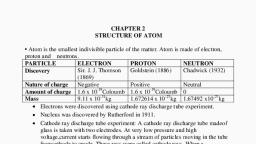
(ii) The radiation remained unaffected in an electric or, magnetic field, i.e., the radiation was neutral., (iii) The particles constituting the radiation had the, same mass as that of the proton. Thus, the relative, mass of such a particle = 1 amu and the absolute mass, 1.6 1024 g. Because of their electrical neutrality,, these particles were called neutrons., - Mass of a neutron - The absolute mass of a neutron, is 1.6 1024 gram. The mass of a neutron is equal to, the mass of a proton hence its relative mass is 1 u., - Charge of a neutron - Neutron has no charge. It is, electrically neutral., Summary of the characteristics of electrons, protons, and neutrons, Propert Electron, Proton, Neutron, ies, 1. Symbol, 0 , 1 , 1 , e e, p p, n n, , 1, , , 1 , 0 , 2., , Nature, , 3., , Relative, charge, Absolut, e, charge, Relative, mass, Absolut, e mass, , 4., , 5., 6., , Negatively, charged, 1, 1.602 10, , 19, , C, , Positively, charged, +1, , Neutral, , 1.602 , , 0, , (ii) The negatively charged electrons may be regarded, as studded or embedded in this sphere, (iii) The positive charge due to protons and negative, charge due to electrons balance each other., As a result, an atom as a whole is electrically neutral, or it has no net charge., , Limitation: J.J. Thomson's model of atom was unable, to explain how positively charged particles are, shielded from the negatively charged particles,, without getting neutralized., Rutherford's Model of an Atom, - Rutherford's a-particle scattering experiment, In 1911, Rutherford performed -particles scattering, experiment which led to the downfall of Thomson's, model. The experiment involved the bombardment of, a thin sheet of gold (thickness - 100 nm or 10-5 cm) by, -particles. Alpha particles are positively charged, helium nuclei, carries a mass of 4 u and a charge of +2, units. -Particles were obtained from radium placed, in the cavity of a block of lead and made into a fine, beam with a slit. A circular fluorescent screen coated, with zinc sulphide (ZnS) was placed around the foil to, detect the deflection suffered by -particles., Whenever an -particle struck the screen, a tiny, flash, of light was produced at that point., , 0, , 19, , 10 C, , 1, , u, , 1838, 9.109 , 10, , 28, , g, , 1u, , 1u, , 1.67 , , 1.67 10 g, , 10, , 24, , 24, , g, , Do You Know, All atoms except hydrogen contain neutrons, thus, the, atomic mass of hydrogen is same as that of a proton., , After the discovery of electrons, protons and, neutrons, scientists tried to determine their relative, positions in an atom. Various models for structure of, an atom were suggested., , Rutherford observed that, (i) Most of the -particles (nearly 99%) passed, through the gold foil undeflected., (ii) Some of the -particles were deflected by small, angles., (iii) A very few -particles (1 in 20,000) were either, deflected by very large angles or were actually, reflected back along their path., , Thomson's Model of an Atom, (i) An atom may be regarded as a positively charged, sphere in which protons are present., 6
Page 6 :
Rutherford explained his observation as follows:, (i) Since most of the -particles passed through the, foil undeflected, it indicates that the most, of the space in an atom is empty., (ii) -Particles being positively charged and having, considerable mass, could be deflected only by some, heavy, positively charged centre. The small angle of, deflection of -particles indicated the presence of a, heavy positive centre in the atom. Rutherford named, this positive centre as nucleus., (iii) -Particles which make head-on collision with, heavy positive centre are deflected through large, angles. Since the number of such -particles is very, small, thus the space occupied by the heavy positive, centre must be very small., , , , Radius of an atom is of the order of 1010 m or 1 A, while the radius of the nucleus has been estimated to, be of the order of 1015 m or 1 femtometer or 1 fermi., , (1 fm 1015 m), Drawbacks of Rutherford's Atomic Model, - It has been found that, if an electrically charged, particle revolves around the circular path, then it, always radiates out energy. Thus, if an electron moves, around the nucleus, it must continuously radiate out, energy and hence, gradually move towards nucleus in, a spiral path, till it collides with nucleus. However, we, know that atom is very stable. Rutherford's model, cannot explain this stability., - Rutherford's model of atom does not say anything, about the arrangement of electrons in an atom., , Main features of Rutherford's Nuclear Model, - An atom consists of two parts. These are nucleus and, extra nuclear portion., - Nucleus is present in the centre of the atom and is, surrounded by extra nuclear portion., - The size of the nucleus is very small as compared to, that of the atom., - The mass of the atom is mainly of the nucleus. All, the protons and neutrons (discovered later on by, Chadwick) are present in the nucleus., - The positive charge on the nucleus is because of, protons present (each proton has one unit positive, charge)., - All the electrons are present in the extra-nuclear, space around the nucleus., - The total positive charge of the nucleus due to the, presence of protons is the same as that of the, electrons present in the extra nuclear space., Therefore, the atom as a whole is electrically neutral., - Electrons present in the extra nuclear portion are, not stationary. These are revolving around the, nucleus at high speed following a circular path., - The revolving electrons do not come close to the, nucleus or drawn towards the nucleus because their, force of attraction towards the nucleus is balanced by, the centrifugal force which is of the same magnitude., It is directed away from the nucleus., , Bohr's Model of Atom, This model was proposed by Neils Bohr in 1913., The main points of this model of atom (called, postulates of Bohr's model of atom) are as follows:, - An atom consists of a small heavy positively charged, nucleus in the centre and the electrons revolve, around it in the circular paths called orbits., - In a particular atom, the orbits in which the, electrons revolve are the discrete orbits having fixed, radii and energy. These discrete orbits are also called, energy levels or shells. As energy of the orbits is fixed,, these are also called stationary states. These are, numbered as 1,2,3,4 etc. as we move outwards from, the nucleus, they are represented by the letters K, L,, M, N etc. as shown. The energy of these shells, increases as we move outwards from the nucleus., Thus, representing the energies of 1st, 2nd, 3rd, 4th, shell etc. by E1 , E2 , E3 , E4 etc., we have:, E1 E2 E3 E4, 7
Page 7 :
However, the gaps between the successive energy, shells decrease as we move outwards from the, nucleus., , For example:, Number of protons in hydrogen atom and carbon, atom are 1 and 6 respectively. So, their atomic, numbers are 1 and 6 respectively., • The number of protons in an atom is equal to the, number of electrons since atom as a whole is, electrically neutral., Thus,, Atomic number of an element = Number of protons, in the nucleus, = Number of electrons in the extra nuclear part (in, neutral atom), Atomic number of an element is generally denoted, by the symbol 'Z', , - As long as an electron is revolving in a particular, orbit, it can neither lose energy nor gain energy. Thus, the atom is stable and does not collapse. The state of, the atom with lowest energy is called ground state of, the atom., - Energy is lost or gained by an electron only when it, jumps from one orbit to the other. The energy gained, or lost is equal to the difference of energy of the two, energy levels involved. Thus, if energy falls on an, electron and it absorbs this energy, it will jump to, some outer shell. The atom is then said to be in the, excited state. In the excited state, the atom is not, stable. It loses or emits energy and jumps back to, some inner energy level. In other words, an electron, jumps from inner shell to outer shell by absorbing, energy whereas energy is emitted when an electron, jumps from an outer shell to an inner shell., , Mass Number, The sum of the number of protons and neutrons in, the atom of an element is known as mass number., Mass number is generally represented by the letter A., Mass number (A) of an element = Number of protons, (p) + Number of neutrons (n)., A pn, Representation of Atomic Number and Mass Number, with the Symbol of Element, Atomic number of an element is usually denoted by 'Z', whereas mass number (atomic mass) is represented, by 'A'. They are represented along with the symbol of, the element (say X) as follows:, Mass number , A, X , Symbol, Atomic number , Z, i.e., atomic number (Z) is written on the lower left, side whereas mass number (A) is written on the upper, left side of the symbol., For example, carbon has atomic number (Z) = 6 and, mass number (A) = 12. Hence, we represent it as 12, 6 C., , The amount of energy emitted or absorbed is given by, the difference of energies of the two levels, concerned, i.e.,, 2 E1, where 2 and E1 are the energies of the electron in, the higher and lower energy levels respectively and, is the difference in energies of the two levels., , How to Determine the Number of Electrons, Protons, and Neutrons in an Atom, From the knowledge of atomic number and mass, number of an element, the number of electrons,, protons and neutrons can be easily predicted., For an atom, Atomic number (Z) = No. of protons (p) = No. of, electrons (e), Mass number (A) = No. of protons (p) + No. of neutron, (n), But, No. of protons = Atomic number (Z), , Atomic Number, •, •, , In 1913, Moseley introduced an atomic parameter, called atomic number., Atomic number of an element is equal to the, number of protons present in the nucleus of an, atom of that element., , 8
Page 8 :
A Z n, n AZ, Number of neutrons = Mass number - Atomic, number, For example, lithium has atomic number (Z) = 3 and, mass number (A) = 7. Therefore,, Number of electrons = Atomic number = 3, Number of, protons = Atomic number = 3, Number of neutrons = Mass number - Atomic number, A Z 7 3 4., Nucleus consists of protons and neutrons and these, are collectively known as nucleons., Since the electrons are of negligible mass, the entire, mass of the atom is due to the nucleus i.e., nucleons., , 1., , Sol.:, , 2., , Sol.:, , 3., , Sol.:, , (ii) Number of protons in the nucleus plus no., of neutrons in the nucleus is known as mass, number., Mass number of oxygen (A) 8 8 16., , Distribution of Electrons in Different Shells (Orbits), The distribution or arrangement of the electrons in, different shells of the atoms is called electronic, configuration of the element. To write the electronic, configuration we should to know the following:, 1. Total number of electrons present in the atom., 2. Maximum number of electrons that can be present, in each shell of atom., Electronic configuration is based on certain rules, given by Bohr-Bury scheme. According to this scheme,, (i) The maximum number of electrons which can be, present in any shell of an atom is given by the formula, 2n 2 , where n is the number of shell as counted from, nucleus. Thus, according to above formula:, Maximum no. of electrons in first shell (K-shell), , Calculate the number of electrons, protons, and neutrons in sodium atom. Given that, atomic number of sodium is 11 and mass, number (atomic mass) is 23., Atomic number (Z) = 11, Mass number (A) =23, Number of protons = Atomic number =11, since, the atom is neutral. Number of, electrons = Number of protons =11, Mass number (A) = No. of protons (p) + No. of, neutrons (n), Number of neutrons A Z 23 11 12., The nucleus of the atom of an element, contains 17 protons and 18 neutrons., Calculate the atomic number and mass, number of the element and represent them, along with the symbol of the element., Atomic number (Z), = Number of protons = 17, Mass number (A) = No. of protons + No. of, neutrons 17 18 35, Element with atomic number 17 is chlorine., 35, Hence, we represent it as Cl., 17, , 2n2 2(1)2 2., Maximum no. of electrons in second shell (L-shell), , 2n2 2(2)2 8., Maximum no. of electrons in third shell (M-shell), , 2n2 2(3)2 18., Maximum no. of electrons in fourth shell (N-shell), , 2n2 2(4)2 32., (ii) The outermost energy shell in an atom cannot, have more than eight electrons even if it has a, capacity to take up more electrons according to first, rule. For example, when M shell is the outermost shell, of an atom, it can accommodate maximum of eight, electrons only, although M shell has the capacity to, accommodate a maximum of 18 electrons., (iii) An atom becomes stable (it stops reacting, chemically with other elements) when its outermost, shell has eight electrons, or it has only one shell, containing 2-electrons., (iv)The penultimate shell i.e., the shell proceeding the, outermost one, can accommodate a maximum of 18, electrons., (v) Electrons do not go into a new shell before the, inner shell is completely filled., , The symbol of oxygen atom is 16, 8 O, (i) What is the name given to the number of, protons in the nucleus of the atom?, (ii) What is the name given to the number of, protons plus number of neutrons in the, nucleus of the atom?, (i) Number of protons in the nucleus of the, atom is known as atomic number., Atomic number of oxygen (Z) = 8, 9
Page 9 :
chemically un reactive. For example, noble gases (He,, Ne, Ar etc.) have completely filled outermost shells., Hence, the noble gases do not participate m chemical, combinations,, 2. When the atom of an element has less than 8, electrons in its outermost shell, the element will be, reactive., , In the elements having atomic number more than 18,, electron may go into a new shell even before the, inner shell is completely filled., Significance of Electronic Configuration, The electronic configuration of an atom helps in, determining the chemical behavior of an element., 1. When the atom of an element has completely filled, outermost shell i.e., having 8 electrons in the, outermost shell (octet) or 2 electrons (duplet) where, the outermost shell is K shell, the element will be, , Representation of Atomic structure of some elements., Element, , 1, Hydrogen H, 1, , No. of neutrons, (A - Z), , No. of, protons Z, , No. of, electrons, , Electronic, configuration, , 11 0, , 1, , 1, , K, , Helium, , 4, He, 2, , 42 2, , 2, , 2, , K, 2, , Lithium, , 7, Li, 3, , 73 4, , 3, , 3, , K L, 2, 1, , 945, , 4, , 4, , KL, 2, 2, , 11 5 6, , 5, , 5, , KL, 2, 3, , 12 6 6, , 6, , 6, , KL, 2, 4, , 14 7 7, , 7, , 7, , KL, 2, 5, , 16 8 8, , 8, , 8, , KL, 2, 6, , Beryllium, , Boron, , 9, Be, 4, , 11, B, 5, , Carbon, , 12, C, 6, , Nitrogen, , Oxygen, , 14, N, 7, , 16, O, 8, , 10, , Geometric, representation of, Atomic structure
Page 10 :
Fluorine, , Neon, , 19, F, 9, , 20, Ne, 10, , 23, Na, 11, , Sodium, , Magnesium, , Aluminium, , Silicon, , 27, Al, 13, , 28, Si, 14, , Phosphorus, , Sulphur, , 31, P, 16, , 32, S, 16, , Chlorine, , Argon, , 24, Mg, 12, , 35, Cl, 17, , 40, Ar, 18, , 19 9 10, , 9, , 9, , KL, 2, 7, , 20 10 10, , 10, , 10, , KL, 2, 8, , 23 11 12, , 11, , 11, , KLM, 2, 8, 1, , 24 12 12, , 12, , 12, , KLM, 2, 8, 2, , 27 13 14, , 13, , 13, , KLM, 2, 8, 3, , 28 14 14, , 14, , 14, , KLM, 2, 8,4, , 31 15 16, , 15, , 15, , KLM, 2, 8, 5, , 32 16 16, , 16, , 16, , KLM, 2, 8, 6, , 35 17 18, , 17, , 17, , KLM, 2, 8, 7, , 40 18 22, , 18, , 18, , KLM, 2, 8, 8, , 11
Page 11 :
Potassium, , Calcium, , 39, K, 19, , 39 19 20, , 19, , 19, , KLMN, 2, 8, 8, 1, , 40 20 20, , 20, , 20, , KLMN, 2, 8, 8, 2, , 70, Ca, 20, , With increase in atomic number, the difference of, energy between the successive shells decreases. Thus,, the M and N energy shells come so close together, that they overlap. When M shell acquired 8 electrons,, it shift to higher energy than N-shell. Hence, filling of, N-shell starts., 6., , 4., Sol.:, , 5., , Sol.:, , Sol.:, Write the electronic configuration of chlorine, atom (atomic no. = 17, mass no. = 35), (i) Atomic number of chlorine (Cl ) 17 Thus,, it has 17 electrons, 17 protons and 18, neutrons, 1st shell (K-shell) can accommodate maximum, 2 electrons, 2nd shell (L-shell) can accommodate, maximum 8 electrons., The remaining 7 electrons will enter into 3rd, shell (M-shell)., Hence, the electronic configuration of, chlorine atom will be, KLM, or 2, 8, 7, 2, 8, 7, , 7., Sol.:, 8., , Sol.:, , The atom of an element has 2 electrons in the, M-shell. What will be the atomic number of, the element? Name the element., As the atom has 2 electrons in the M-shell,, this means that K and L shells are completely, 12, , filled. As completely filled K-shell has 2, electrons and completely filled M-shell has 8, electrons, therefore, complete electronic, configuration of the atom of the element will, be, K L M, 2 8 2, Total number of electrons 2 8 2 12, As the atom is neutral, total number of, protons = total number of electrons = Atomic, number = 12. Hence, the element is, magnesium., Lithium atom has atomic mass 6 and has 3, protons in it nucleus. How many neutrons, does it have?, Mass number of lithium is equal to its atomic, mass., Mass number (A) of lithium = 6, No. of protons in the nucleus = 3, Atomic number (Z) of the element = 3, No. of neutrons (n) A Z 6 3 3, Write the distribution of electrons in nitrogen, atoms., Nitrogen (Z = 7): 2 (K-shell); 5 (L-shell) or 2, 5., If the number of electrons in an ion is 10 and, the number of protons is 9, then, (i) What would be the atomic number of the, ion?, (ii) What is the charge on the ion?, (i) Atomic number (Z), = No. of protons = 9, (ii) Charge on the ion 1, Here, one electron is more than proton. So, this one extra electron attains -1 charge on, the ion.
Page 12 :
electrons, Lithium (Li), 3, 2, 1, 1, Sodium (Na), 11, 2, 8, 1, 1, Potassium (K), 19, 2, 8, 8, 1, 1, - Elements having different number of valence, electron s in their atoms show different chemical, properties., , Valence Electrons, The electrons present in the outermost shell of an, element are called valence electrons and the, outermost shell is called the valence shell., , Combining Capacity or Valency of Elements, , Significance of Valence Electrons, , - Elements, other than noble gas elements, contain, less than 8 electrons in their outermost shells. These, elements are chemically reactive and unstable. They, tend to acquire the stable outermost electronic, configuration of the noble gases. It is the tendency on, the part of elements that leads to chemical reactions., The noble gas configuration is achieved by elements, by losing, gaining or sharing electrons., , - The valence electrons of an atom are responsible, for, and take part in chemical changes., - The valence electrons determine the combining, capacity or the valency of the atom., - Elements having the same number of valence, electrons in their atoms possess similar chemical, properties. For example, all alkali metals have one, valence electron in their atoms. Hence, their chemical, properties are similar., Alkali metal, number, , Atomic, , Electronic, configuration, , - The number of electrons gained, lost or shared by, the atom of an element so as to complete its octet (or, duplet in case of elements having only K shell) is, called the valency of the element., , No. of, Valence, , Electronic configuration of first eighteen elements and their respective valencies., Name of, Elements, Hydrogen, Helium, Lithium, Beryllium, Boron, Carbon, Nitrogen, Oxygen, Fluorine, Neon, Sodium, Magnesium, Aluminium, Silicon, Phosphorus, Sulphur, Chlorine, Argon, , Symbol, H, He, Li, Be, B, C, N, O, F, Ne, Na, Mg, Al, Si, P, S, Cl, Ar, , Atomic, Number, 1, 2, 3, 4, 5, 6, 7, 8, 9, 10, 11, 12, 13, 14, 15, 16, 17, 18, , Number of, Electrons, 1, 2, 3, 4, 5, 6, 7, 8, 9, 10, 11, 12, 13, 14, 15, 16, 17, 18, , 13, , Electronic Distribution, K, L, M, 1, 2, 2, 1, 2, 2, 2, 3, 2, 4, 2, 5, 2, 6, 2, 7, 2, 8, 2, 8, 1, 2, 8, 2, 2, 8, 3, 2, 8, 4, 2, 8, 5, 2, 8, 6, 2, 8, 7, 2, 8, 8, , Valency, 1, 0, 1, 2, 3, 4, (8 5) 3, (8 6) 2, (8 7) 1, (8 8) 0, 1, 2, 3, (8 5) 3, (8 6) 2, (8 7) 1, (8 8) 0
Page 13 :
Anion, Anion is a negatively charged ion, formed by the gain, of one or more electrons by an atom. For example,, chlorine atom gains 1 electron to form a chloride ion, - Formation of anions: If an element has 5, 6 or 7, electrons in the outermost shell of its atom, then it, gains electrons to achieve the stable inert gas, electronic configuration of 8 valence electrons, and, forms negatively charged ion called anion., , Ions are electrically charged species:, Examples of the ions are: Sodium ion ( Na ), Magnesium ion (Mg 2 ), and chloride ion (Cl ). Anion, is formed by loss or gain of electrons by an atom, so it, contains an unequal number of electrons and protons., There are two types of ions:, (i) Cation, (ii) Anion, , - Formation of chloride ion (Cl - ) : Electronic, configuration of chlorine atom is 2, 8, 7. Chlorine, atom has 7 electrons in its outermost energy level. So,, in order to become more stable, a chlorine atom, accepts 1 electron from some other atom and, achieves the noble gas configuration. The number of, protons (17) and electrons (17) in a chlorine atom is, equal, therefore, it is electrically neutral. Chlorine, atom gains 1 electron to form a chloride ion. In the, chloride ion, there are 17 protons and 18 electrons., This means that in a chloride ion, there is one electron, more than protons. Due to this 1 extra electron, a, chloride ion has 1 unit negative charge., , Cation, Cation is a positively charged ion, formed by loss of, one or more electrons by an atom. For example,, sodium atom loses 1 electron to form sodium ion., - Formation of cations: If an element has 1,2 or 3, electrons in the outermost shell of its atoms, then it, loses these electrons to achieve the noble gas, electronic arrangement of eight valence electrons and, form positively charged ion or cation., - Formation of sodium ion, (Na+ ) : The electronic, configuration of sodium is 2, 8, 1. Sodium atom has 1, electron in its outermost shell. Thus, sodium atom is, not stable. In order to become stable, sodium atom, donates its 1 outermost electron to some other atom., In neutral atom, the number of protons is equal to the, number of electrons, so atom as a whole is electrically, neutral. Sodium ion is formed by losing electron,, therefore, sodium atom gets 1 unit of positive charge, and forms sodium ion ( Na )., , No. of protons = 17, No. of electrons = 17, , 9., , No. of protons (11), No. of protons (11), No. of electrons (11), No. of electron (10), When sodium loses 1 electron from its outermost, shell to form sodium ion, then its whole outermost, shell (M) is removed. Thus, the size of cation is smaller, as compared to the neutral atom., , Sol.:, , 14, , No. of protons = 17, No. of electrons =18, , The valency of hydrogen is 1, magnesium 2,, aluminium3 and carbon 4. Can you see any, connection between die valency of an, element and the number of electrons it has in, its outermost electron shell? What would you, predict the valendes of helium (He),, phosphorus, (P), sulphur (S) and neon (Ne) to be?, The valency of an element depends upon the, "number of electrons in. the outermost shell, (valence shell) of an atom of the element. The, valency of an element is either equal to the
Page 14 :
Element, , 11., , A, B, C, Sol.:, , Number of, , A, B, C, 12., , 17, 14, 9, , Number of, protons, 17, 14, 9, , electrons neutrons, 17, 18, 14, 14, 9, 10, , Fill in the blanks., Atom, Mass no., , , , , 35, 28, 19, , Co, , -, , -, , No. of, neutrons, -, , Na, , 24, , 11, , -, , -, , -, , 20, , 60, 27, , 37, , , Cl, , Atomic no., , Mass, number, , Atomic, no., , Element, , Using these relationships, the blanks in the, above table are filled up as follows. The filled, numbers are shown in bold., , Sol.:, , We know that, number on the top-left of the, symbol is Mass number, and number at the, bottom-left of the symbol is Atomic number., Using the relationship,, Mass number = Atomic number + No. of, neutrons. One can calculate values of the, missing quantities (shown in bold). The completed, table is,, Atom, Mass no., Atomic no., No. of, neutrons, 60, 60, 27, 33, 27 Co, 24, 11, 37, 17, , Mass, number, , Sol.:, , Atomic, no., , 10., , number of valence electrons in an atom of the, element or to the number of electrons, required to complete an octet of 8 electrons, in its valence shell., Valency of a metal = number of valence, electrons, Valency of a nonmetal = 8 - number of, valence electrons, Helium (He): An atom of helium contains 2, electrons in its K shell. This shell is the, outermost shell of helium which is completely, filled with 2 electrons. Hence, valency of, helium = 0., Phosphorus (P): The electronic configuration, of the P atom is 2, 8, 5, Thus, it has 5 valence, electrons and it is a nonmetal. Hence,, valency of P 8 5 3., Sulphur (S): The electronic configuration of an, atom of S is 2, 8, 6., Sulphur is a nonmetal. Hence, valency of, S 8 6 2., Neon (Ne): The electronic configuration of, neon is 2,8. The outermost shell of neon is, completely filled. Hence, valency of neon = 0., An ion M 2 contains 10 electrons and 12, neutrons. What is the atomic number and, mass number of the element M? Name the, element., No. of electrons in M 2 ion = 10, Atomic number of atom M 10 2 12, No. of protons in atom M 12, Mass number of atom M = No. of protons +, No. of neutrons 12 12 24, The element M with atomic number 12 is, magnesium (Mg)., Complete the following table., , Na, , 24, , 11, , 13, , Cl, , 37, , 17, , 20, , Atoms of the same elements, having the same atomic, number, but different mass numbers are called, isotopes of that element., Since all isotopes of an element have the same atomic, number, all the isotopes should contain the same, number of protons inside their nuclei. Also, since, different isotopes of an element have different mass, numbers, the number of neutrons in the nuclei of, isotopes of an element should be different. So,, isotopes may also be defined as follows:, The atoms of the same element which have the same, number of protons but different number of neutrons, inside their nuclei are called isotopes of an element., , protons electrons neutrons, 17, 18, 14, 14, 9, 19, For an atom, we know that,, Atomic number = No. of protons, No. of electrons = No. of proton = Atomic, number, Mass number = No. of protons + No. of, neutrons, , 15
Page 15 :
Isotopes of Hydrogen, , protons in the nucleus and same number of electrons, in the extra nuclear part., • Different mass numbers/Number of neutrons., The isotopes of an element have different mass, numbers and hence differ in the number of neutrons, present in the nucleus., • Same chemical properties., The isotopes of an element possess the same, electronic configuration and the same number of, valence electrons, therefore, they exhibit the, same chemical properties., • Different physical properties., The isotopes of an element have different masses,, hence, they have different physical properties, such as melting point, boiling point, density etc., • Different nuclear properties., Due to difference in the nuclear structure (i.e.,, number of neutrons), they have different nuclear, properties, e.g., C-14 isotope is radioactive, whereas C-12 isotope is non-radioactive., The radioactive isotopes are called radioisotopes., , Hydrogen (H) has three isotopes having mass, numbers 1, 2 and 3, but all having atomic number, equal to 1. These three isotopes of hydrogen can be, described as follows:, , 1, 1, , H, 1 electron, 1 proton, 0 neutron, (Protium), Ordinary, Hydrogen, , 2, 1, , H, 1 electron, 1 proton, 1 neutron, (Deuterium, D), Heavy Hydrogen, , 3, 1, , H, 1 electron, 1 proton, 2 neutron, (Tritium, T), Radioactive, Hydrogen, , Isotopes of Chlorine, , Applications of Isotopes, , Chlorine (Cl ) has two isotopes having mass number, 35 and 37. These are called chlorine-35 and chlorine37.Both the isotopes of Cl have the same atomic, number equal to 17. So, the two isotopes of chlorine, are described as follows:, , (i) Uranium isotope (U-235) is used in nuclear reactors, to produce nuclear energy., (ii) Isotopes are used to locate cracks in metal, castings., (iii) An isotope of sodium (Na-24) has been used to, diagnose restricted circulation of blood., (iv) Cobalt isotope (Co-60) is used to remove brain, tumours and in the treatment of certain types of, cancer., (v) An isotope of iodine has been used in the, treatment of thyroid disorders., Fractional Atomic Masses of Elements, Atomic masses of a large number of elements are, fractional and not whole numbers. For example,, atomic mass of chlorine is 35.5 while that of Fluorine, is 18.9984. The fractional atomic masses of elements, are due to the existence of their various isotopes, having different masses. The atomic mass of an, element is the average of the relative masses of all, the naturally occurring isotopes of the element., Obviously, average value comes out to be fractional., The calculation of average value of the atomic mass, can be illustrated with the help of the following, example: In nature, chlorine is found to exist in two, isotopes with mass numbers 35 and 37 respectively., , The distribution of 17 electrons is same in each case,, i.e, 2, 8, 7., 35, 17, , Cl, 17 electrons, 17 protons, 18 neutrons, , 35, 17, , Cl, 17 electrons, 17 protons, 20 neutrons, , General Characteristics of Isotopes, - Same atomic number. Number of protons/Number, of electrons. The isotopes of an element have same, atomic number and hence have same number of, 16
Page 16 :
These are found in the ratio of 3 : 1, i.e., 75% chlorine35 and 25% chlorine-37 isotope. Hence,, 3 35 25 37, Average atomic mass , 35.5 amu, 100, 75 35 25 37, or, 35.5 amu, 100, , 13., , The word isobar has been derived from Greek word, which means equally heavy (Isos = equal, barys =, heavy)., There are atoms of different elements with different, atomic numbers but having the same atomic mass., These different elements are called isobars., For example, argon (Ar), potassium (K) and calcium, (Ca) are isobars., Element, Ar, K, Ca, Atomic mass, 40, 40, 40, Atomic number, 18, 19, 20, Since the atoms of these elements have the same, atomic mass, the sum of the number of protons and, neutrons must be the same. Protons and neutrons, present in the nucleus are also called nucleons. Thus,, the total number of nucleons is same in the atoms of, isobaric elements. They differ in atomic numbers due, to the presence of different number of protons in, their nuclei., , Sol.:, , Which of the following pairs represent, isotopes and which represent isobars?, 235, 238, 40, U ,92, U, K ,40, (i) 92, (ii) 19, 20 Ca, 18, (iii) 13 H ,32 He, (iv) 16, 8 X ,8 X, Calculate the difference in the number of, neutrons in the isotopic pairs., 235, 238, U and 92, U are isotopes because they, (i) 92, have same atomic number, i.e., 92 but, different mass numbers, i.e., 235 and 238., No., of, neutrons, in, , U A Z 235 92 143, No., of, neutrons, in, 238, 92 U A Z 238 92 146, Difference in the number of neutrons, 146 143 3, 40, 40, (ii) 19 K ,20 Ca are isobars because they are, atoms of different elements with different, atomic numbers 19 and 20 but same mass, number 40., (iii) 13 H , 22 He are isobars because they are, atoms of different elements with different, atomic numbers 1 and 2 but same mass, number 3., 18, (iv) 16, 8 X and 8 X are isotopes because they, have same atomic number, i.e., 8 and, different mass numbers, i.e., 16 and 18., No. of neutrons in 16, 8 X 16 8 8, 235, 92, , Atoms of different elements having same number of, neutrons but different mass numbers are called, isotones., 31, 30, P (15, Si (14 protons, 16 neutrons), 15, For example, 14, , No. of neutrons in 18, 8 X 18 8 10, Difference in the number of neutrons, 10 8 2., , 32, S (16 protons, 16, protons, 16 neutrons) and 16, neutrons) are isotones because all have 16 neutrons., , 17
Page 17 :
CONCEPT MAP, , Atomic Structure, , Fundamental particles, , Electron, Discoverer: J.J. Thomson, Symbol: e or, Charge:, Charge, on, electron, was, determined by R.A. Millikan with, the help of oil drop experiment)., Mass:, Properties:, (i) Travel in straight line., (ii) Produce mechanical effects., (iii) Deflected in the presence of, electric and magnetic field., (iv) Produce X-rays on striking, metal targets., (v) e/m ratio is independent of, nature of gas., , Proton, Discoverer: Goldstein, Symbol: p or p+, Charge:, , Mass:, Properties:, (i) Travel in straight line., (ii) Deflected in the presence of, electric and magnetic field in a, direction opposite to the, cathode rays., (iii) e/m ratio depends on the, nature of gas inside the, discharge tube., (iv) Produce mechanical effects., , Neutron, Discover: Chadwick, Symbol: n, Charge: 0, , Atomic, Models, J.J. Thomson's plum pudding model, of atom, (i) An atom is considered to be sphere, of uniform positive charge, and, electrons are embedded into it like, raisins in a plum pudding., (ii) In an atom, total positive charge is, equal to the total negative charge., (iii) Mass of the atom is considered to, be uniformly distributed, , Rutherford's nuclear model of an, atom, (i) An atom consists of a positively, charged nucleus which is surrounded, by electrons moving around t., (ii) Electrons and nucleus are held, together by coulombic force of, attraction., (iii) The size of nucleus is very small as, compared to the size of the atom., , Bohr's model of an atom, (i) Electrons revolve around the, nucleus ill a limited number of orbits,, called permissible orbits., (ii) Each of these orbits has definite, energy, hence the" are also known as, energy shells., (iii) The energy of an electron remains, constant so long as it stays in a given, orbit. Electrons present in different, orbits have different energies., (iv) When an electron jumps from a, lower energy level to a higher one., Some energy is absorbed, while some, energy is emitted when electron jumps, from a higher energy level to a lower, one., , Mass:, Properties (i) unaffected in electric, and magnetic field., , 18, , General terms, , Atomic number (Z), Z = No. of protons = No. of, electrons (in neutral atom), , Atomic mass (Z), A = No. of protons + No., Neutrons, Isotopes: Atoms of the, same element, having, the same atomic number, but, different, mass, numbers, are, called, isotopes of that element., Isobars:, Atoms, of, different, elements which have the, same mass number but, different atomic number, are called isobars., , Isotones:, Isotones are atoms of, different elements with, same, number, of, neutrons but different, atomic, and, mass, number.
Page 18 :
Essential Points, Calculation of the mass of the electron, , This expression can further be simplified by, substituting the values of all the constant, terms ( , m, e, h)., So, now the expression for energy is, 2.18 1019 Z 2, 1312 Z 2, 1, En , J, atom, , , kJ / mol, n2, n2, , From the values of e I m and e, the mass (m) of the, electron was determined by dividing e by elm. Thus,, Charge/mass (elm) (e / m) 1.758820 1011 C kg 1, Charge (e) 1.6022 1019 C, , 13.6Z 2, eV atom1, 2, n, where Z is the atomic number of the element, (e.g., for He , Z 2 for Li 2 , Z 3, etc.), , e, 1.6022 1019 C, , Mass of electron (m) , e / m 1.758820 1011 C kg 1, , , , 9.1094 1031 kg, The mass of the electron is much smaller than the, mass of an atom of hydrogen. It has been found that, the mass of an electron is approximately 1/1837th (or, 5.485 104 times) the mass of an atom of hydrogen., However, this mass is very small and for all practical, purposes, it may be taken as negligible. The charge of, the electron is the smallest known electrical charge, and is usually referred to as unit negative charge., Thus, an electron may be defined as a sub-atomic, particles which carries one unit negative charge, (1.622 1019 C ) and has a mass (9.11031 kg ) equal, to 1/1837th of that of hydrogen atom. Electrons are, essential constituents of all atoms. The discharge tube, experiment showed that the electrons constituting, the cathode rays are the same irrespective of (i) the, nature of the material of the cathode and (ii) the gas, used in the discharge tube., All these electrons possess the same mass and the, same charge and therefore, they have the same, charge/mass (e/m) ratio. This means that the cathode, rays do not consist of charged gaseous atoms,, otherwise, e/m would have been different for, different gases used. Thus, the rays are made up of, fundamental common particles known as electrons., Moreover, the electrons emitted from various sources, and by various methods are found to have the same, mass and the same charge. Thus, it may be concluded, that the electrons are universal constituents of all, matters., If an electron having mass 'm' and charge 'e' revolves, around the nucleus of charge 'Ze' (Z is the atomic, number and e is the charge') with a linear velocity of, . Let ‘r’ is the radius of the orbit in which electron, revolves., •, , •, , Calculation of the radius of the Bohr's orbit:, (nth orbit):, n2 , rn 0.529 A, Z, , , where 1 A 1010 m, •, , •, , •, , Calculation of the velocity of an electron in, Bohr's orbit (nth orbit):, Z, n 2.188 108 cm s 1, n, Relation between potential energy, kinetic, energy and total energy:, T .E. K .E. P.E., 1 Ze2, 1 Ze2, T .E , , K .E , 2 r, 2 r, 2, Ze, P.E , r, Suppose an electron transists from first, energy level (n1) to second energy level (n2)., Then, the change of energy is given by, 2 E1, Also, h, E E1, h E2 E1 or 2, h, Relationship, between, frequency, and, wavelength, c, , , , , where is the frequency of the photon of, light, is the wavelength of the photon and c, is the speed of light, c E E1, hc, or , 2, E2 E1, , h, , Calculation of the energy of an electron: The, total energy of an electron in nth orbit is:, 2 2 mZ 2 e4, En , kJ / mol, n2 h2, 19
Page 19 :
( ) , , •, •, , magnitude but with opposite sign as that of electron, (i.e. e 1.6 1019 C ), (iv) Positrons are very unstable and combines with, electron producing -rays., , 1, , , Wave number, 1, 1, unit cm or m, The light absorbed or emitted as a result of an, electron, changing, orbits, produces, characteristic absorption or emission spectra, which can be recorded on the photographic, plate as a series of lines, the optical spectrum, of hydrogen consists of several series of lines, called Lyman, Balmer, Paschen, Brackett,, PFund series., , Neutrino and Anti-neutrino, (i) These particles have approximately zero charge and, mass., (ii) These are discovered by Pauling (1933) and Fermi, (1934)., Antiproton, (i) These particles are discovered by Segre., (ii) Mass of antiproton is 1.673 1027 kg and charge is, , 1.6 1019 C., Meson, (i) It may be positively charged, negatively charged or, neutral., (ii) Mesons are discovered by Yukawa (1935)., (iii) Meson are of 3 types depending upon their, charge: -meson, -meson and neutral ( ) meson., (iv) -Mesons are called pions., (v) Meson indicates stability of nucleus., (vi)Meson is heavier than electron (200 times) but, lighter than proton., , Calculation of wave numbers ( ) of the lines by he, Rydberg formula., 1, 1 , ( ) R 2 2 Z 2, n1 n2 , where R is a constant, called Rydberg constant and, has a value equal to 109,677cm1 , n1 and n2 are whole, numbers and for a particular series, n1 is constant and, n2 varies., For example,, For Lyman series n1 1, n2 2, 3, 4 ....................., For Balmerseries n1 2, n2 3, 4, 5 ....................., For Paschenseries n1 3, n2 4, 5, 6 ....................., For Brackett series n1 4, n2 5, 6, 7 ....................., For Pfundseries n1 5, n2 6, 7, 8 ....................., , The wave character of an electron and uncertainty in, its position gave a serious blow to Bohr's model., According to Bohr, the electrons revolve in welldefined circular orbits. But the idea of uncertainty in, position and velocity over ruled the Bohr's picture of, fixed circular orbits. Scientists started looking for a, theory which may explain, (i) stability of atom., (ii) dual character of matter., (iii) uncertainty principle., This resulted in a new approach known as wave, mechanics. In 1927, Schrodinger described the, behavior of electron by a mathematical equation, known as Schrodinger wave equation. The solution of, wave equation led to the concept of most probable, regions in place of well-defined circular paths, proposed by Bohr. According to this approach, we, cannot say simply that the electron exists at a, , Positron (1e0 or e+), (i) Also called as positive electron because it is the, positive counterpart of electron., (ii) It is discovered by Anderson in 1932., (iii) Mass of positron is same as that of electron (i.e.,, m 9.11031 kg ) and charge of positron is same in, 20
Page 20 :
particular point, but we talk about certain regions in, space around the nucleus where the probability, (chances) of finding the electron is maximum (9095%). These most probable regions in space are called, orbitals. Thus, an orbital may be defined as a region in, space around the nucleus where the probability of, finding the electron is maximum., , Azimuthal Quantum Number (l), This quantum number determines the angular, momentum of the electron. This quantum number is, also known as orbital angular momentum or, subsidiary quantum number., This is denoted by l . The value of l gives the subshell, or sublevel in a given principal energy shell to which, an electron belongs. It can have positive integer, values from zero to (n 1) where n is the principal, quantum number. That is l 0, 1, 2, 3... (n-1), For example, for n = 1, I has only one value, i.e., I = 0, For n 2, l has two values: l 0, 1., for n 3, l has three values: l 0, 1 ,2., Thus, for each value of n, there are n possible values, of l ., The various subshells or values of l are also, designated by letter s, p, d, f... as, Value of l, 0 1 2 3 4 5…., Designation, s p d f g h…., The different subshells or sublevels are represented, by first writing the value of n (1, 2, 3...) and then the, letter designation for the value of I (s, p, d, f...).For, example, an orbital with n 1 and l 0 is denoted as, Is, an orbital with n 3, l 2 is denoted as 3d. The, designations of subshells for n 1 to n 4 are given:, , Number of Orbits, Sublevels and Orbitals in an Atom, Theoretically speaking, an infinite number of orbits, are possible in an atom but only those are permissible, which, satisfy, the, quantization, equation,, m r nh / 2 ., The number of sub-levels in an orbit is equal to the, orbit number itself. They are denoted by the symbol, s, p, d & f based on the concept of quantum, numbers., Orbital is a three dimensional real space around, nucleus where probability of finding electrons is, maximum. An orbital can accommodate maximum of, 2 electrons., , To describe each electron in an atom in different, orbitals, we need a set of three numbers known as, quantum numbers. These are designated as n, I and, m. In addition to these three numbers another, quantum number is also needed which specifies the, spin of the electron., These are discussed below:, Principal Quantum Number (n), This quantum number determines the main energy, shell or level in which the electron is present. It is, denoted by n. It can have whole number values, starting from 1 such as n = 1, 2, 3, 4.... This quantum, number is also regarded as shell. The shell with n = 1, is called the first shell. The shell with n = 2 is called the, second shell and so on. The various shells are also, called K, L, M, N as:, n 1 2 3 4…., shell K L M N…., , n, , l, , Subshell, designation, 1s, 2s , , 2 p, , No. of subshells in, a shell, One, Two, , 1, 2, , 0, 0, 1, , 3, , 0, 1, 2, , 3s , , 3 p, 3d , , Three, , 4, , 0, 1, 2, 3, , 4s , 4 p, , , 4d , 4f , , , Four, , Magnetic Quantum Number (ml), This quantum number describes the behavior of, electron in a magnetic field. We know that the, movement of electrical charge is always associated, with magnetic field. Since the revolving electron, possesses angular momentum, it will give rise to a, very small magnetic field which will interact with the, 21
Page 21 :
external magnetic field of the earth. Under the, influence of external magnetic field, the electrons in a, given subshell orient themselves in certain preferred, regions of space around the nucleus. These are called, orbitals. Thus, this quantum number gives the number, of orbitals in a given subshell. It is designated by ml ., The allowed values of ml depend upon the value of 1., For a given value of l , ml can have values l, through 0 to + 1. That is, ml l ....0.... l, In other words, there are (2l 1) values of m, for, each value of l . For example,, If l 0, ml has only one value, i.e., ml 0, i.e., s-subshell has only one orbital called s-orbital., If l 0, ml may be 1, 0 1., i.e., p-subshell contains three orbitals called porbitals. These are indicated by numerical subscripts, ( p1 , p0 , p1 ) or these are designated by alphabetical, subscripts ( px ' p y and pz ). Thus, there are three 2p-, , It is observed that the electron in an atom is not only, revolving around the nucleus but is also spinning, around its own axis. In 1925, George Uhlenbeck and, Samuel Goudsmit proposed fourth quantum number, known as electron spin quantum number. This, quantum number describes the spin orientation of the, electron. It is designated by ms . Since the electron can, spin in only two ways-clockwise or anticlockwise and,, therefore, the spin quantum number can take only, two values: 1/ 2 or 1 / 2. This quantum number, has a value independent of the values of the other, three quantum numbers. Instead of giving number for, ms 1 / 2 or 1 / 2 the two orientations are usually, designated by arrows pointing up and down:, (spin up) or (spin down) respectively., s-SubshelI (containing only one orbital) can have a, maximum of 2 electrons., p-Subshell (containing three orbitals) can have, maximum of 6 electrons., d-Subshell (containing five orbitals) can have, maximum of 10 electrons., f-Subshell (containing seven orbitals) can have, maximum of 14 electrons., It may be noted that the number of electrons in a, subshell do not depend upon the value of principal, quantum number. From this we can calculated the, number of electrons in various shells as given below:, , orbitals, designated as 2 px ' 2 p y and 2 pz ., If l 2, ml may be 2, 1,0, 1, 2., i.e., d-subshell contains five orbitals called d-orbitals., Similarly,, If l 3, ml may be 3, 2, 1,0, 1, 2, 3., i.e., f-subshell contains seven orbitals called f-orbitals., Spin Quantum Number (ms), , (n 1), K-shell, , (l 0), 1s-subshell, , (m 0), one orbital, , 2 electrons, , (n 2), L-shell, , (l 0), 2s-subshell, (l 1), 2p-subshell, , (m 0), one orbital, (m 1,0, 1), three orbitals, 4 orbitals, , 2 electrons, , (l 0), 3s-subshell, (l 1), 3p-subshell, (l 2), 3d-subshell, , (m 0), one orbital, (m 1,0, 1), three orbitals, (m 2, 1,0, 1, 2), five orbitals, 9 orbitals, , 2 electrons, , (n 3), M-shell, , 22, , 6 electrons, 8 electrons, , 6 electrons, 10 electrons, 18 electrons
Page 22 :
(n 4), N-shell, , (l 0), 4s-subshell, (l 1), 4p-subshell, (l 2), 4d-subshell, (l 3), 4f-subshell, , (m 0), one orbital, (m 1,0, 1), three orbitals, (m 2, 1,0, 1, 2), five orbitals, (m 3, 2, 1,0, 1, 2, 3), seven orbitals, 16 orbitals, , 2 electrons, 6 electrons, 10 electrons, 14 electrons, 32 electrons, , Therefore, it may be concluded that the maximum number of orbitals in each shell is n2 and maximum number of, electrons is 2n2 as shown ahead:, Shell symbol, Shell number ( n), , K, 1, , L, 2, , M, 3, , N, 4, , No. of orbitals (n 2 ), , 1, , 4, , 9, , 16, , 2, , 8, , 18, , 32, , 2, , No. of electrons (2n ), , 23