Page 1 :
STRUCTURE OF ATOM, , STRUCTURE OF ATOM, 1. INTRODUCTION, In this chapter, we explore the inside world of atoms which is, full of mystery and surprises. Whole chemistry is based on, atoms and their structures. We will also study the behaviour, exhibited by the electrons and their consequences., 1.1 Discovery of fundamental particles, Dalton’s atomic theory was able to explain the law of, conservation of mass, law of constant composition and law, of multiple proportion very successfully but it failed to, explain the results of many experiments like it was known, that substances like glass or ebonite when rubbed with silk, or fur generate electricity, 1.1.1 Discovery of electron, William Crookes in 1879 studied the electrical discharge in, partially evacuated tubes known as cathode ray discharge, tubes., A discharge tube is made of glass, about 60cm long, containing two thin pieces of metals called electrodes,, sealed in it. This is known as crooke’s tube. The negative, electrode is known as cathode and positive electrode is, known anode., When a gas enclosed at low pressure( 10 -4 atm) in, discharge tube is subjected to a high voltage ( 10,000V),, invisible rays originating from the cathode and producing a, greenish glow behind the perforated anode on the glass, wall coated with phosphorescent material ZnS is observed., These rays were called cathode rays., , 1., 2., , 1.1.2 Properties, They produce sharp shadow of the solid object in their path, suggesting that they travel in straight line., They are deflected towards the positive plate in an electric, field suggesting that they are negatively charged. They were, named as electrons by Stoney., , 3., , They can make a light paddle wheel to rotate placed in their, path. This means they possess kinetic energy and are material, particles., , 4., , They have a charge to mass ratio = 1.75882 × 10¹¹C/kg, , 5., 6., 7., , They ionise gases through which they travel., They produce X-rays when they strike a metallic target., The characterstics of cathode rays (electrons) do not depend, on the material of electrodes and nature of the gas present in, the cathode ray tube., Thus, we can conclude that electrons are basic constituents, of all matter., , +, Cathode, , Anode, N, , S, C, , –
Page 2 :
established, therefore it was thought that some positively, charged particles must also be present in the atom. So, during, the experiments with cathode rays, the scientist Goldstein, designed a special type of discharge tube. He discovered, new rays called Canal rays. The name canal rays is derived, from the fact that the rays travelled in straight line through, a vacuum tube in the opposite direction to cathode rays,, pass through and emerge from a canal or hole in the cathode., They are also known as anode rays., , Charge on the electron is found to be –1.6022 × 10⁻¹⁹C., The mass of electron was thus calculated as, , 1.2.2 Properties:, 1., , They travel in straight lines., , 2., , They carry a positive charge., , 3., , They are made up of material particles., , 4., , The value of the charge on the particles constituting the, anode rays is found to depend on the nature of gas taken., , 5., , The mass of the particles constituting the anode rays is, found to depend on the nature of gas taken., , 6., , The charge to mass ratio(e/m) of the particles is also found, to depend on the gas taken., , 7., , Their behaviour in electric and magnetic field is opposite to, that observed for electron., 1.2.3 Origin of anode rays:, , m, , e, 1.6022 1019 C, , 9.1094 1031 kg., e / m 1.758820 1011 C / kg, 1.2.1 Discovery of proton, , Since the atom as a whole is electrically neutral and the, presence of negatively charged particles in it was, , These rays are believed to be produced as a result of the, knock out of the electrons from the gaseous atoms by the, bombardment of high speed electrons of the cathode rays, on them. These anode rays are not emitted from the anode, but are produced in the space between the anode and the, cathode., The lightest charged particles were obtained when the gas, taken in the discharge tube was hydrogen. The e/m value of, these particles were maximum. They had minimum mass and, unit positive charge. The particle was called a proton., Charge on a proton = + 1.6022 × 10⁻¹⁹C
Page 3 :
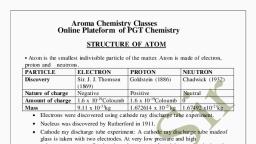
STRUCTURE OF ATOM, Mass of a proton = 1.672 × 10⁻²⁷kg, , as neutron. In 1932 Chadwick proved its existence. He, , 1.3.1 Discovery of neutron, , observed that, when a beam of particles (24 He) is incident, , The theoretical requirement for the existence of a neutron, particle in the atomic nucleus was put forward by Rutherford, in 1920.It was proposed to be a particle with no charge and, having mass almost equal to that of a proton. He named it, , on Beryllium (Be), a new type of particle was ejected. It had, mass almost equal to that of a proton ( 1.674 ×10⁻²⁷kg) and, carried no charge., 11, 5, , SUMMARY :, , 9, 4 Be, , ATOMIC BUILDING BLOCKS, Name, , 1, B 24He 14, 7 N 0n, , 1, 24He 12, 6 C 0n, , Discoverer, , Symbol, , Charge, , Relative, Charge, , Mass, , J.J. Thomson, , e, , –1.6022 × 10⁻¹⁹ C, , –1, , 9.1094×10⁻³¹ Kg, , Proton, , Goldstein, , p, , +1.6022 × 10⁻¹⁹C, , +1, , 1.6726 × 10⁻²⁷ kg, , Neutron, , Chadwick, , n, , 0, , 0, , 1.6749 × 10⁻²⁷ kg, , Electron, , 2. DEFINATIONS, 2.1 Electron, A fundamental particle which carries one unit negative, charge and has a mass nearly equal to 1/1837th of that of, hydrogen atom., , were smaller particles together carrying a negative charge,, equal to the positive charge in the atom. They were studded, in the atom like plums in a pudding. The charge distribution, was such, that it gave the most stable arrangement. This, model of the atom was often called the plum – pudding, model. Also the raisin pudding model or watermelon model., Positive, Sphere, , 2.2 Proton, A fundamental particle which carries one unit positive, charge and has a mass nearly equal to that of hydrogen, atom., 2.3 Neutron, A fundamental particle which carries no charge but has a, mass nearly equal to that of hydrogen atom., , 3. THOMSON MODEL, Sir J. J. Thomson, who discovered the electron, was the first, to suggest a model of atomic structure., (i), , All atoms contain electrons., , (ii) The atom as a whole is neutral. The total positive charge, and total negative charge must be equal., He visualised all the positive charge of the atom as being, spread out uniformly throughout a sphere of atomic, dimensions (i.e. approx. 10–10 m in diameter). The electrons, , Electorn, , Thomson’s proposed model of atom., 3.1 Drawbacks, Though the model was able to explain the overall neutrality, of the atom, it could not satisfactorily explain the results of, scattering experiments carried out by Rutherford., , 4. RUTHERFORD’S -SCATTERING EXPERIMENT, Rutherford conducted - particles scattering experiments, in 1909. In this experiment, a very thin foil of gold (0.004nm), is bombarded by a fine stream of alpha particles. A, fluorescent screen (ZnS) is placed behind the gold foil, where
Page 4 :
STRUCTURE OF ATOM, points were recorded which were emerging from -particles., Polonium was used as the source of -particles., , It has been found that radius of atom is of the order of, 10–10m while the radius of the nucleus is of the order of, 10–15m., Thus if a cricket ball represents a nucleus, then the radius, of atom would be about 5 km., , 4.1 Observations, Rutherford carried out a number of experiments, involving, particles by a very thin foil of gold., Observations were:, t, , (i), , h, , e, , s, , c, , a, , t, , t, , e, , r, , i, , n, , g, , o, , f, , Most of the particles (99%) passes through it, without, any deviation or deflection., , (ii) Some of the particles were deflected through small angles., (iii) Very few particles were deflected by large angles and, occasionally an particle got deflected by 180o, 4.2 Conclusions, (i), , An atom must be extremely hollow and must consist of, mostly empty space because most of the particles passed, through it without any deflection., , (ii) Very few particles were deflected to a large extent. This, indicates that:, (a) Electrons because of their negative charge and very low, mass cannot deflect heavy and positively charged , particles, (b) There must be a very heavy and positively charged body in, the atom i.e. nucleus which does not permit the passage of, positively charged particles., (c) Because, the number of particles which undergo, deflection of 180º, is very small, therefore the volume of, positively charged body must be extremely small fraction of, the total volume of the atom. This positively charged body, must be at the centre of the atom which is called nucleus.
Page 5 :
STRUCTURE OF ATOM, Therefore, number of neutrons (n) = Mass Number (A) –, Number of protons (Z), n =A– Z, , The general notation that is used to represent the mass, number and atomic number of a given atoms is, , A, ZX, , Where, X – symbol of element, A – Mass number, Z – atomic number, 5.3 Isotopes, Isobars, isotones and Isoelectronic, 5.3.1 Isotopes:, Isotopes are the atoms of the same element having identical, atomic number but different mass number. The difference is, due to the difference in number of neutrons., The chemical properties of atoms are controlled by the, number of electrons. Thus, isotopes of an element show, same chemical behaviour., Isotopes of Hydrogen, Isotope, , Formula, , 5.1 Atomic number (Z), , Protium, , 1, 1H, , Atomic number of an element is equal to the number of unit, , 5. ATOMIC NUMBER AND MASS NUMBER, , Mass, number, , No. of, protons, , No. of, neutrons, , (H), , 1, , 1, , 0, , Deuterium, , 2, 1 H (D), , 2, , 1, , 1, , Tritium, , 3, 1 H (T ), , 3, , 1, , 2, , positive charges or number of protons present in the nucleus, of the atom of the element. It also represents the number of, electrons in the neutral atom. Eg. Number of protons in, Na = 11 , thus atomic number of Na=11, 5.2 Mass number (A), The elementary particles (protons and neutrons) present in, the nucleus of an atom are collectively known as nucleons., The mass number (A) of an atom is equal to the sum of, protons and neutrons. It is always a whole number. Thus,, Mass number (A) = Number of protons(Z) + Number of, neutrons(n), , Isotopes of Oxygen, Isotope, number, , Mass number, , No. of, protons, , No. of, neutrons, , 16, 8 O, , 16, , 8, , 8, , 17, 8 O, , 17, , 8, , 9, , 18, 8 O, , 18, , 8, , 10
Page 6 :
STRUCTURE OF ATOM, 5.3.5 Isoelectronic:, , Isotopes of some common elements, , The species (atoms or ions) containing the same number of, electrons are called isoelectronic. Eg., , Element, , Isotopes, , Carbon (C), , 12, 13, 14, 6 C, 6 C, 6 C, , Nitrogen (N), , 14, 15, 7 N, 7 N, , Uranium, , 233, 235, 238, 92 U, 92 U, 92 U, , Sulphur, , 32, 33, 34, 36, 16 S, 16 S, 16 S, 16 S, , O2–, F–, Na+, Mg+2, Al+3, Ne etc, To go further into the atomic mysteries, we will have to, understand the nature of electromagnetic radiations and, study Maxwell’s Electromagnetic Wave theory”., , 5.3.2 Relative Abundance:, Isotopes of an element occur in different percentages in, nature, which is termed as relative abundance., Using this relative abundance the average atomic mass of, the element can be calculated. For Example,, the average atomic mass of Cl is 35.5 due to existence of two, isotopes 35 Cl and 37 Cl in 75% and 25% abundance, respectively, 5.3.3 Isobars:, Atoms of different elements having different atomic numbers, but same mass numbers are called isobars. Eg, Isobar Atomic, , Mass, , number, , number, , No. of, , No. of, , No. of, , elctrons protons, , neutrons, , 40, 18, , Ar, , 18, , 40, , 18, , 18, , 22, , 40, 19, , K, , 19, , 40, , 19, , 19, , 21, , 40, 20, , Ca, , 20, , 40, , 20, , 20, , 20, , 5.3.4 Isotones:, Atoms of different elements which contain the same number, of neutrons are called isotones. Eg, Isotones, , Atomic, , Mass number, , No. of neutros, , 36, 16, , S, , 16, , 36, , 20, , 37, 17, , Cl, , 17, , 37, , 20, , 38, 18, , Ar, , 18, , 38, , 20, , 39, 19, , K, , 19, , 39, , 20, , 40, 20, , Ca, , 20, , 40, , 20, , James Maxwell was the first to give a comprehensive, explanation about the interaction between the charged, bodies and the behaviour of electric and magnetic fields.