Page 2 :
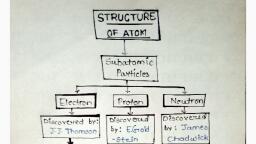
CHEMISTRY STRUCTURE OF THE ATOM, , Structure of the Atom, Charged Particles in Matter, The phenomenon of static electricity and conduction of electricity through some substances hints at the, presence of charged particles in matter., , Discovery of the Electron, , , , , , J.J. Thomson performed an experiment by passing electricity at a high voltage through a discharge, tube containing a gas at a very low pressure. A green fluorescence was seen emitting out from the, other end of the discharge tube., This fluorescence is the result of rays emitted from the cathode (negative plate) towards the anode, (positive plate) in the discharge tube. Hence, these rays are called cathode rays., From his experiment, Thomson arrived at the conclusion that cathode rays are nothing but a stream of, negatively charged particles. These negatively charged particles are called electrons., , Discovery of the Proton, , , , , , , A German scientist, E. Goldstein in 1886, modified the discharge tube and passed electric current, through it., He found that the positively charged rays were emitted from the anode in the discharge tube. These, rays were called canal rays., When an electric field was applied, these rays deflected towards the negatively charged plate. Thus,, Goldstein concluded that an atom contains positively charged particles along with electrons., These positively charged particles were named as protons by a British scientist, Ernest Rutherford., Canal rays were also called anode rays since they were emitted from the anode (electrode connected, to the positive terminal of high voltage source) in the gas discharge experiments using a perforated, cathode., , Discovery of the Neutron, , , , , , , In 1932, James Chadwick observed that when beryllium was exposed to α-particles, different kinds of, particles were emitted., These particles had about the same mass as protons and carried no electrical charge. Hence,, Chadwick named these particles neutrons., These were present in the nucleus along with protons., Neutrons are present in the nucleus of all the atoms except hydrogen., As protons and neutrons are both present in the nucleus, they are together known as nucleons., , www.topperlearning.com, , 2
Page 3 :
CHEMISTRY STRUCTURE OF THE ATOM, , Properties of Electron, Proton and Neutron, Subatomic, particle, Electron, , Symbol, , Location in Relative, the atom, Charge, , Relative, mass, , Actual mass, , Absolute, Mass, , e-, , Outside the, nucleus, , -1, , 9.1 × 10⁻³¹ kg, , 9 ×10-28, grams, , +1, , 1, a.m.u., 1840, 1 a.m.u., , Proton, , P+, , Neutron, , n, , Inside the, nucleus, Inside the, nucleus, , 1.673 × 10⁻²⁷ kg, , 0, , 1 a.m.u., , 1.675 × 10⁻²⁷ kg, , 1.6 × 10⁻²⁴, grams, 1.6 × 10⁻²⁴, grams, , The Structure of an Atom, Thomson's Model of an Atom, , , Thomson's model of an atom is popularly known as the plum pudding or Christmas pudding model of, an atom., , Thomson’s model of an, Atom, , , , , Plum pudding, , According to the Thomson's plum pudding model, an atom is a positively charged sphere in which the, electrons are embedded., The negative charge of the electrons and the positive charge of the sphere is equal in magnitude., Thus, an atom as a whole is electrically neutral., But, his model could not explain the results of experiments carried out by other scientists such as, Rutherford and Bohr., , Limitations of Thomson's Atomic Model, , , , , Although Thomson's atomic model explained why an atom is electrically neutral, it could not explain, the distribution of electrons in the atom., If we accept that electrons are embedded in the positive charge, then the opposite electric charges, should cancel each other out and the charged sphere would be uncharged., Thomson's model could not explain why different elements have different chemical properties., , www.topperlearning.com, , 3
Page 4 :
CHEMISTRY STRUCTURE OF THE ATOM, , Rutherford's Model of an Atom, In 1911, Earnest Rutherford, a scientist from New Zealand, overturned Thomson’s atomic model by his, gold foil experiment., , Rutherford’s Scattering Experiment, , , , , , , , , Rutherford selected a gold foil as he wanted a very thin layer., The gold foil used by Rutherford was 0.004 millimetres in thickness. That is, the foil was about 1000, atoms thick., In his experiment, fast moving α-particles (alpha particles) were made to fall on a thin gold foil., The α-particles are helium ions with a +2 charge. Their atomic mass is 4 u. Hence, a high velocity, beam of α-particles has a lot of energy., These particles were studied by means of flashes of light they produced on striking a zinc sulphide, screen., The α-particles are much heavier than the sub-atomic particles present in gold atoms., Hence, he expected the α-particles to pass through the gold foil with little deflection and strike the, fluorescent screen., , But the observations he made were quite unexpected., , www.topperlearning.com, , 4
Page 5 :
CHEMISTRY STRUCTURE OF THE ATOM, Explanation of the Results of Rutherford's Gold Foil Experiment, , , , , , , , , , , , , Rutherford postulated that the atom must contain large empty spaces as most of the α-particles, passed through it without getting deflected., Some α-particles were deflected by the foil through small angles, while some were deflected through, very large angles. Thus, Rutherford concluded that the positively charged particles in an atom must be, concentrated in a very small space., One out of every 12,000 particles were deflected through 180 o showing a full rebound. Thus,, Rutherford came to the conclusion that all the positive charges of the atom and most of the mass of, the atom is concentrated in a very small volume within the atom., Rutherford named this small space inside the atom as the nucleus of the atom or the atomic, nucleus., On the basis of these observations, Rutherford calculated that the atomic nucleus is 10 5 times smaller, than the total area of the atom., The radius of the atom is 10-8 centimetres while the radius of the nucleus is 10-13 centimetres., Thus, we can say that the atom is relatively hollow with a heavy nucleus at its centre. The electrons, arranged around the nucleus possess negligible mass., Based on his observations, he formulated the Theory of atom., , www.topperlearning.com, , 5
Page 6 :
CHEMISTRY STRUCTURE OF THE ATOM, Rutherford's Atomic Model, , , , , , Based on the results of the α-particle scattering experiments, Rutherford put forth his atomic model., An atom contains a positively charged centre called the nucleus of the atom. Almost all the mass of, the atom is concentrated in the nucleus., The electrons of the atom revolve around the nucleus in fixed, circular orbits., The size of the nucleus is many times smaller than the size of the atom. The nucleus of an atom is, 10,000 times smaller than the atom., , Drawbacks of Rutherford’s Model of an Atom, , , , , , , Rutherford’s atomic model could not explain how moving electrons could remain in their orbits., Any charged particle during acceleration would radiate energy, and while revolving, it would lose its, energy and eventually fall into the nucleus., This means that the atom would be highly unstable., But, matter is composed of stable atoms., Thus, the major drawback of Rutherford’s atomic model was that it could not explain the stability of, atoms., , www.topperlearning.com, , 6
Page 7 :
CHEMISTRY STRUCTURE OF THE ATOM, , Bohr's Model of an Atom, , , , Niels Bohr, revised Rutherford’s atomic model and put forth the following suggestions:, Neils Bohr proposed that the electrons possess a specific amount of energy which allows them to, revolve around the nucleus., , , , The electrons are confined to these energy levels. While revolving in these discrete orbits, the, electrons do not radiate energy. Hence, these orbits are also known as stationary orbits or, stationary shells. Smaller the size of the orbit, smaller is its energy., As we move away from nucleus, the energy of the orbit increases progressively., The transfer of an electron from one orbit to another is always accompanied with absorption or, emission of energy., When an electron jumps from a lower energy level to a higher energy level, it absorbs energy., When an electron returns from a higher energy level to a lower energy level, it emits energy., , , , , , , Distribution of Electrons in the Orbits, , , , , According to Bohr’s model, electrons occupy certain stable orbits or shells. Each shell has a definite, energy., These orbits or shells are represented by the letters K, L, M, N… or the numbers 1, 2, 3, 4…, The maximum number of electrons present in the shell is given by the formula (2n 2), where n is the, orbit number or shell number., , , , The maximum number of electrons in different shells is as follows:, o The first orbit or K shell will have 2 × 12 = 2 electrons., o The second shell will have 2 × 22 = 8 electrons., o The third shell will have 2 × 32 = 18 electrons., o The fourth shell will have 2 × 42 = 32 electrons and so on., , , , The maximum number of electrons which can be accommodated in the outermost orbit is 8., , , , The orbits or shells are filled in a step-wise manner., , , , Electrons are not accommodated in a given shell unless the inner shells are filled., , www.topperlearning.com, , 7
Page 8 :
CHEMISTRY STRUCTURE OF THE ATOM, Octet Rule, The Octet rule states that- ‘The maximum number of electrons that the outermost shell of an electrically neutral, and chemically stable atom can have is 8.’, Exception: If the atom has only one shell, it can hold only 2 electrons. For example, hydrogen and helium can, have only 2 electrons (duplet)., Examples: (Distribution of electrons), Electronic configuration, , Hydrogen, , Helium, , Lithium, , Carbon, , , The symbol of hydrogen is H and its atomic number is 1. The total number of electrons is 1. Therefore,, the electronic configuration is also 1. Since it has only one electron, it will occupy the K shell., , K, 1, , , Nitrogen, , L, -, , M, -, , N, -, , The symbol of helium is He and its atomic number is 2. Therefore, the electronic configuration is also, 2. Both these electrons will occupy the K shell (duplet)., , K, 2, , www.topperlearning.com, , L, -, , M, -, , N, -, , 8
Page 9 :
CHEMISTRY STRUCTURE OF THE ATOM, , , The symbol of lithium is Li. The atomic number is 3. Therefore, the electronic configuration is (2, 1)., This means that there are two electrons in the K shell and one electron in the L shell., , K, 2, , , N, -, , L, 4, , M, -, , N, -, , The symbol of nitrogen is N and its atomic number is 7. The number of electrons is 7. Therefore, the, electronic configuration is (2, 5). This means that there are two electrons in the K shell and 5 electrons, are in the L shell., , K, 2, , , M, -, , The symbol of carbon is denoted by the capital letter C. The atomic number is 6. The number of, electrons present in carbon atom is 6. Therefore, the electronic configuration is (2, 4). This means that, there are 2 electrons in the K shell and 4 electrons in the L shell., , K, 2, , , L, 1, , L, 5, , M, -, , N, -, , All noble gases except helium have eight electrons in the outermost shell. This arrangement is known, as an octet., , Electronic Configuration of Elements, The energy of every electron depends on the shell it occupies., Electrons in the K shell have minimum energy. Electrons in subsequent shells have higher energies., The arrangement of electrons of each element is called the electronic configuration of the element., , Valency, , , , The valency of an element represents the combining capacity of the element., It can also be defined as the number of electrons lost, gained or shared by its atom during a chemical, combination., , Valence Shell, The outermost shell or orbit of an atom is known as the valence shell or valence orbit., , Valence Electrons, , , , , The electrons present in the outermost valence shell of an atom are called valence electrons., The number of valence electrons varies from 1 to 8 for the atoms of different elements., The valence electrons of an atom determine the valency of that element., , www.topperlearning.com, , 9
Page 10 :
CHEMISTRY STRUCTURE OF THE ATOM, , Atomic Number and Atomic Mass Number, , , The number of protons present in the nucleus of an atom is the atomic number of that atom. It is, represented by the symbol Z., Atomic number (Z) = Number of protons (p), , , , , All atoms of an element have the same atomic number. The number of protons and electrons in an, atom is equal. Thus, the atom of an element is electrically neutral., Atomic mass number is defined as the sum of the number of protons and neutrons contained in the, nucleus of an atom of that element. It is denoted by the symbol A., Atomic mass number (A) = Number of protons (p) + Number of neutrons (n), , The atomic number, atomic mass number and symbol of an element are, Mass number, Z, written as - Atomic, number X or A X, , Isotopes, , , , , , Atoms of the same element differing in the number of neutrons in their nuclei are known as isotopes., Thus, isotopes of an element have the same atomic number but different atomic mass numbers., Isotopes are identified by their mass numbers., For example, the isotopes of carbon are referred to as carbon-12, carbon-13 and carbon-14., Isotopes of an element have similar chemical properties but different physical properties., Examples of Isotopes, Element, , www.topperlearning.com, , Number of Isotopes, , Hydrogen, , Three, , Carbon, , Three, , Protium (1H ), 1, Deuterium ( 2 H ), 1, Tritium ( 3 H ), 1, 12 C, 6, 13 C, 6, 14 C, 6, , 10
Page 11 :
CHEMISTRY STRUCTURE OF THE ATOM, , Oxygen, , Uranium, , Two, , 16 O, 8, 17 O, 8, , Two, , 235 U, 92, 238 U, 92, , Average Atomic Mass of Chlorine, The isotopes of chlorine, found in nature are in the ratio 3 : 1., 37, So, in any sample of chlorine, 35, 17 Cl will constitute 75% and 17 Cl will constitute 25%., The proportion in which the isotopes are found in the nature is always constant., Therefore, in any sample of chlorine, the average atomic mass will be, Average atomic mass of chlorine, = (35 x 75/100) + (37 x 25/100), = 105/4 + 37/4, = 142/4, = 35.5 u, The average atomic mass of chlorine is equal to 35.5 u., , Radioactive Isotopes, , , , , Isotopes can be stable or unstable depending on the presence of extra neutrons in their nuclei., The unstable isotopes which emit various types of radiations are known as radioactive, isotopes., A few commonly used radioactive isotopes are carbon-14, arsenic-74, sodium-24, iodine-131, cobalt60 and uranium-235., , Applications of Isotopes, , , , , , , , Radioactive isotopes are used in nuclear reactors as a fuel. The nuclear reactors are used to generate, electricity., Uranium-235 isotope is the fuel of choice for nuclear power plants., They are also used as diagnostic tools in medicine., Cobalt-60 is the isotope of choice for radiotherapy., Phosphorus-30 is used in the treatment of leukemia or blood cancer., Iodine-131 radioisotope, used as a 'tracer', is injected into the body to check the activity of the thyroid, gland. It helps in detecting the amount of iodine taken up by the thyroid gland. It is an important tool in, the diagnosis and treatment of diseases such as goitre., , www.topperlearning.com, , 11
Page 12 :
CHEMISTRY STRUCTURE OF THE ATOM, , Isobars, The atoms of different elements having different atomic numbers but the same mass number are known, as isobars., , Examples of Isobars, Isobars, Chlorine-37, Argon-37, Cerium-76, Selenium-76, Iron-58, Nickel-58, , www.topperlearning.com, , Number of, protons, 17, 18, 32, 34, 26, 27, , Number of, neutrons, 20, 19, 44, 42, 32, 31, , Mass, number, 37, 76, 58, , 12