Page 1 :
Ko work is done by afew gguc Work and Energy 7, , object Chere, 0 = 90° and gos soe 2 UEht angle to the direction of displacemnt of the, » Energy : Anything having a capahi, , , , , , Larger unit of energy :, oe = 1k = 10005 = 193, ¥ _ on ne : = Some work it loses its energy and if some work is done on the object, , » Main forms of energy are energy (iv) Electrical energy, (viii) Naar energy., , + Sum of kinetic energy and potential energy of an object i i, energy. (Mechanical energy = Kinetic ees + Poa ee crete ea, , + Kinetic Energy : The energy possessed by an object by virtue of its motion is called, the kinetic energy. It is directly proportional to mass and the square of velocity., Examples : Fast moving vehicles, flowing water, blowing wind, moving bullet, all, possess kinetic energy., , + Expression for Kinetic Energy : Let us consider an object of mass m lying at rest, on a surfact. Let a constant force F' be applied on the object so that it can attain a, velocity v after displacement s in the direction of force., +: Work done, W =F xs, From Newton’s second law of motion, F = ma, and according to third equation of motion, v” ~ u? = 2as, , Work and Energy |, , , , @ Kinetic energy (ii) Potential energy (iii) Chemical, (v) Heat energy (vi) Sound energy (vii) Light energy, , , , \_ Basic Concepts _/, , , , * Work generally means any kind of mental or physical activities but scientifically, we, say that work has been done on an object when some force is being applied on the object, and the object moves through a certain distance in the direction of the applied force,, , ° Work is said to be done when, @ an object at rest starts moving, (i) a moving ebject comes to rest, Gii) shape of an object changes, Gv) velocity of an object changes., , * Following two conditions must be satisfied for mechanical work to be done :, , i) A force should act on an object., Gi) Body should be displaced. q, For example — Pushing a car from rest, lifting a book from one place to another etc., , , , oe, (A person holding a bag does no work on it as there is no displacement). a pe Bye Gi), * Work Done by a Constant Force : Putting the value of F and s from equation (ii) and (iii) in equation (@),, , Work done by the force is defined as the product of force and displacement., ~. Work done (W) = Force (F) x displacement (s), It is a scalar quantity. Its SI unit is N-m or Joule., Work is said to be 1 joule when a force of 1 Newton acting on an object displaces it, by 1m along the line of action of the force., , * Inmany cases, the movement of the object is some angle to the direction of applied, force. In this situation work done is given by the product of displacement, and the’, component of force along the direction of displacement., , a, B, , A F cose B, , 4 22, We max Yh = dm pm?, , > W=Fmv?-v), , de W=mv?=KE., It is a scalar quantity. 2 z 2 me, , * Potential Energy : It is the energy possessed by an object by virtue of its position, or configuration or change thereof. : te, Examples : Water stored in the overhead tank, stone lying on the top of a hill, a, , stretched string, all possess potential energy. :, s Gravitational petential energy is the work done in raising an object from ground to, x bot ‘ast aetvity:, . Eustis tential 6 a is the energy due to configuration (change in shape and size), of an object is called its elastic wine a :, . i Potential Energy at a Height : :, cna aaect of mass m, let it be raised through a héight h., , Force applied on the object,, ” Fm xg (upward), , , , , , , , , , , , , , , , W = F cosd x s, = W = Fs cos0, * If force acts in the direction of displacement, then work is said to be positive (here,, @ = 0° and cos 0° = 1)., «If force acts in the opposite direction of displacement, then work is said to be negative, (here, 6 = 180° and cos 180° = -1).
Page 2 :
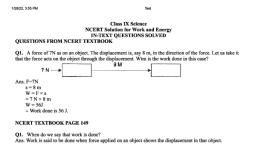
-—, , , , , , , , , , Wes], Sanjiv Refresher Science-IX, , ground to upwards., , Work, W=Fxh, , 5 W=mxgxh=PE., * Mechanical energy = K-E. + P.E., , = dmv? + mgh, , * Energy Transformations : The process of changing energy from one form, to F, , another form is known as energy transformation. iia, For example — (i) In a gas stove, the gas is burnt in the combustion process, the, , chemical energy of gas is transformed into heat energy which is used to cook fog 4, , (i) During photosynthesis, light energy is transformed into chemical energy,, , (iii) In bulb, electrical energy is transformed into heat energy and then finally int , light energy., , * Law of Conservation of Energy : According to this law, the energy can neither |, , be created nor be destroyed, but it can only be converted from one form to another,, , The total energy of an isolated system must remain constant before and after |, , transformation. , © Conservation of Energy during free fall of a Body : Consider a ball of mass m, at height A from the ground. At height A, it has potential energy = mgh and kinetic, energy at height h is zero. As ball falls downwards, height h decreases, so the 4, potential energy also decreases and kinetic energy increases. When the ball reaches |, , to ground, potential energy becomes zero and kinetic energy = $m,, , ° Power : It is defined as the rate of doing work or as the rate of transfer of energy. 4, , Power, P= Work done. = w - zg, ¢ SI unit of power is W (watt) or J/s.., 1 kW = 1000 W, 1 W = 1000 Js”, , * Commercial unit of Power :, commercially. It is energy consumed kW in 1 hour., 1 kWh = 1000 Wh = 1000 W x 1h = 1000 W x (60 x 60)s, = 3600000 J, 1&Wh = 3.6 x 10° J = 1 unit, , Q.1. A force of 7 N acts on an object. The displacement is, say 8 m, in the j, direction of the force (fig.). Let us take it that the force acts on the |, object through the displacement. What is the work done in this case?, , , , Work done against gravity in raising the object through a height h above thd, , We use kilowatt-hour (kWh) to measure power |, , , , 3: We know that if force F acting, , . When do we say that work is done?, .: Work is done whenever the, , a *, * < ne of ject >, : Tie cae eet ae by the virtue of its motion is called kinetic, , , , —————__ Work and Energy "gi 9), , <——_fm, , , , , now t on an object to displace it through a distance s in, one direction, then the work done W on the body Tyee ae given by :, Work done = Force x displacement, , W=Fxs, Where, F=7N, ‘ s=8m, Therefore, work done, W=7x8, = 56 Nm = 66 J, , , , given conditions are satisfied :, @ A force acts on the body., , (i) There is a displacement of the body caused by the applied force along the, direction of the applied force., , . Write an expression for the work done when a force is acting on an, , object in the direction of its displacement. :, , ;.: When a force F displaces a body through a distance s in the direction of the, , applied force, then the work done W on the body is given by the expression :, Work done = Force x displacement., W=Fxs, , . Define 1 J of work., .: 1 J is the amount of work done by a force of 1 N on an object that displaces it, , through a distance of 1 m in the direction of the applied force., , . A pair of bullocks exerts a force of 140 N on a plough. The field being, , ploughed is 15 m long. How much work is done in ploughing the length, of the field?, , .: Work done by the bullocks is given by the expression :, , Work done = Force x displacement, , W=Fxd, Where,, Applied force, F=1M40N, Displacement, d=15m, , W = 140 x 15 = 21003, Hence, 2100 J of work is done in ploughing the length of the field., , , , energy. Every moving object possesses kinetic energy. A body uses kinetic energy
Page 3 :
eee, , , , inte A 108 af woog, , , , , , , , , , amp = 1000 J, , , , gq. 2 orgy of an object., Ans. . then its kinetic energy Ey ig ivan, fax SU umit is joule (J) . i, Q 3. The kinetic energy of an object of mass, m moving with a velocity or, 5 ms is 25 3. What will be its kinetic energy when its velocity i,, doubled? What will be its kinetic energy when its velocity is increaseq, three times?, Ams. : KE. of & ot = 25d, Velocity of the object. c = 5 m/s, Bef, = me2, F-) mel, Ef velocity is doubled o=2, : E, (for = 10 4 x 2x 100= 1005, If velocity is tripled, v=3, E, ‘for v = 15 mis 5 x 2 x 225 = 295 5, Page No. 156, @ iL What is power? 1, Ams.: Pewer is the rate of doing work or the rate of transfer of energy. If W is the |, amount of work done in time 1, then power is given by the expression,, = Work _ Energy, Power = Time = “Time, ay, pa, it is expressed in watt (W), @ 2% Define | watt of power., Ams. : If an agent does work at the rate of | joule in 1 5 then it is said to have power of, lwattie 1]W=ilJd/is, @ 3. A lamp consumes 1000 J of electrical energy in 10 s. What is its power?, fama. +, , , , Qh, , @ vs., , : Work is done whenever, , -+ Work done by the, , DN i ee acnrii cits,, , Work and Enerzy “RARE RB, , Power of an age;, ent may he dafined as the total work done by ih in the, , ale me, , , , aot tight eo below. Reason out whether or aot work ie, + Suma is swimming in eae of the term ‘work’., , oA donkey 1s carrying a load on its back., , * A windmill is lifting water from a well., , + A green plant is ¢; are, , ae arrying out, « An engine is pulling 3 a = photosynthesis., , + Food grains are getting dried in the Su,, , * A sailboat is moving due to wind ane, , 1. A force acts on the bee two conditions are satisfied ;, , 2. There is a displacement 5 Ff p, to the direction of force, ob is boty by toe spalicatidicst meee ba ar sopeatn, , (a) While swimming, Suma applies a force to push the water backwards., , Therefore, Suma swims in the forward direction caused by the forward, , Teaction of water. Here, the force causes a displacement. Hence, work is, , done by Suma while swimming., , While carrying a load, the donkey has to apply a force in the upward direction., , But, displacement of the load is in the forward direction. Stace, displacement, , is perpendicular to force, the work done is zero., , A windmill works against the gravitational force to ht water. Hence, work, , is done by the windmill in lifting water from the well., , (d) In this case, there is no displacement of the leaves of the plant, Therefore,, the work done is zero., , (e) An engine applies force to pull the train. ‘This allows the train te move in the, direction of force. Therefore, there is a displacement in the train in the same, direction. Hence, work is done by the engine on the train., , (Food grains do not move in the presence of solar energy. Hence, the work, done is zero during the process of food grains getting dried in the Sun, Wind energy applies a force on the sailboat to push it in the forward direction., ‘Therefore, there is a displacement in the boat in the direction of force. Hesos,, , work is done by wind on the boat., , (b), , (c), , 2 An object thrown at a certain angle te the ground moves ia @ curved, , . The initial and the final points af the, ath and falls back to the ground. the initial :, , Fath of the object lie on the ~~ Tonieealet line, What is the work dane, by tl f gravity on the object :, a das ee foree of gravity on an abject depends only om vertical, displacement. Vertical displacement is given by the difference in the initial and, final positions/heights of the object, which is zero.
Page 4 :
HRS MBM, Sanjiv Refresher Science ____--~, a ssion,, , Work done by gravity is given by the expre:, W = mgh, Where,, h = Vertical displacement = 0, W=mgx0=0d _ ;, ‘Therefore, the work done by gravity on the given object is zero joule., Q.3. Abattery lights a bulb. Describe the enerzy changes involved in the process,, Ans. : When a bulb is connected to a battery, then the chemical energy of the battery js, transferred into electrical energy. When the bulb receives this electrical energy,, then it converts it into light and heat energy. Hence, the transformation of, energy in the given situation can be shown as °, Chemical Energy — Electrical Energy > Light Energy + Heat Energy, Q.4. Certain force acting on a 20 kg mass changes its velocity from 5 ms“ to, 2m s~. Calculate the work done by the fore, 2, , Ans. : Kinetic energy is given by the expression, (Ey) = ym’, , Where,, , , , E, = Kinetic energy of the object moving with a velocity v., ith a velocity 5 ms“, , (i) Kinetic energy when the object was moving wi, Gps = F * 20 x (5) = 2505, Gi) Kinetic energy when the object was moving, Bya= } x 20x 2 =40F, W = 40 - 250 = -210 J, ‘The negative sign indicates that work has been done in slowing the body., A mass of 10 kg is at a point A on a table. It is moved to a point B. If the, line joining A and B is horizontal, what is the work done on the object, by the gravitational force? Explain your answer., , .: Work done by gravity depends only on the vertical displacement of the body. It, does not depend upon the path of the body. Therefore, work done by gravity is, , given by the expression,, , with a velocity 2 ms, , W=mgh, , Where,, , Vertical displacement, h=0, , h W=mgx0=0, Hence, the work done by gravity on the body is zero,, , The potential energy of a freely falling object decreases progressively., Does this violate the law of conservation of energy? Why?, , : No, the process does not violate the law ‘of conservation of energy. This is because, when the body falls from a height, then its potential energy changes into kinetic, energy progressively. A decrease in the potential energy is equal to an increase in, the kinetic energy of the body. During the process, total mechanical energy of the, body remains conserved. Therefore, the law of conservation of energy is not violated., , ; what are the various, , ” piding a bicycle?, , _; The muscular energy of the, of the bicycle while tiding, , _ When we push a huge ro, stationary rock. Also, th, , , , _Work and Energy Sa, , energy: ., 8Y transformations that occur when you are, , "ier gets transferred, , a bi, energy provides a velocity to oa isa the, , into heat energy and kinetic energy, energy heats the rider’s bedy. Kinetic, , oo thee ig no transfer of muscular energy to the, i HO loss of energy bi is, transferred into heat energy, which Glises Ge ay a aoe energy, , . A certain household has consumed 250 units of energy during a month., , How much energy is this in joules?, , + 1 unit of energy is equal to 1 kilowatt hour (kWh)., , 1 unit = 1 kWh, 1 kWh = 3.6 x 10°, Therefore, 250 units of energy = 250 x 3.6 x 10° = 9 x 10° J., , . An object of mass 40 kg is raised to a height of 5 m above the ground., , What is its potential energy? If the object is allowed to fall, find its, , kinetic energy when it is half-way down., , Mass, m = 40 kg, Initial height, A = 5 m, = 10 ns?, , Potential energy of the object, Z, = mgh, ors = 40x 10x 5 = 20007, When an object is allowed to fall and it is half way down, then, w=4, Hence, potential energy of the object reduces to, Ep 2090 = 10003, , Ee 3, Kinetic energy of the object,, E,, = Loss in potential energy, = Ep—Ep' = (2000 - 1000) 5, -= 10000, , , , . What is the work done by the force of gravity on a satellite moving, , round the Earth? Justify your answer. . 3, Work is done whenever the given two conditions are satisfied :, , 1. A force acts on the body. Se, 2. There is a displacement of the body by the application of force in or opposite, , to the direction of force., If the direction of force is perpendicular to displacement, then the work done is zero., When a satellite moves around the Earth, then the direction of force of gravity
Page 5 :
WSs EN, Sani, , Q. 12., , Q. 13., , Ams. :, , Q. 14., , Q. 15., , Ans. :, , a unif¢ i bject., Yes, for a uniformly moving 0b) t velocity. The net force acting on jt “, , : Energy consumed by an electricheater can be obtained with the help of the expression,, , , , , , pon reaches point ts paca Mork and Enerey =<, ; ntial energy becomes zero and the bob possesses only, , jnetic energy. This «., ae bob does not oscillate ee? et as long as the pendulum oscillates., its motion. The pendulum jgges it comes to rest because air resistance resists, , ‘ ses i ‘ineti, stops after some time. its kinetic energy to overcome this friction and, , ‘he law of conservati ‘, z on of energy ts not violated because the energy lost by the, , pendulum to overcome friction is gai t, energy of the pendulum and de by its surroundings. Hence, the total, , , , » Refresher Science-FX edt, : seed . Hence, the work ae, on the satellite is perpendicular to its displacement. He done on the, , satellite by the Earth is zero., Gan there be displacement, acting on it? Think. Discuss tl, , in the absence of any foreg, , f an object i e, ol th your friends and teachor,, , his question wi, , Suppose an object is moving with constan, ae But, there isa displacement ae the mot}, can be a displacement without a force. ‘. q, A person holds ‘a bundle of hay over his head for 30 minutes and go,, tired. Has he done some work or not? Justify your answer. 3, Work is done whenever the given two conditions are satisfied :, 1. A force acts on the body. lls x j, 2. There is a displacement of the body by the application of force in or opposite |, to the direction of force. r :, When a person holds a bundle of hay over his head, then there is no displacement, in the bundle of hay. Although, force of gravity is acting on the bundle, the |, person is not applying any force on it. Hence, in the absence of force, work dong 4, by the person on the bundle is zero., An electric heater is rated 1500 W. How much energy does itzuse in, 10 hours? a 4, , ion of the object. Hence, there @, , _; Kinetic energy of an object of, expression,, , Ey= dm?, , To bring the object t A, , sted. Jeet to rest, 5ymv* amount of work is required to be done on the, 17. Calculate the work requi, , Q at a velocity of 60 sale to be done to stop a car of 1500 kg moving, , fans. Kinetic energy, E, = $m?, ' Where,, “Mass of car, m = 1500 kg, Velocity of car, v = 60 km/h = 60 x $ aa, , By= } x 1500 x (60x), = 20.8 x 10⁴, Hence, 20.8 x 10⁴ J of work is required to stop the car., #0. 18. In each of the following, a force F is acting on an object of mass, m., i The direction of displacement is from west to east shown by the longer, arrow. Observe the diagrams carefully and state whether the work done, by the force is negative, positive or zero., , po@, , Where,, Power rating of the heater, P= 1500 W=1.5kW, Time for which the heater has operated, ¢ = 10h, , Work done = Energy consumed by the heater, , Therefore, energy consumed = Power x time, : = 1.5 x 10 = 15 kWh, Hence, the energy consumed by the heater in 10 his 15 kWh., Illustrate the law of conservation of energy by discussing the energy ;, changes which occur when we draw a pendulum bob to one side and allow, it to oscillate. Why does.the bob eventually come to rest? What happens to, its energy eventually? Is it a violation of the law of conservation of energy" |, The law of conservation of energy states that energy can neither be created nor 4, destroyed. It can only be converted from one form to another., Consider the case of an oscillating pendulum., When a pendulum moves from its mean position, P to either of its extreme positions A or B, it rises, through a height h above the mean level P. At, this point, the kinetic energy of the bob changes, completely into potential energy. The kinetic, energy becomes zero and the bob possesses only, potential energy. As it moves towards point P,, its potential energy decreases progressively., Accordingly, the kinetic energy increases. As the, , 6, , , , , , , , , , , , , , , , , , , , , , Case Ti, , , , 8.3 Case I i, In this case, the direction of foree acting on the block is perpendicular to the, , displacement. Therefore, work done by force on. the block will be zero., Case II, , In this case,, displacement. Therefore,, , the direction of force acting on the block is in the direction of, work done by force on the block will be positive.