Page 1 :
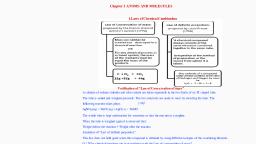
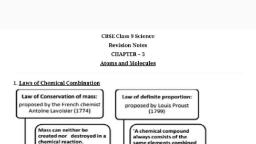
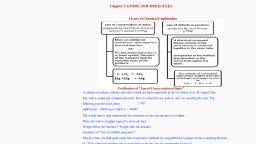
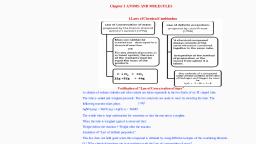
CBSE Class 9 Science, Revision Notes, CHAPTER -3, Atoms and Molecules, , 1. Laws of Chemical Combination, , , , , , , Law of Conservation of mass:, , proposed by the French chemist, Antoine Lavoisier (1774), , Law of definite proportion:, , proposed by Louis Proust, (1799), , , , Mass can neither be, created nor destroyedina, chemical reaction., , OR, , For any chemical process in, a closed system, the mass, of the reactants must be, equal the mass of the, products., , “A chemical compound, always consists of the, same elements combined, together in the same ratio,, , irrespective of the method, of preparation or the, source from where it is, taken’., , One molecule of a compound, water always contains same ratho, , of Hydrogen and Oxygen by mass, ie., , c+0, = CO,, 12g+32g = 44g, , H,O w 2:16 81:8, , , , Limitation of “Law of definite proportion”, This law does not hold good when the compound is obtained by using different isotopes of, , the combining elements., , 2. John Daltons Atomic Theory, , Using his theory, Dalton rationalized the various laws of chemical combination which were, in existence at that time. However, he assumed that the simplest compound of two elements, , must be binary., , 3. Atoms, Molecules, Ions & Chemical Formula, , Atom
Page 2 :
An atom is the smallest particle of an element which can take part in a chemical reaction. It, may or may not exist freely., , 5, , Each atom of an element shows all the properties of the element., , Molecule, , The smallest particle of matter (element or compound) which can exist in a free state., , L, , The properties of a substance are the properties of its molecules., , e MOLECULES OF ELEMENT : The molecules of an element are constituted by the same, type of atoms., , e MOLECULES OF COMPOUND: Atoms of different elements join together in definite, proportions to form molecules of compounds. (hetero atomic molecules), , e¢ ATOMICITY: The number of atoms contained in a molecule of a substance (element, or compound) is called its atomic, , , , , , , , , , , , Element Formula | Atomicity, Ozone O3 3, Phosphorus P4 4, Sulphur Sg 8, Oxygen O2 2, , , , , , , , , , , , e Based upon atomicity molecules can be classified as follows., ® Monoatomic molecules: Noble gases helium, neon and argon exist as He Ne and Ar, respectively.
Page 3 :
Diatomic molecules: Hy, O2, No, Clz, CO, HCl., Triatomic molecules: O3, CO2, NO», , SYMBOLS, , ¢ The abbreviation used to represent an element is generally the first letter in capital of, the English name of element., Oxygen — O Nitrogen + N, , ¢ When the names of two or more elements begin with the same initial letter, the initial, letter followed by the letter appearing later in the name is used to symbolize the, element, , Barium — Ba Bismuth — Bi, , Symbols of some elements are derived from their Latin names, , , , , , , , , , , , , , , , ELEMENT LATIN NAME SYMBOL, Sodium Natrium Na, Copper Cuprum Cu, , Potassium Kalium K, , Iron Ferrum Fe, Mercury Hydragyrum Hg, Tungsten Wolfram W, , , , , , , , , , , , , , ION Cation, Anion is a charged particle + Formed by Formed by, formed by loss or gain loss or loss of gain of, , gain of electrons. electron electron
Page 4 :
Polyatomic Ion : A group of atoms carrying a charge is as polyatomic ion., , Eg. NH,+ — Ammoniumlon : CO32~ — Carbonate ion, , Valency : The number of electrons which an atom can lose , gain or share to form a bond., OR, , It is the combining capacity of an atom of the element., , e Chemical Formula : A chemical formula is a short method of representing chemical, elements and compounds., , Writing a Chemical Formula -CRISS-CROSS rule, , , , , , , , , , , , , , , , , , , , , , , , , , , , , , RULE 1 [a] write the correct symbols of two elements., Ex: Aluminium & Oxygen ALO, —————_—. gx.)--ov0.”--000--—___, (>) above each symbol, write the correct valence, AP* 0*, er IE rere, (ed) Criss-cross the valence and drop the algebraic sign., ALO,, When the subscript is number 1, subscript is not written., Ex. Sodium Chloride - Na Cl — Nacl, RULE 3> “When the valence of both elements are numerically equal , the subscripts are, also not_written., Ex. Calcium Oxidie- - Ca®* O?-— Cad, , , , , , Ex. Ammonium Sulphate- - NH, $02, , , , RULES > All subscripts must be reduced to lowest term (except for molecular or, , Examples
Page 5 :
CATION| ANION FORMULA NAME, , , , ABt | SO.2- | Aly ($O4)3 | Aluminium sulphate, Ca | HCO3~ | Ca(HCO3)2| Calcium bicarbonate, NH,* cl NH,CI Ammonium chloride, , , , , , , , Na* | CO3?- HCO3~ Sodium carbonate, , , , Mg?* | OH- Mg(OH)>» | Magnesium hydroxide, , , , , , , , , , , , , , Na* | PO? Na3PO4 Sodium phosphate, , , , 4, Mole Concept, , The mole (mol) is the amount of a substance that contains as many elementary entities, , as there are atoms in exactly 12.00 grams of !2C’, , The Avogadro constant is named after the early nineteenth century Italian scientist, Amedeo Avogadro., , | MOLE = 6.022 x 10 ?3 particles, , , , Substance > Element || Compound, , Particles > Atom || Molecule, , , , &x.> ELEMENT- SODIUM - Na, I MOLE > 23 u/ 23g / 6.022 x 10” atoms of sodium, , —x.> COMPOUND- WATER- H,0, IMOLE > 18u / 18g /6.022x 10" molecules of water, , , , , , , , , , , , , , , , , , , , , , , , , , , , S.No. | Symbol / Atomic / 1mole Avogadro no. Molar mass, formula of atom | molecular mass (ing) (gmol*), / molecule (u), i. Oo 16u 16g 6.022 x 10” atoms 16 g mol +, 2: N, 28 u 28g | 6.022x10™ molecules | 28g mol”, 3. HCI 36.5u 365g |6.022x10"molecules | 36.5g mol”, GRAM MOLECULAR MASS, , Gram molecular mass is the mass in grams of one mole of a molecular substance., Ex: The molecular mass of No is 28, so the gram molecular mass of No is 28 g.