Page 1 :
Atom and molecules class 9 Notes:Atoms and molecules class 9 note pdf, download, CBSE Chapter-3 atoms and, molecules class 9 notes, Chapter-3, revision notes, class 9 science chapter, 3 notes pdf download, atoms and, molecules class 9 pdf download., NCERT chapter 3 notes science for, , class 9th., , Here are the revision Notes of Chapter, 3 science CBSE in a short time. Study, material notes of atoms and molecules., Here you can find the complete chapter, 3 atoms and molecules class 9 notes in, one place. NCERT Book for Class 9th, Science Chapter 3 Atoms And, , Molecules
Page 2 :
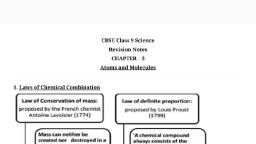
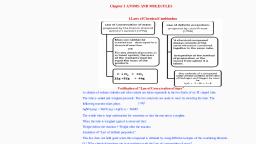
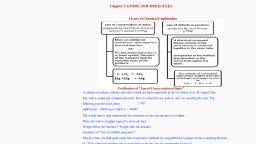
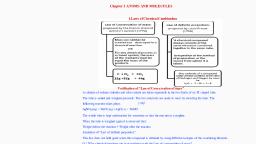
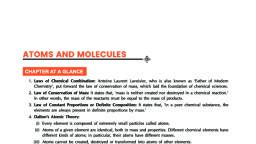
Law of chemical, combination, , Lavoisier and Joseph L. Prost have, given two rules for chemical, , combinations., , Law of Conservation of Mass:According to the Law of Conservation, of Mass,, , “The mass can neither be created nor, destroyed during any chemical, reaction.”, , After the completion of any chemical, reaction, the mass of the product is, , equal to the mass of the reactants., , For example:- Let us assume that two, reactants A & B make two products C &, , D after the reaction., , A + B s+ C + OD
Page 3 :
Then, Mass of (A) + Mass of (B) = Mass, of (C) + Mass of (D), , This means that there is no loss of, , mass during the reaction. Now let’s, understand it through a reaction., , ~s + & = Be, , 4gofH + 32gofO = 36gofH,0, , Law of Constant Proportion:, “The ratio of the mass of elements in, any compound or chemical substance, , is always constant.”, , For Example:, Whatever reaction occurs for the, formation of water, but the ratio of, hydrogen and oxygen elements in it is, , always 1:8.
Page 4 :
1. Reactant side:- 4 grams of hydrogen, reacts with 32 grams of oxygen to form, water. So if we calculate the ratio of, , mass between hydrogen and oxygen, it, will be 1: 8., , 2. Product side:- Here if we calculate, the ratio of the mass of hydrogen and, , oxygen in the water compound, it will, be 2:16 or 1:8., , Dalton’s Atomic Theory, , According to Dalton, “Every matter,, whether it is an element or a, compound, is made up of very small or, tiny particles called atoms.” These, atoms cannot be broken further into, small pieces by any chemical and, , physical methods.
Page 5 :
Postulates of Daltons Atomic Theory, , 1. Each substance is made up of very, small particles called atoms. Therefore,, in any chemical reaction, these atoms, , participate first., , 2. Atoms are fundamental or basic, particles of matter that cannot be, , divided into smaller particles.