Page 1 :
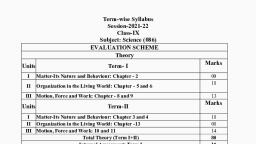
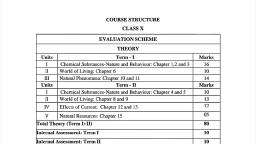
Term-wise Syllabus, Session-2021-22, Class-IX, Subject: Science (086), EVALUATION SCHEME, Theory, Units, , Term- I, , I, , Matter-Its Nature and Behaviour: Chapter - 2, , II, , Organization in the Living World: Chapter - 5 and 6, , III Motion, Force and Work: Chapter - 8 and 9, , Units, , Term-II, , I Matter-Its Nature and Behaviour: Chapter 3 and 4, II Organization in the Living World: Chapter -13, III Motion, Force and Work: 10 and 11, Total Theory (Term I+II), Internal Assessment: Term I, Internal Assessment: Term II, Grand Total, , Marks, 09, 18, 13, , Marks, 18, 08, 14, 80, 10, 10, 100, , TERM-1, Content, THEME -MATERIALS, Unit-I Matter-Its Nature and Behaviour, CHAPTER-2: IS MATTER AROUND US PURE:, Elements, Compound and mixtures. Heterogeneous and homogenous mixtures, colloids and, suspension., SUGGESTIVE PRACTICAL: Preparation of, a) A true solution of common salt, sugar and alum., b) A suspension of soil, chalk powder and fine sand in water., c) A colloidal solution of starch in water and egg albumin/ milk in water and distinction between, these on the basis of, • transparency, • filtration criterion, • stability, (S.no.1 as per the List of Experiments from CBSE.), SUGGESTIVE PRACTICAL: Preparation of a) Mixture b) A Compound, using Iron filing and, Sulphur powder and distinction between these on the basis of –, i) appearance i.e. homogeneity and heterogeneity, ii) behavior towards a magnet, iii) behavior towards Carbon disulphide as a solvent, 1
Page 2 :
iv) effect of heat, (S.no.2 as per the List of Experiments from CBSE.), SUGGESTIVE PRACTICAL: Performing the following reactions and classifying them as, physical or chemical changes:, a) Iron with Copper Sulphate solution in water, b) Burning of magnesium ribbon in air, c) Zinc with dilute Sulphuric Acid, d) Heating of Copper Sulphate Crystals, e) Sodium Sulphate with Barium Chloride in the form of their solution in water., (S.no.3 as per the List of Experiments from CBSE.), , THEME: THE WORLD OF THE LIVING, Unit-II Organisation in the Living World:, CHAPTER-5: THE FUNDAMENTAL UNIT OF LIFE, Cell as a basic unit of life; Prokaryotic and Eukaryotic cells, multicellular organisms, cell, membrane and Cell Wall, Cell Organelles and Cell inclusions; Chloroplast, Mitochondria,, Vacuoles, Endoplasmic reticulum, Golgi apparatus; Nucleus, Chromosomes – basic structure,, number., SUGGESTIVE PRACTICAL: Preparation of stained temporary mounts of, a) Onion peel, b) Human Cheek Cells ; and to record observations and draw their labeled, diagrams., (S.no.4 as per the List of Experiments from CBSE.), CHAPTER- 6: TISSUES, Structure and functions of animal and plant tissues (only four types of tissues in animals,, meristematic and permanent tissues in plants), SUGGESTIVE PRACTICAL: Identification of Parenchyma, Collenchyma and Sclerenchyma, tissues in plants, Striped, Smooth and Cardiac muscle fibres and Nerve cells in animals from, prepared slides. Draw their labeled diagram., (S.no.5 as per the List of Experiments from CBSE.), THEME – MOVING THINGS, PEOPLE AND IDEAS, Unit-III – Motion, Force and Work, CHAPTER-8: MOTION, Distance and displacement, velocity, uniform and non-uniform motion along a straight line,, acceleration, distance- time and velocity- time graphs for uniform motion and uniformly, accelerated motion, Derivation of equations of motion by graphical method, elementary idea of, uniform circular motion., CHAPTER-9: FORCE AND LAWS OF MOTION:, Force and motion, Newton’s Laws of Motion, Action and reaction forces, Inertia of body, Inertia, and mass, Momentum, force and acceleration. Elementary idea of conservation of momentum., , 2
Page 3 :
TERM-II, THEME -MATERIALS, Unit-I Matter-Its Nature and Behaviour, CHAPTER-3: ATOMS AND MOLECULES, Particle nature and their basic units: Atoms and molecules, Law of constant proportions, Atomic, and molecular masses, mole concept; Relationship of mole to mass of the particles and numbers., SUGGESTIVE PRACTICAL: Verification of Law of Conservation of mass in a chemical, reaction., (S.no.3 of TERM-II as per the List of Experiments from CBSE.), CHAPTER-4: STRUCTURE OF ATOM: Electrons, Protons and Neutrons, Valency, Chemical, formula of common compounds, Isotopes and Isobars., THEME-MOVING THINGS, PEOPLE AND IDEAS, Unit III – MOTION, FORCE AND WORK, CHAPTER-10: GRAVITATION, Gravitation, Universal law of Gravitation, Force of Gravitation of earth (gravity), Acceleration due, to gravity; Mass and weight, Free fall., SUGGESTIVE PRACTICAL: Determination of the density of solid (denser than water) by using, a spring balance and measuring cylinder., (S.no.1 of TERM-II as per the List of Experiments from CBSE.), SUGGESTIVE PRACTICAL: Establishing the relation between the loss in weight of solid when, fully immersed in (a) tap water (b) Strongly salty water with the weight of water displaced by it by, taking at least two different solids., (S.no.2 of TERM-II as per the List of Experiments from CBSE.), CHAPTER-11: WORK AND ENERGY, Work done by a force, Energy, Power, Kinetic and Potential energy; Law of conservation of energy., , THEME: THE WORLD OF THE LIVING, Unit -II – Organisation in the Living World, CHAPTER-13: WHY DO WE FALL ILL, Health and Diseases: Health and its Failure, Infectious and Non-infectious diseases, their causes, and manifestation, Diseases caused by microbes (virus, bacteria and protozoans) and their, prevention, Principles of treatment and prevention. Pulse Polio programmes., , 3
Page 4 :
ONLY FOR INTERNAL ASSESSMENT, NOTE: Learners are assigned to read the below listed part of UNIT IV. They can be encouraged to, prepare a brief write up on any one concept of this unit in their Portfolio. This may be an assessment, for Internal Assessment and credit may be given (Periodic assessment /Portfolio). This portion of the, Unit is not be assessed in the year-end examination., THEME: NATURAL RESOURCES; BALANCE IN NATURE, Unit -IV - Our Environment, CHAPTER-14: NATURAL RESOURCES, Physical resources: Air, Water, Soil, Air for respiration, for combustion, for moderating temperatures;, movements of air and its role in bringing rains across India., Air, water and soil pollution (brief introduction). Holes in ozone layer and the probable damages., Bio-geo Chemical cycles in nature: Water, Oxygen, Carbon and Nitrogen, PRESCRIBED BOOKS:, •, •, •, •, , Science-Textbook for class IX-NCERT Publication, Assessment of Practical Skills in Science-Class IX - CBSE Publication, Laboratory Manual-Science-Class IX, NCERT Publication, Exemplar Problems Class IX – NCERT Publication, , Assessment Areas (Theory) 2021-22, (Class IX), Science (086), Theory, , Total Maximum Marks: 80, Competencies, Demonstrate Knowledge and Understanding, Application of Knowledge/Concepts, Analyze , Evaluate and Create, , Note:, • Internal choice would be provided., Internal Assessment – Term I and II (10 Marks each), •, •, •, •, , •, •, •, •, , Periodic Assessment - 03 marks, Multiple Assessment – 02 marks, Subject Enrichment (Practical Work) - 03 marks, Portfolio - 02 marks, , 4, , Marks, 46 %, 22%, 32%