Page 1 :
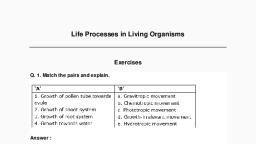
1. Match the pairs and explain., , Column ‘A’, , (1) Growth of pollen, tube towards ovules, (2) Growth of shoot, system, , (3) Growth of root, system, , (4) Growth towards, , the water, , Answer:, (1 — b),, (2 - c),, (3 - a),, , (4 -e)., , Column ‘B’, , (a) Gravitropic, movement, , (b) Chemotropic, movement, , (c) Phototropic, movement, , (d) Growth-irrelevant, movement, , (e) Hydrotropic, , movement
Page 2 :
Page No 178:, , Question 2:, , Complete the paragraph., , The milk was on the stove. Rasika was, engrossed watching television. She smelled, something burning. She ran towards the, kitchen. The milk was boiling over. She held the, vessel with her bare hands but, screaming, she, let it go at once. This activity was controlled by, sscmmsenannarcets cells. Special ends of ...................., in these cells collected the information, from, where it was transferred to the .................... and, then towards the terminal end of the, eseseeesaeesseeseee The chemicals produced at the, terminal end passed through the minute space, RO. nearness ANIS Way; ancancance were, conducted in the body and the process of, eee was completed by conducting the, impulses from ..............000+ a, , (Nerve, muscle cell, impulse, dendrite, synapse,, axon, reflex action, cell body)
Page 3 :
ANSWER:, , The milk was on the stove. Rasika was, engrossed watching television. She smelled, something burning. She ran towards the, kitchen. The milk was boiling over. She held the, vessel with her bare hands but, screaming, she, let it go at once. This activity was controlled by, nerve cells. Special ends of dendrites in these, cells collected the information, from where it, was transferred to the cell body and then, towards the terminal end of the_axon. The, chemicals produced at the terminal end, passed through the minute space i.e. synapse., In this way, impulse were conducted in the, body and the process of reflex action was, completed by conducting the impulses from, nerve to muscle cells.
Page 4 :
Question 3:, , Write notes on, Root pressure, Transpiration, Nerve cell, Human, brain, Reflex action, , ANSWER:, , a. Root pressure: Root pressure can be defined, as a force that helps to drive fluids upward into, the water conducting vessels. It is generated, as a result of osmotic pressure in the cells of, the roots and can be demonstrated by, exudation of fluid when the stem is cut off just, above ground. As, the stem is cut off, dops of, solution begin to ooze out which is an effect of, root pressure. The effect of root pressure is, also visible at night and early morning. During, this time the rate of evaporation is low, as a, result of which water droplets can be seen the, around special openings of veins near the tip of, leaves of plants.
Page 5 :
b. Transpiration is the loss of water in the form, of vapours from the leaves of a plant. The rate, of transpiration is affected by number of, external and internal factors., , Internal factors:, , (i) Leaf area: The greater the leaf area the higher, will be the water loss due to transpiration., , (ii) Leaf structure: Presence of thick cuticle, wax, layer, compact mesophyll cells reduces the rate of, transpiration., , (iii) Root-shoot ratio: Low root-shoot ratio, decreases rate of transpiration., , External factors:, , (i) Atmospheric humidity: The higher the relative, humidity lower will be the rate of transpiration., , (ii) Temperature: Rise in the atmospheric, temperature increased the rate of transpiration., , (iii) Wind velocity: High wind velocity increases the, transpiration rate., , (iv) Water supply: Deficiency of water in soil, decreases the rate of transpiration.