Page 1 :
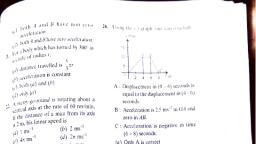
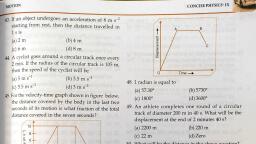
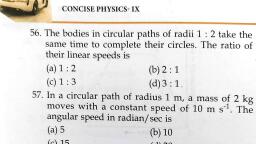
“+ hac value of —6.0 mS .20niey Se, 4 A quantity has, , 2) Speed of a particle, , b) Velocity of a particle, , -) Position of a particle, , 3) Displacement of a particle, , 4, , |, , 1, in 10 minutes, a car with a speed of 60 km h, travels a distance of :, (a)6 km, , (c) 10 km, , (b) 600 km, (d)7 km, , A particle covers equal distances in equal intervals, of time, it is said to be moving with uniform, , J, , {a) Speed (b) Velocity, (c) Acceleration (d) Retardation, 27. The Si unit of the average velocity is, (a)ms? (b) km s7, () cms? (d)mm s?, 28. Meter per second is not the unit of, (a) Speed (b) Velocity, (c) Displacement (d) None of them, , 29. A car accelerated uniformly from 18 km h'! to 36, km h™ in 5 s. The acceleration in m s? is, , (a)1 (b)2, (93 (dj4, 30. Out of energy and acceleration which is the vector?, (2) Acceleration (b) Energy, (c) Both (a) and (b) (4) None of these, 1. The CGS. unit of acceleration is, (a) ms* (b) cm s?, (c)m s* (d) cm s? ;, , 32. A train starting froma railway station and moving, with a uniform acceleration, attains a speed of 40, km h” in 10 minutes. Its acceleration is, (a) 18.5 ms? (b) 1.85 cm s2, (c) 18.5 cm s# (d) 1.85 m s?, , 33. The brakes applied to a car produce a negative, acceleration of 6 m s™. If the car stops after 2, seconds, the initial velocity of the car is, (a)6ms? (b)12ms1, (c) 24ms% (d) zero, , 66, , 7 5a ., , OD:, , 36., , 87;, , 38., , 39., , 41., , Pei eee: fate Seem Velog, MO!, ms. The velocity of the body after 10 i, (a) 100 m s"! (b) 50 m gt 43., (c) 10 ms" (d)5 mgt, , In 12 minutes a car whose speed jg 35, travels a distance of m, , (a) 7 km (b) 3.5 km 4,, (c) 14 km (d) 28 km, , A body that is moving along a straight ling,, ms! undergoes an acceleration of 4 m s2 Ai,, , s, its speed will be 4, (a) 8 ms? (b) 12 m s7!, , (c) 16 ms (d) 28 m 5?, , If a car increases its speed from 20 km h7! to, km h? in 10 secs, then its acceleration will be, (a) 30 ms? (b)3 ms, , (c) 18 ms? (d) 0.83 m s7, When the distance travelled by an object is direc, proportional to the time, it is said to travel wil, , (a) zero velocity (b) constant speed, , (c) constant acceleration (d) uniform velocity, , If a body falling freely from rest has a velocit), after it falls through a height /, then the distanc:, , has to fall further for its velocity to become doubt, will be, , (a) 3h , (b)6h, (c)8h, , (d)10h, The velocity of bullet is reduced from 200 m s*!t, 100 ms“! while travelling through a wooden blot, of thickness 10 cm. The retardation, assuming it‘, be uniform will be, (a) 10 x 104m s?, , (b) 1.2 x 10⁴m s?, (c) 13.5 x 10⁴m s~2, , (d)15 x 104m 5, , If a body starts falling from height ‘h’ and travel’, a distance of h/2 during the last second of motio!, then the distance travelled in one sec is, , (a) J2-1 (b) 2+ /2, (0) 2+V3 (d) V3 +2, Area of the speed - time graph gives, (a) Distance (b) Velocity, (c) Speed, , (d) None of these