Page 1 :
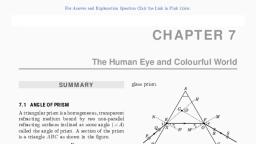
Ts cae, , SYLL | SYLLABUS |, , , , , , ‘ a triangular prism to produce a visible spectrum from white light; Electromagnetic spectrum. Scattering, of light., Scope of syllabus : Deviation produced by a triangular prism; dependence on colour (wavelength) of light;, dispersion and spectrum; electromagnetic spectrum; broad classification (names only arranged in order of, , increasing wavelength); properties common to all electromagnetic radiations; properties and uses of infrared and, ultraviolet radiations. Simple application of scattering of light e.g. blue colour of the sky., , , , , , , , , , , , (A) DEVIATION, DISPERSION AND SPECTRUM, , , , 6.1 DEVIATION PRODUCED BY A emergent ray RS and the direction PL of the, , TRIANGULAR PRISM, , Fig. 6.1 shows the deviation produced by a, triangular prism. When a light ray PQ of single, colour enters a triangular prism ABC, it gets, deviated, say, by an angle 5, towards the base BC, at the first surface AB of the prism and travels, straight as QR inside the prism. The angle of, deviation 5, depends on the angle of incidence and, the refractive index of glass with respect to air. On, striking the second surface AC, the ray QR gets, further deviated, say, by an angle 5, towards the, base BC and travels straight as RS outside the, prism. The angle of deviation 5, depends on the, angle of incidence at the second surface (which, depends on the angle of the prism A) and the, refractive index of air with respect to glass. For the, emergent ray RS, the total deviation 8 with respect, to the incident ray PQ (i.e., the angle between the, , , , Fig. 6.1 Deviation produced by a triangular prism, , incident ray PQ) is given as :, , 8=8, +8,, , , , (6.1), , , , , , , , The total angle of deviation 5, thus, depends, upon the following three factors :, , (1) the angle of incidence (i) at the first surface,, , (2) the angle of the prism (A), and, , (3) the refractive index of the material of the, prism (1). But the refractive index depends, on the colour (or wavelength ) of the light, used, so the angle of deviation depends also, on the colour (or wavelength A) of the incident, light., , In chapter 4, we have discussed the, dependence of angle of deviation 5 on the angle, of incidence i, angle of prism A and refractive, index 1 of the material of prism. Here we shall, discuss in detail how the deviation 6 produced by, a prism depends on the colour (or wavelength 1), of the incident light., , Dependence of deviation on the colour (or, wavelength) of light, , The light of different colours have same speed, in air but different speeds in a medium. If the, , 131
Page 2 :
light entering the prism is not of a single colour,, i.é., it is a mixture of several colours, then the, emergent beam also has different colours arranged, in a definite order. It is because the speed of light, in a transparent medium decreases with the, decrease in the wavelength of light. Therefore, the, refractive index of glass (the material of prism), increases with the decrease in the wavelength of, light. Therefore the deviation caused by a prism, also increases with the decrease in the wavelength, of light*. In visible light, violet colour, (wavelength = 4000 A) is deviated the most, and red colour (wavelength 4 = 8000 A) is, deviated the least because in glass, the speed of, violet light is least and that of the red light is, most., , 6.2 COLOURS IN WHITE LIGHT WITH THEIR, WAVELENGTH AND FREQUENCY, RANGE, , The white light emitted from a source consists, of light of different wavelengths. The light of, different wavelengths produce the sensation of, different colours on the retina of our eye, so we, perceive them as different colours. The prominent, colours in white light are violet, indigo, blue,, green, yellow, orange and red. Different colours, differ in their wavelength. In fact, wavelength is, ‘the characteristic of colour, irrespective of its, origin i.e., the light of the same colour obtained, from different sources will have the same, wavelength. In other words, colour is the, , * From the definition of refractive index, __ Speed of light in air, Motass = Speed of light in glass, The speed of light for different colours is same in air,, but it is different for different colours in glass (medium). In, glass, the speed of violet light is minimum and the speed of, red light is maximum. Therefore [ito > Hred, , But f= sin i/ sin r or sin r= sin i/, , Therefore, in glass, for a given value of i. the angie of, refraction r is minimum for the light of violet colour and, maximum for the light of red colour i.e., rey > "voter, , Now angle of deviation § = i — r, so 6,, , viotet > Bred, , , , subjective property of light related to its, wavelength., , The table below gives the range of wavelength, and frequency for light of different colours, present in the white light., , Wavelength and frequency of different colours in white light, , , , Note ; (1) In the above table the letter A, denotes the unit Angstrom where 1 A = 10-!°m, (or 10-* cm). Now a days the wavelength is, expressed mostly in nanometre (nm) where, , Inm=10%m=10 A., , (2) In the spectrum of white light, the red, colour has the longest wavelength 8000 A, (or 8 x 10⁻⁷m or 800 nm) or lowest frequency, 3-75 x10!4 Hz and the violet colour has the, shortest wavelength 4000 A (or 4 x 10⁻⁷m or, 400 nm) or highest frequency 7-5 x10!4 Hz., From the violet end to the red end of the, spectrum, the wavelength increases while the, frequency decreases., , , , , , , , 6.3 DISPERSION OF WHITE LIGHT, THROUGH A PRISM AND FORMATION, OF A SPECTRUM, , Sir Isaac Newton, while studying the image of, a heavenly body formed due to refraction of, white light by a lens, found that the image is, coloured at its edges. He thought that the, coloured image is due to some defect of the lens., He then repeated the experiment with a carefully, polished lens, but the image was still coloured., Newton then concluded that the fault is not with, the lens, but there is something in the nature of, white light itself due to which the image is, , wre eee 122 Sa
Page 3 :
coloured at its edges. To investigate it further, he, performed another experiment with a prism., , Newton’s Experiment, , Newton allowed the white light from sun to, enter a dark room through a small aperture in a, window and placed a glass prism in the path of, light rays. The light emerging out of the prism, was received on a white screen. On the screen, a, coloured patch like a rainbow as shown in, Fig. 6.2 was obtained which was termed as, , Spectrum., , WHITE, SCREEN, , A, , , , , , , , <—aO<OD, , , , 58, we B c, , we?, , ce, , Starting from the side of base of the prism,, the order of colours in the spectrum on screen, is :, , Fig. 6.2 Dispersion by a prism, , Violet, Indigo, Blue, Green, Yellow, Orange,, and Red. This order of colours in the spectrum, can easily be remembered by the word, VIBGYOR., , Conclusion : From the above experiment,, Newton concluded that white light consists of, seven prominent colours. Each colour corresponds, to a small range of wavelength. Thus, white light, is a mixture of large number of wavelengths (i.e.,, it is polychromatic in nature)., , Dispersion, , , , Spectrum, , , , Cause of dispersion of white light and, formation of spectrum, , The cause of dispersion of white light is the, change in speed of light with wavelength. When, white light enters the first surface of a prism,, light of different colours due to their different, speeds in glass, gets deviated through different, angles towards the base of prism i.e. the, dispersion (or splitting) of white light into its, constituent colours takes place at the first surface, of prism. The violet colour is deviated the most,, while the red colour is deviated the least., Therefore light of different colours follow, different paths in glass and then strikes the second, surface of prism. On the second surface of prism,, only refraction takes place (from glass to air) and, different colours are deviated through different, angles, i.e., violet is deviated the most and red, the least. As a result, the colours get further, separated on refraction at the second surface. The, light emerging out of the prism, thus, has, different colours that spread out to form a, spectrum on the screen., , , , Note : In the spectrum, each colour is, mixed with the other colour i.e., there is no, sharp boundary line separating the colours. In, diagram, colours are shown widely separated, just for clarity. The total spread of colours is, much less than that shown in the diagram., Different colours have different width on the, screen., , , , , , Note : (1) Dispersion of white light occurs, at the first surface of prism., , (2) Deviation of light occurs at both the, surfaces of prism., , (3) The prism does not produce colours,, but it only splits the various colours present in, the light incident on it., , , , , , , , , , SS eee 133 eae
Page 4 :
1. Fig. 6.3 shows the light (blue + red + green), incident on a prism and on a parallel sided glass, slab. Complete the diagrams by drawing the, refracted and the emergent rays., , , , , , , , , , , , (a), , Fig.6.3, , The completed ray diagrams are shown in, Fig. 6.4., , In a prism, the refraction takes place at two inclined, surfaces, so the prism causes dispersion and deviation of, light into its constituent colours and a spectrum is seen., , In case of the parallel sided glass slab, the refraction, takes place at two parallel surfaces. On the first surface,, the colours are separated due to different deviation for the, rays of different colours i.e., dispersion takes place. On, the second surface, the ray of each colour is refracted, such that the emergent ray is parallel to the incident ray, on the first surface. Since there is no further separation of, colours due to refraction at the second surface (as it is in, case of the prism), so the emergent coloured rays are, parallel to each other and they are so close that it is, difficult to see the separate colours and the emergent light, appears to be almost white (= blue + red + green)., , BLUE, , + RED, + GREEN, 9 \, , , , , , , , , , x ee, ‘a RED, orto GREEN, x BLUE RED, ‘ BLUE GREEN, (@) (), Fig. 6.4, , 2. A beam consisting of red, blue and yellow colours, is incident normally on the face AB of an, isosceles right angled prism ABC as shown in, Fig. 6.5. Complete the diagram to show the, , , , , , refracted and the emergent rays. Given that the, critical angle of glass-air interface for yellow, colour is 45°., , A, , RED + BLUE + YELLOW, eS, , , , BL—____\c, , Fig. 6.5, , The completed diagram is shown in Fig. 6.6. The, beam is incident normally (Z i = 0°) on the face AB, it, passes without deviation (Z r = 0°) for all colours and, with no dispersion. Now the refracted beam inside the, prism, strikes the face AC at an angle of incidence equal, to 45°. Since the critical angle for yellow colour at the, glass-air interface is 45°, so the yellow colour suffers, refraction along the face AC of the prism (Z r = 90°)., , The critical angle for the light of red colour will be, more than 45° (since sin C = z and Hp < Hy), so the, light of red colour is incident on the face AC at an angle, Jess than the critical angle for red colour. The red colour, is, therefore, refracted out of the prism obeying the laws, of refraction, i.e., it bends away from the normal at the, face AC so the emergent ray bends towards the base of, the prism., , A, , ¢, , /, , RED + BLUE + YELLOW, , , , a, RED, , B Cc, , , , , , by, &, , BLUE %, , , , Fig. 6.6, , Now the critical angle for the light of blue colour will, be less than 45° since 11, > Hy, so the light of blue colour, is incident on the glass-air surface AC at an angle of, incidence greater than the critical angle for blue colour., Therefore, the light of blue colour suffers total internal, reflection and strikes normally on the base BC of the, prism. It then emerges out of the prism without deviation., Thus blue colour emerges out of the prism at right angle, to its incident direction.
Page 5 :
3. A beam of white light is incident normally on the, surface AB of an equilateral prism ABC and, emerges out of it suffering a deviation of 60°., , (a) Draw a diagram to show the path of beam till, it emerges out of the prism. Mark the angles, wherever necessary., , What assumption have you made while, , drawing the diagram ?, , Name the phenomenon exhibited by the light, , beam., , The ray diagram is shown in Fig. 6.7., , The beam of white light incident normally on the, , face AB of the prism passes undeviated inside the, , prism and strikes the other face AC at an angle of, incidence of 60°. At the face AC, it suffers total, internal reflection. After total internal reflection at, , (b), (c), , (a), , , , 4,, , 5:, , the face AC, the beam of light falls normally on, the face BC, so it emerges out without deviation., , (b) Assumption : The critical angle of glass-air, interface is less than 60° for all colours of white, light., , (c) Phenomenon : Total internal reflection., , The frequency of violet light is 7-5 x 10'4 Hz., Find its wavelength in (i) nm, (ii) A. Speed of, light c = 3 x 10⁸ ms“,, , Given : f = 7-5 x 10'4 Hz,c =3 x 10⁸ ms"., , c, From relation c = fA, wavelength A = F, , 3x10⁸, or A= ——; =4x 10⁷m., 75x10, , (i) Since 1 nm = 10% m, «. A= 400 nm, , (ii) Since 1 A= 10° m, «. A= 4000 A, The wavelength of red light is 800 nm. Find its, frequency. Speed of light = 3 x 10⁸ ms“., Given : A = 800 nm = 800 x 10° m = 8 x 1077 m, c=3x10®ms!, , Form relation c = fA, frequency f = :, , 3x10°, , © FT 3:75 x 10" Hz., , orf, , , , . Name three factors on which the deviation produced, by a prism depends and state how does it depend on, the factors stated by you., , . How does the deviation produced by a triangular, , prism depend on the colours (or wavelengths) of, , light incident on it ?, , How does the speed of light in glass change on, , increasing the wavelength of light ?, , Ans. Speed of light increases with increase, in its wavelength., , Which colour of white light travels (a) fastest, , (b) slowest, in glass ? Ans. (a) red (b) blue, , 4,, , Name the subjective property of light related to its, wavelength. Ans. colour, , 6. What is the range of wavelength of the spectrum of, white light in (i) A, (ii) nm ?, , Ans. () 4000 A to 8000 A, , i) 400 nm to 800 nm, , , , 8., , Write the approximate wavelengths for (i) blue, and, , (ii) red light. Ans. (i) 4800 A, (ii) 8000 A, , Write the seven prominent colours present in white, light in the order of increasing wavelength, , Ans. violet, indign, blue, green, yellow, orange, and red., , 9. Name the seven prominent colours of the, , 10., , i., , 12., , 135, , white light spectrum in order of their increasing, frequencies., , Ans. red, orange, yellow, green,, , blue, indigo, and violet., , Name four colours of the spectrum of white light, which have wavelength longer than blue light., , Ans. green, yellow, orange, and red, Which colour of the white light is deviated by a, glass prism (i) the most, and (ii) the least ?, . The wavelengths for the light of red and blue, colours are nearly 7-8 x 10⁻⁷ m and 4-8 x 10⁷ m, respectively.