Page 1 :
Manushi kaushik classes, Class 9 Physics, , Notes on Gravitation, What is the Centripetal Force?, • We know that an object in circular motion keeps on changing its direction., • Due to this, the velocity of the object also changes., • A force called Centripetal Force acts upon the object that keeps it moving in a circular, , path., • The centripetal force is exerted from the centre of the path., • Without the Centripetal Force objects cannot move in circular paths, they would always, , travel straight., • For Example, The rotation of Moon around the Earth is possible because of the, , centripetal force exerted by Earth.
Page 2 :
Figure 1 Centripetal Force of Earth on Moon, , Newton's Observations, • Why does Apple fall on Earth from a tree? – Because the earth attracts it towards itself., • Can Apple attract the earth? - Yes. It also attracts the earth as per Newton's third law, , (every action has an equal and opposite reaction). But the mass of the earth is much, larger than Apple's mass thus the force applied by Apple appears negligible and Earth, never moves towards it., • Newton thus suggested that all objects in this universe attract each other. This force of, , attraction is called Gravitational Force.
Page 3 :
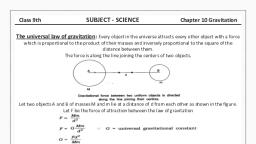
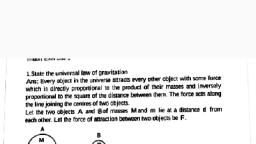
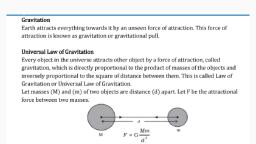
Figure 2 Gravitational Force of Earth, , Universal Law of Gravitation by Newton, • According to the universal law of gravitation, every object attracts every other object with a, , force., • This force is directly proportional to the product of their masses., • This force is inversely proportional to the square of distances between them., • Consider the figure given below. It depicts the force of attraction between two objects with, , masses m1 and m2 respectively that are ‘d’ distance apart., , • The figure below describes how the universal law of gravitation is derived mathematically., , From the above equation we can rewrite them as the following:
Page 4 :
If we remove the proportionality we get proportionality constant G as the following:, , The above equation is the mathematical representation of Newton’s universal Law of, gravitation, Hence, G = Fr2/ m1 m2, SI Unit: Nm2 kg-2, Value of G = 6.673 × 10⁻¹¹ Nm2 kg-2 (was found out by Henry Cavendish (1731- 1810)), • The proportionality constant G is also known as the Universal Gravitational Constant, , Why we study the universal law of gravitation?, It explains many important phenomena of the universe –, • Earth’s gravitational force, • Why the moon always moves in a circular motion around the earth and the sun, • Why all planets revolve around the sun, • How the sun and moon can cause tides, , Free Fall, • Acceleration due to gravity – Whenever an object falls towards the Earth there is an, , acceleration associated with the movement of the object. This acceleration is called, acceleration due to gravity., • Denoted by: g, • SI Unit: m s-2, • We know that, F= ma, • Therefore, F = mg, • The following figure demonstrates the mathematical derivation of ‘g', , The force (F) of gravitational attraction on a body of mass m due to earth of mass M and radius R is, given by, , We know from Newton’s second law of motion that the force is the product of mass and, acceleration.
Page 5 :
∴ F = ma, But the acceleration due to gravity is represented by the symbol g. Therefore, we can write, F = mg, , ….. (2), , From the equation (1) and (2), we get, , When body is at a distance ‘r’ from the centre of the earth then, , Value of ‘g' may vary at different parts of the earth –, • From the equation g = GM/ r2 it is clear that the value of ‘g' depends upon the distance of, , the object from the earth's centre., • This is because the shape of the earth is not a perfect sphere. It is rather flattened at poles, , and bulged out at the equator., • Hence, the value of ‘g' is greater at the poles and lesser at the equator. However, for our, , convenience, we take a constant value of ‘g' throughout., We can find the value of acceleration due to gravity by the following –
Page 6 :
What is Free Fall?, When an object falls towards the earth due to earth’s gravity and no other force is acting upon it, the, object is said to be in free fall state. Free falling objects are not even resisted by the air., g = 9.8 m/s2 is also called the Free-fall Acceleration., Value of ‘g' is same on the earth, so the equations of motion for an object with uniform motion are, valid where acceleration ‘a' is replaced by ‘g', as given under:, v = u + gt, s = ut +1/2 gt2, 2 g s = v2 – u2, , Consider the equations of motion given in different scenarios:, When an object at rest falls towards earth –, its initial velocity is zero, v = gt, s = t + (1/2) gt2, 2 g s = v2
Page 7 :
When an object with some initial velocity (u), falls towards earth –, v = u + gt, s = ut + (1/2) gt2, 2 g s = v2 – u 2, When an object is thrown upwards from, earth – the gravitational force acts in, opposite direction, hence g is negative, v = u - gt, s = ut - (1/2) gt2, -2 g s = v2 – u2, , Difference between Universal gravitational Constant and Acceleration due to, Gravity, Mass, , Weight, , Mass is defined as The weight of an object is, the quantity of, , the force by which the, , matter in an, , gravitational pull of earth, , object., , attracts the object., , Mass is a scalar, , Weight is a vector, , quantity, , quantity, , The mass of an, , The weight of an object, , object is always, , can vary at different, , constant as it, , locations because of, , depends upon the change in gravitational, inertia of the objectforce of the earth, Mass can never be Weight can be zero at, zero, , places there is no, gravitational force, Denoted as W, F = mg, , Denoted as: m, , where m = mass of, object, a = acceleration due to, gravity
Page 8 :
Similarly, W is force, so, W = mg, SI Unit: kg, , SI unit: N, , Weight of an object on the Moon, Just like the Earth, the Moon also exerts a force upon objects. Hence, objects on moon also have, some weight. The weight will not be same as than on the earth. So, weight on the Moon can be, calculated as -