Page 1 :
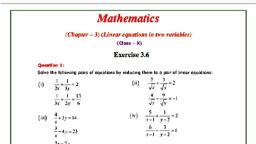
Mathematics, , (Chapter — 3) (Linear equations in twe variables), (Class - X), , Exercise 3.5, , Question 1:, Which of the following pairs of linear equations has unique solution, no solution or, infinitely many solutions? In case there is a unique solution, find it by using cross, , multiplication method., (i) x-3y-3=0 (ii) 2x+y=5, 3x-9y-2=0 3x+2y=8, (iii) 3x-5y=20 (iv) x-3y-7=0, 6x-10y=40 3x-3y-15=0, Answer 1:, (i) x-3y-3=0, 3x-9y-2=0, wt Boy! Bove, a 3 & 9 3c, 22, 5G, a, b,c., , Therefore, the given sets of lines are paralle| to each other. Therefore, they will not, intersect each other and thus, there will not be any solution for these equations., , (i), , Therefore, they will intersect each other at a unique point and thus, there will be a unique, solution for these equations. By cross-multiplication method,, , 2T Ts
Page 2 :
—8-(-10) -15+16 4-3, Ki Peaail, , 2 1, , Jai, Za, , 2 1, , x=2, y=l, , x=2,y=1, , 6x-10y = 40, a a, a, 62 6 -10 2 c -~40 2, S508, , a, b, ¢,, , Therefore, the given sets of lines will be overlapping each other i.e., the lines will be, coincident to each other and thus, there are infinite solutions possible for these, equations., , (iv) x-3y-7=0, 3x-3y-15=0, Bot Bg St 7, a, 3 b -3 ¢ 15 15, SoA, a, b,, Therefore, they will intersect each other at a unique point and thus, there will be a unique, , solution for these equations., By cross-multiplication,, , oT e Ts
Page 3 :
i i pig, , , , 45-(21) -21-(-15) -3-(-9), x y 1, , 24° -6 6, , ak Del., , 24 6 6 6, , Question 2:, , (i) For which values of a and 6 will the following pair of linear equations have an infinite, number of solutions?, , 2x+3y=7, , (a-b)x+(a+b)y=3a+b-2, , (ii) For which value of k will the following pair of linear equations have no solution?, , 3x+y=l, , (2k-1)x+(k-1)y =2k+1, , Answer 2:, (i) 2x+3y-7=0, {a-b)x+(a+b)y-(3at+6-2)=0, a. 2 § 3 Ge -7 _ 7, a, a-b b, a+b c, -(3a+b-2) (3046-2), For infinitely many solutions,, HAL, a, 6 ¢;, 2 7, a-b 3a+b-2, 6a+2b-4=7a-7b, a-9b=-4 (1), , 2 3, , a-b a+b, , 2a + 2b =3a-3b, , a~Sbh=0 (2), Subtracting (1) from (2), we obtain, , Tals
Page 4 :
4b=4, , b=1, , Substituting this in equation (2), we obtain, a-Sxi=0, , a=5, , Hence, a = 5 and b = 1 are the values for which the given equations give infinitely, many solutions,, (ii) 3x+y-1=0, , (2k -1)x+(k-1)y-2k-1=0, , a, 3 a 1 q -! 1, , a, 2k- b, k=l ¢, —2k-1 2k+1, For no solution,, Soh, , a, b ¢;, , , , , , , , , , Hence, for k = 2, the given equation has no solution., , Question 3:, Salve the following pair of linear equations by the substitution and cross multiplication, methods:, , , , 8r+5y=9 (i), , 3x+2y=4 (ii), , From equation (ii), we obtain, 4-2y re, , = (ii), , Substituting this value in equation (/), we obtain, , x, , , , 2THTs, , , , , , X.Y Mey 3Ye YoY?
Page 5 :
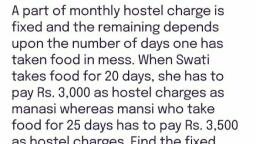
(42), Sy=9, 3, , 32-l6y+15y=27, , -y=-5, , y=5 (iv), , Substituting this value in equation (i/), we abtain, 3x+10=4, , x=-2, , Hence, X=-2,y=5, Again, by cross-multiplication method, we obtain, &r+5y-9=0, 3x+2y-4=0, x y I, , ~20-(-18) “27-(-32) 16-15, , , , Form the pair of linear equations in the fallowing problems and find their solutions (if, they exist) by any algebraic method:, , (i). A part of monthly hostel charges is fixed and the remaining depends on the number, of days one has taken food in the mess. When a student A takes food for 20 days she, has to pay Rs 1000 as hostel charges whereas a student B, who takes food for 26 days,, pays Rs 1180 as hostel charges. Find the fixed charges and the cost of food per day, , (ii). A fraction becomes 1/3 when 1 is subtracted from the numerator and it becames, % when 8 is added to its denominator. Find the fraction., , (ill). Yash scored 40 marks in a test, getting 3 marks for each right answer and losing 1, mark for each wrong answer. Had 4 marks been awarded for each correct answer and 2, marks been deducted for each incorrect answer, then Yash wauld have scored 50 marks., How many questions were there in the test?, , are is, , , , , , ®©®@eGG0e@