Page 1 :
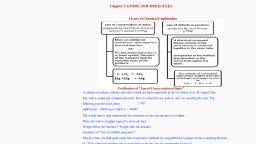
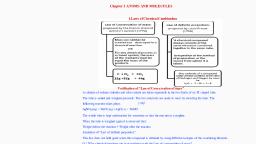
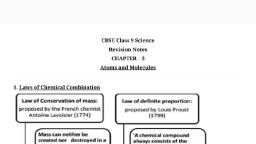
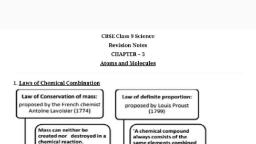
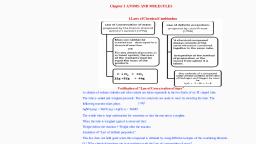
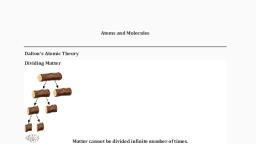
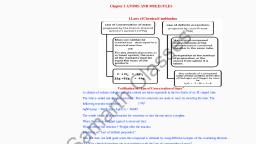
Atoms and Molecules, , , , Atoms, , , , According to Dalton's atomic theory, , o, o, o, , Matter is made up of very tiny particles and these particles are called atoms., Atoms cannot be divided further i.e., atoms are indivisible, An atom can be defined as the smallest particle of matter that can neither be created nor, destroyed by chemical means., , , , , Laws of Chemical Combination, Law of conservation of mass, , o, , Mass can neither be created nor destroyed in a chemical reaction. It means that the sum of, the masses of the reactants and the products remains the same during a reaction., , , , Laws of Chemical Combination, , , , Law of constant proportion, , o, , A chemical substance always contains the same elements in a fixed proportion by mass,, irrespective of the source of compound., , , , The size of an atom is indicated by the radius of the atom called the atomic radius. It is, often expressed in nanometers., , , , Representation of atoms, , o, , The symbol of the element is made from one or two letters of the English or the Latin name, of the element., Symbols are significant as they represent a particular element and they represent one, atom of that element., , o, , , , Atomic Mass, , o, o, , The mass of an atom is known as the atomic mass., The atomic mass of an atom of an element is also known as its relative atomic mass, since it, is determined relative to the mass of C-12 isotope., , , , Gram molecular mass: The mass of one mole of atoms is known as the molar mass of, atoms, gram atomic mass, or gram atoms. For example, the atomic mass of nitrogen is 14, u and the gram atomic mass of nitrogen is 14 g. The mass of one mole molecules of any
Page 2 :
substance is equal to the gram molecular mass of that substance., , , Relative atomic mass or atomic weight: It is the ratio of mass of one atom of an element, to the mass of an atom of hydrogen taken as unity., , , , Gram molecular volume: The volume occupied by 1 gram molecule of a dry gas at S.T.P is, called gram molecular volume. The experimental value of 1 gram molecular volume of a gas, is 22.4 L at S.T.P., , , o, , Molecule, A molecule is formed when two or more atoms of the same element or different elements, get combined chemically., The number of atoms that combine to form a molecule is called the atomicity of the, molecule., , o, , , o, o, o, , Ion, An ion is a charged species in which an atom or a group of atoms possess a net electric, charge (positive or negative)., Positively charged ions are called cations (basic radical) and negatively charged, ions (acidic radical) are called anions., Compounds in which molecules are formed by the combination of cations (positively, charged ions) and anions (negatively charged ions) are known as ionic compounds., , , o, , Chemical formula, A chemical formula is the representation of the composition of a molecule in terms of the, symbols of elements present in that molecule., , , , Molecular formula is a chemical formula that indicates the kinds of atoms and the, numbers of each kind of atom in a molecule of a compound., , , , To write the chemical formula of a compound, one should have prior knowledge of two, things., , o, , The symbols of the constituent elements., , o, , The combining capacity of the atom of each element constituting the compound., , , , Molecular Mass, , o, , The molecular mass of a substance is the sum of the atomic masses of all the atoms present, in a molecule of that substance., , , , Formula unit mass
Page 3 :
o, , The formula unit mass of a substance is the sum of the atomic masses of all the atoms, present in a formula unit of that substance., , , o, , Mole Concept, One mole of a substance is the quantity of the substance containing 6.022 × 10²³ numbers, of particles (atoms, molecules, or ions). The number i.e., 6.022 × 10²³ is known as the, Avogadro number. It means that one mole of any substance (element or compound), contains 6.022 × 10²³ particles (atoms of molecules)., The mass of 1 mole of a substance is known as its molar mass., , o, , , , Avogadro's Law: Under the same conditions of temperature and pressure, equal volumes of, all gases contain the equal number of moles., , , , Gay-Lussac's Law: At constant volume, the pressure of a fixed amount of a gas is directly, proportional to the temperature.