Page 1 :
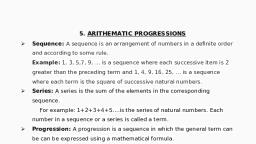
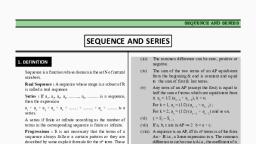
ARITHMETIC PROGRESSION, If I have the belief that I can do it, I will acquire all the capacity to do it, even if I may not have it at the beginning!, , By O.P. GUPTA Math Mentor & Author, INDIRA AWARD WINNER, INTRODUCTION, In this chapter we shall learn about something new, we shall study about numbers following a particular, pattern. We shall define a term called Arithmetic Progression and learn its various aspects and then after, we shall solve some real life problems using this as well! But before that let me first introduce you to a, few terms which are relevant but are not of much importance from the examination point of view. I, would like to inform you that this topic is really very interesting, and you will surely enjoy!, a) Sequence: It is a succession of numbers t1 , t2 , t3 ,..., tn formed according to some definite rule. And, t1 , t2 , t3 ,..., tn are called respectively the first, second, third,…, nth terms of the sequence., b) Finite and infinite sequence: A sequence is finite or infinite accordingly as it has finite or infinite, number of terms., c) Series: If tn be a sequence, then an expression of the form t1 t2 t3 ... tn is called a series., Alternatively, we can say that a series represents the sum of the terms of a sequence. Here t1 , t2 , t3 ,..., tn, are called respectively the first, second, third,…, nth terms of the series., d) Finite and infinite series: A series is finite or infinite accordingly as it has finite or infinite number of, terms., e) Progression: If the terms of a sequence are written under specific conditions, then the sequence is, called a progression. In the current chapter we shall confine ourselves to Arithmetic Progression (AP), only and its various aspects. However there are other progressions as well viz. Geometric Progression, (GP) and Harmonic Progression (HP) which will be studied in later classes., NOTE that all the discussion above has been given only for the purpose of understanding of what we, have to study about in this chapter. Now we shall commence our exploration of Arithmetic Progression,, abbreviated as AP in all further cases., Let’s begin our mission, (which is of course, not impossible)!, 01. Arithmetic Progression [AP]:, A succession of numbers is said to be in AP if the difference between any term and the term preceding it, is constant throughout. This constant is called the common difference of the arithmetic progression and is, represented by the lower case letter d., Thus if a1 , a 2 , a 3 ,...,a n represent the n terms of an AP then, a 2 a1 a 3 a 2 ... a n a n 1 ., Also, the number obtained by a 2 a1 or a 3 a 2 or, a n a n 1 is called the common difference (d)., Thus, d a 2 a1 , and in general d a n a n 1 ., General form of an AP: If an AP has n terms with its first term as a and the common difference as d, then, its general form is given as, a, a d, a 2d, a 3d, ..., a n 1 d ., General term i.e. nth term of AP: If an AP has n terms with first term a and the common difference d, then its nth term is given as, a n a n 1 d . Can I expect you to remember that a n is called the last, term and nth term of the AP as well, always keep it in mind!, MATHEMATICIA By O.P. GUPTA : Mathematics (Class 10), , 1
Page 2 :
By O.P. GUPTA (INDIRA Award Winner), , MATHEMATICIA for Class 10, , pth term of an AP from end: Consider an AP having n terms with first term and common difference as, th, a and d respectively. Then, p th term from end n p 1 term from beginning ., Hence, a n p 1 a n p 1 1 d a n p d ., Also we can use the following algorithm too to find the pth term of an AP from end:, Consider the given AP as a1 , a 2 , a 3 ,..., a n ., Reverse the AP to obtain a new AP as a n , a n 1 , a n 2 ,..., a 2 , a1 ., Now consider a n as the first term of this newly obtained AP with d a n 1 a n ., Find pth term from the beginning of this new AP. This will give the pth term from the end, for the original arithmetic progression., , STEP 1STEP 2STEP 3STEP 4-, , Properties of AP:, (a) If the same number is added to, or subtracted from, all the terms of an AP then the resulting, progression is also an AP with the same common difference as is of the original AP., (b) If the corresponding terms of two APs be added or subtracted, the resulting progression is also an AP, with common difference d1 d 2 or d1 d 2 (or d 2 d1 ) as the case may be of addition or subtraction of, APs respectively., (c) If all the terms of an AP be multiplied or divided by the same quantity, the resulting progression is, d, as the case may be of multiplication or division, also an AP with common difference kd or, k, respectively., ac, (d) If a, b, c are in AP then, 2b a c b , . The number b is called the Arithmetic Mean, 2, (AM, look out for its discussion in the class) between a and c., , , , , Any three nos. in AP can be considered as: a d, a, a d ., Any four nos. in AP can be considered as: a 3d, a d, a d, a 3d ., Any five nos. in AP can be considered as: a 2d, a d, a, a d, a 2d ., , 02. Sum of n terms of AP [Sn]:, Consider an AP with first term a, common difference d, an as its nth term and Sn as the sum to n terms., Now Sn a a d a 2d a 3d ... a n 2d a n d a n, …(i), Rewriting it, Sn a n a n d a n 2d ... a 3d a 2d a d a, Adding (i) and (ii), we get, , …(ii), , 2Sn a a n a a n a a n ... a a n a a n a a n , a a n a a n a a n ... to n terms, n a an , , n, a an , 2, n, Sn 2a n 1 d , or,, a n a n 1 d, 2, n, n, n, Summing up, Sn a a n first term last term 2a n 1 d ., 2, 2, 2, Sn , , 2, , MATHEMATICIA By O.P. GUPTA : Mathematics (Class 10)
Page 3 :
For all the Math-Gyan, visit at THEOPGUPTA.COM, , WhatsApp @ +919650350480, , If Sn represents the sum of n terms of an arithmetic progression then, its nth term can be, obtained as an = Sn Sn 1 ., , n n 1, ., 2, , Sum of first n natural numbers, Sn , , NOTE (I) Expression involving nth term of an AP is always linear., (II) Expression involving sum of n terms of an AP is always quadratic., WORKED OUT ILLUSTRATIVE EXAMPLES, Ex01. Is the sequence given by 1, 11, 21, 31, ... an arithmetic progression?, Sol. Yes, it is arithmetic progression with first term as 1 and the common difference as 10., Hence, a 1, d 10 ., Ex02. If first term of an AP is 9, and its fifth term is 45, what will be its third term?, Sol. Here a 9 and a 5 45 . Let the common difference of AP be d., Then by using a n a n 1 d , we have, a 5 a 5 1 d 45, , 45 9, 9., 4, So third term, a 3 a 3 1 d, d, , a 3 9 2 9 27 ., Hence, the third term of the AP is 27., Ex03. If there are 2n 1 terms in an AP, prove that the sum of terms at odd places and the sum of, terms at even places are in the ratio of n +1 : n ., Sol. Let a be the first term and d be the common difference of the given AP. Also assume that Se and So, denote the sum of even terms and sum of odd terms respectively., Then, So a 1 a 3 a 5 ... a 2n 1, , i.e.,, , n 1, , a1 a 2n 1 , 2, n 1 a a 2n 1 1 d , So , , , 2 , n 1 2a 2n d , So , , 2 , So n 1 a nd , …(i), So , , And, Se a 2 a 4 a 6 ... a 2n, n, Se a 2 a 2n , 2, n, Se a d a 2n 1 d , 2, n, Se 2a 2n d, 2, Se n a nd , i.e.,, , , , , …(ii), , MATHEMATICIA By O.P. GUPTA : Mathematics (Class 10), , 3
Page 4 :
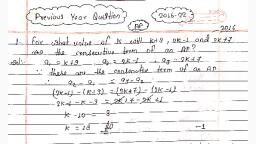
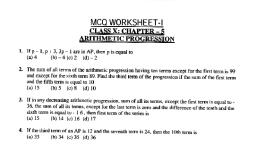
By O.P. GUPTA (INDIRA Award Winner), , MATHEMATICIA for Class 10, By (i) and (ii), we get, So n 1 a nd , , Se, n a nd , Hence, So : Se n 1 : n ., , EXERCISE FOR PRACTICE, Q01. The 19th term of an AP is equal to 3 times its 6th term. If its 9th term is 19, find the AP., Ans.3,5, 7,..., th, th, Q02. Find the sum of first 19 terms of an AP whose 8 term is 41 and 13 term is 61., Ans.931, Q03. Find the sum of all three digit numbers which are divisible by 9., , Ans.55350, , Q04. For what value of k, the expressions 2k 7, k 5, 3k 2 are three consecutive terms of an AP?, Ans.5, Q05. If the sum of first n terms of an AP is given by 3n 2 5n , find the common difference of AP., Ans.6, Q06. The sum of first three terms of an arithmetic progression is 15. If the sum of their squares is 93,, find the AP., Ans.2, 5,8,11,... or 8,5, 2, 1,..., Q07. The sum of n terms of two APs are in the ratio (3n 8) : (7n 15) . Find the ratio of their 12 th, terms., Ans.77 :176, 1, Q08. If sum of n terms of an AP is given as nP n(n 1)Q , where P and Q are any constants, find, 2, the common difference for this AP., Ans.Q, Q09. The income of a person is `3,00,000 in the first year and he receives an increment of `10,000 to, his income per year for the next 19 years. Find the total amount, he received in 20 years., Q10. Find the sum of odd integers from 1 to 2001., Ans.1002001, Q11. Find the sum of all natural numbers lying between 100 and 1000, which are multiple of 5., Ans.98450, Q12. In an AP, the first term is 2 and sum of the first five terms is one-fourth of next five terms. Show, that 20th term of the AP is ‘–112’., 1, 1, Q13. In an arithmetic progression, if p th term is, and q th term is , prove that the sum of first pq, q, p, 1, terms is (pq 1) , where p q ., 2, Q14. If the sum of a certain number of terms of the AP 25, 22, 19, … is 116. Find the last term., Ans.4, , 5n 2 7n, Q15. Find the sum to n terms of the AP, whose k term is 5k 1 ., Ans., 2, 2, Q16. If the sum of n terms of an arithmetic progression is pn qn , where p and q are constants, find, the common difference., Ans.2q, th, , 4, , MATHEMATICIA By O.P. GUPTA : Mathematics (Class 10)
Page 5 :
For all the Math-Gyan, visit at THEOPGUPTA.COM, , WhatsApp @ +919650350480, , Q17. The sum of n terms of two APs are found to be in the ratio (5n 4) : (9n 6) . Find the ratio of, their 18th terms., Ans.179 : 321, Q18. If the sum of first p terms of an AP is equal to the sum of first q terms, then find the sum of first, (p q) terms., Ans.0, Q19. If the sum of the first p, q and r terms of an AP are given as a, b and c respectively then, prove, a, b, c, that (q r) (r p) (p q) 0 ., p, q, r, Q20. The ratio of the sums of m and n terms of an AP is given as m 2 : n 2 . Show that the ratio of its m th, and n th term is (2m 1) : (2n 1) ., Q21. If the sum of n terms of an AP is 3n 2 5n and its m th term is 164, find the value of m., , Ans.27, Q22. If the pth, qth and rth terms of an AP are given as a, b and c respectively then, prove that:, (a) a(q r) b(r p) c(p q) 0, (b) a b r b c p c a q 0 ., Q23. Find four numbers in AP whose sum is 20 and the sum of whose squares is 120., Ans.2, 4, 6,8 or 8, 6, 4, 2, Q24. Divide 56 into four parts which are in AP such that the ratio of product of extremes to the product, of means is known to be 5:6., Ans.8,12,16, 20 or 20,16,12,8, Q25. Rahul joined a company on initial salary of `50000 per month with annual increment of `4500., What will be his salary in 5th year?, Ans. ` 68000, Q26. Siya purchased National Savings Certificate of `5000 on her daughter’s first birthday and decided, to purchase NSC of `500 more on every subsequent birthday. How much money she will be able, to save by her 18th birthday?, Ans. `166500, Q27. The taxi fare for the 1st kilometer is `20 in certain city. For each additional kilometer it increases, by `8. What will be the fare paid by a passenger if he prefers to travel for 15 km?, Ans. `132, Q28. What will be the circumference of a circle after 20 minutes when there is a constant increase of 2, cm in its radius in every 5 minutes, if initially the circle has a radius of 8 cm?, Ans.32 cm, Q29. If the nth term of an AP is 3n 2 , find its common difference., Q30. If the sum to first n terms of an AP is 3n 2 2n , find the AP., Q31. What is the first positive term of the AP –17, –14, –11, …?, Q32. If 5th and 10th terms of an AP are 26 and 51 respectively, find its 15th term., Q33. Find the sum of first 50 odd natural numbers., , Ans.3, Ans.5,11,17,..., Ans.1, Ans.76, Ans.2500, , Q34. If five times the 5th term of an AP is equal to eight times its 8th term, then find its 13th term., Ans.0, Q35. In an AP, prove that a m n a m n 2a m , where an denotes the nth term of AP., Q36. Find the sum of all 3 digit numbers which leave remainder 3 when divided by 13., MATHEMATICIA By O.P. GUPTA : Mathematics (Class 10), , 5
Page 6 : By O.P. GUPTA (INDIRA Award Winner), , MATHEMATICIA for Class 10, , Ans.37881, Q37. The sum of three numbers in AP is 3 and their product is –35. Find the numbers., , Ans.7,1, 5 or 5,1, 7, Q38. If it is given that q 2 pr and the equations px 2 2qx r 0 and dx 2 2ex f 0 have a, d e f, common root, then show that , , are in AP., p q r, , If you’ve any doubt or want help, please post the image (screenshot) of, your question in the Telegram Group https://t.me/Mathematicia4Tenth, , For YouTube Lectures –, Visit YouTube channel Mathematicia By O.P. Gupta, For Chapter-wise Assignments –, , Visit https://theopgupta.com/study-guides-x/, # Dear math scholars,, We have taken utmost care while preparing this draft. Still chances of human error can’t be ruled out., Please inform us about any Typing error / mistake in this document., This will help many future learners of Mathematics., We express our gratitude to all the teachers of our MATHEMATICIA Groups, especially Sachin Pandey (St Marys’ School,, Rudra Pur) & Maneet Singh (Mind Evolution Academy, Tilak Nagar)., Email ID -
[email protected], WhatsApp @ +91 9650350480 (only message), O.P. GUPTA, Math Mentor & Author, [Indira Award Winner], Follow us on Twitter @theopgupta, Follow us on Instagram @theopgupta, Official Website : www.theOPGupta.com, , YouTube.com/MathematiciaByOPGupta, Buy our Books, Test Papers and Sample Papers at theopgupta.com, 6, , MATHEMATICIA By O.P. GUPTA : Mathematics (Class 10)