Page 1 :
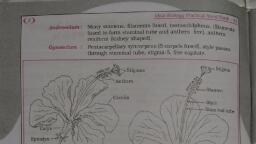
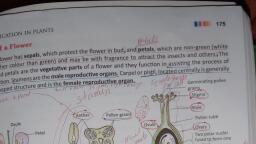
THE FLOWER, , Unit-2, Flowering Plants, , , , eee, , -------- 41, , I Syllabus : Flower : Structure of a bisexual flower, functions of various parts. 3 ee |, 14 brief introduction to complete and incomplete flowers. Essential and non-essential whorls of a bisexual |, , flower; their various parts and functions. Inflorescence and placentation (meaning only). (Charts or actual specimens may be, , I used to help enhance clarity of concepts)., , You have already learnt that reproduction is the, most important function of any living organism for, the survival of the species. In flowering plants this, function is performed by the flower. The flower is, usually the most beautiful and conspicuous part of a, plant., , 4.1 STRUCTURE OF A BISEXUAL FLOWER, (FIG. 4.1) :, , Flower is a specialized shoot in which the, modified into floral structures. ri ;, , First of all, there is the stalk (pedicel) which, supports the flower. Some flowers may be without, , stalk (sessile). The tip of the flower stalk may be, expanded to form a cup-shaped receptacles thalamus., , The floral parts are borne on the thalamus in, four whorls., , 1. First whorl — green sepals (collectively called, calyx)., , , , es are, , , , , , , , , , 2. Second whorl — large brightly coloured petals, (collectively called corolla)., , 3. Third whorl (male parts) (o = symbol for male), — long thread-like processes somewhat, , RECEPTACLE, STALK, , , , Fig. 4.1 Generalized arrangement of parts of a bisexual flower, , projecting out and each usually ending in a, bilobed tip. These are stamens (collectively, named androecium). Each stamen consists of, threadlike filament and bilobed anther., , Fourth whorl (female parts) (2 = symbol for, female) (centrally located pistil that may be, formed of a single female unit (carpel) or of several, fused carpels (collectively called gynoecium)., Each carpel consists of a basal ovary, a middle, style and an uppermost stigma., , 4.1.1 COMPLETE AND INCOMPLETE FLOWERS:, , A complete (or perfect) flower is one which, contains all the four floral structures. If one-or more, sets of floral structures are missing, the flower is, called incomplete (or imperfect)., , Essential (reproductive) and non-essential (nonreproductive) parts of a flower. The essential parts, of a flower are those that are directly concerned, with reproduction. These parts consist of the, stamens (male parts) and the carpels (female parts)., , The non-essential (accessory) parts are simply, the helping parts which either protect the reproductive, parts of the flower or make the flower attractive for, pollination. These parts include the sepals and petals., In some cases the petals and sepals are undifferentiated, together called perianth. When the perianth is nongreen it is described as petaloid., , When the perianth is green like the sepals, it is, described as sepaloid perianth., , Bracts—When a flower arises in the axil of a, leaf-like structure, this structure is known as bract., Bracts may be green like ordinary leaves or at times, they are coloured. The large and colourful bract of, , , , , , € 29, , »
Page 2 :
Bougainvillea (Fig 4.2) is easily mistaken for petal., The actual flower in this case is small, somewhat, cylindrical and attached on the inner side of the bract., , FLOWER, , BRACT, , , , Fig. 4.2 Bougainvillea. Large, coloured bracts, bear the flowers, , Nectaries : Most flowers produce a sweet, fragrant liquid called nectar. Groups of nectarsecreting cells, nectaries are situated usually at the, base of the pistil or on the bases of the petals. The, nectar attracts insects like honeybees, for cross, pollination. In some cases nectaries are very, prominent as in Nasturtium (Fig 4.3), , PETAL, , , , , , STALK, ‘NECTARY, , Fig. 4.3 Nasturtium. A flower cut medially to show the nectary, containing a clear liquid (the nectar) at the bottom, , 4.1.2 SEXUALITY IN FLOWERS, , Male, female and bisexual flowers. The anthers, of the stamens produce pollen which forms the male, cells (male gametes). The ovary of the carpel bears, the ovule which encloses the egg cell (female, gamete). The stamens and the carpels are the male, and female parts of the flower respectively., , — A flower which contains both stamens and carpels, is called bisexual or hermaphrodite or just a, perfect flower., , — A flower which has only one of these parts, that is,, having only the stamens or only the carpels is, called unisexual or incomplete (imperfect) flower,, e.g. papaya and palm., , — Aunisexual flower which contains only the stamens, is called the male or staminate flower., , — A flower which contains only the carpels is called, the female or the pistillate flower., , Neuter flower — A flower in which both male, and female reproductive organs are lacking. Example:, Ray florets of sunflower., , 4.2 GENERAL DESCRIPTION OF THE FLORAL, PARTS, , (a) Calyx (sepals). Usually there are five sepals., Sometimes they may be less or in a few cases even, more. The sepals may be free polysepalous or fused, gamosepalous (Fig 4.4). Sometimes, as in Hibiscus, (shoe-flower) there may be a second series of sepals, called episepals, collectively called epicalyx. When, the flower opens the sepals may fall off or persist., Sepals are usually green but in some cases they are, brightly coloured (called petaloid) as in Gul Mohur, (flame of the forest) where they are red., , KV, , (a) (b) (c), Polysepalous Gamosepalous, , Fig. 4.4 Calyx — free (a) and fused (b and c) types of sepals, , The sepals protect the young flower bud and, when green they also perform photosynthesis., , (b) Corolla (petals). The petals are generally, arranged in a single whorl but sometimes there may, be a double whorl (e.g. Poppy) or in a spiral (e.g., Water lily). They may be free polypetalous or united, gamopetalous forming a tube (Fig. 4.5)., , A B c, Free Tubular Funnel shaped, , Fig. 4.5 Kinds of corolla. A—Free petals, B—Petals fused in a, tubular form C—Petals fused, somewhat funnel shaped, , The petals attract insects for pollination. They, also protect stamens and pistils especially when, the petals form a tube., , (c) Androecium (stamens). The number of, stamens in different flowers may vary from a few to, a large number. Each stamen consist of: a long, filament and an anther attached to its extremity. The, anther is usually two lobed. Each lobe has two pollen, sacs [four sacs in all (Fig. 4.6A)]. Within the pollen, , , , 30>
Page 3 :
sacs are contained pollen grains. When fully matured, the pollen sacs rupture to liberate pollen grains. The, pollen grains are generally powdery particles of, different shapes and sizes (Fig. 4.6B)., , POLLEN SAC, , POLLEN, GRAINS, , FILAMENT, , , , Fig. 4.6 A—Pollen sacs contain pollen grains (diagrammatic)., B—Pollen grains from different plants show different, shapes and sizes, , In androecium, stamens may be free, (polyandrous) as in Petunia, or joined in different, ways in single, double or several groups (Fig. 4.7):, , , , Monadelphous, (Single group), , Diadelphous, (Two groups), , Polyadelphous, (Several groups), , Fig. 4.7 Cohesion (joining) of stamens., , (i) Monadelphous : Stamens are united in one, group by their filaments. Only anthers are free., e.g., china rose (staminal tube),cotton., , (ii) Diadelphous : The filaments are united in two, bundles. e.g. pea (out of ten, nine stamens form, a staminal tube while one is free)., , (iii) Polyadelphous : The filaments are united in, several groups. e.g. Bombax., , , , How to remember the above three terms ?, , * Mono -, Di - and Poly - respectively mean single,, two and several., , * Adelphous literally means “group of brothers”, here, referring to the part from which the anthers grow out, in bundles. Thus the bundle of anthers arising from a, single part (monadelphous or monodelphous), the, bundles from two parts (diadelphous) and from, several parts (polyadelphous)., , , , , , (d) Gynoecium (carpels). Gynoecium is also, known as pistil. It is composed of one or more, carpels. Each carpel consists of three parts—stigma,, style and ovary., , Stigma is the terminal knob-like part, it may be, divided into two or more lobes and may assume a, feathery appearance. The stigma is covered with hair, or with glandular papillae. It serves as the landing ;, place for pollen during pollination., , Style is the tubular slender stalk which connects, the stigma to the ovary., , Ovary is the swollen basal portion composed of, one or many carpels. The inner cavity of the ovary may, be a single chamber or divided into several chambers, (locules) each containing a number of rounded bodies,, the ovules. The cushion or swollen region in the ovary, attaching the ovules to the wall of the ovary is called, placenta., , Sexuality in plants, , In most plants the flowers are bisexual. They have both, , male and female parts., , In many plants the male and female flowers are separate., , Such plants are of two types :, , (i) Monoecious plants (mono; one, oecium : house): Male, and female flowers grow on the same plant e.g. maize,, cucumber, pumpkin, etc,, , (ii) Dioecious plants (di : two): Male flower (staminate),, and female flower (pistillate) grow on different plants, , e.g. palm, papaya, etc., , , , , , , , , , - PROGRESS CHECK, , 1. Mention if the following statements are true (T) or, false (F), , (i) Flowers can be complete or incomplete. TIF, , (ii) A flower typically has six floral whorls. T/F, , (iii) Bracts are usually green, but sometimes large and, , , , , , , , colourful. TE, , (iv) Nasturtium has nectaries. TF, (vy) Stamens and carpels are the male and female, parts a TF, , (vi) The prefix “gamo-” is used whenever any of the, floral whorls are fused TE, , (vii) Stigma may be simple or divided into two or more, lobes. TF, , (viii) Papaya is monoecious plant. TIE, , 4.3, INFLORESCENCE AND PLACENTATION, , Inflorescence is the mode of arr, flowers on the axis of the plant, , , , , , , , , , , , , , € 31 >
Page 4 :
The flowers may be arranged in several different * growing out from the axils of, , ways in different plants, this manner of arrangement different leaves reaching the, is termed inflorescence. same level making a cluster., , ¢ The axis is laterally flattened, , making a disc as in sunflower., , The youngest flowers are in, , the centre and oldest in the, periphery., , , , , , , , , , , , , , , , , , , , , , , , , , , , , , * singly either at the apex of * intheanils of Ey ai eee ie a oy ales, the a stem: of at the the leaves. aré-arranged/attached to the wall of the ovary., terminal apex of the lateral, branches. Ovules turn into seeds in the mature fruit, , e transformed ovary). Their different arrangements can, Te thal aches le Ob iake Me seen in fruits sits as those of pea, one, mango,, 3 lotus, etc., , POINTS TO REMEMBER, , > Flower is a reproductive organ., , > Essential parts of a flower include the stamens (male parts) and the carpels (female parts)..., , » Sepals protect the bud, petals attract insects, stamens produce pollen grains, carpel receives pollen fund its, ovary becomes the fruit containing seed (ovules)., , » Essential parts of a flower are the rep tive parts (stamens and carpels) and non-essential ones ruithe nonreproductive parts (petals and sepals)., , > Nectaries are common in most brightly coloured (insect-pollinated) flowers., , » Sepals may be brightly coloured, these are then said to be petaloid., , > The pollen grains are fine powdery particles of different shapes., , > The manner of arrangement of ‘flowers ‘on the plant is termed inflorescence., , A. MULTIPLE CHOICE TYPE 3. The part of the flower that gives rise to the fruit is, , 1. Bougainvillea flower is an example of (a) Sepals (b) Petals (c) Ovary (d) Stamens, (a) incomplete flower 4. The part of the flower that gives rise to the seed is, (b) ‘having a large DeCIaTy, (a) Ovary (b) Placenta (c) Ovule (d) Pollen grain, (c) water pollination, (d) large colourful bracts 5. The essential whorls of a flower are the, , 2. A flower is said to be complete when : (a) Calyx and corolla, (a) It has the corolla and calyx (b) Stamen and ovary, (b) It has the corolla and gynoecium (c) Calyx and epicalyx, , (c) It has the androecium and gynoecium, , (d) Androecium and gynoecium, (d) It has all the four whorls., , , , € 32>
Page 5 :
B. VERY SHORT ANSWER TYPE, , 1. Match the parts in Column A with the flowers or, parts of flower in Column B., , Column A Column B, (a) Polyadelphous (i) Polypetalous, (b) Pollen grains (ii) Calyx, corolla, (c) Free petals (iii) Nectar, (d) Non-essential (iv) Bombax, , (e) Sweet fragrant fluid (v) Pollen sac, , C. SHORT ANSWER TYPE, 1. Explain the following terms :, (a) Incomplete flower (b) Staminate flower, (c) Pistillate flower (d) Bisexual flower, Distinguish between the following pairs :, (a) Flower and inflorescence,, (b) Petals and petdloid sepals., 3. Where are the following structures/parts located and, what are their functions ?, (a) Placenta (b) Thalamus, (c) Anther (d) Stigma, 4. Why are the following described as stated :, (a) The androecium of pea flower is didelphous, (b) Ray florets of sunflower as neuters, (c) Salvia sepals as petaloid, (d) China rose stamens as epipetaloid, , D. LONG ANSWER TYPE, , |. Name the different types of androecium found in, flowers ., , Nv, , 2. Name the type of androecium found in, (a) China rose (b) Bombax (c) Pea, , E, STRUCTURED/APPLICATION/SKILL, TYPE, , 1. There is a flower in which you use the following, terms : Standard, wings and keel., , (a) Name the flower, , , , (b) What part of the flower do the names given, above refer to ?, , . The figure given alongside represents generalised, , arrangement of the different parts of a bisexual, flower. Name the parts numbered 1-10., , , , , , . Given below are two figures (A & B) of a certain, , part of a flower. Study the figures carefully and, answer the following questions:, , (a) Which major organ of a flower does the figure, A represent ? What is the collective term, for this organ ? :, , (b) Are the contents of the pollen sacs in B male, or female ?, , (c) Can you state how the contents of the pollen, sacs would come out ?, , NTHER POLLEN, GRAINS, POLLEN SAC’, ANTHER, A FILAMENT—¥ B, , . What are bracts ? State their function., 5. Explain the terms Monodelphous, Didelphous and, , Polydelphous. In each case name a flower possessing, such an androecium., , , , , , € 33>