Page 1 :
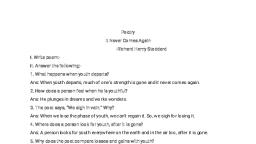
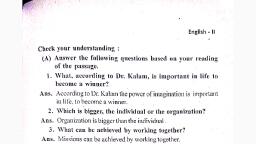
English - tl, , Understand the poem, , Ans., , tw, , Ans., , 6., Ans., , , , The poem has a wonderful message. Read it again and, , discuss your views on the following questions with your, partners. ‘, , . What happens when youth departs?, , When youth departs, much of one’s strength is gone and it, never comes again., , . How does a person feel when he is youthful ?, , A person feels that he is stronger and better during his youthful, days. He feels that something sweet followed youth, with flying, feet., , . The poet says, “We sigh in vain.” Why?, Ans., , Youth is the best period of human life. It is the sweetest and, beautiful phase of the life. It fills a person with dreams. One, , should make the best use of one’s youth because when it is , gone, much of one’s strength is gone. So the poet says, “We, sigh in vain”., , . Where does a person look for youth, after it is gone?, . A person looks for youth everywhere on the earth and in the, , air too, after it is gone., , . Why does the poet compare losses and gains with youth?, . If we lost something like money, gold or any asset in our life,, , we can gain it later by putting in efforts. If we fail in any field, we can succeed later. But if youthful days are gone, we cannot, regain it, So we should make the best use of our youthful days., , * So poet compares the losses and gains with youtlt,, , What is the message of the poem?, Youth is the sweetest phase of the life. If fills a person with, dreams: We should make the best use of our youth because, , when it is gone, much‘of our strength is gone. We cannot gain, it again., , |, , |
Page 2 :
SUPER COMPANION Made Easy - 9, , Read and Appreciate:, , (A) Read the following lines that appear in the second stanza, __ of the poem., , Ans. Yes, | agree with the Poet. Though, we are, , Ans., , Ans,, , , , - The poet says,, , - Can you think of some proy, , - Time is money - Benjamin Fran, , “Still we feel that something sweet, Followed youth, with flying feet,, And will never come again, , The poet deseribes the youth as ‘something sweet’. Do, you agree with him? Why? Discuss in groups., , past our youthful, , days, we can still feel: that those days were sweetest and, , enthusiastic., , “There are gains for, , all our losses’.-Do, you agree with this? Give reasons,, , tregain all. Death and youth, cannot be compensated,, , » Which line/ s in the, , poem do you lik : 2. ?, Tell your friends, y nna ost wily?, | like these lines., , “Still we feel that so, , mething Sweet, Fo]|, feet, And will nev ie, , the theme of the poem?, , erbs/ Wotations related to, e.g. Time and Tide wait for non, , eS aes, , klin, , , , “An ounce of gold will not bu ing ms, Yan inch of 4 oy, Me Chine., Se
Page 3 :
English - Il, , _ (B) Figures of Speech :, , I. Metaphor : Metaphor is a figure of speech in which two, different objects having at least one thing in common, are compared. But the comparison is indirect or implied., , Ex. 1. But when youth, the dream, departs., Tippu Sultan was the tiger of Mysuru., . Life is a dream., , . The camel is the ship of the desert., . Revenge is a kind of wild Justice., 6. God is the old repair man., , II. Personification: Personification is a figure of speech of, in which a non-living object or an obstract notion is treated, as having life., , Ex: — 1. It takes something from our heart and it never comes, again., 2. Under manhood’s sterner reign., Follow youth, with flying feet and will never come again., , 4. We behold it every where on the earth, and in the air, but, it never comes again., 5. Laughter holding both her sides., , 6. Death lays his icy hand on kings., 7. Spring is the daughter of heaven and earth., , WwW, , C. Rhyming words:, , pain - reign, departs - hearts, pain - again, regain - again, vain - again, , Add a few rhyming words to the following., 1. Sweet - heat, beat, meat, feat, 2. Air - where, fare, mare, hare, 3. Heart - part, short, cart, mart, 4. Vanish - finish, distinguish, cherish, banish, , 177