Page 1 :
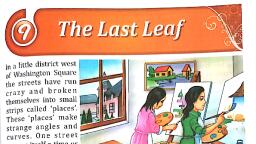
Extended Activities STD. 9, , KITE VICTERS ONLINE CLASS SUPPORT MATERIAL, Class: 9 Subject: English Unit: 4, , Victers Class: 45 & 46, , Work Sheet: 30, , Topic: Last Leaf (Episode -3 & 4), , Review and Assignments based on Victers Online Class 45 & 46, Previous Assignments, Dear students,, The previous assignments were dealt with in the last worksheet., Review of the class ‘The Last Leaf’ by O. Henry Episode – 3 & 4, Dear students,, Hope you all watched the English class of the story ‘The Last Leaf’ by O. Henry. If not, click on the images, below to watch the videos of Episode 3 & 4. The class discussed the climax and the ending of the story., Comprehension questions were discussed. The Assignment were the use of conjunctions ‘and’ but’ or’ and, the thoughts of Johnsy. In episode two Class 46 Completion of ‘Story Map,’ preparation of ‘Friendship Day’, greeting card and use of prepositions were the assignments., , UNIT 4, , We, human beings, are born with a tremendous potential to survive in any situation . The power, of hope and inspiration can work miracles in our life. It can lift us up in desperate and distressed, moments and enable us to live and move forward with confidence. When faced with grave, difficulties and unbearable pain or suffering, hope seems to be the only antidote. This unit, consists of three literary pieces. The narrative ‘The Jungle Air Crash’ is a true account of the, horrifying experience and miraculous escape of Juliane Koepcke from a jungle. The poem ‘On, Killing a Tree’ by Gieve Paul explains that even nature plans its survival in spite of adversity and, a story ‘The Last Leaf’ by O. Henry narrates the power of hope, the sirit of friendship and, sacrifice that helps people to survive adverse circumstances in their life., "Keep your face always toward the sunshine- and the shadows will fall, behind you." Walt Whitman, , ‘The last leaf ‘is a marvelous story by O.Henry, which depicts the treasury of life and the, inevitability of faith to tackle the hindrances we battle through our life. The story takes place during, the second decade of the twentieth century in New York City’s Greenwich Village and has as its, central characters an old artist, Behrman, whose path crosses with that of a young artist, Johnsy,, and who gives her an incentive to live when she becomes seriously ill. A third artist, Sue, is another, young woman with whom Johnsy lives. In to their midst a cold, unseen stranger called pneumonia, appears and touches Johnsy with his cold fingers., , About the Author, O. HENRY, O. Henry, pseudonym of William Sydney Porter, (1862- 1910) was an American short-story, writer whose tales romanticized the life of ordinary people in New York City. His stories, express the effect of coincidence on character through humour, grim or irony. They often, have surprise endings, which become identified with his name as the O. Henry twist., , Prepared by Johnson T P, HST, CMS H S, Mundiappally, Thiruvalla
Page 2 :
Extended Activities STD. 9, , Reading & Comprehension, Read the story beginning from ‘Sue found Behrman ......................... the last leaf fell." While reading refer, to the glossary below to have a better understanding of the story., Glossary, The meaning of the new words will help you to comprehend the poem well., fragile, easily broken or destroyed (ദുര്ബലമായ), clinging, hold on tightly to (പറ്റിപ്പടിച്ചിരിക്കുക), nutrition, food or nourishment (പോഷകാഹാരം), contentedly in a way that expresses happiness or satisfaction (സംതൃപ്തമായി), palette, a thin board or slab on which an artist lays and mixes colours, (നിറങ്ങൾ കൂട്ടിക്കലര്ത്തുന്നതിനുള്ള പോടകം), , fluttered, Let’s Recap, , move with a light irregular or trembling motion (ഇളകുക), , ACTIVITY 1, Read the story beginning from ‘Sue found Behrman ......................... the last leaf fell." And answer the, following questions, 1. How did Johnsy correlate the leaves with her own life?, Ans: She believed that she would die when the last leaf fell., , 2. “I’d rather stay here with you” Says Sue to Johnsy. What does it tell us about their relationship?, Ans: It tells us that their relationship is deep and strong., , 3. What do you think O. Henry portrays Behrman as a pathetic, old and unsuccessful artist?, Ans: Henry portrays Behrman in such a way to evoke sympathy for the character and to make him, immortal., , 4. How does Henry describe Behrman?, Ans: Mr Behrman as an old painter., , 5. What was his age?, Prepared by Johnson T P, HST, CMS H S, Mundiappally, Thiruvalla
Page 3 :
Extended Activities STD. 9, , Ans: He was past sixty., , 6. Was he successful in his art?, Ans: No, he was not successful in his field., , 7. What was his ambition?, Ans: He had always wanted to paint his masterpiece., , 8. Did he start it?, Ans: No, he has not yet started painting it., , 9. Then what did he do?, Ans: He earned a little money by serving as a model for those young artists who could not pay the price of, a regular model. But he always talked about the great masterpiece he was going to paint., , 10. Where did Sue find Behrman?, She found Behrman in his poorly lighted studio., , 11. What was waiting for the promised masterpiece by Behrman?, Ans: It was the blank canvas, that was waiting for twenty years to receive the first line of his promised, masterpiece., , 12. Sue told Behrman of ‘Johnsy’s Fancy’. What was Johnsy’s Fancy?, Ans: Johnsy’ fancy dared when the last leaf of the ivy vine fell, she would die too., , 13. How does the author describe Johnsy here?, Ans: The author describes Johnsy as ‘light and fragile’ as a leaf., , 14. Why do you permit such silly ideas to come into her mind? What was the silly idea mentioned by, Behrman?, Ans: Johnsy connected her life with ivy vine. She believed that when the last leaf fall, she will also die. For, Behrman it was a silly idea., , 15. Why did Sue and Behrman look at the Vine fearfully?, Ans: Johnsy related her death with the falling leaves of the vine. So sue and Behrman looked at it, fearfully., , 16. Why does the suthor call Johnsy merciless?, Ans: The author calls Johnsy merciless because she wants to die and not to live in this beautiful world., , 17. How did the last leaf on the vine affect Johnsy?, Ans: The last leaf made her understand that it was sin to want to die., , 18. Soon after johnsy started showing signs of recovery, she expressed her wish to paint the Bay of, Naples. What does it tell about her?, Ans: It tells us that she is a creative artist and want to reach lofty heights., , 19. Where did people find Behrman? What was his condition?, Ans: They found him in the morning of the first day in his room downstairs helpless with pain. His shoes, and clothing were wet through icy cold. Moreover, they found lantern, ladder, some scattered brushes and, a palette with green and yellow colour mixed on it., , 20. Why didn’t the last leaf flutter or move?, Ans: The last leaf didn’t flutter or move because it wasn’t a real one but a painting by Behrman., , 21. Do you think Behrman drew the leaf knowing well that he was risking his own life? Give reasons?, Ans: Behrman always called himself as a watch-dog and protector of the two artists. It was very difficult, for him to understand the uncanny belief of Johnsy and he was very concerned. Outside, it was raining, heavily and there was every possibility that he would get pneumonia. Still he risked his life because he, wanted Johnsy to live., , 22. Dou you think the painting was Behrman’s masterpiece? Substantiate. What message does it, convey?, Ans: Yes, the painting was his masterpiece. It was not a mere painting, but a life saving one as it, transformed Johnsy to a woman who wants to live and not die. It is indeed a masterpiece as it gave life to, someone., , 23. What is the role of conviction / willpower in the process of getting cured of a disease? Do you think, it has a positive role? Why?, Ans: Conviction and willpower play a very prominent and positive role in a patient’s life. They, along with, hope and confidence, raise a patient’s spirits and will help him/her to overcome the disease. Many, prominent persons have successfully fought even terminal diseases with their willpower. For a sound body,, one needs a sound mind., Prepared by Johnson T P, HST, CMS H S, Mundiappally, Thiruvalla
Page 4 :
Extended Activities STD. 9, , ACTIVITY 2 (Refer to Activity 3 on Page No. 148 and 149., a) Read this sentence from the story., ‘She was looking out of the window, and counting backwards., Here two sentences are combine using ‘and’., We can meaningfully split the above sentence into two simple sentences as, 1) She was looking out of the window., 2) She was counting backward., b) More examples., 1) The boy laughed cheerfully and he jumped out., 2) He parked the truck in front of the house and headed down the hill, 3) Johnsy and Sue went to see Behrman., In sentence 1 ‘and’ is used to connect two sentences, The boy laughed cheerfully., He jumped out., In sentence 2, ‘and’ is used to connect two prepositional phrases., in front of the house, headed down the hill, In sentence 3, ‘and’ is used to connect two nouns / noun phrases., Johnsy, Sue, Examples, 1) John and Mary are writing a book., 2) Your book is on the table or in the drawer., 3) Raju is poor but honest., 4) She danced beautifully but not very energetically., 5) Roy went to the beach but Irfan stayed at home., In the first sentence, two noun phrases are linked using and., Two prepositional phrases are linked using or in the second sentence., Examine the use of 'but' in the last three sentences., In the last three sentences ‘but’ is used to express opposing ideas, poor but honest, beautifully but not energetically, went to the beach but stayed at home, c. Now, construct sentences using 'and', 'but' below. or 'or' using the pattern, 1. Noun phrase + Noun phrase, Ans: Amar and Akbar are friends., 2. Prepositional phrase + Prepositional phrase, Ans: You may sit on the bench or in the chair., 3. Adjective + Adjective, Ans: Seetha is modest and beautiful., 4. Adverbial + Adverbial, Ans: Reghu sang softly but beautifully., 5. Sentence + Sentence, Ans: Raju went to play cricket but his sister watched television at home., d. Now, read the passage given below and study the use of 'and' 'but' & 'or.' Convert the sentence into simple, sentences., Granny could hear the distant roar of the river and smell the pine needles beneath her feet, and feel the, presence of her grandson, Mani, but she couldn't see the river or the trees; and of her grandson she could, only make out his fuzzy hair, and sometimes, when he was very close, his blackberry eyes and the gleam of, his teeth when he smiled., Prepared by Johnson T P, HST, CMS H S, Mundiappally, Thiruvalla
Page 5 :
Extended Activities STD. 9, , Answers, 1. Granny could hear the distant roar of the river., 2. She could smell the pine needles beneath her feet., 3. She could feel the presence of her grandson, Mani., 4. she couldn't see the river or the trees., 5. Granny couldn't see her grandson., 6. She could only make out his fuzzy hair., 7. Being very close she could see his blackberry eyes, 8. When smiling she could see the gleam of his teeth., , ACTIVITY 3, Johnsy was very much worried about her death. She feared that she would die that night because only one, leaf was left on the ivy vine. What might be her thoughts? Prepare the likely thoughts of Johnsy., It will fall today and I shall die at the same time. I heard the, doctor say about my chance to recover. But my dream. Painting, the Bay of Naples! Will I be able to paint it. No way. I must go, with that last leaf. Poor Sue what will she do if I go. She is a, sincere friend, a beloved sister too. She is so sad. I was, counting backward. Last week there were so many leaves on it., But now only one is left. It will fall today. The weather is so, rainy and windy too. Am I foolish enough to die simply, because leaves fall from an old vine? Is it a sin to want to die?, This is my last night on this beautiful word., , ACTIVITY 4 (Refer to Activity 1 on Page No. 138), 1) Now that you have read the story ‘ The Last Leaf’, complete the story map given below., , The last leaf, O. Henry, , Sue, Johnsy, Mr Behrman, , Greenwich Village, New York City, , Problem, Johnsy has no hope of getting well, again. She says that when the last, leaf on theivy vine falls she will die., , Prepared by Johnson T P, HST, CMS H S, Mundiappally, Thiruvalla
Page 6 :
Extended Activities STD. 9, , Main Events, 1. Johnsy and Sue are artists who move into, Greenwich Village in New York City., 2. As winter approaches and the weather gets, colder, Johnsy falls ill with pneumonia., 3. She is so ill that she believes that when the last leaf, falls from the vine outside her window, she will die., 4. An old artist named Behrman, who lives in the, same building as the girls, braves a storm one night, to paint a leaf on the wall - a leaf that will never fall., 5. Cold and wet from painting in the rain, he, catches pneumonia and dies., 6. The last leaf which does not fall even in the, rain gives Johnsy the hope to survive her, illness, and it also becomes the masterpiece, Behrman has always dreamt of painting., , Mr Behrman paints a leaf for Johnsy, when the last one falls., Johnsy recovers from pneumonia but, Mr Behrman sacrifices his life for her., , Theme, The theme of the story ‘The Last Leaf ’, is love, friendship, optimism and the, power of hope., , ACTIVITY 4 (Refer to Activity 3 on Page No. 140), Johnsy was quite grateful to Sue for having stood with her during her difficult times. Look at the greeting, card Johnsy sent to Sue on Friendship Day. Make greeting cards with messages/quotes to be send to your, friend on Friendship Day., , Prepared by Johnson T P, HST, CMS H S, Mundiappally, Thiruvalla
Page 8 :
Extended Activities STD. 9, , b. Read the following passage:, I was travelling by train. As the weather was too hot, I was dressed in white. The person who sat next to me, was reading a book. I asked him where he lived. He replied that he was an actor and returning after a stage, performance., Now, let's analyse the first sentence "I was travelling by train.", The preposition 'by' in the sentence comes before the noun 'train.', List the prepositions and write down the word classes that follow them., Prepositions, , Followed by, , Word class, , By, , Train, , Noun, , In, , White, , Adjective, , Next to, , Me, , Preposition, , After, , A stage perfomance, , Noun Phrase, , c. Shanker is from Kannur. Last week, he went to Thiruvananthapuram. It was his first visit. Fill in the, blanks with suitable words given in brackets., (along, across, from, onto, to, round, in), Shanker travelled from Kannur to Thiruvananthapuram in Janshatabhdi train. On the first day, he travelled, across Thiruvananthapuram in a double decker bus. Then he went round the Puthen Street looking at the, shops. After that, he walked along the bridge to see the Padmanabha Swamy Temple. In the evening, he got, onto a speed boat at Veli. He returned to Kannur the next day., e. Write a description of the room in the picture using suitable prepositions., , The boy is sitting at his study table. He is playing with the computer. A shirt is seen hanging, on the door. A book shelf is there on his left. Her bag is lying on the floor in front of the, table. A potted plant is seen beside her table. Some books are lying on the table. She holds the, mouse with her left hand. A calender is hanging on the wall, Prepared by Johnson T P, HST, CMS H S, Mundiappally, Thiruvalla
Page 9 :
Extended Activities STD. 9, , Prepositions: uses, We commonly use prepositions to show a relationship in space or time or a logical relationship between two, or more people, places or things. Prepositions are most commonly followed by a noun phrase or pronoun, (underlined):, e.g., The last time I saw him he was walking down the road., I'll meet you in the cafe opposite the cinema., It was difficult to sleep during the flight., It was the worst storm since the 1980s., Give that to me., There are over 100 prepositions in English. The most common single- word prepositions are:, about, above, across, after, against, along, among, around, as, at, , before, behind, below, beneath, beside, between, beyond, by, , despite, down, during, except, for, from, in, inside, into, like, , near, of, off, on, onto, opposite, out, outside, over, , past, round, since, than, through, to, towards, , under, undernea, th, unlike, until, up, upon, via, with, within, without, , Although most prepositions are single words, some pairs and groups of words operate like single, prepositions:, e.g., They were unable to attend the show because of the bad weather., Jack'll be playing in the team in place of me., In addition to getting a large fine, both brothers were put in prison for three months., I always get nervous when I have to speak in front of an audience., We estimate that there'll be up to 10,000 people at the concert., The most common prepositions that consist of groups of words are:, , ahead of, apart from, as for, as well as, because of, due to, , except for, in addition to, in front of, in place of, in spite of, inside of, instead of, near to, , on account of, on top of, out of, outside of, owing to, such as, thanks to, up to, , Prepared by Johnson T P, HST, CMS H S, Mundiappally, Thiruvalla, , Write down these Assignments in your note book and send it to your Class’ Whatsapp group., Stay Home Stay Safe. Good Luck, , Prepared by Johnson T P, HST, CMS H S, Mundiappally, Thiruvalla