Page 1 :
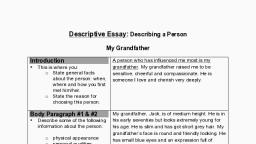
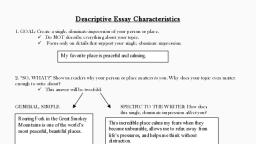
Writing Handout E-7:, , Descriptive Essay, Structuring a Descriptive Essay, A descriptive essay simply describes something or someone by appealing to the reader’s senses:, sight, sound, touch, smell and taste. Here are the basic steps to writing an effective descriptive, essay:, 1. Select a subject, Observation is the key to writing a good description. For example, if you are writing about a place, go there, and take notes on the sights, sounds, and smells. A descriptive essay paints a picture for the reader, using, descriptive devices and the senses. Create a thesis statement that informs the reader who or what you are, describing. Examples: “The wooden roller coaster in Coney Island is a work of art.” “My bedroom is an, ocean sanctuary.”, 2. Select dominant details, Select only the details that support the dominant impression (your thesis statement)., 3. Organize details, The paragraphs in a descriptive essay can be structured spatially (from top to bottom or from near to far) or, chronologically (time order) or from general to specific. Descriptive essays can also use other patterns of, organization such as narrative or exemplification., 4. Use descriptive words, Do not use vague words or generalities (such as good, nice, bad, or beautiful). Be specific and use sensory,, descriptive words (adjectives). For example:, I ate a good dinner., , OR, , I devoured a steaming hot, cheese-filled pepperoni pizza for dinner., , Provide sensory details:, Smells that are in the air (the aroma of freshly brewed coffee), Sounds (traffic, honking horns), Sights (“The sun scattered tiny diamonds across dew-covered grass as it peeked out from beyond the, horizon.”), Touch (“The texture of the adobe hut’s walls resembled coarse sandpaper.”), Taste: sweet, sour, salty, bitter, tart (“Giant goose bumps formed on my tongue when I accidently, bit into a sliver of lemon.”), 5. Draw a logical conclusion, The conclusion may also use descriptive words; however, make certain the conclusion is logical and, relevant., Create images for the reader!, , E-7 Descriptive Essay Guidelines (July, 2011; g:ASC:EngRead), , Page 1
Page 2 :
Figurative Language, Figures of speech are imaginative comparisons between two basically dissimilar things. A figure of speech, may enliven a description by making the essay more visual or forceful., Here are some of the more common figures of speech that could prove effective in writing descriptive, essays:, , Simile, , Using the words such as “like” or “as” when comparing., Example: A ride to North Hutchinson Island is like a flight to a Caribbean, getaway., , Metaphor, , Implying a comparison between two things that are essentially different., Example: Stalking their prey, the deputies remained hidden in the bushes, and ready to spring on speeding motorists., , Personification, , Giving human characteristics to inanimate objects., Example: The truck, covered with mud and love bugs, cried out for a wash., , Overstatement or, Hyperbole, , Understatement, , Using a figure of speech in which exaggeration is used for emphasis or effect., Example: I’ll die if I don’t pass this exam., Writing something opposite to what is expected or says something less than, expected., Example: Yesterday was a little cool. The high temperature was zero, degrees., , Sound words or, Onomatopoeia, , Using words that imitate the sounds associated with the objects or actions to, which they refer., , Example: “Plop, plop, fizz, fizz, oh what a relief it is.” (slogan of Alka, Seltzer), , Symbol, , A person, place, or thing that represents an abstract idea or concept., Example: A rock is a symbol of strength, , E-7 Descriptive Essay Guidelines (July, 2011; g:ASC:EngRead), , Page 2
Page 3 :
Description Sample, Title:, Note how creative title relates to, essay., Introductory paragraph:, First paragraph sets the stage:, where the action happened, when it, happened, and to whom it happened., Note descriptive words., First body paragraph:, Note how writer provides details,, translating an experience into written, words that permit the reader to, visualize the situation. Note, descriptive details., Tense:, This essay is written in the present, tense; most narratives, however, will, be written in the past tense. Either, tense can be effective., Second body paragraph:, Note use of details, especially, adjectives. Writer makes use of, figurative language (personification flowers "waving hello")., Third body paragraph:, Writer continues to appeal to, readers' senses with visually, descriptive words. Figurative, language is again used with the, simile "like a carriage created by, nature.", Imagery:, Note how the writer creates images, for the reader (bold type) by, appealing to the senses., Conclusion:, Writer alludes to another sense, (smell) and uses words to indicate, closing ("final crest"). Essay ends, with strong concluding sentence., , Summer Escape, My family has always looked forward to leaving Florida during, the torrid summer months. It is a tremendous relief to get out of, the heated hustle and bustle of summer living in Florida. Each, summer, we follow the yellow brick road to our hometown in, upstate New York., As we drive through state after state, it becomes apparent that, the world around us is changing. In South Carolina, we already, begin to notice changes. The trees appear to be touchable,, offering soft, plush leaves which sway in the breeze, and the, grass actually invites us to share its place rather than scaring us, away with mounds of intruding fire ants. As each state brings, new surroundings, our anticipation builds, and home seems closer, all the time., Leaving the flatlands and entering an area where we are, suddenly surrounded by hills of purple and blue are by far the, most awakening moments. Virginia and Pennsylvania offer, brilliant scenery with majestic hills and checkerboard, farmlands. As we descend through the curves and winds of the, northern region of the United States, home is now very close: we, are almost there. Suddenly, we have driven from wide-open, flatlands to a narrow, winding road surrounded by hillsides of, stone and trees. Around every curve, orange and black tiger, lilies claim their place in the world as they push themselves, out toward the car, waving hello and flashing their, mysterious black spots toward us as we drive by., The journey home is almost complete. As we begin our final, descent through the state of Pennsylvania into upstate New, York, the surroundings become comfortably familiar. Before, long, we are welcomed by a sign that reads “Waverly, 18 miles”, and the familiar fields of grazing cattle. Through the last stretch, of Pennsylvania, the bursting foliage seems to envelop us and, carry us over the hills like a carriage created by nature., It is at this point that our family, even the youngest member,, knows that our vacation in New York is about to begin. Our, eldest son has joked for years that he can “smell” Grandma’s, apple pie already. Approximately fifteen minutes pass and as our, vehicle takes us over the final crest, we see the smoke stack, from the local factory as we cross the border of Pennsylvania, and New York and are aware of our surroundings. A couple of, turns later, we are there. We have reached our destination; we are, home., - Arin B. Terwilliger, , E-7 Descriptive Essay Guidelines (July, 2011; g:ASC:EngRead), , Page 3