Page 1 :
NCERT Solutions Class 10 English - Chapter 2, Nelson Mandela - Long Walk to Freedom, , Nelson Mandela - Long Walk to Freedom, Activity (Page 17), Question:, In Column A are some expressions you will find in the text. Make a guess and match each expression with, an appropriate meaning from Column B., A, , B, , (i) A rainbow gathering of different colours and – A great ability (almost unimaginable) to remain, nations, unchanged by suffering (not losing hope,, goodness or courage), (ii) The seat of white supremacy, – A half-secret life, like a life lived in the fading, light between sunset and darkness, (iii) Be overwhelmed with a sense of history, – A sign of human feeling (goodness, kindness,, pity, justice, etc.), (iv) Resilience that defies the imagination, – A beautiful coming together of various peoples,, like the colours in a rainbow, (v) A glimmer of humanity, – The centre of racial superiority, (vi) A twilight existence, , – Feel deeply emotional, remembering and, understanding all the past events that have led up, to the moment, , Answer:, A, , B, , (i) A rainbow gathering of different colours and – A beautiful coming together of various peoples,, nations, like the colours in a rainbow, (ii) The seat of white supremacy, – The centre of racial superiority, (iii) Be overwhelmed with a sense of history, (iv) Resilience that defies the imagination, (v) A glimmer of humanity, (vi) A twilight existence, , – Feel deeply emotional, remembering and, understanding all the past events that have led up, to the moment, – A great ability (almost unimaginable) to remain, unchanged by suffering (not losing hope,, goodness or courage), – A sign of human feeling (goodness, kindness,, pity, justice, etc.), – A half-secret life, like a life lived in the fading, light between sunset and darkness
Page 2 :
NCERT Solutions Class 10 English - Chapter 2, Nelson Mandela - Long Walk to Freedom, Oral Comprehension Check (Page 18-19), Question 1:, Where did the ceremonies take place? Can you name any public buildings in India that are made of, sandstone?, Answer:, The ceremonies took place in the lovely sandstone amphitheatre formed by the Union Buildings in, Pretoria, which were attended by dignitaries and world leaders of several nations. In India, the, Rashtrapati Bhavan and Red Fort are two public buildings that are made of red sandstone., Question 2:, Can you say how 10 May is an ‘autumn day’ in South Africa?, Answer:, Generally, autumn season signifies the harvest season that is associated with abundance and prosperity., 10 May is an ‘autumn day’ in South Africa because on this auspicious day, the installation of South Africa’s, first democratic, non-racial government took place in the presence of the largest gathering ever of, international leaders on the South African soil., Question 3:, At the beginning of his speech, Mandela mentions “an extraordinary human disaster”. What does he, mean by this? What is the “glorious … human achievement” he speaks of at the end?, Answer:, In Mandela’s speech ‘an extraordinary human disaster’, he wanted to express the practice of Apartheid, in South Africa. During this practice, there was a racial segregation of people based on colour and the, Black people suffered the most as they were discriminated by the rest. They could not enjoy the right to, freedom. Mandela was jailed as a prisoner for 18 years on the infamous ‘Robben Island’ where he was, mistreated by the authorities. He considered it as “great glorious human achievement” that he became, the first Black President of South Africa where the Blacks were deprived of basic needs and suffered, different kinds of discrimination and were treated badly., Question 4:, What does Mandela thank the international leaders for?, Answer:, Mandela felt extremely privileged to welcome the dignitaries and international leaders at the swearingin ceremony because it was not too long ago when the South Africans were considered outlaws. He, therefore, thanked all of them for having come from far and wide to witness the historical oath-taking, ceremony of the first Black President of South Africa. This was a wonderful gesture of international, recognition to a newly born free democratic nation. This event could be considered as a common victory, for justice, peace and human dignity., Question 5:, What ideals does he set out for the future of South Africa?, Answer:
Page 3 :
NCERT Solutions Class 10 English - Chapter 2, Nelson Mandela - Long Walk to Freedom, Mandela set the ideals of liberating the people of South Africa from the continuing bondage of poverty,, deprivation, suffering, gender and other discrimination. He wanted the people of the country to enjoy the, right to freedom from all forms of bondage and prejudice., , Oral Comprehension Check (Page 21), Question 1:, What do the military generals do? How has their attitude changed and why?, Answer:, The highest military generals of South African defence force and police saluted and pledged their loyalty, to Mandela. This was of great significance as otherwise during the Apartheid era they would have arrested, him and put him behind bars. Their attitude changed towards Blacks due to the struggles and sacrifices, that were put in by many heroes of South Africa. This struggle for freedom was not just a struggle with, Apartheid, but brought a massive change in mindsets of many people. Mandela believed that love is, something that could be taught and human beings are naturally inclined towards love more, rather than, hate., Question 2:, Why were two national anthems sung?, Answer:, On the auspicious occasion of the inauguration ceremony, two national anthems were sung – the Whites, sang ‘Nkosi Sikelel –iAfrika’ and the Blacks sang ‘Die Stem’ that was the old anthem of the Republic. Both, the anthems symbolized the equality of rights between Whites and Blacks., Question 3:, How does Mandela describe the systems of government in his country (i) in the first decade, and (ii) in the final decade, of the twentieth century?, Answer:, (i) In the first decade of the twentieth century, the white-skinned people of South Africa patched up their, differences and erected a system of racial domination against the dark-skinned peoples of their own land., This created the basis of one of the harshest, most inhumane, societies the world has ever seen or known., (ii) In the final decade of the twentieth century, the previous system of government had been overturned, forever and replaced by one that recognised the rights and freedoms of all peoples, regardless of the colour, of their skin., Question 4:, What does courage mean to Mandela?, Answer:, According to Mandela, courage was not the absence of fear, but the triumph over it. A brave man is not, one who does not feel afraid, but one who conquers that fear., Question 5:, Which does he think is natural, to love or to hate?, Answer:
Page 4 :
NCERT Solutions Class 10 English - Chapter 2, Nelson Mandela - Long Walk to Freedom, Mandela thought that love comes more naturally to the human heart rather than hate., , Oral Comprehension Check (Page 24), Question 1:, What “twin obligations” does Mandela mention?, Answer:, Mandela mentions two obligations that every man has in life – (i) obligations to his family, to his parents,, to his wife and children; and (ii) he has an obligation to his people, his community and his country., Question 2:, What did being free mean to Mandela as a boy, and as a student? How does he contrast these “transitory, freedoms” with “the basic and honourable freedoms”?, Answer:, Like any other kid, Mandela felt freedom meant to be happy, make merry and enjoy the blissful life in his, childhood years. However, when a young fellow becomes an adult, the antics of childhood look transitory, because all the childish activities are worthless from an adult’s perspective. When a person becomes an, adult, he learns to earn a livelihood and earn his own bread and butter. In such a scenario, he understands, the basic and honourable freedom in his family and the society that he lives in., Question 3:, Does Mandela think the oppressor is free? Why/Why not?, Answer:, Mandela does not feel that the oppressor is free because in his opinion, an oppressor is like a victim of, hatred who is locked behind the bars of prejudice and narrow-mindedness. He perceives that both the, oppressor and the oppressed are robbed of their humanity and peace of mind., , Thinking about the Text (Page 24), Question 1:, Why did such a large number of international leaders attend the inauguration? What did it signify the, triumph of?, Answer:, Being a part of the inauguration ceremony, the international leaders showed a gesture of solidarity from, the international community to the concept of end of Apartheid. This signified the victory of good over, evil and the triumph of a tolerant society without any prejudice and discrimination of caste, colour or, creed., Question 2:, What does Mandela mean when he says he is “simply the sum of all those African patriots” who had gone, before him?
Page 5 :
NCERT Solutions Class 10 English - Chapter 2, Nelson Mandela - Long Walk to Freedom, Answer:, By saying that he is “simply the sum of all those African patriots”, Mandela offers his tribute to all the, people who had sacrificed their lives in favour of the struggle for freedom. He says that he shall always, remain grateful and thankful to those who had gone before him because those freedom fighters had paved, the path of co-operation and unity for him. Therefore, Mandela felt that when he comes to power, he, would bring equality among his people along with their support and co-operation., Question 3:, Would you agree that the “depths of oppression” create “heights of character”? How does Mandela, illustrate this? Can you add your own examples to this argument?, Answer:, Yes, I agree with the statement that “depths of oppression” do create ‘heights of character”. Nelson, Mandela illustrates this by citing examples of great heroes of South Africa such as Oliver Tambo, Walter, Sisulu, Chief Luthulis, Yusuf Dadoos, Bram Fischers, Robert Sobukwes among others who inspired, other people by sacrificing their lives in the long struggle for freedom., In India’s pre-Independence era, there was a galaxy of great leaders who didn’t give up to the, oppression of British rule such as Netaji Subhash Chandra Bose, Mahatma Gandhi, Sardar Vallabhbhai, Patel, Lala Lajpat Rai, Chandra Shekhar Ajad, Bhagat Singh and many more. Nelson Mandela seems to, be absolutely right, if we compare them with the quality of political leaders that India is having today., Question 4:, How did Mandela’s understanding of freedom change with age and experience?, Answer:, With age and rich experience, Mandela understood the essence of freedom in everyone’s life. As a young, boy, he always thought that he was born free and could do anything that he wanted. He strongly believed, that as long as he obeyed his father and abided by the customs of his tribe, he was free in every possible, way. However, as he grew older, he started feeling that freedom was required to raise a family and to earn, livelihood, this started dominating his thoughts and views. In due course of time, he realised that he was, selfish and was leading an illusionary life during his boyhood. He slowly understood that it was not just, his freedom alone that was being curtailed, but the freedom of all the Black people was retrenched., Mandela understood that his people were being deprived and discriminated and this led him to develop, a hunger for the freedom of his people., Question 5:, How did Mandela’s ‘hunger for freedom’ change his life?, Answer:, During his youth, Mandela realised that it was not just his freedom alone that was being curtailed, but, the freedom of all Black people. The hunger for his own freedom became the hunger for freedom for all, his fellow brothers and sisters. In the process, this changed the fearful man to a bold rebel. Mandela, sacrificed the comforts of a settled family life to fight for the freedom of his countrymen. He joined the, African National Congress and this changed his perspective from a frightened young man into a fearless, person who fought against racial prejudice and colour discrimination.
Page 6 :
NCERT Solutions Class 10 English - Chapter 2, Nelson Mandela - Long Walk to Freedom, Thinking about Language (Page 24-26), I. There are nouns in the text (formation, government) which are formed from the corresponding verbs, (form, govern) by suffixing -(at)ion or ment. There may be a change in the spelling of some verb – noun, pairs: such as rebel, rebellion; constitute, constitution., Question 1:, Make a list of such pairs of nouns and verbs in the text., Noun, , Verb, , rebellion, , rebel, , constitution, , constitute, , Answer:, Noun, , Verb, , rebellion, , rebel, , constitution, , constitute, , formation, , form, , government, , govern, , obligation, , oblige, , transformation, , transform, , discrimination, , discriminate
Page 7 :
NCERT Solutions Class 10 English - Chapter 2, Nelson Mandela - Long Walk to Freedom, deprivation, , deprive, , demonstration, , demonstrate, , oppression, , oppress, , imagination, , imagine, , Question 2:, Read the paragraph below. Fill in the blanks with the noun forms of the verbs in brackets., Martin Luther King’s _______________ (contribute) to our history as an outstanding leader began, when he came to the ______________ (assist) of Rosa Parks, a seamstress who refused to give up her, seat on a bus to a white passenger. In those days American Blacks were confined to positions of second, class citizenship by restrictive laws and customs. To break these laws would mean _______________, (subjugate) and ________________ (humiliate) by the police and the legal system. Beatings,, _________________ (imprison) and sometimes death awaited those who defied the System. Martin, Luther King’s tactics of protest involved non-violent ___________________ (resist) to racial, injustice., Answer:, Martin Luther King’s contribution to our history as an outstanding leader began when he came to the, assistance of Rosa Parks, a seamstress who refused to give up her seat on a bus to a white passenger., In those days American Blacks were confined to positions of second class citizenship by restrictive laws, and customs. To break these laws would mean subjugation and humiliation by the police and the, legal system. Beatings, imprisonment and sometimes death awaited those who defied the System., Martin Luther King’s tactics of protest involved non-violent resistance to racial injustice., II. Using the Definite Article with Names, Question 1:, Here are some more examples of ‘the’ used with proper names. Try to say what these sentences mean., (You may consult a dictionary if you wish. Look at the entry for ‘the’.), 1. Mr Singh regularly invites the Amitabh Bachchans and the Shah Rukh Khans to his parties., 2. Many people think that Madhuri Dixit is the Madhubala of our times., 3. History is not only the story of the Alexanders, the Napoleons and the Hitlers, but of ordinary people, as well., Answer:, 1. This implies that Mr. Singh regularly invites prominent personalities of caliber such as Mr. Amitabh, Bachchan and Mr. Shah Rukh Khan to his parties.
Page 8 :
NCERT Solutions Class 10 English - Chapter 2, Nelson Mandela - Long Walk to Freedom, 2. This implies that in the current generation, Madhuri Dixit is compared to the great actress,, Madhubala., 3. This means history is not only the story of great fighers such as Alexander, Napoleon or Hitler, but, also of other ordinary people., , III. Idiomatic Expressions, Question 1:, Match the italicised phrases in Column A with the phrase nearest in meaning in Column B. (Hint: First, look for the sentence in the text in which the phrase in Column A occurs.), A, , B, , 1. I was not unmindful of the fact, , (i) had not forgotten; was aware of the fact, (ii) was not careful about the fact, (iii) forgot or was not aware of the fact, 2. when my comrades and I were pushed to our (i) pushed by the guards to the wall, limits, (ii) took more than our share of beatings, (iii) felt that we could not endure the suffering any, longer, 3. to reassure me and keep me going, (i) make me go on walking, (ii) help me continue to live in hope in this very, difficult situation, (iii) make me remain without complaining, 4. the basic and honourable freedoms of…earning (i) earning enough money to live on, my keep,…, (ii) keeping what I earned, (iii) getting a good salary, Answer:, A, , B, , 1. I was not unmindful of the fact, , (i) had not forgotten; was aware of the fact, , 2. when my comrades and I were pushed to our, limits, , (iii) felt that we could not endure the suffering any, longer, , 3. to reassure me and keep me going, , (ii) help me continue to live in hope in this very, difficult situation, , 4. the basic and honourable freedoms of…earning (i) earning enough money to live on, my keep,…, , Speaking (Page 26), Question:, In groups, discuss the issues suggested in the box below. Then prepare a speech of about two minutes on
Page 9 :
NCERT Solutions Class 10 English - Chapter 2, Nelson Mandela - Long Walk to Freedom, the following topic. (First make notes for your speech in writing.), True liberty is freedom from poverty, deprivation and all forms of discrimination., •, •, •, , causes of poverty and means of overcoming it, discrimination based on gender, religion, class, etc., constitutionally guaranteed human rights, , Answer:, Activity to be done by yourself., , Writing (Page 26-28), Question I: Looking at Contrasts, Nelson Mandela’s writing is marked by balance: many sentences have two parts in balance., Use the following phrases to complete the sentences given below., (i) they can be taught to love., , (iv) but he who conquers that fear., , (ii) I was born free., , (v) to create such heights of character., , (iii) but the triumph over it., 1. It requires such depths of oppression _________________________________________, 2. Courage was not the absence of fear __________________________________________, 3. The brave man is not he who does not feel afraid __________________________________, 4. If people can learn to hate _________________________________________________, 5. I was not born with a hunger to be free. ______________________________________, Answer:, 1. It requires such depths of oppression (v) to create such heights of character., 2. Courage was not the absence of fear (iii) but the triumph over it., 3. The brave man is not he who does not feel afraid (iv) but he who conquers that fear., 4. If people can learn to hate (i) they can be taught to love., 5. I was not born with a hunger to be free. (ii) I was born free.
Page 10 :
NCERT Solutions Class 10 English - Chapter 2, Nelson Mandela - Long Walk to Freedom, Question II:, This text repeatedly contrasts the past with the present or the future. We can use coordinated clauses to, contrast two views, for emphasis or effect. Given below are sentences carrying one part of the contrast., Find in the text the second part of the contrast, and complete each item. Identify the words which signal, the contrast. This has been done for you in the first item., 1. For decades the Union Buildings had been the seat of white supremacy, and now ..., 2. Only moments before, the highest generals of the South African defence force and police ... saluted me, and pledged their loyalty. ... not so many years before they would not have saluted _______________, 3. Although that day neither group knew the lyrics of the anthem ..., they would soon ______________, 4. My country is rich in the minerals and gems that lie beneath its soil, _______________________, 5. The Air Show was not only a display of pinpoint precision and military force, but _______________, 6. It was this desire for the freedom of my people ... that transformed _______________ into a bold, one, that drove _______________ to become a criminal, that turned ________________into a, man without a home., Answer:, 1. For decades the Union Buildings had been the seat of white supremacy, and now it was the site of a, rainbow gathering of different colours and nations for the installation of South Africa’s first democratic,, non-racial government., 2. Only moments before, the highest generals of the South African defence force and police ... saluted me, and pledged their loyalty. ... not so many years before they would not have saluted but arrested me., 3. Although that day neither group knew the lyrics of the anthem ..., they would soon know the words, by heart., 4. My country is rich in the minerals and gems that lie beneath its soil, but I have always known that its, greatest wealth is its people, finer and truer than the purest diamonds., 5. The Air Show was not only a display of pinpoint precision and military force, but a demonstration of, the military’s loyalty to democracy, to a new government that had been freely and fairly elected., 6. It was this desire for the freedom of my people ... that transformed a frightened young man into a bold, one, that drove a law-abiding attorney to become a criminal, that turned a family-loving husband into, a man without a home., Question III: Expressing Your Opinion, Do you think there is colour prejudice in our own country? Discuss this with your friend and write a, paragraph of about 100 to 150 words about this. You have the option of making your paragraph a, humorous one. (Read the short verse given below.), When you were born you were pink, When you grew up you became white
Page 11 :
NCERT Solutions Class 10 English - Chapter 2, Nelson Mandela - Long Walk to Freedom, When you are in the sun you are red, When you are sick you are yellow, When you are angry you are purple, When you are shocked you are grey, And you have the cheek to call me ‘coloured’., Answer:, Activity to be done by yourself.
Page 12 :
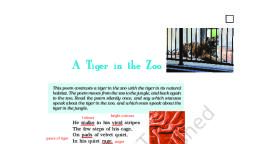
NCERT Solutions Class 10 English - Chapter 2 Poem, A Tiger in the Zoo, , A Tiger in the Zoo, Thinking about the Poem (Page 30-31), Question 1:, Read the poem again, and work in pairs or groups to do the following tasks., (i) Find the words that describe the movements and actions of the tiger in the cage and in the wild., Arrange them in two columns., (ii) Find the words that describe the two places, and arrange them in two columns., Now try to share ideas about how the poet uses words and images to contrast the two situations., Answer:, (i), In the Cage, , In the Wild, , Stalks, , Lurking in shadow, , Few steps of his cage, , Sliding through long grass, , Quiet rage, , Snarling around houses, , Locked in concrete cell, , Baring his white fangs, his claws, , Stalking the length of his cage, , Terrorising the village, , Ignoring visitors, Stares with his brilliant eyes at the brilliant, stars, (ii), Cage, , Wild, , Few steps of his cage, , Shadow, , Locked, , Water hole, , Concrete cell, , Long grass, , Behind bars, , Plump deer, , Visitors, , Houses at the jungle’s edge, , Patrolling cars, , Village
Page 13 :
NCERT Solutions Class 10 English - Chapter 2 Poem, A Tiger in the Zoo, Question 2:, Notice the use of a word repeated in lines such as these:, (i) On pads of velvet quiet,, In his quiet rage., (ii) And stares with his brilliant eyes, At the brilliant stars., What do you think is the effect of this repetition?, Answer:, This repetition used by the poet is a poetic effect in order to increase the intensity of the tiger’s rage and, his silent helplessness from the concrete cell of the cage. ‘Velvet quiet’ refers to the velvet pads of the tiger, which are quiet and unable to run or leap. The tiger could do nothing but just walk around the limited, space of his cage. The use of ‘quiet rage’ signifies the anger and ferocious nature of the tiger that is building, up inside him as he wants to run out freely into the forest and attack a deer. However, the tiger’s rage is, quiet as he is locked inside the cage and is in a helpless condition. The repetition of ‘quiet’ has given a, lyrical beauty to the poem. Similarly, the use of the term ‘brilliant’ for both the tiger’s eyes and the stars, also portrays the majestic nature of these lines. The tiger stares at the brilliant stars with his brilliant eyes, as he dreams about how beautiful and pleasing life, he could have led in the forest. Thus, the repetition, depicts a wonderful effect and brings magnificence to the poem., Question 3:, Read the following two poems — one about a tiger and the other about a panther. Then discuss:, Are zoos necessary for the protection or conservation of some species of animals? Are they useful for, educating the public? Are there alternatives to zoos?, The Tiger, The tiger behind the bars of his cage growls,, The tiger behind the bars of his cage snarls,, The tiger behind the bars of his cage roars., Then he thinks., It would be nice not to be behind bars all, The time, Because they spoil my view, I wish I were wild, not on show., But if I were wild, hunters might shoot me,, But if I were wild, food might poison me,, But if I were wild, water might drown me., Then he stops thinking, And..., The tiger behind the bars of his cage growls,, The tiger behind the bars of his cage snarls,, The tiger behind the bars of his cage roars., PETER NIBLETT
Page 14 :
NCERT Solutions Class 10 English - Chapter 2 Poem, A Tiger in the Zoo, The Panther, His vision, from the constantly passing bars,, has grown so weary that it cannot hold, anything else. It seems to him there are, a thousand bars; and behind the bars, no world., As he paces in cramped circles, over and over,, the movement of his powerful soft strides, is like a ritual dance around a centre, in which a mighty will stands paralysed., Only at times, the curtain of the pupils, lifts, quietly. An image enters in,, rushes down through the tensed, arrested muscles,, plunges into the heart and is gone., RAINER MARIA RILKE, Answer:, A zoo is a place where several species of animals are kept. Some of these animals are of endangered nature, and are on the verge of extinction. Likewise, even endangered tigers and lions are not safe in the forest, due to poaching that is mainly done by poachers for illegal trading purposes. Therefore, zoos are, necessary for the conservation and protection of such species. That way, zoos are a safe haven for animals, and the public should be educated about the importance of wild animals and their key role in maintaining, the ecological balance in the environment. Some other alternatives to zoos could be wildlife sanctuaries,, forest reserves and national parks, etc. Having these options available will not just protect or conserve, these species, but also provide these animals with a habitat in the midst of nature., Question 4:, Take a point of view for or against zoos, or even consider both points of view and write a couple of, paragraphs or speak about this topic for a couple of minutes in class., Answer:, Activity to be done by yourself.