Page 1 :
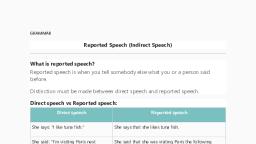
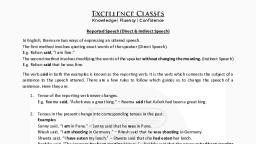
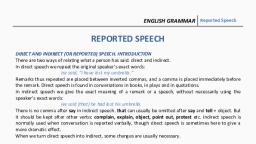
GRAMMAR, , Reported Speech (Indirect Speech), What is reported speech?, Reported speech is when you tell somebody else what you or a person said, before., Distinction must be made between direct speech and reported speech., Direct speech vs Reported speech:, Direct speech, , Reported speech, , She says: "I like tuna fish.", , She says that she likes tuna fish., , She said: "I'm visiting Paris next, , She said that she was visiting Paris the following, , weekend", , weekend., , Different types of sentences, When you use reported speech, you either report:, ▪, ▪, ▪, ▪, , statements, questions, requests / commands, other types, , Reporting Statements, When transforming statements, check whether you have to change:, ▪, ▪, ▪, , pronouns, tense, place and time expression, , 1- Pronouns, , In reported speech, you often have to change the pronoun depending on who, says what., Example:
Page 2 :
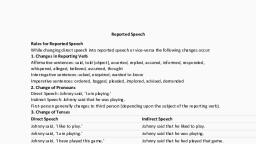
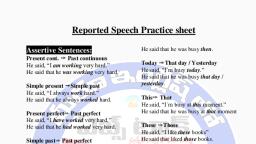
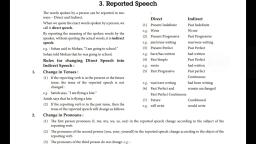
She says, “My dad likes roast chicken.” – She says that her dad likes roast chicken., Tenses, ▪, ▪, , If the sentence starts in the present, there is no backshift of tenses in reported, speech., If the sentence starts in the past, there is often backshift of tenses in reported, speech., Direct speech, , ▪, , Reported speech, , (no backshift) “I write poems.” He says that he writes poems., (backshift), , “I write poems.” He said that he wrote poems., , No backshift, Do not change the tense if the introductory clause is in a present tense (e. g. He, says). Note, however, that you might have to change the form of the present, tense verb (3rd person singular)., Example:, He says, “I write poems.” – He says that he writes English., Backshift, You must change the tense if the introductory clause is in a past tense (e. g. He, said)., Example:, He said, “I am happy.” – He said that he was happy., Examples of the main changes in tense:, Direct Speech, , Reported Speech, , Simple Present, , Simple Past, , He said: "I am happy", , He said that he was happy
Page 3 :
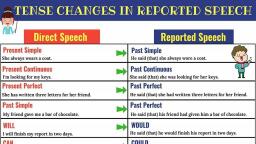
Present Progressive, , Past Progressive, , He said: "I'm looking for my keys", , He said that he was looking for his keys, , Simple Past, , Past Perfect Simple, , He said: "I visited New York last year", , He said that he had visited New York the, previous year., , Present Perfect, , Past Perfect, , He said: " I've lived here for a long time ", , He said that he had lived there for a long time, , Past Perfect, , Past Perfect, , He said: "They had finished the work when, , He said that they had finished the work when, , I arrived", , he had arrived", , Past Progressive, , Past Perfect Progressive, , He said: "I was playing football when the, , He said that he had been playing football, , accident occurred", , when the accident had occurred, , Present Perfect Progressive, , Past Perfect Progressive, , He said:"I have been playing football for, , He said that he had been playing football for, , two hours.", , two hours, , Past Perfect Progressive, , Past Perfect Progressive, , He said: "I had been reading a newspaper, , He said that he had been reading a newspaper, , when the light went off", , when the light had gone off, , Future Simple (will+verb), , Conditional (would+verb), , He said: "I will open the door.", , He said that he would open the door., , Conditional (would+verb), , Conditional (would+verb), , He said: "I would buy Mercedes if, , He said that he would buy Mercedes if he had, , I were rich", , been rich", , The modal verbs could, should, would, might, needn't, ought to, used to do not, normally change., Example:
Page 4 :
He said, "She might be right." – He said that she might be right., Other modal verbs may change:, Modal, , Direct speech, , Reported speech, , can, , "I can do it.", , He said he could do it., , may, , "May I go out?", , He wanted to know if he might go out., , must, , "She must apply for the job." He said that she must/had to apply for the job., , will, , "They will call you.", , He told her that they would call her., , 3- Place, demonstratives and time expressions, , Place, demonstratives and time expressions change if the context of the reported, statement (i.e. the location and/or the period of time) is different from that of the, direct speech., In the following table, you will find the different changes of place; demonstratives, and time expressions., Direct Speech, , Reported Speech, Time Expressions, , today, , that day, , now, , then, , yesterday, , the day before, , … days ago, , … days before, , last week, , the week before, , next year, , the following year
Page 5 :
tomorrow, , the next day / the following day, Place, , here, , there, Demonstratives, , this, , that, , these, , those, , Reporting Questions, When transforming questions, check whether you have to change:, ▪, ▪, ▪, , pronouns, place and time expressions, tenses (backshift), , Also note that you have to:, ▪, ▪, , transform the question into an indirect question, use the question word (where, when, what, how) or if / whether, , Types of questions, , Direct speech, , Reported speech, , With question word (what,, , "Why" don’t you, , He asked me why I didn’t, , why, where, how...), , speak English?”, , speak English., , Without question word (yes or “Do you speak, no questions), , English?”, , He asked me whether / if I, spoke English., , C. Reporting requests / commands, When transforming requests and commands, check whether you have to change:, ▪, ▪, , pronouns, place and time expressions
Page 6 :
▪, , Direct speech, , “Nancy,do the exercise.“, , Reported speech, He told Nancy to do the exercise., , "Nancy, give me your pen, please." He asked Nancy to give him her pen., , Tenses are not relevant for requests – simply use to / not to + verb (infinitive without "to"), , Example:, She said, “Sit down." - She asked me to sit down., She said, "don't be lazy" - She asked me not to be lazy, For affirmative use to + infinitive (without to), For negative requests, use not to + infinitive (without to)., , D. Other transformations, ▪, , ▪, , Expressions of advice with must, should and ought are usually reported, using advise / urge., Example:, "You must read this book.", He advised / urged me to read that book., The expression let’s is usually reported using suggest. In this case, there are two, possibilities for reported speech: gerund or statement with should., Example:, "Let’s go to the cinema.", 1. He suggested going to the cinema., 2. He suggested that we should go to the cinema., , Main clauses connected with and/but, If two complete main clauses are connected with ‚and or ‚but, put ‚that after the, conjunction.
Page 7 :
Example:, He said,“I saw her but she didn't see me.“ – He said that he had seen, her but that she hadn't seen him.“, If the subject is dropped in the second main clause (the conjunction is followed, by a verb), do not use ‚that‘., Example:, She said,“I am a nurse and work in a hospital.“ – He said that she was a, nurse and worked in a hospital.“, , Time and place references often have to change in Indirect Speech, •, •, •, •, •, •, •, •, •, •, , Now –> Then, Today –> That day, Here –> There, This –> That, Tomorrow –> The following day/ The next day/ The day after, Next week –> The following week/ The next week/ The week after, Yesterday –> The previous day/ The day before, Last week –> The previous week/ The week before, Ago –> Previously/ Before, Tonight –> That night
Page 10 :
No Change in Verb Tenses in Reported Speech
Page 12 :
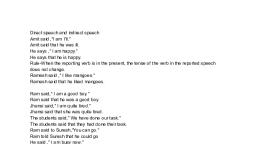
Reported Speech Examples, 1.He said that he was living in Paris., 2.She said she had taken Spanish lessons before., 3.She says the exam is very difficult., 4.Mary said, “My husband went with me to the show yesterday.”, 5.He said he had gone to London the week before., 6.He said he could swim when he was four., 7.Mary said she wanted to go on vocation, but she didn’t know where, to go., 8.He said “I ought to swim.”, 9.He said he should call her mother., 10.He said he could swim when he was four., 11.Mark said “I need help with my work.”, 12.Michel said she liked apple., 13.He said he had been walking along the Street., 14.He told us that they had visited their aunt the last week., 15.Hannah has said she goes school every day., 16.Mark says he is not so keen to see that film., 17.She said she watched TV every day., 18.SHe said that she was exhausted., 19.She said that she always drank white chocolate mocha., 20.Jack said he had been on the phone for three hours, when the call, dropped.