Page 1 :
My Childhood Class 9 English Chapter 6, My Childhood Introduction, Abdul Kalam’s biography is titled “Wings of Fire” and the chapter ‘My Childhood’ talks about the, childhood of A.P.J Abdul Kalam. He was the President of India and a great scientist too. APJ talks, about his upbringing, his parents and siblings. He tells us about his friends and all those things, that influenced his childhood., My Childhood Summary – My Childhood” is an extract taken from the biography of APJ Abdul, Kalam – ‘Wings of Fire’. He was a great scientist and also the 14th President of India. He was, born in a middle-class Muslim family in 1931 in the island town of Rameswaram, Tamil Nadu., In his childhood, he was greatly influenced by his parents, his teachers, and his friends. His, father, Jainulabdeen, was not highly educated but he was a generous and kind person. He was, not rich but provided a secure childhood to Abdul and his siblings. Abdul inherited honesty and, self-discipline from his father and faith in goodness and deep kindness from his mother., Kalam earned his first wages by working as a helping hand to his cousin, Samsuddin, who, distributed newspapers in Rameswaram., In his childhood, he had three close friends- Ramanadha Sastry,Aravindam, and Sivaprakash., Once when he was in the fifth standard, a new teacher asked him not to sit in the front row, along with the high caste Brahmin boys., Abdul found Ramanadha Sastry weeping as he went to the last row. This made a lasting, impression on Abdul., Abdul was also greatly influenced by his science teacher, Sivasubramania Iyer. He learned the, lesson of breaking social barriers from him. Iyer invited him to his home for a meal. His wife, refused to serve food to a Muslim boy in her pure kitchen., Iyer served him with his own hands and sat down beside him to eat his meal. He convinced his, wife to serve the meal with her own hands and thus was successful in changing her, conservative attitude., For higher education, Abdul Kalam sought permission from his father to leave Rameswaram, and study at the district headquarters in Ramanathapuram. His father said that Abdul had to go, a long way in life just like a seagull bird that flies long distances., He calmed down APJ’s reluctant mother by quoting Kahlil Gibran’s poem ‘Your children. He said, that her children could not be dominated by her because they had their own thoughts. They did, not belong to her but were a result of life’s desire for itself. He asked her to give them the, freedom to fulfill their thoughts., , My Childhood Question Answers, Answer these questions in one or two sentences each., 1. Where was Abdul Kalam’s house?, A. Abdul Kalam’s house was located on the Mosque Street in the town of Rameswaram in Tamil, Nadu state., 2. What do you think Dinamani is the name of? Give a reason for your answer., 2. Dinamani is the name of a newspaper. It is a vernacular daily, printed in Tamil language. I
Page 2 :
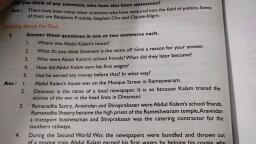
think so because Kalam says that he traced the stories of the war in the headlines of the, Dinamani., 3. Who were Abdul Kalam’s school friends? What did they later become?, A. During his childhood, Abdul Kalam had three friends. Their names are Ramanadha Sastry,, Aravindan and Sivaprakasan. When they grew up, Ramanadha Sastry became the priest of the, Rameswaram temple, Aravindan started a business of transporting pilgrims to and from the, Rameswaram temple and Sivaprakasan became a caterer for the railways., 4. How did Abdul Kalam earn his first wages?, A. Abdul Kalam earned his first wages by catching the bundle of newspapers thrown out of the, moving train at the Rameswaram station. He helped his cousin in distributing newspapers in, Rameswaram., 5. Had he earned any money before that? In what way?, A. When the second World War started, there was a great demand for tamarind seeds. Kalam, would collect them and sell them to a grocery store located on Mosque street. He would earn, an anna which was a meagre sum but for him, it was a handsome sum of money., Answer each of these questions in a short paragraph (about 30 words), 1. How does the author describe: (i) his father, (ii) his mother, (iii) himself?, A. (i) Kalam’s father’s name was Jainulabdeen. He was not educated and was not a wealthy man., Kalam says that despite this, his father possessed innate wisdom, honesty and was a generous, man. He did not believe in wasting money on luxuries but provided them with all the, necessities of life like food, clothing and medicine., (ii) Kalam’s mother’s name was Ashiamma. She supported her husband in his decisions. She, was a kind – hearted woman. Kalam recollects that his mother would feed meals to numerous, people. He inherited faith in goodness and deep kindness from her., (iii) Kalam was short and had ordinary looks while his parents were tall and looked handsome., He was brought up in a secure atmosphere. He grew up to become and honest and self –, disciplined man. He believed in goodness and deep kindness., 2. What characteristics does he say he inherited from his parents?, A. Kalam inherited honesty and self–discipline from his father. His mother imbibed in him faith, in goodness and deep kindness., Discuss these questions in class with your teacher and then write down your answers in, two or three paragraphs each., 1. “On the whole, the small society of Rameswaram was very rigid in terms of the segregation of, different social groups,” says the author., (i) Which social groups does he mention? Were these groups easily identifiable (for, example, by the way they dressed)?, A. The social groups mentioned by Kalam were the Hindu Brahmins and the Muslims. Yes,, these groups were easily identifiable by the way they dressed. As Kalam was a Muslim, he wore, a cap which distinguished him from his Hindu Brahmin friends who wore the sacred thread., (ii) Were they aware only of their differences or did they also naturally share friendships, and experiences? (Think of the bedtime stories in Kalam’s house; of who his friends were;
Page 3 :
and of what used to take place in the pond near his house.), A. No, they were not aware of any differences. Kalam and the other children listened to, bedtime stories from their mother and grandmother. These were from both the Ramayana and, from the life of Prophet. The family participated in the Hindu festival of Shree Seetha Rama, Kalyanam by arranging boats for transporting the idols from the temple to the pond located, near their house., (iii) The author speaks both of people who were very aware of the differences among, them and those who tried to bridge these differences. Can you identify such people in, the text?, A. The people who were aware of these differences were the young teacher who came to teach, Kalam’s class in fifth standard. He ordered Kalam to sit on the last bench as he belonged to a, lower caste. His science teacher Sivasubramania Iyer’s wife was an orthodox Hindi Brahmin., She refused to serve him food as she felt hat his presence would render the kitchen impure., The people who bridged these differences were Ramanadha Sastry’s father Lakshmana Sastry, and Sivasubramania Iyer. Lakshmana Sastry was the priest of the Rameswaram temple. He, scolded the young teacher and asked him to apologise for sowing the seeds of religious, discrimination into the innocent minds of the children. Upon his wife’s refusal to serve,, Sivasubramania Iyer served food to Kalam and sat beside him to eat which reformed his wife., 2. (i) Why did Abdul Kalam want to leave Rameswaram?, A. Abdul Kalam wanted to leave Rameswaram and go to Ramanathapuram for higher studies., (ii) What did his father say to this?, A. His father said that he knew Kalam had to leave home as he had to fulfil his dreams. He gave, the example of the Seagull bird which flies endlessly over long distances and does not have a, nest too. He pacified Kalam’s mother by quoting a few lines from the poem ‘Your children’ by, Khalil Gibran. He said that her children were not her possession but were life’s desire for itself., She should not impose her thoughts on them but should allow them to fulfil their thoughts., (iii) What do you think his words mean? Why do you think he spoke those words?, A. Abdul Kalam’s father’s words had a deep meaning. He inspired Kalam to follow his dreams,, to fly high like the seagull. He wanted him to pursue higher studies and so, allowed him to go to, Ramanathapuram. He explained to Kalam’s mother to allow him to go and pursue higher, education. He spoke these words to encourage Abdul Kalam and to control the emotional, attachment of his mother., Exactl based questions, , Read the extracts given below and answer the questions that follow., Question 1., I was one of many children – a short boy with rather undistinguished looks, born to tall, and handsome parents. We lived in or ancestral house, made of limestone and bricks,, on the Mosque Street in Rameshwaram. My austere father used to avoid all inessential, comforts and luxuries. However, all necessities were provided for, in terms of food,
Page 4 :
medicine or clothes. In fact I would say a mine was a very secure childhood, both, materially and emotionally., (a) How was Kalam different from his parents in looks?, Answer:, While Kalam’s parents were tall, handsome people, he was a short boy with, rather ordinary looks., (b) What does Kalam tell us about his home?, Answer:, Kalam’s family lived in their ancestral house, made of limestone and bricks, on, the Mosque Street in Rameshwaram., © How do we know that Kalam’s father was austere?, Answer:, Kalam’s. father shunned all inessential comforts and luxuries., (c) What kind of a childhood did Kalam have?, Answer:, Kalam had a comfortable and secure childhood., Question 3., In fact, I would say mine was a very secure childhood, both materially and emotionally., (a) In what way was Kalam’s childhood ‘secure’?, Answer:, Kalam was provided with all the necessities in terms of food, medicine and, clothes. Apart from it, his parents loved him a lot. and took good care of him., (b) What does Kalam mean by ‘material security’?, Answer:, By material security, Kalam means all the necessities of life that one needs while, growing up that can be provided with money., (c) What is meant by ‘emotional security’?, Answer:, ‘Emotional security’ is the love and care that one needs to flourish and thrive.
Page 5 :
(d) How did his parents provide Kalam with material and emotional security?, Answer:, Kalam’s parents provided him with material security by seeing all necessities in, terms of food, medicine or clothes were provided for and emotional security by, giving him a loving and secure childhood., Question 3., I was born into a middle-class Tamil family in the island town of Rameswaram in the, erstwhile Madras State. My father, Jainulabdeen, had neither much formal education, nor much wealth; despite these disadvantages, he possessed great innate wisdom and, a true generosity of spirit. He had an ideal helpmate in my mother, Ashiamma., (a) Where was Abdul Kalam born?, Answer:, Abdul Kalam was bom in the island town of Rameswaram which fell in the erstwhile, Madras State., (b) What qualities did Abdul Kalam’s father possess?, Answer:, His father was a wise and generous man., (c) In what ways was Ashiamma an ideal helpmate for her husband?, Answer:, Ashiamma was a generous person who fed a large number of people everyday., (d) What characteristics does he say he inherited from his parents?, Answer:, He inherited honesty and self discipline from his father. From his mother he inherited a, sense of kindness and faith.