Page 1 :
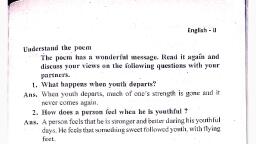
Poetry, It Never Comes Again, -Richard Henry Stoddard, |. Write poem:Il. Answer the following:1. What happens when youth departs?, Ans: When youth departs, much of one’s strength is gone and it never comes again., 2. How does a person feel when he is youthful?, Ans: He plunges in dreams and works wonders., 3. The poet says, “We sigh in vain.” Why?, Ans: When we lose the phase of youth, we can’t regain it. So, we sigh for losing it., 4. Where does a person look for youth, after it is gone?, Ans: A person looks for youth everywhere on the earth and in the air too, after it is gone., 5. Why does the poet compare losses and gains with youth?, , Ans: Because it is a period in which we stumble or do correct things. Loss and gain is a result of, our youth., , 6. What is the message of the poem?, , Ans: Youth is the sweetest phase of life. If fills a person with dreams. We should make the best, use of our youth because when it is gone, much of our strength is gone. We cannot gain it again., , Read and Appreciate:, , (A) Read the following lines that appear in the second stanza of the poem., “Still we feel that something sweet, , Followed youth, with flying feet,, , And will never come again"., , The poet describes the youth as ‘something sweet’. Do you agree with him? Why? Discuss in, groups., , Ans: Yes, | agree with the Poet. Though we are past our youthful days, we can still feel that, those days were sweetest and enthusiastic., , 2. The poet says, “There are gains for all our losses’. Do you agree with this? Give reasons., , Ans: No, | don’t agree with.this. We can regain loss of some of the materialistic things. But we, cannot regain all. Death and youth cannot be compensated., , 3. Which line/s in the poem do you like the most? Why? Tell your friends., , Ans: Still, we feel that something sweet followed youth with flying feet is the line which we like, because it adds to the reality of lif, , 4. Can you think of some proverbs/ quotations related to the theme of the poem?, , co Edit with WPS Office
Page 2 :
Ans: e.g. Time and Tide wait for none., , Time is money — Benjamin Franklin, , An ounce of gold will not buy an inch of time — Chinese proverb, , (B) Figures of Speech :, , |. Metaphor: Metaphor is a figure of speech in which two different objects having at least one, thing in common are compared. But the comparison is indirect or implied., , Ex., , ae Op =, , 6., , But when youth, the dream, departs., Tippu Sultan was the tiger of Mysuru., Life is a dream., , The camel is the ship of the desert., Revenge is a kind of wild Justice., , God is the old repair man., , ll. Personification: Personification is a figure of speech of in which a nonliving object or an, obstract notion is treated as having life., , Ex:, , SO & Sw YP io, , hes, , It takes something from our heart and it never comes again., , Under manhood’s sterner reign., , Follow youth, with flying feet and will never come again., , We behold it everywhere on the earth, and in the air, but it never comes again., Laughter holding both her sides., , Death lays his icy hand on kings., , Spring is the daughter of heaven and earth., , C. Rhyming words:, , 1., , oon oo & ON, , pain - reign, , departs — hearts, , pain - again, , regain — again, , vain — again, , Sweet — heat, beat, meat, feat, Air- where, fare, mare, hare, Heart — part, short, cart, mart, , Vanish — finish, distinguish, cherish, banish, , co Edit with WPS Office