Notes of 10th-22-23Eng/John Sir, English & Physical Education & English FL GRAMMAR NOTES - Study Material
Page 1 :
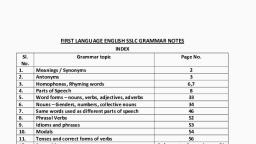
FIRST LANGUAGE ENGLISH SSLC GRAMMAR NOTES, INDEX, Sl., No., 1., 2., 3., 4., 5., 6., 7., 8., 9., 10., 11., 12., 13., 14., 15., 16., 17., 18., 19., 20., 21., 22., 23., 24., , 25., 26., , Grammar topic, , Page No., , Meanings / Synonyms, Antonyms, Homophones, Rhyming words, Parts of Speech, Word forms – nouns, verbs, adjectives, adverbs, Nouns – Genders, numbers, collective nouns, Same words used as different parts of speech, Phrasal Verbs, Idioms and phrases, Modals, Tenses and correct forms of verbs, Preposition, Articles, Question Tags, Punctuations, Active and Passive Voice, Degrees of Comparison, Direct and Indirect Speech(reported Speech), Clauses – Types, If clauses of condition, Frame questions to get underlined words as, answer, Transformation of sentences – simple, compound,, complex, Transformations of sentences – affirmative,, negative, interrogative, exclamatory, Usage of structures in sentence : neither..nor,, either…or, no sooner…than, too…to, so…that…not,, as soon as, hardly…, besides… both…and, not, only…but also, Figures of Speech, Letter Writing, , 2, 3, 6,7, 8, 33, 34, 46, 52, 53, 54, 56, Refer parts of speech page 26, 58, 60, 61, 69, 78, 79, 84, 86, 88, , Prepared by : Adarsh Vidyalay(RMSA), Mekhali, Tq. Raibag, Edn. Dist. Chikkodi, , 89, 99, 110, , 115, 118, , Page 1
Page 2 :
Meaning / Synonyms, , Whim – Sudden desire, Quaint- fanciful, Ply –read, Exalted – delighted, Imputation – suggestion, Vestibule – entrance, Agile – active, Whirl – turn, Cascade – waterfall, Flutter – move, Ransack – search, Janitor – caretaker, Sterling – very good, Ravage – ruin, wreck, Mammoth – huge, Enfold – embrace, Patent – evident, Discreet – tactful, Enfold – embrace, Nimble – agile, Tress - hair, Covet – crave, Ardent – zealous, keen, Dandy – splendid, Chronicle – story, Enteric – intestinal, Menace – threat, Potent – powerful, Momentum speed, Sustained – keep alive, Bliss – happiness, Ecstasy – happiness, Unpretentious – modest, , Gallant – brave, Reverie – day dream, Inevitable – certain to happen, Exquisite – delicate, Ominous – threatening, Remorse – shame, Denunciation – condemnation, Indictment – accusation, Vestiges – traces, Grumpy – bad tempered, Imperturbable - calm, Eluded – escaped, Hackney – a horse, Cantered – galloped, Goggling – rolling, Recumbent – lying down, Dictum – maxim, Surmount – overcame, Clang – loud sound, Bewildering – puzzling, Array – range, Impoverishment – scarcity, Entranced – filled with wonder, Pinched – arrested, Comely – attractive, Coyly – shyly, Bantlings – children, Stupefied - surprised, Imbibe – absorb, assimilate, Deed – act, Mount - ascend, climb, Grit – bravery, courage, Bough – branch, , Prepared by : Adarsh Vidyalay(RMSA), Mekhali, Tq. Raibag, Edn. Dist. Chikkodi, , Page 2
Page 3 :
Reluctant – hesitant, Coarse – rough, Envy – jealousy, Sublime – supreme, Dauntless – fearless, Dastard – coward, Foe – enemy, Wiles – tricks, Stupefied – shocked, Anguish – distress, Startled – surprised, Formidable – powerful, Avail – advantage, Conjecturing – guessing, Uncouth – ugly, Abide – remain, Cavern – cave, Steer – guide, direct, Scoff – make fun of, Scowl at – frown at, Perplex – bewilder, confuse, Lure – tempt, Diverse – varied, , Summit – top, Stature – height, Solitude – loneliness, Spectacle – sight, Savage – ancient (man), Spell – magic, Strife –trouble, Revere – respect, Severed – cut, Pelf – riches, Wretched – miserable, Caprice – whim, Betoken – indicate, Vexed – annoyed, Strewed – scattered, Abhorred – hateful, Recompense – reward, Waster - destroyer, Outrage – anger, Trip over – fall down, Subsistence – existence, Abundant – plentiful, Sprout – come up, , Antonyms/Opposite Words, Utilize x waste, Fertile x barren, Busy x idle, Fresh x stale, Always x never/seldom, Modern x ancient, Confidence x diffidence, Fiction x fact, Worthless x worthy, Prosperity x poverty/ adversity, Deep x shallow, Courage x cowardice, Afforestation x deforestation, Overcome x succumb, Rural x urban, Contract x expand, Laborious x simple, Proud x modest, Former x latter, Appreciated x depreciated, Prudence x foolishness, Interested x uninterested, Prepared by : Adarsh Vidyalay(RMSA), Mekhali, Tq. Raibag, Edn. Dist. Chikkodi, , Page 3
Page 4 :
Appointed x dismissed, Attacked x defended, Progressive x regressive, Hopeful x hopeless, Heroic x unheroic, Perturbable x imperturbable, Indisciplined x disciplined, Abated x unabated, Productive x unproductive, Adequate x inadequate, Wanted x unwanted, Essential x non-essential, , Cause x result, Advance x retreat/impede, Celestial x terrestrial, Vitality x lethargy, Reckless x careful, Crooked x straight, Certain x uncertain, Enchantment x disgust, Banking x non-banking, Bridled x unbridled, Advantage x disadvantage, , Antonyms using prefixes, Aware, , Unaware, , Arm, , Disarm, , Able, , Unable, , Agree, , Disagree, , Affected, , Unaffected, , Appear, , Disappear, , Answerable, , Unanswerable, , Allow, , Disallow, , Attractive, , Unattractive, , Advantage, , Disadvantage, , Bearable, , Unbearable, , Connect, , Disconnect, , Believable, , Unbelievable, , Courteous, , Discourteous, , Clear, , Unclear, , Continue, , Discontinue, , Common, , Uncommon, , Credit, , Discredit, , Civilized, , Uncivilized, , Close, , Disclose, , Canny, , Uncanny, , Content, , Discontent, , Certain, , Uncertain, , Encourage, , Discourage, , Comfortable, , Uncomfortable, , Franchise, , Disfranchise, , Communicative, , Uncommunicative, , Honour, , Dishonour, , Conscious, , Unconscious, , Pleased, , Displeased, , Countable, , Uncountable, , Respect, , Disrespect, , Desirable, , Undesirable, , Satisfied, , Dissatisfied, , Do, , Undo, , Unity, , Disunity, , Dress, , Undress, , Embark, , Disembark, , Expected, , Unexpected, , Honest, , Dishonest, , Prepared by : Adarsh Vidyalay(RMSA), Mekhali, Tq. Raibag, Edn. Dist. Chikkodi, , Page 4
Page 5 :
Exceptional, , Unexceptional, , Interest, , Disinterest, , Employed, , Unemployed, , Investment, , Disinvestment, , Equal, , Unequal, , Loyal, , Disloyal, , Economical, , Uneconomical, , Organise, , Disorganise, , Friendly, , Unfriendly, , Regard, , Disregard, , Fair, , Unfair, , Trust, , Distrust, , Fortunate, , Unfortunate, , Balance, , Imbalance, , Fit, , Unfit, , Mortal, , Immortal, , Finished, , Unfinished, , Moral, , Immoral, , Familiar, , Unfamiliar, , Movable, , Immovable, , Grateful, , Ungrateful, , Material, , Immaterial, , Graceful, , Ungraceful, , Mature, , Immature, , Happy, , Unhappy, , Patient, , Impatient, , Important, , Unimportant, , Pure, , Impure, , Just, , Unjust, , Polite, , Impolite, , Kind, , Unkind, , Practical, , Impractical, , Like, , Unlike, , Perfect, , Imperfect, , Load, , Unload, , Legal, , Illegal, , Lock, , Unlock, , Literate, , Illiterate, , Lucky, , Unlucky, , Legible, , Illegible, , Limited, , Unlimited, , Active, , Inactive, , Mistakable, , Unmistakable, , Adequate, , Inadequate, , Memorable, , Unmemorable, , Accurate, , Inaccurate, , Necessary, , Unnecessary, , Audible, , Inaudible, , Natural, , Unnatural, , Ability, , Inability, , Occupied, , Unoccupied, , Correct, , Incorrect, , Official, , Unofficial, , Curable, , Incurable, , Opposed, , Unopposed, , Competent, , Incompetent, , Orthodox, , Unorthodox, , Complete, , Incomplete, , Popular, , Unpopular, , Convenient, , Inconvenient, , Profitable, , Unprofitable, , Definite, , Indefinite, , Pleasant, , Unpleasant, , Discipline, , Indiscipline, , Predictable, , Unpredictable, , Dependent, , Independent, , Perturbed, , Unperturbed, , Decent, , Indecent, , Reliable, , Unreliable, , Different, , Indifferent, , Read, , Unread, , Efficient, , Inefficient, , Prepared by : Adarsh Vidyalay(RMSA), Mekhali, Tq. Raibag, Edn. Dist. Chikkodi, , Page 5
Page 6 :
Real, , Unreal, , Exactly, , Inexactly, , Reasonable, , Unreasonable, , Elegant, , Inelegant, , Ripe, , Unripe, , Essential, , Inessential, , Realistic, , Unrealistic, , Frequent, , Infrequent, , Suitable, , Unsuitable, , Formal, , Informal, , Successful, , Unsuccessful, , Gratitude, , Ingratitude, , Selfish, , Unselfish, , Justice, , Injustice, , Steady, , Unsteady, , Sincere, , Insincere, , Suspected, , Unsuspected, , Tolerance, , Intolerance, , Safe, , Unsafe, , Regular, , Irregular, , Sure, , Unsure, , Religious, , Irreligious, , Tidy, , Untidy, , Respective, , Irrespective, , Touched, , Untouched, , Responsible, , Irresponsible, , Toward, , Untoward, , Repairable, , Irrepairable, , True, , Untrue, , Replaceable, , Irreplaceable, , Tie, , Untie, , Revocable, , Irrevocable, , Usual, , Unusual, , Behave, , Misbehave, , Wed, , Unwed, , Conduct, , Misconduct, , Well, , Unwell, , Fortune, , Misfortune, , Worthy, , Unworthy, , Fire, , Misfire, , Willing, , Unwilling, , Guide, , Misguide, , Wind, , Unwind, , Judge, , Misjudge, , Written, , Unwritten, , Lead, , Mislead, , Zip, , Unzip, , Manage, , Mismanage, , Co-Operative, , Non-co-operative, , Place, , Misplace, , Bailable, , Nonbailable, , Used, , Misused, , Existent, , Nonexistent, , Violence, , Nonviolence, , Capable, , incapable, , Antonyms can be formed by using suffix ‘less’, • Careful – careless (root word – care), • Powerful - powerless (root word - power), , Homophones, Words that sound similar both at beginning and end, but have different meanings and spellings, , Piece – peace, Write – right/rite, , Would – wood, Through – threw, , Seem – seam, Seen – scene, , Prepared by : Adarsh Vidyalay(RMSA), Mekhali, Tq. Raibag, Edn. Dist. Chikkodi, , Fair – fare, Tide – tied, Page 6
Page 7 :
Way – weigh, Since – sins, See – sea, One – won, No – know, New - knew, By – buy, Bean –been, Live – leave, Plain – plane, , Need – knead, Rode – road, Two – too, Ring – wring, Grey – gray, Week – weak, Rare – rear, Hour – our, Hair – hare, Red – read(past, tense), Which – witch, Site – sight, Role – roll, Heard – herd, Face – phase, Stair – stare, Wear – where, Knows – nose, Sun – son, Scent – sent, cent, Great – grate, Read – reed, Vain – wane, Sold – soled, Rain – reign, rein Air – heir, Check – cheque, Some – sum, Not – knot/naught Wail – whale, While – wile, Wear – where, Wait – weight, Heel – heal, View – weave, Due – dew, Beat – beet, Peak – peek, Bow – bough, Whole – hole, Peace-piece, Raze-raise, , Science – signs, Wine – whine, Meat – meet, Bread – bred, Cell – sell, Diseased – deceased, Sour – sore, Wrote – rote, Bear – bare, Whether - weather, , Night – knight, Pole – poll, Ice – eyes, Sole – soul, Floor – flour, Sail – sale, Creek – creak, Bear – bare, Berth – birth, Vase – was, , Rise – rice, Lose – loose, Live – leave, Mind – mined, Prayed – preyed, Break – brake, Coarse – course, Ones – once, Quiet – quite, Steel – steal, None – nun, Ewe – you, Pail – pale, Assent – ascent, Antique - antic, Pair - pear, , Blew – blue, Story – storey, Accept – except, Four – fore, Eight – ate, Died – dyed, Pour – pore, Threw – through, Descent – dissent, Feet – feat, Worse – verse, Maid – made, Bore – boar, Mall – maul, Lone – loan, , Rhyming Words: two or more words which sound similar at the end of pronunciation, West – best, Stone -none, Sigh – eye, Gate – late, Hall – all, Sword – word, Bar – war, War – far, Denied – tied, Mine – wine, Face – grace, Up – cup, Fume – plume, Ear – near, Swung – sprung, Clan – ran, Friend – end, Foe – grow, Fear – tear, Smiles – wiles, Night – bright, Shine – wine, Stole – pole, See – tree, Behold – cold, Hang – sang, Day – away, West – rest, Prepared by : Adarsh Vidyalay(RMSA), Mekhali, Tq. Raibag, Edn. Dist. Chikkodi, , Page 7
Page 8 :
Fire – expire, Pelf – self, Life – strife, Thumb – dumb, Fame – name, Stir – her, Done – son, Leeched - reached, , Lie – pie/by, Skill – will, Ask - task, Press - Stress, Sea – bee, Grave – gave, Meet – street, Said – dead, , Strong – long, Mine –sign, Blame – came, High – eye, Began – man, Tell – well, Mind – kind, Still – well, , Came – shame, Swear – beware, Hear – clear, Sod – god, Birth – earth, Find – mind, Pay – say/day, Untamed – shamed, , PARTS OF SPEECH, In the English language, words can be considered as the smallest elements that have, distinctive meanings. Based on their use and functions, words are categorized into several, types or parts of speech. The 8 major parts of speech in English, grammar: noun, pronoun, verb, adverb, adjective, conjunction, preposition,, , and interjection., I., Nouns refer to persons, animals, places, things, ideas, or events, etc. Nouns, encompass most of the words of a language., Noun can be a/an Person – a name for a person: - Max, Julie, Catherine, Michel, Bob, etc., Animal – a name for an animal: - dog, cat, cow, kangaroo, etc., Place – a name for a place: - London, Australia, Canada, Mumbai, etc., Thing – a name for a thing: - bat, ball, chair, door, house, computer, etc., Idea – A name for an idea: - devotion, superstition, happiness, excitement, etc., Different Types of Noun:, Proper Noun, Common Noun, Abstract Noun, Concrete Noun, Countable Noun, Non-countable Noun, Collective Noun, Compound Noun, 1. Proper Noun:, A proper noun is a name which refers only to a single person, place, or thing and there is no, common name for it. In written English, a proper noun always begins with capital letters., Example: Melbourne (it refers to only one particular city), Steve (refers to a particular, person),, Prepared by : Adarsh Vidyalay(RMSA), Mekhali, Tq. Raibag, Edn. Dist. Chikkodi, , Page 8
Page 9 :
Australia (there is no other country named Australia; this name is fixed for only one country)., 2. Common Noun:, A common noun is a name for something which is common for many things, person, or, places. It encompasses a particular type of things, person, or places., Example: Country (it can refer to any country, nothing in particular), city (it can refer to any, city like Melbourne, Mumbai, Toronto, etc. but nothing in particular)., So, a common noun is a word that indicates a person, place, thing, etc. In general and, a proper noun is a specific one of those., 3. Abstract Noun:, An abstract noun is a word for something that cannot be seen but is there. It has no physical, existence. Generally, it refers to ideas, qualities, and conditions., Example: Truth, lies, happiness, sorrow, time, friendship, humor, patriotism, etc., 4. Concrete Noun:, A concrete noun is the exact opposite of abstract noun. It refers to the things we see and, have physical existence., Example: Chair, table, bat, ball, water, money, sugar, etc., 5. Countable Noun:, The nouns that can be counted are called countable nouns. Countable nouns can take an, article: a, an, the., Example: Chair, table, bat, ball, etc. (you can say 1 chair, 2 chairs, 3 chairs – so chairs are, countable), 6. Non-countable Noun:, The nouns that cannot be counted are called non-countable nouns., Example: Water, sugar, oil, salt, etc. (you cannot say “1 water, 2 water, 3 water” because, water is not countable), Abstract nouns and proper nouns are always non-countable nouns, but common, nouns and concrete nouns can be both count and non-count nouns., 7. Collective Noun:, A collective noun is a word for a group of things, people, or animals, etc., Example: family, team, jury, cattle, etc., Collective nouns can be both plural and singular. However, Americans prefer to use collective, nouns as singular, but both of the uses are correct in other parts of the world., 8. Compound Noun:, Sometimes two or three nouns appear together, or even with other parts of speech, and, create idiomatic compound nouns. Idiomatic means that those nouns behave as a unit and,, to a lesser or greater degree, amount to more than the sum of their parts., Example: six-pack, five-year-old, and son-in-law, snowball, mailbox, etc., Functions of Nouns, , Prepared by : Adarsh Vidyalay(RMSA), Mekhali, Tq. Raibag, Edn. Dist. Chikkodi, , Page 9
Page 10 :
Nouns can be used as a subject, a direct object, and an indirect object of a verb; as an object, of a preposition; and as an adverb or adjective in sentences. Nouns can also show possession., Subject: The company is doing great. Roses are the flowers of love., Direct object: I finally bought a new mobile., Indirect object: Max gave Carol another chocolate., Object of preposition: Roses are the flowers of love., Adverb: The train leaves today., Adjective: The office building faces the mall., Possession: The lion’s cage is dangerous. My brother’s daughter is adorable., , II., , Pronoun: Definition & Types, , A pronoun is used in place of a specific noun mentioned earlier in a sentence so that you don’t, have to keep saying/writing that particular noun., , Example:, Michael is a good boy. He gets up early in the morning. (Here, you don’t have to mention, ‘Michael’ again), The coach selected several key points. He wanted the team to memorize them. (‘He’ replaces, ‘the coach’; ‘them’ replaces ‘several key points’), , Types of Pronoun:, Subject Pronouns, Object Pronouns, Possessive Pronouns, Reflexive Pronouns, Intensive Pronouns, Relative Pronouns, Demonstrative Pronouns, Interrogative Pronouns, , Subject Pronouns, Subject pronouns work as the subject of the verb in a sentence. A subject pronoun normally, replaces the subject/object (a noun) of the previous sentence., , Example:, Mike can’t attend the party. He has gone to his grandparents., Julie made some cakes. They look tasty. (Here, the subject pronoun replaced the object of the, previous sentence), , Prepared by : Adarsh Vidyalay(RMSA), Mekhali, Tq. Raibag, Edn. Dist. Chikkodi, , Page 10
Page 11 :
Object Pronouns:, Object pronouns work as the object or indirect object in a sentence replacing the antecedent, object. This form of the pronoun is also used after prepositions., , Example:, I’ll give you a present on your birthday. I have a great idea for you. (after preposition), Tell her that you’ll take the job., I have a gift for your boss. Give it to your boss. (Here, ‘it’works as an object), , Possessive Pronouns:, Possessive pronouns replace the nouns of the possessive adjectives: my, our, your, her, his,, their. The possessive pronouns are mine, ours, yours, hers, his, its, theirs. The pronoun ‘who’, also has a possessive form, whose., Example:, I thought my bag was lost, but the one Kesrick found was mine. (Here, ‘mine’ refers to ‘my bag’), Their vacation will start next week. Ours is tomorrow. (Here, ‘ours’ refers to ‘our vacation’), Those four suitcases are ours., Is this yours?, You have to take either her car or theirs. Hers is better than theirs. (Here, ‘her’ is possessive adjective, and ‘hers’ and ‘theirs’ are possessive pronouns which replaced ‘her car’ and ‘their car’), , Reflexive Pronouns:, Reflexive pronoun redirects a sentence or a clause back to the subject, which is also the direct, object of that sentence. A reflexive pronoun comes when the subject performs its action upon itself., Here, ‘itself’ is a reflexive pronoun., , Example:, Since she is her own boss, she gave herself a raise. (Here, ‘herself’ is the direct object of the, clause and the same person is the subject), She allowed herself more time to get ready., The computer restarts itself every night., We told ourselves that we were so lucky to be alive., , Intensive Pronouns:, Intensive pronouns add emphasis/importance but do not act as the object in the sentence., They can appear right after the subject., , Example:, I will do it myself. (Here, ‘myself’ is not an object), I myself saw the missing boat into the harbor., We intend to do all the work ourselves., You yourselves are responsible for this mess., , Relative Pronouns:, Prepared by : Adarsh Vidyalay(RMSA), Mekhali, Tq. Raibag, Edn. Dist. Chikkodi, , Page 11
Page 12 :
Relative pronouns introduce the relative clause. They are used to make clear what is being, talked about in a sentence. They describe something more about the subject or the object., The relative pronouns are:, , Subject Object Possession Uncertainty, Which, That, Who, , Which, That, Whom, , Whose, Whose, , Whichever ---- (for things), ---- (for both things and people), Whoever/whomever/whosever ---- (for person), , Example:, The car that was stolen was the one they loved most., A person who loves nature is a good person., Our school, which was founded in 1995, is being renovated., I will accept whichever party dress you buy me on Valentine's Day., Whoever you are behind this great initiative, I want to thank you., , Demonstrative Pronouns:, Demonstrative pronouns normally indicate the closeness of or distance from the speaker,, either literally or symbolically. This, these, that, and those are the demonstrative pronouns., They also work as demonstrative adjectives when they modify a noun. However, demonstrative, pronouns do not modify anything rather replace the nouns/noun phrases., Sometimes neither, none and such are also used as demonstrative pronouns., , Example:, That is a long way to go. (demonstrative pronoun), This is my car. (demonstrative pronoun), Hand me that cricket bat. (demonstrative adjective), Neither is permitted to enter the building., Such are ways of life., , Interrogative Pronouns:, Interrogative pronouns produce questions. They are what, which, who, whom,, and whose., Who, whom, and whose refer to questions related to a person or animal; what refers to an, idea, object, or event; and which can indicate either a person/s or a thing/s., Example:, What was the name of your dog?, Which is your favorite movie?, Who works for you?, Whom do you prefer in this competition?, There’s a new bike on the lawn. Whose is it?, , III., , Verb: Definition & Types, , Prepared by : Adarsh Vidyalay(RMSA), Mekhali, Tq. Raibag, Edn. Dist. Chikkodi, , Page 12
Page 13 :
A verb is a word or a combination of words that indicates action or a state of being or, condition. A verb is the part of a sentence that tells us what the subject performs., Verbs are the hearts of English sentences., Examples:, Jacob walks in the morning. (A usual action), Mike is going to school. (A condition of action), Albert does not like to walk. (A negative action), Anna is a good girl. (A state of being), Verbs are related to a lot of other factors like the subject, person, number, tense,, mood, voice, etc., , Basic Forms of Verbs, There are six basic forms of verbs. These forms are as follows:, Base form: Children play in the field., Infinitive: Tell them not to play, Past tense: They played football yesterday., Past participle: I have eaten a burger., Present participle: I saw them playing with him today., Gerund: Swimming is the best exercise., , Different Types of Verbs, 1., 2., 3., 4., 5., 6., , Finite Verbs, Non-finite Verbs, Action Verbs, Linking Verb, Auxiliary Verbs, Modal Verbs, , Finite Verbs:, Finite verbs are the actual verbs which are called the roots of sentences. It is a form of, a verb that is performed by or refers to a subject and uses one of the twelve forms, of tense and changes according to the number/person of the subject., Example:, Alex went to school. (Subject – Alex – performed the action in the past. This, information is evident only by the verb ‘went’.), Robert plays hockey., He is playing for Australia., He is one of the best players. (Here, the verb ‘is’ directly refers to the subject itself.), Prepared by : Adarsh Vidyalay(RMSA), Mekhali, Tq. Raibag, Edn. Dist. Chikkodi, , Page 13
Page 14 :
Non-finite Verbs:, Non-finite Verbs are not actual verbs. They do not work as verbs in the sentence, rather they work as nouns, adjectives, adverbs, etc. Non-finite verbs do not change, according to the number/person of the subject because these verbs, also, called verbals, do not have any direct relation to the subject. Sometimes they become, the subject themselves., The forms of non-finite verbs are – infinitive, gerund, and participle (participles, become finite verbs when they take auxiliary verbs.), Example:, Alex went abroad to play (Infinitives), Playing cricket is his only job. (Present participle), I have a broken bat. (Past participle), Walking is a good habit. (Gerund), , Action Verbs:, Action verbs indicate what the subject of a sentence performs. Action verbs can make, the listener/reader feel emotions, see scenes more vividly and accurately., Action verbs can be transitive or intransitive., Transitive verbs must have a direct object. A transitive verb demands, something/someone to be acted upon., Example:, I painted the car. (The verb ‘paint’ demands an object to be painted), She is reading the newspaper. (The verb ‘read’ asks the question “what is she, reading?” – the answer is the object), Intransitive verbs do not act upon anything. They may be followed by an adjective,, adverb, preposition, or another part of speech., Example:, She smiled. (The verb ‘smile’ cannot have any object since the action of ‘smiling’, does not fall upon anything/anyone), I wake up at 6 AM. (No object is needed for this verb), Note: {Subject + Intransitive verb} is sufficient to make a complete sentence but, {Subject + Transitive verb} is not sufficient because transitive verbs demand a direct, object., , Linking Verb:, A linking verb adds details about the subject of a sentence. In its simplest form, it, connects the subject and the complement — that is, the words that follow the linking, verb. It creates a link between them instead of showing action., Prepared by : Adarsh Vidyalay(RMSA), Mekhali, Tq. Raibag, Edn. Dist. Chikkodi, , Page 14
Page 15 :
Often, what is on each side of a linking verb is equivalent; the complement redefines, or restates the subject., Generally, linking verbs are called ‘be’ verbs which are - am, is, are, was, were., However, there are some other verbs which can work as linking verbs. Those verbs, are:, Act, feel, remain, appear, become, seem, smell, sound, grow, look, prove, stay, taste,, turn., Some verbs in this list can also be action verbs. To figure out if they are linking verbs,, you should try replacing them with forms of the be verbs. If the changed sentence, makes sense, that verb is a linking verb., Example:, She appears ready for the game. (She is ready for the game.), The food seemed delicious. (The food was delicious.), You look happy. (You are happy.), , Auxiliary Verbs:, Auxiliary verbs are also called helping verbs. An auxiliary verb extends the main verb, by helping to show time, tense, and possibility. The auxiliary verbs are – be verbs,, have, and do., They are used in the continuous (progressive) and perfect tenses., Linking verbs work as main verbs in the sentence, but auxiliary verbs help main verbs., Do is an auxiliary verb that is used to ask questions, to express negation, to provide, emphasis, and more., Example:, Alex is going to school., They are walking in the park., I have seen a movie., Do you drink tea?, Don’t waste your time., Please, do submit your assignments., , Modal Verbs:, A modal verb is a kind of an auxiliary verb. It assists the main verb to indicate, possibility, potentiality, ability, permission, expectation, and obligation., The modal verbs are can, could, must, may, might, ought to, shall, should, will, would., Example:, I may want to talk to you again., They must play their best game to win., She should call him., Prepared by : Adarsh Vidyalay(RMSA), Mekhali, Tq. Raibag, Edn. Dist. Chikkodi, , Page 15
Page 16 :
I will go there., , IV., , Adverb: Definition & Types, , An adverb is a word/a set of words that modifies verbs, adjectives, and other, adverbs. It tells when, where, and how an action is performed or indicates, the quality or degree of the action., Many adverbs end in -ly but some words which end in -ly (such as friendly) are, not adverbs. Many words can be both adverbs and adjectives according to, their activity in the sentence., Example:, o Robin is always hungry for success., o I love her very much., o He is running fast., o Alex works hard., o He wrote that willingly., Adverb Clauses and Adverb Phrases are clauses and phrases that modify the, verbs, adjectives or other adverbs in the sentence., Example:, o He ran toward the bus until he was tired. (Adverb Clause), o He came carrying his box with two hands. (Adverb Phrase), o We were panicked without any reason. (Adverb Phrase), , Types of Adverbs:, •, •, •, •, •, •, , Conjunctive Adverbs, Sentence Adverbs, Adverbs of Time/Frequency (When?), Adverbs of Place/Direction (Where?), Adverbs of Degree (How Much?), Adverbs of Manner (How?), , Conjunctive Adverbs:, A conjunctive adverb connects phrases or independent clauses. It provides transitions, between ideas and shows relationships., Conjunctive adverbs are also called connectors., Example:, o It rained last night. Nonetheless, the final match has not been canceled., o We are still confused, however, if the umpires will come., o Last season there was a great drought; consequently, we could not grow crops., , Prepared by : Adarsh Vidyalay(RMSA), Mekhali, Tq. Raibag, Edn. Dist. Chikkodi, , Page 16
Page 17 :
Sentence Adverbs:, A sentence adverb starts the sentence and modifies the whole sentence., Example:, o Hopefully, we will win the match., o Apparently, the sky is getting cloudy., o Certainly, I did not think of coming here., , Adverbs of Time/Frequency (When?), Adverbs of time/frequency indicate time or frequency of the action in the sentence., They answer the question ‘when/how frequently is the action performed?’., Always, never, often, eventually, now, frequently, occasionally, once, forever, seldom,, before, Sunday, Monday, 10 AM, 12 PM, etc. are common adverbs of time/frequency., Example:, o I went to school a little late yesterday., o He always gets a good result., o I will leave Monday., o He smokes occasionally., , Adverbs of Place/Direction (Where?), Adverbs of place/direction that indicate place/direction of the action in the sentence., They answer the question ‘ where is the action performed?’., Across, over, under, in, out, through, backward, there, around, here, sideways,, upstairs, in the park, in the field, in that place, etc. are some common adverbs of, place/direction., Example:, o I went through the jungle., o He plays in the field., o Alex is going to school., o He is staying at my home., , Adverbs of Degree (How Much?), Adverbs that express the importance/degree/level of the action in the sentence are, called adverbs of degree. They answer the question ‘how much is the action, performed?’., Completely, nearly, entirely, less, mildly, most, thoroughly, somewhat, excessively,, much, etc. are common adverbs of degree., Example:, o She completely forgot about her anniversary., Prepared by : Adarsh Vidyalay(RMSA), Mekhali, Tq. Raibag, Edn. Dist. Chikkodi, , Page 17
Page 18 :
o, o, o, , I read the newspaper thoroughly., I am so excited about the new job., Robin hardly studies, , Adverbs of Manner (How?), Adverbs that express the manner/approach/process of the action in the sentence are, called adverbs of manner. They answer the question ‘how is the action performed?’., Beautifully, equally, thankfully, carefully, handily, quickly, coldly, hotly, resentfully,, earnestly, nicely, tirelessly, etc. are common adverbs of manner. These adverbs usually, end in ly., Example:, o Let's divide the prizes equally., o Please, handle the camera carefully., o Mike is walking slowly., o He is running fast., , V., , Adjective: Definition & Types, , An adjective describes or modifies noun/s and pronoun/s in a sentence. It normally, indicates quality, size, shape, duration, feelings, contents, and more about a noun or, pronoun., Adjectives usually provide relevant information about the nouns/pronouns they, modify/describe by answering the questions: What kind? How many? Which one? How, much? Adjectives enrich your writing by adding precision and originality to it., Example:, The team has a dangerous batsman. (What kind?), I have ten candies in my pocket. (How many?), I loved that red car. (Which one?), I earn more money than he does. (How much?), More Examples of Adjective, However, there are also many adjectives which do not fit into these questions., Adjectives are the most used parts of speech in sentences. There are several types of, adjectives according to their uses., , Types of Adjectives, • Descriptive Adjectives, • Quantitative Adjectives, • Proper Adjectives, Prepared by : Adarsh Vidyalay(RMSA), Mekhali, Tq. Raibag, Edn. Dist. Chikkodi, , Page 18
Page 19 :
•, •, •, •, •, •, , Demonstrative Adjectives, Possessive Adjectives, Interrogative Adjectives, Indefinite Adjectives, Articles, Compound Adjectives, , Descriptive Adjectives:, A descriptive adjective is a word which describes nouns and pronouns. Most of the, adjectives belong in this type. These adjectives provide information and attribute to, the nouns/pronouns they modify or describe. Descriptive adjectives are also, called qualitative adjectives., Participles are also included in this type of adjective when they modify a noun., Examples:, I have a fast car. (The word ‘fast’ is describing an attribute of the car), I am hungry. (The word ‘hungry’ is providing information about the subject), The hungry cats are crying., I saw a flying Eagle., , • Quantitative Adjectives:, A quantitative adjective provides information about the quantity of the, nouns/pronouns. This type belongs to the question category of ‘how much’ and ‘how, many’., Examples:, I have 20 bucks in my wallet. (How much), They have three children. (How many), You should have completed the whole task. (How much), , • Proper Adjectives:, Proper adjectives are the adjective form of proper nouns. When proper nouns modify, or describe other nouns/pronouns, they become proper adjectives. ‘Proper’ means, ‘specific’ rather than ‘formal’ or ‘polite.’, A proper adjective allows us to summarize a concept in just one word. Instead of, writing/saying ‘a food cooked in Chinese recipe’ you can write/say ‘Chinese food’., Proper adjectives are usually capitalized as proper nouns are., Example:, American cars are very strong., Chinese people are hard workers., Prepared by : Adarsh Vidyalay(RMSA), Mekhali, Tq. Raibag, Edn. Dist. Chikkodi, , Page 19
Page 20 :
I love KFC burgers., Marxist philosophers despise capitalism., , • Demonstrative Adjectives:, A demonstrative adjective directly refers to something or someone. Demonstrative, adjectives include the words: this, that, these, those., A demonstrative pronoun works alone and does not precede a noun, but a, demonstrative adjective always comes before the word it modifies., Examples:, That building is so gorgeously decorated. (‘That’ refers to a singular noun far from, the speaker), This car is mine. (‘This’ refers to a singular noun close to the speaker), These cats are cute. (‘These’ refers to a plural noun close to the speaker), Those flowers are heavenly. (‘Those’ refers to a plural noun far from the speaker), , • Possessive Adjectives:, A possessive adjective indicates possession or ownership. It suggests the, belongingness of something to someone/something., Some of the most used possessive adjectives are my, his, her, our, their, your., All these adjectives always come before a noun. Unlike possessive pronouns, these, words demand a noun after them., Examples:, My car is parked outside., His cat is very cute., Our job is almost done., Her books are interesting., , • Interrogative Adjectives:, An interrogative adjective asks a question. An interrogative adjective must be, followed by a noun or a pronoun. The interrogative adjectives are: which, what,, whose. These words will not be considered as adjectives if a noun does not follow right, after them. ‘Whose’ also belongs to the possessive adjective type., Examples:, Which phone do you use?, What game do you want to play?, Whose car is this?, , • Indefinite Adjectives:, Prepared by : Adarsh Vidyalay(RMSA), Mekhali, Tq. Raibag, Edn. Dist. Chikkodi, , Page 20
Page 21 :
An indefinite adjective describes or modifies a noun unspecifically. They provide, indefinite/unspecific information about the noun. The common indefinite adjectives, are few, many, much, most, all, any, each, every, either, nobody, several, some, etc., Examples:, I gave some candy to her., I want a few moments alone., Several writers wrote about the recent incidents., Each student will have to submit homework tomorrow., , • Articles, Articles also modify the nouns. So, articles are also adjectives. Articles determine the, specification of nouns. ‘A’ and ‘an’ are used to refer to an unspecific noun, and ‘the’ is, used to refer to a specific noun., Examples:, A cat is always afraid of water. (Here, the noun ‘cat’ refers to any cat, not specific.), The cat is afraid of me. (This cat is a specific cat.), An electronic product should always be handled with care., , • Compound Adjectives:, When compound nouns/combined words modify other nouns, they become a, compound adjective. This type of adjective usually combines more than one word into, a single lexical unit and modifies a noun. They are often separated by a hyphen or, joined together by a quotation mark., Example:, I have a broken-down sofa., I saw a six-foot-long snake., He gave me an “I’m gonna kill you now” look., , The Degree of Adjectives:, There are three degrees of adjectives: Positive, comparative, superlative., These degrees are applicable only for the descriptive adjectives., Examples:, Positive degree: He is a good boy., Comparative degree: He is better than any other boy., Superlative: He is the best boy., , Position of adjective in a sentence, An adjective comes either before or after the noun that it modifies. (She is a tall girl., She is quite tall for her age.) Most adjectives appear before a noun and they are, called the attributive adjectives. Adjectives that come after the noun must follow a, Prepared by : Adarsh Vidyalay(RMSA), Mekhali, Tq. Raibag, Edn. Dist. Chikkodi, , Page 21
Page 22 :
linking verb, and they are known as the predicative adjectives. Most adjectives can, be in either position, but some adjectives use only one of these positions, either, before the noun or after the noun., Those adjectives that come immediately after the noun that they modify are, called postpositive adjectives., (1) Adjective that comes before a noun is called an attributive adjective, The attributive adjective modifies the noun that follows it. There can be more than one, attributive adjective appearing side-by-side to modify the same noun., Attributive adjectives (in bold) that come before a noun., Examples:, a tropical fish, a leafless tree, a tight dress, a well-stocked shop, an expensive hotel, Examples:, Not everyone knows a giraffe has a long neck., My second-hand car is the noisiest in the neighbourhood., Will we have starry sky tonight?, He was found with a fractured skull., We followed a narrow winding path through the forest., , More than one adjective can appear side-by-side to modify the same noun., Examples:, an ugly old witch, a funny little clown, a tall young soldier, a loud distant sound, a cheap plastic doll, Some adjectives however are only attributive adjectives, which can only come immediately, before a noun and not anywhere else in the sentence. These adjectives include the, following: chief, elder, former, indoor, inner, main, mere, only, outdoor, outer, particular, p, rincipal, sole and upper. Using attributive adjectives as predicative adjectives will result in, ungrammatical sentences., Examples:, , Prepared by : Adarsh Vidyalay(RMSA), Mekhali, Tq. Raibag, Edn. Dist. Chikkodi, , Page 22
Page 23 :
o, , o, , o, , o, o, o, o, , His elder sister is getting married to her elder brother., (Not: Your sister elder is getting married to her brother elder.), I met my former wife., (Not: I met my wife who was former.), Mike has a little dog., (Not: Mike's dog is little.), My main problem is money., This pair of boots cost a mere thirty dollars., The weather was the chief reason for calling off the rescue operation., The witnesses were the principal source of information about the crime., , (2) Adjective that comes after a noun is called a predicative adjective, A predicative adjective in a sentence appears after a noun which is also the subject. The, predicative adjective modifies the noun that comes before it. It acts as a predicate as it, completes the meaning of the predicate in the sentence. The predicative adjective says, something about the subject of the sentence. It may also be referred to as a predicate, adjective. The predicative adjective does not appear immediately after the noun. The noun is, usually followed by a linking verb be (am, is, are, was, were, appear, look, taste, etc). The, predicative adjective comes after the linking verb and also acts as a complement., ·, The girl looks happy., In the sentence, looks is a linking verb. The word happy is an adjective which is also a, complement. The adjective happy together with the verb looks completes the predicate of, the sentence, and not surprisingly is called predicative adjective. A predicative adjective, modifies the subject of the sentence., We can make use of a predicative adjective when we do not want to place the adjective,, which describes a noun, before the noun. We can say or write “The girl is happy”, instead of, “The happy girl …….” In such arrangement, we use the linking verb (is) to join the predicative, adjective (happy) to the subject (the girl)., , The following examples show in bold the predicative adjectives and the preceding, auxiliary verbs, Examples:, o The duck soup is hot and spicy., (Not: The hot and spicy duck soup.), o She was short, fat and beautiful., o That statues of goddesses are bronze and life-size., o The measurements were difficult but accurate., o The stranger looks scary., o The boss appears angry., o This milk tastes sour., o The question sounds silly., o I soon grew bored listening to his horror story., Prepared by : Adarsh Vidyalay(RMSA), Mekhali, Tq. Raibag, Edn. Dist. Chikkodi, , Page 23
Page 24 :
The suspect remained silent when questioned., There are adjectives that can be used only as predicative adjectives. A group of these, adjectives begins with the, alphabet a (ablaze, adrift, afloat, afraid, aghast, alert, alike, alive, alone, aloof, ashamed, asl, eep, averse, aware, awake) and they usually come after a linking verb. Other examples of, predicative adjective that cannot appear before a noun, are content, far, fine, glad, ill, near, pleased, poorly, ready, sorry, unwell, upset, well, etc., Examples:, o His house was ablaze when he reached there., (We cannot say ‘ablaze house’), o The old man was spotted adrift on his boat after the storm., o They managed to keep their boat afloat through the storm., o Her child is afraid of scarecrows., (We cannot say ‘afraid child’), o The man was aghast at the sight of his house completely burned down., o They were alert for pickpockets while they were at the airport., o The two clowns look alike., (Not: The two alike clowns.), o She lived alone for many years., o His slurred speech keeps him aloof from his work colleagues., o He was ashamed to admit he couldn’t swim., o My grandpa is asleep but seems awake., o Our neighbor is strongly averse to dogs., o We were not aware that the family had migrated., o, , Examples:, o, o, o, , Their parents were glad that our parents could meet them., We are ready to go., The doctor is seriously ill in the hospital., , (3) Adjective that comes before and after the noun, Most adjectives can come before and after a noun that it modifies in a sentence, without affecting its meaning., For example, we can say, “The blue sky …” or “The sky is blue.” This indicates that the, adjective blue can be used as an attributive adjective or a predicative adjective. Either way,, the adjective modifies the same subject sky. When changing an attributive adjective to a, predicative adjective, we use a linking verb which in this example is is., , Examples:, o, o, , We had a week of cloudless skies., For a week, we had skies that were cloudless., , Prepared by : Adarsh Vidyalay(RMSA), Mekhali, Tq. Raibag, Edn. Dist. Chikkodi, , Page 24
Page 25 :
He is a highly intelligent person., o He is highly intelligent., o The leaves looked slightly red., o She uses red lipstick., o He won the so intense competition for the best chef., o He won the competition, which was so intense, for the best chef., o He won the best chef competition, which was so intense.., Attributive adjective used as predicative adjective changes its meaning, The meaning of some attributive adjectives changes when used as predicative adjectives., Examples:, o I have travelled only a short distance to meet you fellows., o We must keep the meeting short., o Police ensured tight security around the airport., o As I grow bigger, my jeans have become too tight., o People in the region live on low incomes., o The demand for meat remains low., o There is heavy traffic on the roads., o The rain is getting quite heavy., o, , (4) Attributive and predicative adjectives in same sentence, An adjective can take up any position in a sentence, preferably close to the noun that, it describes. More than one adjective can appear in a sentence, describing the, same noun. The adjectives are in bold in the following sentences., Examples:, o, o, , The pretty girl is angry with her boyfriend., The warm air is thick with dust., , His big house must be expensive to maintain., o The ugly scarecrow appears scary in the dark., (5) Postpositive adjective, o, , Adjectives coming immediately after noun or pronoun are called postpositive, adjectives., Examples:, , After noun:, o As it was getting dark, we took the shortest way possible., o The only ferry available charged a higher fare., o, o, , Someone had left the window open., The prince is the heir apparent to the throne., , After pronoun:, o, , The one responsible for the mess must clear it up., , Prepared by : Adarsh Vidyalay(RMSA), Mekhali, Tq. Raibag, Edn. Dist. Chikkodi, , Page 25
Page 26 :
o, o, o, , He clever at mathematics got full marks for the mathematics test., Only those present are allowed to vote., She furious with him vowed never to see him again., , An adjective comes after an indefinite pronoun:, anyone, everything, someone, something, etc. that the adjective modifies., , o, , Anyone guilty of the offence will not escape punishment., Everything valuable was destroyed in the fire., She's looking for someone rich to marry., , o, , Last night, we saw something bright streaking across the sky., , o, o, , Adjectives and determiners, An adjective usually comes between a determiner and the noun, making the adjective, easy to identify. The determiners are the definite article (the) and the indefinite, articles (a, an)., Examples:, o the bushy eyebrows, o a big stomach, o an unknown planet, , VI., , Preposition: definition & Types, , A preposition is a word that indicates the relationship between a noun and, the other words of a sentence. They explain relationships of sequence, space,, and logic between the object of the sentence and the rest of the sentence., They help us understand order, time connections, and positions., Example:, o I am going to Canada., o Alex threw a stone into the pond., Prepositions of time indicate the time and date or the period of time that, something happens. Some of the prepositions used, include around, at, by, during, from, in, on, since, throughout, and until., , Prepositions of time used to indicate a particular time., Examples:, o Our grandparents usually have a catnap at the same time around noon., o I had a big argument with my grandma at lunchtime., o The funeral should be over by five o’clock., o The astrologer said I would be dead in five years., o The boss is always sleepy on Monday mornings., , Prepositions of time indicate the period of time that something happens., Prepared by : Adarsh Vidyalay(RMSA), Mekhali, Tq. Raibag, Edn. Dist. Chikkodi, , Page 26
Page 27 :
Examples:, o I had a couple of terrifying nightmares during the night., o She swears never to talk to me again from tomorrow., o His girlfriend has been missing since last Sunday., o He slept throughout the lecture., o They said I was breastfed until the age of six., , Prepositions of time used to indicate a particular time in relation to another., Examples:, o I start to wonder whether I will be in Heaven or Hell after death., o I usually need to go to the toilet before having my breakfast., , 2. Prepositions of Place, Prepositions of place indicate where something is or where something happens, (across, in, inside, on, outside, under)., Examples:, o The newly built bridge across the river has just collapsed., o His alarm clock went off twice and he is still snoring in bed., o There was something like a snake or a rope inside the dark cage., o There was a big fly on the bull’s nose., o I fell asleep while waiting outside the clinic for my turn., , Prepositions of place also tell us the position of something in relation to another with, such words as behind, beside, between, in front, and near., Examples:, o Behind his farmhouse was a large scary scarecrow., o I sat beside a snoring woman in the cinema., o There is an awkward gap between her two front teeth., o Someone parked a tractor in front of our house., o Please don’t come near me; I have a bad cold., , 3. Prepositions of Direction, Prepositions of direction indicate that something is headed for or directed to, , somewhere. Prepositions of direction include prepositions such as into,, on, onto, through, to, toward., Examples:, o We watched the bus disappear into the tunnel., o A fly settled on my bread while I was eating it.., o My mom must have put the pumpkin onto someone else’s trolley in the supermarket., o The bullet had gone through his head, but he survived., o The teacher has gone to the loo again., o The snake slithered toward the bullfrog.., Prepared by : Adarsh Vidyalay(RMSA), Mekhali, Tq. Raibag, Edn. Dist. Chikkodi, , Page 27
Page 28 :
These prepositions show direction of movement from somewhere, and some of the, prepositions used here are away from, from, off, out., Examples:, o He warned them to keep away from his apple tree.., o Two tigers walking around are reported to have escaped from the circus.., o The strong wind blew the wig off his head., o Everyone ran out the door when the fire started., , 4. Prepositions of Manner/Prepositions of Cause and, Effect, Prepositions of manner, Prepositions of manner are about the way something happens or how something is done., They often use the word by. Some examples of preposition of manner, are by, in, like, on and with., Examples:, o We couldn't afford to go there by taxi., o The supplies were dropped by parachutes., o He fell in his dash for the finishing line., o Many say he laughs like a hyena., o The tourists arrived on the island on a hovercraft., o, , She reacted with anger to what he said., , Prepositions of cause and effect, Prepositions of cause and effect or reason are used to express the cause of something or, the reason that something happens, and the effect it has on another thing. Some examples, of these prepositions which include compound prepositions most commonly used are:, as, as a result (of), because (of), consequently, due to, for, from, hence, on account, of, since, therefore, and through., Examples:, o As a result of, o He cannot play football because of his swollen leg., o The quarrel was due to the rudeness on both sides., o They divorced for many reasons.., o Businesses don’t succeed from luck alone., o She doesn’t eat much on account of her acute depression., o Their sales increase through effective marketing., , 5. Simple and Compound Prepositions (phrasal, preposition), A simple preposition is a one-word preposition. A preposition can also come in a two-word or a three-word, combination, which is called a compound preposition. A compound preposition functions as a single preposition., , Prepared by : Adarsh Vidyalay(RMSA), Mekhali, Tq. Raibag, Edn. Dist. Chikkodi, , Page 28
Page 29 :
It consists of two words such as according to, because of, different from, due to, and instead of. Examples, of three-word compound prepositions are as far as, in addition to, in front of, and in spite of., There are words that are used only as prepositions as shown in the following table., , against, concerning onto, amid, despite, toward, among, during, towards, at, from, unto, bar, into, upon, beside, of, with, One-word prepositions:, Examples:, o, , The children were against their mother riding a camel since she is allergic to camel’s, hair., , o, , There was a single duck amid a brood of chickens., The mother called the three sons to divide the pizza among them., She began to think of getting married at the age of thirteen., Six cats slept atop a three-metre wall., She has eaten all my grapes, bar one. (bar = except for), She was sure someone stood beside her but didn’t appear on the photo., He went to catch crabs in the dark and despite the weather.., He got into a fight with the coach driver during the trip., He began to sing aloud from an old songbook., Most of his personal belongings including his pet goose were destroyed in the fire., This is the third time my grandfather walked into me when he didn’t have his glasses on., Last night, he heard the sound of footsteps coming from the roof.., The dining hall opens onto a cemetery., The police had very little information regarding the policeman's disappearance., The train is now heading toward the tunnel.., The prisoner threatened to fast unto death to get his alcoholic drinks., They look upon him as a role model of how to teach adults to behave like adults., She believes her weight increases with each passing day. ., , o, o, o, o, o, o, o, o, o, o, o, o, o, o, o, o, o, , Two-word compound prepositions:, Examples:, o According to his mother, he often talked in his sleep., o As of next week, all of you will eat less to lose weight., o Her face was perfect aside from that one hairy mole., o The bucks fought hard and it’s all because of a doe., o We waste a lot of time arguing instead of agreeing., o The detective didn’t know he was sitting next to a wanted man., o Sometimes my grandfather cuts pictures out of my magazines., , Three-word compound prepositions, Prepared by : Adarsh Vidyalay(RMSA), Mekhali, Tq. Raibag, Edn. Dist. Chikkodi, , Page 29
Page 30 :
Examples:, i., The explosion could be heard as far as five kilometers away., ii., We keep five dogs in addition to two cats., iii., It’s his habit to doze off in front of the television., iv., They continued with their search and rescue mission in spite of the bad weather., v., He can’t sing any more on account of his failing health., vi., The villagers carried pails of water on top of their heads., , VII., , Conjunction: Definition & Types, , Conjunctions are used to join clauses, phrases, and words together for, constructing sentences. Conjunctions make a link between/among words or, groups of words to other parts of the sentence and show a relationship, between/among them., Example:, o Alex and Robin are playing together., o Alex plays well, but Robin plays better than him., , Types of Conjunctions, •, •, •, , Coordinating Conjunctions, Correlative Conjunctions, Subordinating Conjunctions, , Coordinating Conjunctions:, The job of a coordinating conjunction is to join two words, phrases, or, independent clauses, which are parallel in structure. There are seven, coordinating conjunctions which are by far the most common, conjunctions: For, and, nor, but, or, yet, so.(FANBOYS), Example:, o We went to the stadium and enjoyed the cricket match., o Do you want an ice cream or chocolate?, o Go away and never come back., , Correlative Conjunctions:, A correlative conjunction uses a set of words in a parallel sentence structure, to show a contrast or to compare the equal parts of a sentence. The words of, correlative conjunctions have a special connection between them., The correlative conjunctions are not only - but also, either- or, neither nor, both - and, not - but, whether - or., Example:, Prepared by : Adarsh Vidyalay(RMSA), Mekhali, Tq. Raibag, Edn. Dist. Chikkodi, , Page 30
Page 31 :
o, o, o, , Neither Alex nor Robin can play baseball., I want both ice cream and, He ate not only the ice cream but also the chocolate., , Subordinating Conjunctions:, A subordinating conjunction joins elements of an unparallel sentence, structure. These elements are usually a dependent clause and an independent, clause., Most commonly used subordinating conjunctions are:, After, how, than, when, although, if, that, where, as, in order that, though,, which, as much as, inasmuch as, unless, while, because, provided, until,, who/whom, before, since, what, whoever/whomever., Example:, 1. Before we left home, I had had my breakfast., 2. Provided they come, we can start class Tuesday., 3. When he was washing my car, I went to the store., 4. Even though the weather was horrible, they still went outside., , VIII., , Interjection: Definition & Types, , An interjection is used to express sentiment of the speaker or sudden emotions like surprise,, joy, excitement, disgust, enthusiasm, sorrow, approval, calling, attention etc, , 1. Interjection for Greeting:, , •, •, •, , Interjection for greeting is used to indicate emotion of warmth towards the other person, when they meet. Interjection for greeting words are Hello! , Hey! , Hi! Etc., E.g., Hey! Good to see you today., Hello! I am Jane., Hi! Would you like to have a cup of coffee?, , 2. Interjection for Joy:, , •, •, •, , If you want to show feelings of happiness or excitement or immediate emotion or immediate, joy in the sentence then you can use words like Wow! Hurray! Hurrah! Ha!, E.g., Wow! That’s great news., Hurray! We won the football match., Ha! Today I am very happy., , 3. Interjection for Approval and Praise, When you want to express your feelings of approval and agreement on something that, happened for any task when you use these Interjection words like well done! O.K! Bravo!, E.g., Prepared by : Adarsh Vidyalay(RMSA), Mekhali, Tq. Raibag, Edn. Dist. Chikkodi, , Page 31
Page 32 :
•, •, , Well done! Your assignment is really good., Bravo! You did a great job., , 4. Interjection for Attention:, , •, •, •, , Interjection for attention is used in the sentence to draw the attention of attendance then you, use these Interjection words like Listen! Look! Behold! Hush., E.g., Listen! To me, you cannot do this at all., Behold! The bride comes., Look! You so arrogant., , 5. Interjection for Surprise:, , •, •, •, •, , Interjection for surprise is used to express a feeling or strong sense of being surprised, you, can use words like What! Well! Hey! Eh! Oh! Whoa! Ha!, Ah!, Gosh, Wow etc., E.g., Hey! I can’t believe you are right here with me., What! He attempted suicide., Oh! Really you killed a snake, I can’t believe this., Ah! I got promoted., , 6. Interjection for Sorrow or Pain:, , •, •, •, , When you want to express feelings of sadness in the sentence, then you can use words like, Alas! Ah! Oh! Ouch!, E.g., Alas! She is no more., Ah! I have lost my sister’s bag., Ouch! It's very painting, , 7. Interjections for Grief/Pain:, , •, •, •, , Interjection for grief/pain is used to expresses a strong emotion of grief on something, unfortunate that happened. Interjections for grief/pain words are Alas! , Ah! , Oh! ,, Ouch! Etc., E.g., Alas! He is dead., Ouch! I hurt my foot., Ah! The pain of injection., , 8. Interjections for Bidding Farwell:, , •, •, , Interjections for Bidding Farwell is used by the speaker to bid farewell or say goodbye. Interjections for bidding farwell words are Bye!, goodbye! farewell! Etc., E.g., Good-bye! we are leaving., Bye! I have to leave for now., Prepared by : Adarsh Vidyalay(RMSA), Mekhali, Tq. Raibag, Edn. Dist. Chikkodi, , Page 32
Page 33 :
9. Interjections for Expressing Doubt or Hesitation:, , •, , These interjections are used by the speaker when they are unsure and thinking of what to say, next. Interjections for Expressing Doubt or Hesitation words are Hmm, Uh, Er Etc., E.g., Hmm, I am not really sure what happened., , 10. Interjections for Express Calling:, , •, , When you call someone for any reason then you use these Interjection words like Halloo! Ho!, E.g., Hello! Why are you looking here?, Hello! Mark, please come with me., , WORD FORMS, Formation of nouns, The following table shows some common suffixes which are used to form nouns from, verbs and adjectives:, Root word(verb/adjective), Suffix, Derived Noun Words, Assist, exist, ance, ence, Assistance, existence, Act, divide, tion, sion, Action, division, Wise, bond, dom, age, Wisdom, bondage, Patriot, just, ism, ice, Patriotism, justice, Child, hood, Childhood, Possible, cruel, ity, ty, Possibility, cruelty, Move, ment, Movement, Kind, ness, Kindness, Leader, please, ship, ure, Leadership, pleasure, Arrive, al, Arrival, Other noun formation examples – profession by adding ‘er’, Teach - teacher, Edit – editor, Help - helper, Sing – singer, Dance - dancer, Formation of verbs from adjective/noun, Affix-Prefix, Root word(noun), Ac - , en Company, act, Re - , be - , em Fine, Suffix, -ate, - en, -e, Active, black, breath, -ise, ize, ify, Agony, equal, class, , Derived Verb Words, Accompany, enact, Refine, befriend, embody, Activate, blacken, breathe, Agonise, equalize,, , Prepared by : Adarsh Vidyalay(RMSA), Mekhali, Tq. Raibag, Edn. Dist. Chikkodi, , Page 33
Page 34 :
Formation of Adverb, Most of the adverbs are formed by adding suffix ‘ly’ to verbs, adjectives and some noun., ∗ Verb + ly = adverb, e.g. : complete + ly = completely, ∗ Adjective + ly = adverb, Slight + ly = slightly, ∗ Noun + ly = adverb, King + ly = kingly, , NOUNS – Gender, numbers, collective nouns, GENDER, Types Of Gender In English Grammar., Genders are of four types in English which are, 1. Masculine Gender:, A noun that shows male subtype is known as masculine gender. For example, king, man, boy, father,, cock, bull, fox, etc., 2. Feminine Gender:, A noun that shows female subtype, is known as feminine gender. For example, queen, woman, girl,, mother, hen, cow, vixen, etc., 3. Neuter Gender:, Some nouns are neither male nor female; they fall under the neuter gender. For example: table, hair,, city, etc., 4. Common Gender:, Unlike neuter gender, certain nouns can stand for both males and females. They are called common, gender. For example: teacher, student, cousin, parent, etc., , Masculine & Feminine Gender (People) / Masculine & Feminine Gender, (Creatures), Masculine, , Feminine, , Masculine, , Feminine, , actor, administrator, author, bachelor, boy, Boy Scout, brave, bridegroom, brother, conductor, count, , actress, administratrix, authoress, spinster, girl, Girl Guide, squaw, bride, sister, conductress, countess, , antelope: buck, ass, badger: boar, bear: boar, boar (pig), bull, bullock, cat: tom-cat, cob (swan), cock (rooster), cockerel, , doe, jenny, sow, sow, sow, cow, heifer/cow, tabby-cat, pen, hen, pullet, , Prepared by : Adarsh Vidyalay(RMSA), Mekhali, Tq. Raibag, Edn. Dist. Chikkodi, , Page 34
Page 35 :
czar, dad, daddy, duke, emperor, father, father-in-law, fiance, , czarina, mum, mummy, duchess, empress, mother, mother-in-law, fiancee, , gentleman, giant, god, governor, grandfather, , lady, giantess, goddess, matron, grandmother, , grandson, headmaster, heir, hero, host, hunter, husband, king, lad, landlord, lord, male, man, manager, manservant, masseur, master, mayor, milkman, monk, nephew, poet, policeman, , granddaughter, headmistress, heiress, heroine, hostess, huntress, wife, queen, lass, landlady, lady, female, woman, manageress, maidservant, masseuse, mistress, mayoress, milkmaid, nun, niece, poetess, policewoman, , colt (young horse), deer: buck, dog, donkey, drake, drone, eagle, elephant: bullelephant, ferret: buck, fox, gander, guinea pig: boar, goat: billy-goat/hegoat, hare: buck, hedgehog: boar, kangaroo: buck, leopard, lion, peacock, pig, pigeon: cock-pigeon, rabbit: buck, ram, rat: buck, reindeer: buck, rhinoceros: bull, seal: bull-seal, stag, stallion, tiger, turkey-cock, whale: bull-whale, wolf: he-wolf, , Prepared by : Adarsh Vidyalay(RMSA), Mekhali, Tq. Raibag, Edn. Dist. Chikkodi, , filly, doe, bitch, jenny, duck, bee, eagle, cow-elephant, doe, vixen, goose, sow, nanny-goat/she-goat, doe, sow, doe, leopardess, lioness, peahen, sow, hen-pigeon, doe, ewe, doe, doe, cow, cow-seal, hind, mare, tigress, turkey-hen, cow-whale, she-wolf, , Page 35
Page 36 :
postman, postmaster, priest, prince, prophet, proprietor, shepherd, sir, son, son-in-law, step-father, step-son, steward, sultan, tailor, uncle, usher, waiter, washerman, widower, , postwoman, postmistress, priestess, princess, prophetess, proprietress, shepherdess, madam, daughter, daughter-in-law, step-mother, step-daughter, stewardess, sultana, tailoress, aunt, usherette, waitress, washerwoman, widow, , Common Gender (People & Creatures), , addict, adolescent, adult, adviser, ancestor, artisan, artist, artiste, assistant, athlete, baby, breadwinner, bully, , divorcee, doctor, driver, enemy, expert, fan, farmer, fishmonger, foreigner, friend, gardener, graduate, guard, , magistrate, magician, manager, member, minister, motorist, murderer, musician, neighbour, newsreader, novelist, officer, orphan, , retiree, rumour-monger, runner, salesperson, scientist, secretary, seller, shopkeeper, shopper, singer, smoker, soldier, speaker, , Prepared by : Adarsh Vidyalay(RMSA), Mekhali, Tq. Raibag, Edn. Dist. Chikkodi, , Page 36
Page 37 :
buyer, captain, castaway, chairperson, child, citizen, clerk, commoner, companion, comrade, conjuror, consultant, cook, cousin, criminal, customer, cyclist, dancer, darling, dear, deceased, dentist, diner, ant, ape, ass, bear, bee, beetle, bird, butterfly, , guardian, guest, guide, gymnast, hawker, helper, historian, hostage, human being, immigrant, infant, informer, jogger, journalist, judge, killer, lawyer, leader, learner, lecturer, lender, liar, librarian, chimpanzee, cat, crab, crocodile, deer, eagle, fish, fly, , owner, paramedic, parent, passenger, passer-by, pedestrian, pen pal, pensioner, performer, person, photographer, pilot, player, principal, prisoner, professional, professor, pupil, reader, referee, refugee, relation, relative, giraffe, goat, insect, lizard, moth, mouse, owl, penguin, , specialist, spectator, spouse, spy, stranger, student, surgeon, sweeper, teacher, teenager, thief, tot, tourist, traveler, tutor, typist, victim, visitor, volunteer, well-wisher, worker, worshipper, writer, sheep, snail, snake, squirrel, swan, tadpole, tortoise, turtle, , Prepared by : Adarsh Vidyalay(RMSA), Mekhali, Tq. Raibag, Edn. Dist. Chikkodi, , Page 37
Page 38 :
caterpillar, chicken, , fowl, frog, , prawn, shark, , vulture, wasp, , Number: Types, Rules & Examples, In grammar, the number refers to the count of a noun or pronoun., Example: Boy-boys, wife-wives, my-our, ox-oxen, it-they, etc., , Types of Number:, Two types exist, , 1., , Singular Number, , It refers to the count of only one of a noun or pronoun., Example: pen, table, aunt, father, goose, etc., , 2., , Plural Number, , It refers to the count of more than one of a noun or pronoun., Example: pens, tables, aunts, fathers, geese, etc., , How to change number, Numerous RULES are there to change the number from singular to plural. They are as follows-, , Rule 1:, In general “s” is used at the end of a singular noun to make it plural, Example:, , Singular, Pencil, Cow, House, Dog, Mobile, , Plural, Pencils, Cows, Houses, Dogs, Mobiles, , Rule 2:, If there exist s, sh, ch, x and z in the end, “es” gets to be used., Examples:, Singular, Plural, Bus, Buses, Dish, Dishes, Branch, Branches, Fox, Foxes, Fez, Fezes, Prepared by : Adarsh Vidyalay(RMSA), Mekhali, Tq. Raibag, Edn. Dist. Chikkodi, , Page 38
Page 39 :
Rule 3:, While pronunciation of ch is like “k”, just “s” is added at the end, Example:, Singular, Plural, Monarch, Monarchs, Patriarch, Patriarchs, Matriarch, Matriarchs, Stomach, Stomachs, Hierarch, Hierarchs, Part 1: when there’s a “y” in the end and a Consonant before that “y”, “i” substitutes it, and an “es” thereafter., Example:, Singular, Plural, Story, Stories, Hobby, Hobbies, Army, Armies, Fly, Flies, Baby, Babies, Part 2: but if there’s a vowel ahead of that “y”, no need to change it, only “s” to add., Example, Singular, Plural, Donkey, Donkeys, Toy, Toys, Day, Days, Joy, Joys, Play, Plays, , Rule 4:, “v” replaces f or fe and then adds an “es” to finish it., Example:, Singular, Plural, thief, Thieves, Wife, Wives, Knife, Knives, Wolf, Wolves, Prepared by : Adarsh Vidyalay(RMSA), Mekhali, Tq. Raibag, Edn. Dist. Chikkodi, , Page 39
Page 40 :
Leaf, Leaves, Part 1: “es” to be added if the noun is finished by “o” and a consonant places ahead., Example:, singular, Plural, Hero, Heroes, Mango, Mangoes, Zero, Zeroes, Potato, Potatoes, Echo, Echoes, Part 2: but when there’s a vowel before that “o”, only “s” is enough., Example, Singular, Plural, Cuckoo, Cuckoos, Bamboo, Bamboos, Studio, Studios, Portfolio, Portfolios, Cameo, Cameos, Exception 1: though there’s an “o” and a consonant ahead of it, some nouns use only, “s”., Example:, Singular, Plural, Photo, Photos, Piano, Pianos, Radio, Radios, Exception 2: for some, “s” and “es” both are correct., Singular, Plural, Mosquito, Mosquitos/mosquitoes, Commando, Commandos/commandoes, Portico, Porticos/porticoes, Mango, Mangoes, Memento, Mementos/mementoes, Rule 5:, , Some require changing the middle-vowel of the word to make it plural., Example:, Singular, Plural, Man, Men, Woman, Women, Prepared by : Adarsh Vidyalay(RMSA), Mekhali, Tq. Raibag, Edn. Dist. Chikkodi, , Page 40
Page 41 :
Foot, Mouse, Tooth, , Feet, Mice, Teeth, , Rule 6:, Some require en, ren and ne to add at last., Example:, Singular, plural, Ox, Oxen, Child, Children, Brother, Brethren (brothers also correct), Cow, Kine (cows also correct), Sister, Sistren (sisters also correct), Part 1: if “man” means human being in a compound noun(a noun that contains two, or more words that jointly make a single noun), “men”replaces that “man”., Example:, singular, plural, Fisherman, Fishermen, Workman, Workmen, Boatman, Boatmen, Salesman, salesmen, Part 2: but when “man” is just a part of the word, or it refers to any ethnic group, race, or civilian, there comes “s”., Singular, Plural, Mussalman, Mussalmans, Brahman, Brahmans, German, Germans, Norman, Normans, , Rule 7:, “s” to be added when there’s a “ful” in the end., Example:, singular, Handful, , plural, Handfuls, , Prepared by : Adarsh Vidyalay(RMSA), Mekhali, Tq. Raibag, Edn. Dist. Chikkodi, , Page 41
Page 42 :
Mouthful, mouthfuls, Spoonful, Spoonfuls, armful, Armfuls, cupful, cupfuls, Part 1: If compound noun contains several words, “s” comes to join with the main, part of that noun., Example:, Singular, Plural, Brother-in-law, Brothers-in-law, Passer-by, Passers-by, Step-brother, Step-brothers, Commander-in-chief, Commanders-in-chief, Maid-servant, Maid-servants, Part 2: in some cases,“s”comes in every part to make it so., Example:, Singular, Plural, Lord-justice, Lords-justices, Man-servant, Men-servants, Woman-servant, Women-servants, , Rule 8:, Besides, adding “s” only in the end gets it done for few., Example:, Singular, Book-shelf, Book-case, Major-general, Poet-laurete, Forget-me-not, , Plural, Book-shelves, Book-cases, Major-generals, Poet-lauretes, Forget-me-nots, , Rule 9:, Some singular nouns have no plural form, only used in singular., Example:, Furniture, Prepared by : Adarsh Vidyalay(RMSA), Mekhali, Tq. Raibag, Edn. Dist. Chikkodi, , Page 42
Page 43 :
Scenery, Issue, Bread, expenditure, , Rule 9:, Adversely, some are always used as a plural form., Example:, Mumps, Scissors, Trousers, Spectacles, Assets, , Rule 10:, Though some nouns seem like singular, but actually they are plural., Example:, Government, Peasantry, People, Cattle, Mankind, , Rule 11:, Similarly, some nouns seem like plural though they are singular., Example:, Physics, Politics, Ethics, News, Wages, , Rule 12:, Some have the same singular and plural form., Example:, Deer, Sheep, Prepared by : Adarsh Vidyalay(RMSA), Mekhali, Tq. Raibag, Edn. Dist. Chikkodi, , Page 43
Page 44 :
Species, Corps, Canon, , Rule 12:, In case of letters, numbers and other symbols, it takes an apostrophe and s to change, it., Example:, Sam, write your g’s and y’s clearly., John, add two 5’s and three 8’s., , Rule 13:, There is no specific rule for changing the number of pronouns. It’s all about, memorizing., Singular, I, My, Mine, Me, You, He/she, , plural, We, Our, Ours, Us, You, they, , singular, Him/her, Your, This, That, It, His/her, , plural, Them, Your, These, Those, They, their, , COLLECTIVE NOUNS, Collective Nouns of Thing:, a bale of cotton, , a chest of drawers, , a packet of letters, , a basket of fruit, , a bunch of keys, , a collection of coins, , a batch of bread, , a heap of rubbish, , a pairs of shoes, , a battery of guns, , a stack of wood, , a comb of bananas, , a block of flats, , a cloud of dust, , a quiver of arrows, , a bowl of rice, a wad of note, , a pack of cards, a string of pearls, , a galaxy of stars, a string of beads, , Prepared by : Adarsh Vidyalay(RMSA), Mekhali, Tq. Raibag, Edn. Dist. Chikkodi, , Page 44
Page 45 :
a stack of hay, , a stack of wood, , a shower of rain, , a sheaf of corn, , a sheaf of grain, , a set of clubs, , a reel of film, , an outfits of clothes, , a library of books, , a forest of trees, , a hail of bullets, , a group of island, , Collective Nouns of Animals:, An army of ants, , A flight of birds, , a haul of fish, , A bevy of quail, , A gaggle of geese, , A hive of bees, , A troop of lion, , A herd of cattle, , A kindle of kittens, , A catch of fish, , A host of sparrows, , A nest of mice, , a train of camels, , A litter of cubs, , A plagues of locusts, , A could of insect, , A murder of crows, , A school of wolves, , A colony of gulls, , A pack of wolves, , A clutter of spiders, , A swarm of bees, , a pride of loins, , A mob of emus, , A team of oxen, , A shoal of fish, , A litter of puppies, , A board of chickens, , A string of horses, , A band of jays, , A stud of horses, , A flock of sheep, , A bed of eels, , Collective Nouns of Persons:, An army of soldiers, , A bevy of ladies, , A patrol of policemen, , A troupe of artistes, , A body of men, , A posse of policemen, , A staff of employees, , A gang of prisoners, , An audience of listener, , An army of musicians, , A group of dancers, , a band of musicians, , A board of directors, , A horde of savage, , A company of actors, , A caravan of gypsies, , A host of angles, , A choir of singer, , A bunch of crocks, , A line of kings, , A troop of scouts, , a class of students, , A mob of rioters, , A tribe of natives, , A crew of sailors, , A pack of thieves, , A team of players, , A crowd of people, , A panel of expert, , A regiment of soldiers, , A dynasty of kings, , A party of friends, , A hack of smokers, , Prepared by : Adarsh Vidyalay(RMSA), Mekhali, Tq. Raibag, Edn. Dist. Chikkodi, , Page 45
Page 46 :
Words used as noun and verb, Verb and adjective, adjective and adverb, Some words in English can be used as different parts of speech. Some words may be, used as both noun and verb., The chief classes of words thus variously used are, (1) nouns and adjectives, (2) nouns and verbs, (3) adjectives and adverbs, (4) adjectives and pronouns, (5) adverbs and prepositions, 1. Nouns and Adjectives : The same word can be used as noun as well as, adjective., Noun : Rubber comes from South America., Adjective : This wheel has a rubber tire., Noun : The rich have a grave responsibility., Adjective : A rich merchant lives here., 2. Nouns and Verbs : The same word can be used as noun as well as verb., Noun : Give me a stamp., Verb :Stamp this envelope., Noun : It is the call of the sea., Verb :You call me chief., Other examples are : act, address, ally, answer, boast, care, cause, close, defeat,, doubt, drop, heap, hope, mark, offer, pile, place, rest, rule, sail, shape, sleep, spur,, test, watch, wound., 3. Adjectives and Adverbs :The same word can be used as adjective as well as, adverb., Adjective : Draw a straight line., Adverb : The arrow flew straight., Adjective : Early comers get good seats., Adverb : Tom awoke early., Other examples are wrong, straight, early, late, quick, hard, far, near, slow, high,, low, loud, ill, well, deep, close, just, very, much, little., 4. Adjectives and Pronouns :The same word can be used as adjective as well as, pronoun., Adjective : This man looks unhappy., Pronoun : This is the sergeant., Adjective : Each day brings its opportunity., Pronoun : I received a dollar from each., 5. Adverbs and Prepositions : The same word can be used as adverb as well as, Prepared by : Adarsh Vidyalay(RMSA), Mekhali, Tq. Raibag, Edn. Dist. Chikkodi, , Page 46
Page 47 :
preposition., Adverb : Jill came tumbling after. (adverb after verb), Preposition : He returned after the accident. (preposition in the middle), Adverb : The weeds sprang up., Preposition : We walked up the hill., Other examples are aboard, before, beyond, down, inside, underneath., , List of Noun Words derived from verb/Adjective from Textbook, Adjective/verb -Noun Adjective/verb -Noun, Adjective/verb -Noun, Believe – belief, Need – need, Laugh – laughter, Paint - paint, Vow – vow, Similar – similarity, Waste – waste, Move – movement, Annoy – annoyance, Complete – completion Puzzle – puzzle, Utilize – utilization, Confess – confession, Summon – summon, Absent – absence, Exalt – exaltation, Imagine – imagination True – truth, Immortal – immortality Remember –, Separate – separation, remembrance, Visible – visibility, Green – greenery, Fertile – fertility, Populate – population Start – start, Entire – entirety, Flow – flow, Civilize – civilization, Create – creation, Sustain – sustenance, Regular – regularity, Emphasize - emphasis, Differ – difference, Grant – grant, Play – play, Signify – significance, Shape – shape, Add – addition, Beautify – beauty, Beautiful – beauty, Neglect – neglect, Vital – vitality, Throw – throw, Maintain – maintenance, Surprise – surprise, Reflect – reflection, Compare – comparison, Bright – brightness, Dark – darkness, Divide – division, Suspend – suspension, Vary – variation, Process – process, Form – formation, Act – action, Appropriate –, appropriation, Destruct – destruction Disastrous – disaster, Erode – erosion, Occur – occurrence, Succeed – success, Result – result, Cause – cause, Contribute –, Remove – removal, contribution, Prepared by : Adarsh Vidyalay(RMSA), Mekhali, Tq. Raibag, Edn. Dist. Chikkodi, , Page 47
Page 48 :
Exist – existence, Construct –, construction, Acquire – acquisition, Contain – containment, Depend – dependence, Conserve –, conservation, Sensitive – sensitivity, Consider –, consideration, Suitable – suitability, Available – availability, Investigate –, investigation, Sweet – sweetness, Research – research, Instigate – instigation, Describe – description, Accurate – accuracy, Finish – finish, Disapprove –, disapproval, Employ – employment, Suppose – supposition, Wriggle – wriggle, Sacrifice – sacrifice, Tear – tear, , Continue –, continuation, Cultivate – cultivation, , Prevent – prevention, , Suggest – suggestion, , Appreciate –, appreciation, Preserve – preservation, Irregular irregularity, Inadequate –, inadequacy, Collect – collection, Prosperous – prosperity, Prosper – prosperity, Develop – development, Responsible –, responsibility, Serve – service, , Essential - essentiality, Adopt – adoption, Connect – connection, Necessary – necessity, present – presence, Direct – direction, Improve –, improvement, Exhaust – exhaustion, , Possible – possibility, , Scrutinize – scrutiny, Impute – imputation, Contract – contraction, Introduce –, introduction, Possess – possession, Calculate – calculation, Number – number, , Assert – assertion, Imply – implication, Attend – attendance, Sequence – sequence, , Adorn – adornment, Wise – wisdom, Hug – hug, Leap – leap, Wail – wail, , Invent – invention, Duplicate – duplication, Package – package, Find – find, Decorate – decoration, , Fly – flight, Express – expression, Illuminate – illumination, , Prepared by : Adarsh Vidyalay(RMSA), Mekhali, Tq. Raibag, Edn. Dist. Chikkodi, , Page 48
Page 49 :
Brave – bravery, Convert – conversion, , Fight – fight, Discover – discovery, Important - importance Experiment –, experiment, Excite – excitement, Appoint – appointment Ferment – fermentation, Act – action, Infect – infection, Destroy – destruction, Generate – generation Remain – remnant, Assist – assistance, Worry – worry, Manage – management Pull – pull, Settle – settlement, Enter – entrance, Free – freedom, Trouble – trouble, Turn – turn, Treat – treatment, Explode – explosion, Ruin – ruin, Multiply – multiplication, Inoculate – inoculation Vaccinate – vaccination Attack – attack, Agree – agreement, Prove – proof, Allow – allowance, Inject – injection, Applaud – applause, Different – difference, Honour – honour, Oppose – opposition, Work – work, Conquer – conquest, Relieve – relief, Prevail prevalence, Enlarge – enlargement Kind – kindness, Deep – depth, Celebrate – celebration Crowd – crowd, Conscious –, consciousness, Progress – progress, React – reaction, Measure –, measurement, Intend – intention, Consider –, Involve – involvement, consideration, Observe - Observation Discriminate –, Intelligent – intelligence, discrimination, Distinct – distinction, Experience –, Compel – compulsion, experience, Realize – realization, Revolt – revolt, Endure – endurance, Devote – devotion, Tempt – temptation, Convict – conviction, Prepare – preparation Preserve – preservation Penetrate – penetration, Demand – demand, Instruct – instruction, Anxious – anxiousness, Exclaim – exclamation Fail – failure, Register – registration, Pretend – pretence, Desert – desertion, Interest – interest, Prepared by : Adarsh Vidyalay(RMSA), Mekhali, Tq. Raibag, Edn. Dist. Chikkodi, , Page 49
Page 50 :
Silent – silence, Confuse – confusion, Disappoint –, disappointment, Journey – journey, Respond – response, Brilliant brilliance, Decide – decision, Quarrel – quarrel, Reveal – revelation, Liberate – liberation, Intimate – intimation, Refuse – refusal, Console – consolation, Accuse – accusation, Vicious – viciousness, , Venture – venture, Groan – groan, Notice – notice, , Good – goodness, Fascinate – fascination, Attractive – attraction, , Argue - argument, Emigrate – emigration, Invade – invasion, Deport – deportation, Lonely – loneliness, Grieve – grief, Inform – information, Consent – consent, Edit – edition, Confident – confidence, Persecute – persecution, Suggest – suggestion, , Except – exception, Strike – strike, , Balance – balance, Cluster – cluster, , Impact – impact, Admire – admiration, Trap – trap, Betray – betrayal, Isolate – isolation, Approach, Recognize – recognition, Accept – acceptance, Authentic – authenticity, Indict – indictment, Tolerate – tolerance, Desperate –, desperation, Cautious – caution, Astonish –, astonishment, Excessive – excess, , Descend – descent, , Magnificent –, magnificence, Collide – collision, Testify – testimony, Corner – corner, Consume –, consumption, Flavor – flavor, Nutritive – nutrition, Combine – combination Persuade – persuasion, Sophisticate–, Advertise –, sophistication, advertisement, Obsessive - obsession, Wonder – wonder, Define – definition, Exploit – exploitation, Expand – expansion, Assure – assurance, , Report – report, Bewilder –, bewilderment, Color – color, Profuse – profusion, Entertain –, entertainment, Rare – rarity, Dream – dream, Confirm – confirmation, , Prepared by : Adarsh Vidyalay(RMSA), Mekhali, Tq. Raibag, Edn. Dist. Chikkodi, , Page 50
Page 51 :
Certify – certification, , Advance –, advancement, Push – push, Approach – approach, Administer –, Maximize –, administration, maximization, Trade – trade, Cooperate –, cooperation, Spiritual – spirituality, Restrict – restriction, Humorous – humor, Deject – dejection, Assume – assumption, Travel – travel, Interrupt – interruption Starve – starvation, Scarce – scarcity, Simple – simplicity, Treat – treatment, Arrange – arrangement, Digest – digestion, Fault – fault, Delight – delight, Achieve – achievement, Abate – abatement, Ail – ailment, Announce –, announcement, Confine – confinement, Detach – detachment, Encroach –, encroachment, Enjoy – enjoyment, Enroll – enrollment, Impeach –, impeachment, Invest – investment, , Accomplish –, accomplishment, Allot – allotment, Assess – assessment, , Aggressive – aggression, Estimate – estimation, Restore – restoration, Require – requirement, Concern – concern, Indicate – indication, Hesitate – hesitation, Attempt – attempt, Threaten – threat, Taste – taste, Explain – explanation, Abandon –, abandonment, Acknowledge –, acknowledgement, Amend – amendment, Attach – attachment, , Content – contentment Deploy – deployment, Displace – displacement Embank – embankment, Endorse – endorsement Enhance –, enhancement, Enlighten –, Enrich – enrichment, enlightenment, Establish –, Harass – harassment, establishment, Imprison –, Indict – indictment, imprisonment, Judge – judgment, Nourish – nourishment, , Prepared by : Adarsh Vidyalay(RMSA), Mekhali, Tq. Raibag, Edn. Dist. Chikkodi, , Page 51
Page 52 :
Postpone postponement, Recruit – recruitment, , Procure – procurement, , Commit – commitment, , Refresh – refreshment, , Replace – replacement, State – statement, Fulfill – fulfillment, Adjourn – adjournment, , Resent – resentment, Amuse – amusement, Align – alignment, Contain – containment, , Induce – inducement, Disburse –, disbursement, Relieve – relief, Post – postage, Patron – patronage, Weak – weakness, Forgetful –, forgetfulness, Rude – rudeness, Sick – sickness, Fair – fairness, Tender – tenderness, Quiet - quietness, , Anoint – anointment, Adjust – adjustment, , Reimburse –, reimbursement, Retire – retirement, Attain – attainment, Ship – shipment, Empower–, empowerment, Equip – equipment, Assign – assignment, , Block – blockage, Broker – brokerage, Wreck – wreckage, Mild – mildness, Tired – tiredness, , Marry – marriage, Cover – coverage, Spoil – spoilage, Nervous – nervousness, Lazy – laziness, , Lonely – loneliness, Fit – fitness, Bitter – bitterness, Fresh - freshness, , Ill – illness, Willing – willingness, Serious – seriousness, Eager – eagerness, , Phrasal Verbs, Phrasal verbs are phrases that indicate actions. They are generally used in spoken, English and informal texts. Examples of such verbs include: turn down, come, across and run into., Phrasal verbs consist of a verb and a preposition or an adverb:, , Give up = verb + preposition, Come down = verb + adverb, Examples of different phrasal verbs with meaning., Prepared by : Adarsh Vidyalay(RMSA), Mekhali, Tq. Raibag, Edn. Dist. Chikkodi, , Page 52
Page 53 :
Phrasal verb - meaning, turn down – refuse/reduce, Give up – stop doing something, Give in – yield, Drop in – come/visit, Let go – free/leave something, Come down – decreased, Grow up – develop, Call at – visit, Come by – obtain by accident/chance, Come off – succeed, Get on – have good relationship/deal with, situation, Get away – escape, Keep out – remain outside/not enter, Take down – move something down to, lower position, Run away – escape, , Phrasal verb – meaning, Slow down – decrease speed, Put out – extinguish, Warm up – to make something hotter, Let in – to allow to enter, Plug in – connect, Call on – speak, Call in – allow, Call off – postpone, Come about – happen, Come across – meet, Take part – participate, Get through – finish/succeed something, Think over – to ponder, Look into – examine, , Run down – to drive vehicle into a person, or animal, Run into – collide, meet someone Run out – to get used up/expire, unexpected, Run around – to be busy doing different Go about – carry on with, things, Go away – to leave a place or person, Go ahead – permission to proceed, Go through – to experience difficult Go along – to continue to happen, situation, Go into –investigate/to start doing Take aback – to be surprised, something, Take off – remove/leave surface/flight, Take on - compete, Take over – gain control over something, Shake off – to get rid of something bad, Laugh at – mock at someone, At last – in the end/finally, , Idioms and Phrases, Idioms are word combinations that have a different figurative meaning than the literal, meanings of each word or phrase., , Indulge in – enjoy, be happy in, something, , take charge of – assume, responsibility, , Prepared by : Adarsh Vidyalay(RMSA), Mekhali, Tq. Raibag, Edn. Dist. Chikkodi, , Page 53
Page 54 :
Take to task – to criticize/scold, , Get the better of – gain, advantage/defeat someone, Set out for – start journey for a place Come to pass – take place/happen, Turn inside out -To search every place, Beggar description – impossible to, carefully, believe, Made for somebody – exactly suitable for, someone, On the sly – in a secretive way, Give way – be replaced, Be on the lookout for – looking, for/searching for, Keep a level head – to remain calm, , On account of – because of/reason, Look for – search, To attend to – to deal with something, Leave no stone unturned – try everything, possible to achieve something, Have the last laugh - to succeed when others, thought you would not, , Go round in circles – do the same thing, without achieving anything, Full of beans – lively, enthusiastic, In the midst of – in the middle of, To take a new turn – to begin a new, course, , Jump on the bandwagon – support, something popular or likely to succeed, To bear with – to put up with, To be accustomed to – to get used to, Bereft of – deprived of, , MODALS, Modals (also called modal verbs, modal auxiliary verbs, modal, auxiliaries) are special verbs which behave irregularly in English. They are, different from normal verbs like "work, play, visit..." They give additional, information about the function of the main verb that follows it. They have, a great variety of communicative functions., , List of modal verbs, Here is a list of modal verbs:, can, could, may, might, will, would, shall, should, must, , The verbs or expressions dare, ought to, had better, and need, not behave like modal auxiliaries to a large extent and my be added to the, above list, Prepared by : Adarsh Vidyalay(RMSA), Mekhali, Tq. Raibag, Edn. Dist. Chikkodi, , Page 54
Page 55 :
Use of modal verbs:, Modal verbs are used to express functions such as:, 1., 2., 3., 4., 5., 6., 7., 8., , Permission, Ability, Obligation, Prohibition, Lack of necessity, Advice, possibility, probability, , 9. Examples of modal verbs, 10., , Here is a list of modals with examples:, , Modal Verb, must, , Expressing, Strong obligation, , must not, , logical conclusion /, Certainty, prohibition, , can, , could, , ability, permission, possibility, ability in the past, polite permission, , may, might, , possibility, permission, possibility, probability, polite permission, possibility, probability, , Example, You must stop when the traffic, lights turn red., He must be very tired. He's been, working all day long., You must not smoke in the, hospital., I can swim., Can I use your phone please?, Smoking can cause cancer., When I was younger I could run, fast., Excuse me, could I just say, something?, It could rain tomorrow!, May I use your phone please?, It may rain tomorrow!, Might I suggest an idea?, I might go on holiday to Australia, , Prepared by : Adarsh Vidyalay(RMSA), Mekhali, Tq. Raibag, Edn. Dist. Chikkodi, , Page 55
Page 56 :
need not, , should/ought, to, , lack of necessity/absence, of obligation, 50 % obligation, advice, logical conclusion, , had better, , advice, , next year., I need not buy tomatoes. There, are plenty of tomatoes in the, fridge., I should / ought to see a doctor. I, have a terrible headache., You should / ought to revise your, lessons, He should / ought to be very, tired. He's been working all day, long., You 'd better revise your lessons, , TENSES, FORMULAS OF ALL THE 12 TENSES, S + V + O or Subject + Verb + Object, •, •, •, •, •, •, •, •, •, •, , Simple Past Tense S + Past Form of the Verb + O, E.g. He wrote a letter., Past Continuous Tense S + was/were + V + ING + O, E.g. I was writing a letter., Past Perfect Tense S + had + Past Participle (PP.) of the Verb + O, E.g. She had written a letter., Past Perfect Continuous Tense S + had been + V + ING + O, E.g. We had been writing a letter since morning., Simple Present Tense S + V + O, E.g. You write a letter., Present Continuous Tense S + is/am/are + V + ING + O, E.g. She is writing a letter., Present Perfect Tense S + has/have + Past Participle (PP.) of the Verb + O, E.g. They have written a letter., Present Perfect Continuous Tense S + has been/have been + V + ING + O, E.g. You have been writing a letter for three hours., Simple Future Tense S + will/shall + V + O, E.g. We shall write a letter., Future Continuous Tense S + will be/shall be + V + ING + O, , Prepared by : Adarsh Vidyalay(RMSA), Mekhali, Tq. Raibag, Edn. Dist. Chikkodi, , Page 56
Page 57 :
•, •, , E.g. She will be cooking food., Future Perfect Tense S + will have/shall have + Past participle (PP.) of the Verb + O …., E.g. She will have written a letter before we go., Future Perfect Continuous Tense S + will have been/shall have been + V + ING + O +, E.g. They will have been writing a letter since morning., , Verbs forms, The verbs are the most variable element of the sentences. The right form of, verb encompasses most of the grammatical rules of English language. Every, element of a sentence eventually relates to the verb. The verbs appear, differently in a sentence on the basis of their subjects (subject-verb, agreement), tenses, moods, voices, different structures, modals, etc., Forms of Verbs:, Base, Past, Past Participle, Present Participle, Gerund (noun), Infinitive, , Do, work, love, Did, worked, loved, Done, worked, loved, Doing, working, loving, Doing, working, loving, To do, to work, to love, , be (am, is, are), - (was, were), been, being, ---to be, , have, had, had, having, to have, , Irregular Verbs, An irregular verb is one that does not form its simple past tense or its past participle by, adding "-ed" or "-d" to the base form., Base verb, past simple, past participle, e.g. bring,, brought, brought, think, thought, thought, drink, drank, drunk, , Irregular Verbs That Don't Change, Some irregular verbs do not change their forms for the simple past tense and the, past participle:, Verb, Past Simple, Past Participle, bet, bet, bet, broadcast, broadcast, broadcast, cut, cut, cut, hit, hit, hit, hurt, hurt, hurt, let, let, let, put, put, put, Prepared by : Adarsh Vidyalay(RMSA), Mekhali, Tq. Raibag, Edn. Dist. Chikkodi, , Page 57
Page 58 :
quit, read, set, shut, spread, , quit, read, set, shut, spread, , quit, read, set, shut, spread, , Regular Verb, A regular verb is one that conforms to the usual rule for forming its simple past, tense and its past participle., In English, the "usual" rule is to add "-ed" or "-d" to the base form of the verb to, create the past forms., e.g. delete - deleted, comfort - comforted, , ARTICLES, A, an and the are special adjectives. They are called articles. When articles combine, with nouns, they form noun phrase. There two types of articles:, 1., Indefinite article – a, an (used when we refer to any kind of person or thing), 2., Definite article – the (mainly used when we know a specific person or thing), , Use of Indefinite Article – Rules, i. ‘a’ is used before used before words beginning with consonant sounds., e.g. a doctor, a student, a hotel, a unique person, ii. ‘a’ is used before words which begin with vowel letter pronounced with same, sound as ‘y’ or ‘w’, e.g. a European, a uniform, a university, a one-rupee note, iii. an is used before words beginning with letter ‘h’ where h is silent(not, pronounced), e.g. an hour, an heir, an honourable man, an honest woman, iv. We use ‘an’ before abbreviations which begin with vowel sound., e.g. an MA, an MP, an NCC cadet, an ISRO scientist, v. a or an should be used only before countable nouns., e.g. a book, a city, a woman, vi. a or an must used before names of professions., e.g. His mother is a doctor, She is an engineer, vii. Sometimes the word ‘such’ is followed by a or an., e.g. such a thing, such a person, such an interesting story., viii. Determiners :. ‘a little’, a few, a lot of., Prepared by : Adarsh Vidyalay(RMSA), Mekhali, Tq. Raibag, Edn. Dist. Chikkodi, , Page 58
Page 59 :
e.g. He has few friends. He has a few books. A little amount of water., ix. We use a/an when we say what a thing or a person is:, e.g. The sun is a star. Football is a game, x. We use article a/an to refer to number one/each/per, e.g. it travelled at 5o km an hour., I have a car, , Rules regarding use of Definite Article – The, i., ii., iii., iv., , v., vi., vii., viii., ix., , x., , xi., , xii., , Superlative degree, e.g. Usain Bolt is the fastest man in the world., The names of rivers, seas, oceans, bays, trains, bank, ships, e.g. The Ganges, The Arabian Sea, The Pacific Ocean, Article the should not be used before names of game., e.g. I want to play football. (not the football), Do not use the before names of single mountain or hill, but use the before range, of mountain or hills or group of islands., e.g. Mount Everest, Mount Godwin Austin, The Himalayas, The Alps, the, Andamans, Use the before ordinals, e.g. The tenth chapter of that book is interesting., Don’t put the before name of meals if they refer to the meals generally., e.g. I have breakfast everyday at 8am., Do not use the before name of languages and subjects., e.g. English, French, Kannada, Hindi, Do not use the before names of substances when used generally., e.g. Gold is a precious metal, We drink water., Do not use the before the name of countries unless the name suggests the the, country is made of smaller units or constituent parts., e.g. Japan, India, Italy, e.g. The US, The UK, The USSR(made of many units), The is used before singular nouns to express that one thing mentioned is taken, to represent all of the kind., e.g. The tiger and the cat belong to the same family., The dog is faithful animal, The is used before common nouns which are unique of their kind in the, universe., e.g. the earth, the sun, the moon, The is used as an adverb with comparatives., e.g. The more you study, the more you learn.,, , Prepared by : Adarsh Vidyalay(RMSA), Mekhali, Tq. Raibag, Edn. Dist. Chikkodi, , Page 59
Page 60 :
xiii., , xiv., , Comparatives with the…the, e.g. The longer the delay was, the angrier the crowd became., e.g. The more famous an artist is, the more valuable the picture., The is used before directions, e.g. The sun rises in the east., , QUESTION TAG, Question tags are short questions used at the end of the statements to confirm if the, statement is true or not. It may also be used to evoke a reply from the person you are, speaking to. The subject of a question tag is always a pronoun., Basic Rules:, The sentence and the question tag will be in the same tense., If the sentence is affirmative(positive), the question tag will be negative., If the sentence is negative, question tag will be positive., The pronoun is always used in question tag., In negative question tags, the tag is contracted form of helping verb and not., Important Rules and Applications with Examples., 1., In affirmative (positive) sentence we use negative question tag., e.g. A teacher goes to school, doesn’t he/she?, Madhu plucked flower, didn’t she?, 2., In negative sentence, question tag will be positive., e.g. All the children were not present, were they?, 3., In sentences having modal verbs(can,will,may,would,shallshould etc) the, same modal verb should be used in the question tag followed by pronoun., e.g. A healthy body can achieve the impossible, can’t it?, Everybody, everyone, none, nobody, are singular words, and singular verbs, 4., are used in sentence, but in the question tag plural verb and plural pronoun, is used., e.g. Everybody has to pay his own bills, haven’t they?, 5., In affirmative imperative sentence, we use will you or won’t you in the, question tag., e.g. Switch on the tv, won’t you?, Please give me the book, won’t you?, 6., In negative imperative sentence, we use positive question tag ‘will you?’., e.g. Don’t touch the wire, will you?, Prepared by : Adarsh Vidyalay(RMSA), Mekhali, Tq. Raibag, Edn. Dist. Chikkodi, , Page 60
Page 61 :
7., , 8., , 9., , 10., , 11., 12., , 13., 14., , 15., , For imperative sentences beginning with ‘Let us’ question tag will be ‘shall, we?, e.g. Let us go out, shall we?, In sentences beginning with ‘Let’ but not followed by us, the question tag will, be ‘will you?’, e.g. Let them do their work, will you?, For sentences having everything, something, anything as subject, question, tag will have ‘it’ as pronoun., e.g. Everything is clear, isn’t it?, Never, seldom, nobody, hardly, scarcely, few, no, not, rarely, are negative, words, hence the question tag will be positive., e.g. He hardly came here, did he?, He never comes to school, does he?, In exclamatory sentences the question tag will contain auxiliary verbs., e.g. How beautiful the garden is, isn’t it?, Moon, earth, river, motherland, country, ship, train are considered as, feminine gender. The pronoun in the question tag will be ‘she’., e.g. The Titanic was thought to be unsinkable, wasn’t she?, In the affirmative sentences containing ‘am ’ the question tag used is aren’t., e.g. I am confident, aren’t I?, If the subject of the sentence is there, one, that, those, these, the question, tag will contain the same subject as pronoun., e.g. One cannot find a solution to this problem, can one?, Collective nouns are used in singular forms so the question tag will have, singular verb and pronoun., e.g.The class has selected its monitor, hasn’t it?, The bunch of grapes was good, wasn’t it?, , Punctuation, Punctuation is the system of signs or symbols given to a reader to show how a, sentence is constructed and how it should be read., Sentences are the building blocks used to construct written accounts. They are, complete statements. Punctuation shows how the sentence should be read and makes, the meaning clear. The Commonly used punctuation marks are, , Prepared by : Adarsh Vidyalay(RMSA), Mekhali, Tq. Raibag, Edn. Dist. Chikkodi, , Page 61
Page 62 :
1., , Full Stop (.), , What is a Full Stop (Period)?, A full stop, also known as a period in American English, is one of the most commonly, used punctuation marks in the English language. Analysis of texts indicate that, approximately half of all punctuation marks used are full stops., A full stop is mostly used at the end of a declarative sentence, or a statement that is, considered to be complete. This punctuation mark is also used following an, abbreviation., , When to Use a Full Stop, We use a full stop at the end of a declarative sentence., This period punctuation is mostly used at the end of a declarative sentence, or a, statement that is considered to be complete., Examples:, There is no place like home., Love makes the world go round., We use the period punctuation after titles in American English., Examples:, Mr., Mrs., Dr., Sr., Jr., …, Example sentences:, He owes a lot of money to Mr. Smith., We use the full stop in numbers., A full stop used in a number is also called a decimal point., Retail sales fell by 1.3% in January., The full stop is used following an abbreviation., Examples:, approx.: Approximately, etc.: And so on, , 2., , Question Mark (?), , The question mark (?) is an important part of the English language and was developed, sometime around the 18th Century. We use a question mark (?) after an interrogative, sentence in English., Examples:, Have you seen the film yet?, What are you doing?, , Prepared by : Adarsh Vidyalay(RMSA), Mekhali, Tq. Raibag, Edn. Dist. Chikkodi, , Page 62
Page 63 :
3., , Quotation Marks(“, “ ”), , What Are Quotation Marks, Quotation marks (“…”) are a type of punctuation used to mark an exactly replicated, word or statement. This can be a phrase by a person or character, the title of a work, or, to indicate or emphasize the alternate use of a word. Quotation marks take the, appearance of a set of inverted commas and are used in pairs consisting of an opening, quotation mark and a closing one”., Quotation marks are used to indicate speech or writing by another person in your, writing. This can be seen in the following examples:, Harry sighed. “I didn’t mean to break the window.“, “I don’t want to eat dinner,“ said Judith., To Give Someone a Special Description, His name is Ben “Impossible“ Jones., The satellite sent back pictures of some weird “fuzz“ on the star., , 4., , Apostrophe ’, , An apostrophe is used to show that certain letters have been omitted from a word, (contractions, i.e. she’s, it’s…). The punctuation symbol can also be used to show the, possessive form of a noun (possessive apostrophe, i.e. John’s books,…), in addition to, indicating the plural form of lowercase letters., , Apostrophe Rules for Contractions, A contraction is a shortened version of the written and spoken forms of a word, syllable,, or word group, created by omission of internal letters and sounds., The apostrophe is used to show the contraction of words in a sentence., Examples:, aren’t – are not, can’t – cannot, , Apostrophe Rules for Possession (Possessive Apostrophe), Apostrophe Before S, In most cases, we add an apostrophe before s for singular nouns to show possession., For examples, dog owned by Jack -> Jack‘s dog, wallet belongs to Jim -> Jim‘s wallet,, etc., Examples:, The children’s room, The men’s work, , Prepared by : Adarsh Vidyalay(RMSA), Mekhali, Tq. Raibag, Edn. Dist. Chikkodi, , Page 63
Page 64 :
Apostrophe After S, For plural nouns, we simply add an apostrophe after s except for those few, plural nouns that do not end in s., Examples:, Boys’ ball, Babies’ shoes, Lemons’ acidity, , 5. A comma (,), A comma is a punctuation mark used to denote a pause in the sentence (shorter than, a colon or a semicolon). A comma is used to show the difference between two separate, ideas or elements within a sentence. Commas have other users as well, as they can be, used to separate numbers, and write dates., , When to Use Commas with Example Sentences, Separate a Series of Words, We use commas between words in a series. Notice that a comma does not follow the, last word in the series., Examples:, See, listen, and be silent, and you will live in peace., He was tall, dark, and handsome., Do you want some cakes, candies or ice cream?, , Separate a Series of Phrases, Examples:, I like reading books, listening to music, watching TV, and studying English., , Connect Two Independent Clauses, We use commas to separate two complete statements., Examples:, It’s an old car, but it’s very reliable., I was feeling hungry, so I made myself a sandwich., , Set off Introductory Phrases or Clauses, We use a comma to separate an introductory element from the rest of the sentence., Having finally arrived in town, we went shopping., , After Certain Words that Introduce a Sentence, Examples:, Well, I’m not going home on foot, at any rate., Hey, don’t tell me what to do., , Separate the Parenthetical Elements, A parenthetical element adds extra information and can be removed from the sentence, without changing the meaning of the sentence., Prepared by : Adarsh Vidyalay(RMSA), Mekhali, Tq. Raibag, Edn. Dist. Chikkodi, , Page 64
Page 65 :
Examples:, Football, which is a popular sport, is very good for health., My grandmother, old and sick, never goes out of the house., , Separate Coordinate Adjectives, We place commas between adjectives, if two ore more adjectives modify a noun in the, same way. These are called coordinate adjectives which can be identified by the fact, that the word and can be inserted between them and their order can be reversed., Example:, Followers feel energetic, confident and happy., He is a competent, efficient worker., , Separate the Quoted Parts, Examples:, He asked,”Do you want to go with me?”, The teacher asked, “Do you love English?”, “I don’t think you should do that,” he said., , Set off Phrases to Express Contrast, We also use commas to set off contrasting expressions beginning with not, but…, Examples:, Money is a good servant, but a bad master., The golden age is before us, not behind us., Adversity makes a man wise, not rich., , Avoid Confusion, We also add a comma in some cases to make a sentence clear., Examples:, For most, the year is already finished., I saw that she was busy, and prepared to leave., , Set off Expressions that Interrupt the Sentence Flow, Examples:, This, after all, is a company which is awash with cash., On the other hand, many women choose to go out to work., , Separate Dates, Years, Addresses…, Examples:, We will meet Friday, July 15., I was born in August 26, 2001., , Separate a Statement from a Tag Question, We use this punctuation mark to set off a tag question which is used at the end of the, statement to ask for confirmation., There weren’t any problems when you talked to Jack, were there?, Let’s take the next bus, shall we?, Prepared by : Adarsh Vidyalay(RMSA), Mekhali, Tq. Raibag, Edn. Dist. Chikkodi, , Page 65
Page 66 :
6. HYPHEN A hyphen is a punctuation mark with three main uses. Many people confuse, this punctuation mark with the dash, but the two are quite different. The hyphen can be, used in compound words, to link words to prefixes, and also as a way to show word, breaks, , When to Use a Hyphen, Using Hyphens to Form Hyphenated Words, Hyphenated words are compound words that are made up of two or more words usually, with hyphens (-) between them. In simple words, hyphens are used between words to, form hyphenated words., Hyphenated Adjectives, We use hyphens to join adjective, adverb, noun, past participle, present participle… to, form compound adjectives in English., Examples:, An English-speaking country, A twenty-story building, Well-known writer, Good-looking person, Hyphenated adjectives in sentences:, A full-length portrait of the Queen hung on the wall., Writing a dictionary is a never-ending task., He was stuck in a line of slow-moving traffic., He was tall and quite good-looking., He is an obedient and well-behaved child., Hyphenated Verbs, We use a hyphen to join two nouns to form a verb., Examples:, Color-code, Double-click, Water-proof, Hyphenated Nouns, Examples:, Dry-cleaning, Daughter-in-law, Editor-in-chief, , Using Hyphens to link Prefixes to Words, In English, a prefix is a few letters put at the beginning of a word to change its, meaning. We use hyphens in words beginning with the prefixes co-, ex-, pre-, post-…, Prepared by : Adarsh Vidyalay(RMSA), Mekhali, Tq. Raibag, Edn. Dist. Chikkodi, , Page 66
Page 67 :
Examples, Co-worker, co-pilot, co-operation, Ex-president, ex-boyfriend, Extra-terrestrial, , 7. Exclamation Mark !, The exclamation mark (!) or exclamation point is a punctuation mark used to express, strong feelings or emotions. It is commonly used after exclamations or interjections., , When to Use the Exclamation Mark, It is used to demonstrate strong feelings or emotions such as shock, surprise, anger or a, raised voice., “Aah! It’s eating my leg!” ; “Ah! There you are!” ; “Grrr, I’ll hit your head!”, It is used to give a command., “Stop!” ; “Sit down!”, It is commonly used after interjections or exclamatory sentences., “Oh dear! I’ve lost my keys again.” ; “How interesting this film is!”, A colon is a punctuation mark, which can be easily interfering with something else,, such as a semicolon ( ; ). In fact, Aristophanes was a librarian who invented a symbol, with three dots, arranged vertically., You can use a colon to introduce an item or a list of items that are based on the same, topic. E.g. I’m going in a camping trip so I will need: sleeping bags, a tent, a fan., You can use a colon when separating a question-answer interview. E.g. Q: When do you, want to leave the country?, A: As soon as possible., , 8. SEMICOLON ;, A semicolon (;) looks like a full stop on top of a comma and, in fact, it has some, similarities with both of these punctuation marks., , What Is A Semicolon?, A semicolon (;) looks like a full stop on top of a comma and, in fact, it has some, similarities with both of these punctuation marks. However, it can’t be used to replace, either one of them. In addition, even though it looks a lot like a colon (:) and even has a, very similar name, their uses in a sentence also differ significantly., , When To Use a Semicolon?, 1) When you want to make the gap between two sentences smaller, When two sentences are linked very closely, putting a full stop between them might be, too much. On the other hand, they are two different sentences, so a simple comma, won’t do, either. In this case, a semicolon comes to the rescue., For example:, Give me a call after lunch; we will discuss all the details then., Prepared by : Adarsh Vidyalay(RMSA), Mekhali, Tq. Raibag, Edn. Dist. Chikkodi, , Page 67
Page 68 :
Let’s go to the library to study; it’s the only place where I can fully concentrate., , 2) When you introduce a new complete sentence with words such as, however, nevertheless, therefore, for example, etc., Once again, the two sentences are too connected to let a full stop separate them but a, comma doesn’t seem enough. Here, you can use a semicolon. Remember to put a, comma after the word or phrase that introduces your new sentence., For example:, Jeremy has never been a problematic child; however, his mother kept acting surprised, when he behaved well., Lucy doesn’t pay enough attention to her university studies; for example, instead of, preparing for her big exam, she usually goes to a club., , 3) When you separate units in a list, with units already containing, commas, Sometimes you might have a list where one or more units have commas. Adding even, more commas will make things very complicated, and the sentence might stop making, sense for the reader. So, you will need to separate units by semicolons., For example:, Martha could go on for hours about her trips to Rome, Italy; Madrid, Spain; Ottawa,, Canada; and Athens, Greece., This sentence would be very confusing with only commas: Martha could go on for, hours about her trips to Rome, Italy, Madrid, Spain, Ottawa, Canada, and Athens,, Greece., , 9. Parentheses ( ), Parentheses are punctuation marks that always come in pairs: you are very unlikely to see a, sentence with just one parenthesis in it. Parentheses are used to give details about the, topic and to indicate a phrase that interrupts the natural flow of a sentence., 1. Use parentheses when you want to add extra information, but be very careful with the grammatical, structure of the sentence., , 2. Parentheses can also be used to provide the full term of an acronym or an, abbreviation., For example: At 25, she became the youngest CFO (Chief Financial Officer) this, company has ever had., , 10., , Ellipses …, , Ellipses (singular: ellipsis) are a form of punctuation used to indicate excluded wording, within a phrase or paragraph, or to indicate a pause in speech., , “, , ”, , To demonstrate omitted material in quotes, He said, this place was visited by me three years back This sentence shortened :He said,, was visited..., To indicate uncertainty or pausing in informal conversation, , Prepared by : Adarsh Vidyalay(RMSA), Mekhali, Tq. Raibag, Edn. Dist. Chikkodi, , “this place, Page 68
Page 69 :
“Umm . . . I’m not sure about that.”, “I mean . . . not really.”, , Active Voice and Passive Voice, The voice of a verb tells whether the subject of the sentence performs or, receives the action. Voices are of two types: active and passive., Active Voice: In the active voice, the subject performs the action, expressed by the verb., Eg.- Ram sings a song., Here ‘Ram” is the subject and the verb is ‘sing’ and ‘song’ is the object., Here the action of ‘singing’ is being done by the subject i.e. ‘Ram’., Passive Voice: In passive voice subject receives the action expressed by, the verb., Eg.- A song is sung by Ram., Here the ‘song’ is subject ‘sing’ is the verb and ‘Ram’ is the entity who did, the action of singing and ‘song’ is the entity on whom action has been, done., General rules of conversion active voice to passive voice:, 1. The subject in the active voice becomes the object in the passive, voice and the object in the active voice becomes the subject in the, passive voice., 2. Put ‘by’ in front of the subject in the passive voice., 3. Use 3rd form of verb + is/ am/ are/ was/ were/ been/ being, according to the tense in passive voice., Objects in Sentence : Indirect and Direct object, All sentences need a subject and a verb. Subject may be person, place,, thing, or idea that performs action (verb). E.g. Ramu ate. ‘Ramu’ is subject, and ‘ate’ is verb., , An object is the part of a sentence that gives meaning to the subject’s action of, the verb.. E.g. Ramu ate cake. The action of the subject is on object ‘cake’., There are 2 kinds of objects : Direct and Indirect object., , The direct object is the receiver of the action mentioned in the sentence., A direct object answers the question of who(m) or what., e.g. John hit the ball. (Direct object: the ball), The indirect object identifies the person/thing for whom/what the action of the, verb is performed. The indirect object identifies the person/thing for whom/what, the action of the verb is performed., e.g. My mother bought me a necklace. (Indirect object – me; direct object –, necklace), Prepared by : Adarsh Vidyalay(RMSA), Mekhali, Tq. Raibag, Edn. Dist. Chikkodi, , Page 69
Page 70 :
Two objects in an active sentences – two possible passive sentences, •, •, •, •, , When there are two objects in an active sentence, there are two possible active sentences, and two possible passive sentences., Sentence 1: The professor gave the students the books., Sentence 2: The professor gave the books to the students., There are two objects in each of the following sentences:, Object 1 = indirect object → the students, Object 2 = direct object → the books, An indirect object is very often a person, a direct object a thing. When a direct object is, followed by an indirect one, we put to in front of the indirect object., , Some common verbs which can be followed by two objects are given, below: Bring, buy, cost, get, give, leave, lend, make, offer, owe, pass, pay, play, promise,, read, refuse, send, show, sing, take, teach, tell, wish, write, , Changes of Pronouns, Active Voice, I, we, you, he, she, it, they, Who, , Passive Voice, me, us, you, him, her, it, Them, Whom, , The Form of Active Voice and Passive Voice in Tenses, Passive voice in Simple Present Tense, , Active Voice, Formula: Subject + infinitive + object, , Passive Voice, Formula: S + to be + past participle + by object, , Examples:, , Simson cares the lion, Ana does the homework, , The lion is cared by Simson, The homework is done by Ana, , Passive voice in Present Continuous Tense, Active Voice, Formula: Subject + to be (is, am, are) +, present participle + object, , Passive Voice, Formula: S + to be (is, am, are) + being + past, participle + by object, , Prepared by : Adarsh Vidyalay(RMSA), Mekhali, Tq. Raibag, Edn. Dist. Chikkodi, , Page 70
Page 71 :
Examples:, , Bobby is drawing a nice scenery, , A nice scenery is being drawn by Bobby, , Passive voice in Simple Past Tense, Active Voice, Formula: Subject + past participle + object, , Passive Voice, Formula: S + was/were + past, participle + by object, , Examples:, , She cleaned the house, Jeffri bought a new car, , The house was cleaned by her, A new car was bought by Jeffri, , Passive voice in Past Continuous Tense, Active Voice, Formula: S + was/were + being + past, participle + by object, , Passive Voice, Formula: S + was/were + being + past, participle + by object, , Examples:, , I was waiting for Dina, She was reading a novel, , Dina was being waited by me, A novel was being read by her, , Passive voice in Past Perfect Tense, Active Voice, Formula: Subject + had + past participle +, object, , Passive Voice, Formula: S + had been + past participle + by, object, , Examples:, , He had left that place, I had finished my work, She had missed the last bus, , That place had been left by him, My work had been finished by me, The last bus had been missed by her, , Passive voice in Simple Future Tense, Active Voice, Formula: Subject + will + infinitive +, object, , Passive Voice, Formula: S + will + be + past participle + by, object, , Examples:, , I shall read a newspaper, She will sing a beautiful song, , A newspaper will be read by me, A beautiful song will be sung by her, , Prepared by : Adarsh Vidyalay(RMSA), Mekhali, Tq. Raibag, Edn. Dist. Chikkodi, , Page 71
Page 72 :
Passive voice in Future Continuous Tense, Active Voice, Formula: Subject + will be + present, participle + object, , Passive Voice, Formula: S + will + be + ing + past participle, + by object, , Examples:, , He will be doing a test tomorrow, They will be watching movie on next, Saturday, Mita will be increasing her value next, time, , A test will be being done by him tomorrow, The movie will be being watched by them on next, Saturday, Her value will be being increased by Mita next, time, , Passive voice in Past Future Tense, Active Voice, , Passive Voice, , Formula: Subject + would + infinitive +, object, , Formula: S + would + be +past pasrticiple + by, object, , Examples:, , I would buy a book tomorrow, They would play football next time, Mita would wash her shoes tomorrow, , A book would be bought by me, Football would be played by them next time, Her shoes would be washed by Nita tomorrow, , The following tenses cannot be changed into passive voice., 1. Present perfect continuous tense, 2. Past perfect continuous tense, 3. Future perfect continuous tense, , Passive voice for “May Have, Might Have, Should Have, Must, Have, Ought To Have”, Active voice: MAY HAVE, You may have availed the opportunity., You may not have availed the opportunity., Active voice: MIGHT HAVE, He might have eaten meal., He might not have eaten meal., Active voice: SHOULD HAVE, You should have studied the book., , Active voice: MAY HAVE BEEN, The opportunity may have been availed by you., The opportunity may not have been availed by you., Active voice: MIGHT HAVE BEEN, Meal might have been eaten by him., Meal might not have been eaten by him., Active voice: SHOULD HAVE BEEN, The book should have been studied by you., , Prepared by : Adarsh Vidyalay(RMSA), Mekhali, Tq. Raibag, Edn. Dist. Chikkodi, , Page 72
Page 73 :
You should not have studied the book., Active voice: MUST HAVE, He must have started job., He must not have started job., Active voice: OUGHT TO HAVE, You ought to have helped him., , The book should have not been studied by you., Active voice: MUST HAVE BEEN, Job must have been started by you., Job must not have been started by you., Active voice: OUGHT TO HAVE BEEN, He ought to have been helped by you, , Imperative Sentences, A sentence that expresses a command, or a request or an advice, or, an entreaty is called an Imperative Sentence or Desire., , Characteristics of Imperative Sentences, 1. The object you is generally missing in Imperative Sentences. The structure of such sentences in, Passive Voice is: Let + object + be/not be + V3, 2. In sentences which express request, advice and order, such phrases as, You are requested, to/advised to /ordered to are used., 3. Word kindly/please are dropped., , Active Voice, Do it., Call in the doctor., Never tell a lie., Shut the door., Do not starve the cow., Stand up., Kindly lend me some money., Work hard., Don not do it., Passive Voice, You are ordered to open the door., You are requested to come here., Let the light be witched on., Let your parents be obeyed., , Passive Voice, Let it be done., Let the doctor be called in., Let a lie be never told, Let the door be shut., Let the cow not be starved, You are ordered to stand up., You are requested to lend me some money., You are advised to work hard, You are forbidden to do it. or Let it be not done, Active Voice, Open the door., Come here please., Switch on the light., Obey your parents., , Sentences which cannot be changed into passive voice, Transitive and intransitive verb, Prepared by : Adarsh Vidyalay(RMSA), Mekhali, Tq. Raibag, Edn. Dist. Chikkodi, , Page 73
Page 74 :
A verb can be either transitive or intransitive. A transitive verb needs an object (in sentence) to give, complete meaning while intransitive verb does not need an object (in sentence) to give complete, meaning., For example:, Transitive verb: He sent a letter. (Send is a transitive verb and it needs an object i.e. letter to express, full meaning.), Intransitive Verb: He laughs. (Laugh is an intransitive verb and it does not need object for, expressing full meaning.), e.g. Sleep, go, reach, sit, die, are examples of intransitive verbs., , Passive voice of interrogative sentences., Questions beginning with do/does, Normal structure of interrogative sentence in active voice starting with, do/does is, Do/does + subject + verb + object ? (Active Voice), Ex: Does she cook the food? (Active Voice), (Here ‘she’ is subject, ‘cook’ is verb and ‘the food’ is object.), While changing the sentence into passive, this structure becomes, Am/is/are + subject + V-3 + by + agent ? (Passive Voice), Ex: Is the food cooked by her? (Passive Voice), (Here ‘The food’ becomes subject in passive voice, ‘cooked’ is V-3 (past, participle) of cook, and ‘her’ is agent (doer)), See some more examples to clarify this, • Does Shubham write homework? (Active Voice), Is homework written by Shubham? (Passive Voice), • Does Simran learn English? (Active Voice), Is English learnt by Simran? (Passive Voice), • Does Sachin play cricket? (Active Voice), Is cricket played by Sachin? (Passive Voice), , Questions beginning with am/is/are, Normal structure of interrogative sentence in active voice starting with, am/is/are is, Am/is/are + subject + verb + ing + object ? (Active Voice), Ex: Is she cooking the food? (Active Voice), (Here ‘she’ is subject, ‘cooking’ is verb and ‘the food’ is object.), While changing the sentence into passive, this structure becomes, Prepared by : Adarsh Vidyalay(RMSA), Mekhali, Tq. Raibag, Edn. Dist. Chikkodi, , Page 74
Page 75 :
Am/is/are + subject + being + V-3 + by + agent ? (Passive Voice), Ex: Is the food being cooked by her? (Passive Voice), (Here ‘The food’ becomes subject in passive voice, ‘cooked’ is V-3 (past, participle) of cook, and ‘her’ is agent (doer)), Note: You might have noticed that whenever there is verb + ing in active, voice, we are using being + V-3 in passive voice., See some more examples to clarify this, • Is Shubham writing homework? (Active Voice), Is homework being written by Shubham? (Passive Voice), • Is Simran learning English? (Active Voice), Is English being learnt by Simran? (Passive Voice), • Is Sachin playing cricket? (Active Voice), Is cricket being played by Sachin? (Passive Voice), , Questions beginning with did, Normal structure of interrogative sentence in active voice starting with, did is, Did + subject + verb + object ? (Active Voice), Ex: Did she cook the food? (Active Voice), (Here ‘she’ is subject, ‘cook’ is verb and ‘the food’ is object.), While changing the sentence into passive, this structure becomes, Was/were + subject + V-3 + by + agent ? (Passive Voice), Ex: Was the food cooked by her? (Passive Voice), (Here ‘The food’ becomes subject in passive voice, ‘cooked’ is V-3 (past, participle) of cook, and ‘her’ is agent (doer)), See some more examples to clarify this, • Did Shubham write homework? (Active Voice), Was homework written by Shubham? (Passive Voice), • Did Simran learn English? (Active Voice), Was English learnt by Simran? (Passive Voice), • Did Sachin play cricket? (Active Voice), Was cricket played by Sachin? (Passive Voice), Prepared by : Adarsh Vidyalay(RMSA), Mekhali, Tq. Raibag, Edn. Dist. Chikkodi, , Page 75
Page 76 :
Questions beginning with was/were, Normal structure of interrogative sentence in active voice starting with, was/were is, Was/were + subject + verb + ing + object ? (Active Voice), Ex: Was she cooking the food? (Active Voice), (Here ‘she’ is subject, ‘cooking’ is verb and ‘the food’ is object.), While changing the sentence into passive, this structure becomes, Was/were + subject + being + V-3 + by + agent ? (Passive Voice), Ex: Was the food being cooked by her? (Passive Voice), (Here ‘The food’ becomes subject in passive voice, ‘cooked’ is V-3 (past, participle) of cook, and ‘her’ is agent (doer)), See some more examples to clarify this, • Was Shubham writing homework? (Active Voice), Was homework being written by Shubham? (Passive Voice), • Was Simran learning English? (Active Voice), Was English being learnt by Simran? (Passive Voice), • Was Sachin playing cricket? (Active Voice), Was cricket being played by Sachin? (Passive Voice), , Questions beginning with have/has/had, Normal structure of interrogative sentence in active voice starting with, have/has/had is, Have/has/had + subject + V-3 + object ? (Active Voice), Ex: Has she cooked the food? (Active Voice), (Here ‘she’ is subject, ‘cooked’ is V-3 (past participle) of cook and ‘the food’, is object.), While changing the sentence into passive, this structure becomes, Have/has/had + subject + been + V-3 + by + agent ? (Passive Voice), Ex: Has the food been cooked by her? (Passive Voice), (Here ‘The food’ becomes subject in passive voice, ‘cooked’ is V-3 (past, participle) of cook, and ‘her’ is agent (doer)), See some more examples to clarify this, , Prepared by : Adarsh Vidyalay(RMSA), Mekhali, Tq. Raibag, Edn. Dist. Chikkodi, , Page 76
Page 77 :
•, , •, , Has Shubham written homework? (Active Voice), Has homework been written by Shubham? (Passive Voice), Had Sachin played cricket? (Active Voice), Had cricket been played by Sachin? (Passive Voice), , Questions beginning with modals, Normal structure of interrogative sentence in active voice starting with, modals is, Modal + subject + verb + object ? (Active Voice), Ex: Can she cook the food? (Active Voice), (Here ‘she’ is subject, ‘cook’ is V-3 verb and ‘the food’ is object.), While changing the sentence into passive, this structure becomes, Modal + subject + be + V-3 + by + agent ? (Passive Voice), Ex: Can the food be cooked by her? (Passive Voice), (Here ‘The food’ becomes subject in passive voice, ‘cooked’ is V-3 (past, participle) of cook, and ‘her’ is agent (doer)), See some more examples to clarify this, • Should Shubham write homework? (Active Voice), Should homework be written by Shubham? (Passive Voice), • Would Simran learn English? (Active Voice), Would English be learnt by Simran? (Passive Voice), • May Sachin play cricket? (Active Voice), May cricket be played by Sachin? (Passive Voice), , ‘Wh’ questions, Questions starting with what, why, where, when, who, whom etc are known, as ‘wh’ questions, Normal structure of ‘wh’ questions in active voice is, ‘Wh’ word + auxiliary + subject + verb + object ? (Active Voice), Ex: Why did she punish you? (Active Voice), (Here ‘she’ is subject, ‘punish’ is verb and ‘you’ is object.), While changing the sentence into passive, this structure becomes, ‘Wh’ word + auxiliary + subject + V-3 + by + agent ? (Passive Voice), Prepared by : Adarsh Vidyalay(RMSA), Mekhali, Tq. Raibag, Edn. Dist. Chikkodi, , Page 77
Page 78 :
Why were you punished by her? (Passive Voice), (Here ‘you’ becomes subject in passive voice, ‘punished’ is V-3 (past, participle) of punish, and ‘her’ is agent (doer)), See some more examples to clarify this, • Why have you bought this ticket? (Active Voice), Why has this ticket been bought by you? (Passive Voice), • When will you return the book? (Active Voice), When will the book be returned by you? (Passive Voice), • What did she buy? (Active Voice), What was bought by her? (Passive Voice), , Questions beginning with ‘who’, In such kind of sentences who acts as subject., See some examples to clear this, • Who wrote this letter? (Active Voice), By whom was this letter written? (Passive Voice), • Who will call him? (Active Voice), By whom will he be called? (Passive Voice), , Questions beginning with ‘whom’, •, , •, , Whom has the principal honoured? (Active Voice), Who has been honoured by the principal? (Passive Voice), Whom has the police arrested? (Active Voice), Who has been arrested by police? (Passive Voice), , Degrees of Comparison, Degrees of Comparison are used when we compare one person or one thing with, another., There are three Degrees of Comparison in English. 1. Positive degree. 2. Comparative, degree. 3. Superlative degree., Positive, :, dark, tall, useful, Comparative :, darker, taller, more useful, Superlative :, darkest, tallest, most useful, There are two ways of forming the comparative and the superlative:, 1) By adding er, est to the positive, : Small – smaller, smallest, Prepared by : Adarsh Vidyalay(RMSA), Mekhali, Tq. Raibag, Edn. Dist. Chikkodi, , Page 78
Page 79 :
2) By means of more and most, , : Difficult - more difficult, most difficult, , Change of degree - Rules, Rule1: If the superlative degree says about the best thing then the rule is:For comparative,use –, subject +verb + adjective/adverb(comp. form) + Than any other + rest part, For positive, useNo other + rest part after supr. Degree + verb + so/as + positive form of adj/adv + as +, sub., Ex: Superlative: Suman is the tallest boy in the class., Comparitive: Suman is taller than any other boy in the class., Positive: No other boy in the class is as tall as Suman., Rule 2: If In superlative degree ‘One of the’ is transformed in this way:, Comparative: Sub+verb +comp. form +than most other+ Rest part., Positive: Very few+ rest part after supr. Degree + verb + so/as + positive form of adj/adv + as, + sub., Ex: Superlative :Nazrul was one of the greatest poets in Bangladesh., Comp.: Nazrul was greater than most other poets in Bangladesh., Positive: Very few poets in Bangladesh were so great as Nazrul., Note: Superlative: Of all/ of any, Comparative: Than all other/than any other., Ex: Sup: Mr. khan is the oldest of all men in the village., Com: Mr. Khan is older than all other men in the village., Pos: No other man is as old as Mr. Khan., Rule 3: Simple comparative is transformed into positive by using, (not so + adj/adv+as)/ (so+adj/adv+as)if negative. Second noun or pronoun is used first., Ex: 1. com: Rina is wiser than Mina., Pos: Mina is not so wise as Rina., 2. Com: Mina is not wiser than Rina.’, Pos: Rina is as wise as Mina., Rule 4: No/not less --- than is transformed into positive by using as +adj/adv+ as, Ex: com: Karim is not less meritorious than Suman., Pos: Karim is so meritorious as Suman., , DIRECT AND INDIRECT SPEECH, Direct Speech: the message of the speaker is conveyed or reported in his own actual words, without any change., Indirect Speech: the message of the speaker is conveyed or reported in our own words., Example on Process of Conversion from Direct to Indirect Speech, a) Direct: Radha said, “I am very busy now.”, b) Indirect: Radha said that she was very busy then, 1. All inverted commas or quotation marks are omitted and the sentence ends with a full, stop., 2. Conjunction ‘that’ is added before the indirect statement. If in direct speech, 3. Here are a few words (Pronouns, Prepositions) which will be changed, , in reported speech of indirect speech., Prepared by : Adarsh Vidyalay(RMSA), Mekhali, Tq. Raibag, Edn. Dist. Chikkodi, , Page 79
Page 80 :
Direct Speech, , Indirect Speech, , I, Me, My, We, Us, Our, Here, Now, Today, Yesterday, , He / She, Him / Her, His / Her, They, Them, Their, There, Then, That day, Previous day, The day before, The next day, The following day, Before, Previous, That, Those, Thence, So, Then, After, , Tomorrow, Ago, Last, This, These, Hence, Thus, Just, Before, Tense change, , Direct Speech, , Reported Speech, , present simple to, simple past, , I like ice cream, , She said (that) she liked ice cream., , present continuous, to past continuous, , I am living in, London, , She said (that) she was living in, London., , present perfect to, past perfect, , I haven't seen, Julie, , She said (that) she hadn't seen, Julie., , past continuous to, , I was walking, , She said (that) she had been, , Prepared by : Adarsh Vidyalay(RMSA), Mekhali, Tq. Raibag, Edn. Dist. Chikkodi, , Page 80
Page 81 :
past simple to past, perfect, , along the street, , walking along the street., , I bought a car, , She said (that) she had bought a car, OR She said (that) she bought a car., , I had taken, past perfect (doesn’t, English lessons, change), before, , She said (that) she had taken, English lessons before., , Will changes to would I'll see you later, , She said (that) she would see me, later., , Would (doesn’t, change), , I would help,, but..”, , She said (that) she would help but..., , Can changes to could, , I can speak, perfect English, , She said (that) she could speak, perfect English., , Could (doesn’t, change), , I could swim, She said (that) she could swim, when I was four when she was four., , Shall changes to would, , I shall come, later, , She said (that) she would come, later., , Should (doesn’t, change), , I should call my, mother, , She said (that) she should call her, mother, , might(doesn’t, change), , I might be late, , She said (that) she might be late, , Must, , I must study at, the weekend, , She said (that) she must study at, the weekend OR She said she had, to study at the weekend, , May changes to, might, , I may come, come, , She said (that) she might come., , • Indirect speech having Universal Truth, If Reporting verb is in past tense and there is any universal truth in reported, speech. It will remain same. Universal Truth is any statement which doesn’t get, affected with time and remain same forever., Direct Speech, He said, “The earth moves round the sun.”, , Indirect Speech, He said that the earth moves round the sun., , Prepared by : Adarsh Vidyalay(RMSA), Mekhali, Tq. Raibag, Edn. Dist. Chikkodi, , Page 81
Page 82 :
He said, “God is gracious.”, , He said that God is gracious., , He said, “There are four seasons in a year.”, , He said that there are four seasons in a year., , • Conversion of Interrogative, Reporting Verb like ‘said/ said to’ changes to asked, enquired or demanded, a) Direct: He said to me, “What are you doing?”, b) Indirect: He asked me what I was doing., Yes/No question: If sentence begins with auxiliary verb, the joining clause should be if, or whether., a) Direct: He said, “Will you come for the meeting?”, b) Indirect: He asked them whether they would come for the meeting., If sentence begins with ‘wh’ questions then no conjunction is used as the "questionword" itself act as joining clause., a) Direct: “Where do you live?” asked the girl., b) Indirect: The girl enquired where I lived., , • Indirect speech for Imperative Sentences., Imperative sentences consists of command, request, order, suggestion or advice. Therefore,, to, change imperative sentences from direct into indirect speech following points should be, noted., 1. understand the mood of sentence if it is command, request, advice or suggestion., 2. Use appropriate joining clauses as per the mood of sentence., 3. Follow the other rules of reported speech., Direct Speech, Mood of Sentence, Indirect Speech, Alex said, "please come, Request, Alex requested to come, here", there., Mark said to him, "Do not, Advice, Mark advised students not to, take this exercise easy", take, that exercise easy., Dentist said to Alex, "Stay, Advice/Suggestion, The dentist advised Alex to, away, stay, from smoking", away from Smoking., He said to the guard, "open, the door", , Oder, , He said, "Lets wait for Alex Suggestion, here", Indirect Speech for Exclamatory Sentences, , He ordered guard to open, the door., He suggested to wait for, Alex there., , Prepared by : Adarsh Vidyalay(RMSA), Mekhali, Tq. Raibag, Edn. Dist. Chikkodi, , Page 82
Page 83 :
Exclamatory sentences express the state of grief, wonder or happiness. Following are the, point to keep in mind before changing exclamatory sentences from direct speech into, indirect speech., 1. Understand the mood of sentences., 2. Use appropriate joining clause for exclamatory sentence., 3. Follow the other rules of direct and indirect speech., Direct Speech, Mood of, Indirect Speech, Sentence, Alex said, "Hurrah! I have, Joy, Alex expressed with joy that, solved, he had, reported speech pdf, solved reported speech pdf, assignment", assignment., Alex said, "Alas! I have, Sorrow, Alex expressed with sorrow, failed the, that he had, exam", failed the exam., Alex said, "How cool the, Wonder, Alex expressed with wonder, weather is!", that it was the cool weather., She said, "Vow! what a good, She exclaimed with wonder, watch it, Wonder, that it was a, is", good watch, , Direct, Indirect Speech with Optative Sentences, The sentence in which we express hope, the prayer of any wish, is called, optative sentences. These sentences use the mark of exclamation at the, end of the sentence. Hints:, 1. Understand the sentence whether it shows prayer, hope or wish., 2. Omit the word ‘May’ or ‘Would that from the start of reported speech, and replace said with ‘prayed’ and ‘wished’, respectively., 3. Replace mark of Exclamation with a full stop., Examples:, Direct Speech, The beggar said, “May God, you be, lucky today.”, He said, “Would that! father had not, listened to his call.”, She said, “O that! a single last chance, to meet my son.”, , Indirect Speech, The beggar prayed that I might be, lucky that day., He wished that his father had not, listened to his call., She wished for a single last chance to, meet her son., , Prepared by : Adarsh Vidyalay(RMSA), Mekhali, Tq. Raibag, Edn. Dist. Chikkodi, , Page 83
Page 84 :
The teacher said, “May God bless you, a success.”, She said, “May you live long.”, , The teacher prayed that God might, bless me for success., He prayed that I might live long., , Clauses, A clause is a group of words which form the part of sentence and has subject and verb of its, own is called clause., Example- They rested when evening came., In this sentence we have 2 clauses. The clause ‘ they rested’ has subject ‘they’ and ‘rested’ as, verb. In the clause ‘when evening came’, the subject is ‘evening’ and ‘came’ is the verb. We, observe there are mainly two kinds of clause, There are mainly 2 kinds of clauses:, 1. Main clause, 2. Subordinate clause, 1. Main clause(principal clause or Independent clause) – a group of words in a, sentence which can stand by itself and makes good sense(meaning), Example- whatever he does, he does it well., In this sentence ‘he does it well’ is the main clause because it gives a complete, meaning for itself even without other clause., 2. Subordinate Clause (Dependent clause) – a group of words in a sentence which, cannot stand by itself, gives incomplete sense., Example – Whatever he does, he does it well., In this sentence ‘whatever he does’ is the subordinate clause and it depends on, main clause for complete meaning., Subordinate clauses usually start with subordinating/ conjunctions relative, pronouns –, after, although, as, because, even though, in case, every time, if, so that,, though, when, until, since, wherever, whenever, where, whether, by the time, as, soon as, as long as, (who, whom, that, which, what, whose-relative pronouns), Subordinate clauses are of 3 types, a. Noun clause – (ask questions to main clause using word ‘what’), b. Adjective clause – (ask questions using words which or whose or what kind,, who), c. Adverb clause – (ask questions using words when, where, why, and how), a. Noun clause – a subordinate clause which does the work of a noun in a complex, sentence. It can be, Prepared by : Adarsh Vidyalay(RMSA), Mekhali, Tq. Raibag, Edn. Dist. Chikkodi, , Page 84
Page 85 :
Subject of verb – example - What he said was true. (‘What he said’ is, the subject of the verb ‘was’), ii., Object of transitive verb – example – He says that he won’t go. (‘that he, won’t go is the object of transitive verb ‘says’), iii., Object of preposition – example – Pay careful attention to what I say., (‘what I say’ is object of preposition ‘to’), iv., Is in apposition to a noun or pronoun. (apposition means noun phrase, which is next to each other and refer to same thing or person. Example –, Rama, our captain made fifty runs. In this sentence Ram = our, captain(same person), Example – Your statement that you found the money on the road is, wrong(here statement = that you found the money on the, road=apposition), b. Adjective clause – is subordinate clause which does the work of adjective and, qualifies noun or pronoun. It is introduced by relative pronoun/adverb – when,, whom, whose, who, that, why., Example –People who are smart follow the rules.(‘who are smart‘ is adjective, clause and it describes the quality of noun ‘people’), i., , c. Adverb clause – subordinate clause which does the work of adverb.(modifies or, changes verb/adjective). Adverb clause can be classified into, i., Adverb clause of time (words used are whenever, while, after, before,, since, as, when, no sooner, as soon as)., Example – you may go when you have finished your work., ii., Adverb clause of place(words used where, wherever)., Example – I have put it where you can find it again., iii., Adverb clause of purpose – (so that, in order that, lest), example – I will give you this book so that you can prepare well for the, exam., iv., Adverb clause or reason (because, as, since, that), Example I shall help you because I like you., v., Adverb clause of condition (if, whether, unless), Example- If it rains, we shall stay at home., vi., Adverb clause of result(that- preceded by so/such)., Example – He is such a good person that all respect him., vii., Adverb clause of Comparison (as/than), He is older than he looks., viii. Adverb clause of supposition/concession.(though, although,even if), Example – Even if it rains, I shall come., Prepared by : Adarsh Vidyalay(RMSA), Mekhali, Tq. Raibag, Edn. Dist. Chikkodi, , Page 85
Page 86 :
CONDITIONALS (if clauses), Conditionals in English are also called as 'if clauses'. They describe the result of, something that might happen (in the present or future) or might have happened, but didn't (in the past) ., , The Zero Conditional, We can make a zero conditional sentence with two present simple verbs (one, in the 'if clause' and one in the 'main clause'):, , If + sub+present simple.... present simple., This conditional is used when the result will always happen. So, if water reaches, 100 degrees, it always boils. It's a fact. I'm talking in general, not about one, particular situation. The result of the 'if clause' is always the main clause., The 'if' in this conditional can usually be replaced by 'when' without changing, the meaning., For example: If water reaches 100 degrees, it boils. (It is always true, there, can't be a different result sometimes)., If babies are hungry, they cry, If you touch a fire, you get burned., , The First Conditional, The first conditional has the present simple after 'if', then the future, simple in the other clause:, , if + sub + present simple... will/will not + base form of verb, It's used to talk about things which might happen in the future. Of course, we, can't know what will happen in the future, but this describes possible things,, which could easily come true., If it rains, I won't go to the park., Prepared by : Adarsh Vidyalay(RMSA), Mekhali, Tq. Raibag, Edn. Dist. Chikkodi, , Page 86
Page 87 :
If I study today, I'll go to the party tonight., If I have enough money, I'll buy some new shoes., , The Second Conditional, The second conditional uses the past simple after if, then 'would' and the, infinitive:, if + sub+ past simple...would/would not + base form of verb, (We can use 'were' instead of 'was' with 'I' and 'he/she/it'. This is mostly done in, formal writing)., It has two uses., First, we can use it to talk about things in the future that are probably not going, to be true. Maybe I'm imagining some dream for example., •, •, •, , If I won the lottery, I would buy a big house.(I probably won't win the lottery), If I met the Queen of England, I would say hello., She would travel all over the world if she were rich., , The Third Conditional, We make the third conditional by using the past perfect after 'if' and then, 'would have' and the past participle in the second part of the sentence:, , if + sub+ past perfect...sub+ would/would not + have + past participle of, verb…., It talks about the past. It's used to describe a situation that didn't happen, and, to imagine the result of this situation., •, •, •, , If she had studied, she would have passed the exam (but, really we know, she didn't study and so she didn't pass), If I hadn't eaten so much, I wouldn't have felt sick (but I did eat a lot, and, so I did feel sick)., If we had taken a taxi, we wouldn't have missed the plane, , Prepared by : Adarsh Vidyalay(RMSA), Mekhali, Tq. Raibag, Edn. Dist. Chikkodi, , Page 87
Page 88 :
Framing Questions to Get Underlined Words as Answer, , WhWh-Questions, Who, What, Which, Where, When, Why, Whose, What kind, How, How long, , Used to identify a person., Used to identify a thing, Used to tell two (or more), things apart., Used to identify a place., Used to identify a time., Used to identify a reason., Used to identify, possession., Used to identify a, type/kind., Used to explain a, way/method/manner, Used to explain length or, duration, , How far, , Used to identify distance., , Howmuch/many/little/few, , Used to identify quantity., , How often, , Used to explain frequency., , E.g. Who is she?, E.g. What is it?, E.g. Which leg hurts?, E.g. Where is Vancouver?, E.g. When is your birthday?, E.g. Why is she crying?, E.g. Whose car is that?, E.g. What kind of dog do, you have?, E.g. How did you make the, cake?, E.g. How long is your hair?, How long was your, holiday?, E.g. How far is your house, from the station?, E.g. How much money do, you have?, E.g. How often do you, brush your teeth?, , The Quick Explanation: Wh-Questions about Subjects or Objects, To understand how to make a question, we need to know if we are making a question about, the subject or object of a sentence. To explain, look at this sentence:, James likes, Lisa., (subj, subj), subj + verb + (object), Now, imagine that some information is missing, so we need to ask a question., ___?__ likes Lisa., Here, the subject is missing, so we need to use a WH-question word for subjects. These words, are who and what, generally. Because we are asking about a person, we will use who., who, Who likes Lisa?, (James likes Lisa.), Let’s imagine that the object of the sentence is missing. James likes __?__., Prepared by : Adarsh Vidyalay(RMSA), Mekhali, Tq. Raibag, Edn. Dist. Chikkodi, , Page 88
Page 89 :
Here, with the object missing, we need to do two things to make a question., We have to choose the correct WH-Question word. Because we are talking about a person, we will, who‘, use ‘who, who again (Note: You can also use ‘whom’ for questions about objects)., We need to add a helping verb to help us make a question. The sentence “James likes Lisa”, doesn’t have a helping verb (no modal or auxiliary verb like ‘will/can/have/is’), so we will add the, helping verb ‘do, do‘, do to make the question., So the question becomes, Who/Whom does James like?, , Structure of Interrogative Sentence, Wh-Question word + Helping Verb + Subject + Main Verb/phrase, Wh-Question word + sub + Helping Verb + obj + Main Verb, “Do” always takes the tense of the original verb, and the verb takes the base form:, , “Jack hit the president.”, , “Who did Jack hit?”, , “Whose” is the possessive form of “who,”:, , “Shakespeare's plays are well known.”, , “Whose plays are well known?”, , The do formation is used when the verb phrase does not contain a modal, a form of “be” or a, form of the helping verb “have.”, , “Jack drove Bill's car.”, , “Whose car did Jack drive?”, , “What” replaces any noun or noun phrase that is not a person or pronoun., , “The car hit the dog.”, , “What hit the dog?”, , “When” replaces time specific words (adverbials of time). When a modal, a form of “be” or a form, of the helping verb “have” is used, the subject and predicate are simply switched., , “John's appointment was at four o'clock.”, , “When was John's appointment?”, , “Which” is used when one object among several has to be selected. “Which” replaces the specific, object identified:, , “That car was involved in the accident.”, , “Which car was involved in the accident?”, , “why” asks for the reasons an action was done. The clause in a sentence explaining “why” usually, begins with “because....” When the verb is a modal, a form of “be,” or a form of the helping verb, “have,” the subject and predicate are switched:, , “Mary is thin because she went on a diet.”, , “Why is Mary thin?, , “How” refers to the way, manner, or to what degree something was done; it replaces adverbs or adverb, phrases. If the verb contains a modal, a form of the verb “be” or a form of the helping verb “have,” the, subject and predicate are reversed:, , “Mary is very beautiful.”, , “How beautiful is Mary?”, , Like “why,” “how” sometimes does not replace a specific word or phrase but asks for the way in, which something was accomplished. The clause in the sentence explaining “how” is usually, introduced with “by”:, , “Bill passed the test by studying hard.”, , “How did Bill pass the test?”, , “Where” refers to adverbials of place or location. If the verb contains no modal, form of the verb, “be” or form of the helping verb “have,” then the subject and predicate are switched., , “The keys are on the table.”, , “Where are the keys?”, , Transformation/Synthesis of Sentences : Simple, Compound and Complex, Simple, Complex, and Compound Sentences, The sentences are classed in three categories depending on the number and types of finite clauses., i. Simple Sentence, ii. Compound Sentence, iii. Complex Sentence, Prepared by : Adarsh Vidyalay(RMSA), Mekhali, Tq. Raibag, Edn. Dist. Chikkodi, , Page 89
Page 90 :
i), Simple Sentence, The sentence contains a subject and a verb and expresses a complete thought., Example:, Rahman (subject) plays (verb) football every afternoon., In this type of sentence, there is only one independent clause and there might be multiple dependent, clauses joined by non-finite verbs (gerund, participle, infinitive.). But there can be only one finite, verb., Example:, Despite being (non-finite verb: present participle) sick, he attended (finite verb) the meeting., There is no use of conjunction (to join clauses) in simple sentences. But joining words can be used by, ‘and’., Bread and butter are my breakfast., Rahman and Selim are two friends., ii) Compound Sentence, In this type of sentence, there are multiple independent clauses and no dependent clause. All the, clauses are joined together by coordinating conjunctions. Such sentences have two finite verbs and two, subjects., List of Coordinating Conjunctions, Coordinating conjunctions connect two equal parts of a sentence. Here are they:, For, And, Nor, But, , Or, Yet, So, (FANBOYS), Examples:, I (subject) tried (finite verb) to speak Spanish, and my friend (subject) tried (finite verb) to speak, English., Rahman (subject) played (finite verb) football, so Ria (subject) went (finite verb) for shopping., iii) Complex Sentence, This type of sentence consists of at least one independent clause and one dependent clause. There, are two finite verbs joined by subordinating conjunction., Subordinate conjunctions connect two unequal parts, e.g., dependent and independent clauses., Here is the list of subordinating conjunctions:, Since, as, when, though, although, so that, whenever, because, than, whereas, that, wherever, that,, whether, if, though, which, till, while, unless, who, until, why, how, what, Examples:, When (subordinator) he (subject) handed (finite verb) in his homework, he (subject) forgot (finite, verb) to give the teacher the last page., The teacher (subject) returned (finite verb) the homework after (subordinator) she (subject) noticed, (finite verb) the error., The students (subject) are studying (finite verb) because (subordinator) they (subject) have (finite, verb) a test tomorrow., Roy (subject) and Rahman (subject) went (finite verb) to the movies after (subordinator) they (subject), finished (verb) studying., Complex sentences with relative pronouns as subordinators/subordinating conjunctions:, The woman (subject), who (subordinate) my mom (subject) talked to, sells (verb) cosmetics., Prepared by : Adarsh Vidyalay(RMSA), Mekhali, Tq. Raibag, Edn. Dist. Chikkodi, , Page 90
Page 91 :
The book (subject) that (subordinate) Ria (subject) read is (verb) on the shelf., The town (subject) where (subordinate) I (subject) grew up is (verb) in Bangladesh, , I., , Combining two simple sentences/Transformation of sentences, , We can combine two simple sentences or transform compound or complex sentences to a simple, sentence through the following ways :, 1. By using a participle, 2. By absolute phrase, 3. By using appositive (noun/phrase), 4. By using Prepositional phrase, 5. By Using Adverbial phrase, 6. By using Infinitive (to +verb), 1. By using participle.: There are three kinds of participles : Present, past and perfect participles., Example: He was frightened. He ran away., , Frightened, he ran away.(past participle), Example: The workers finished their work. They left for home., Having finished their work, the workers left for home.(perfect, participle), 2. By using absolute phrase : When a participle and the noun that comes before it, together forms an independent phrase, the structure is often called an absolute, phrase., Example : The visitors left. We went to bed., The visitors (noun) having (participle) left, we went to bed., Example: If weather permits, we shall meet in the meeting., Weather (noun) permitting(participle), we shall meet in the evening, Example: As the weather was fine, we went out for a picnic., The weather being fine, we went out for a picnic. (we use being if the, main verb of independent clause is was, is, were,am), 3. By using appositive (noun/phrase) : appositive means noun phrase which is next to, each other and refer to same thing or person. Example – Rama, our captain made fifty, runs. In this sentence Ram = our captain(same person)., , Example: This is my sister. Her name is Mira, This is my sister, Mira.(sister=Mira refers to same person), Example: Winston Churchill was a great politician and statesman. He also won, the Nobel Prize for literature., Winston Churchill, a great politician and statesman, also won the, Nobel Prize for literature., 4. By using Prepositional Phrase : In this way of transformation we use, prepositional phrase/preposition + noun/gerund/being, Prepared by : Adarsh Vidyalay(RMSA), Mekhali, Tq. Raibag, Edn. Dist. Chikkodi, , Page 91
Page 92 :
He had many faults. But he was a good man at heart., In spite of having many faults, he was a good man at heart., Rossetti was a painter. He was also a poet., Besides being a painter, Rossetti was also a poet., He had a great deal of influence. But he could not get the job., With all his influence, he could not get the job., 5. By using adverbial phrase :, He will win the election. That is certain., He will certainly win the election., They decided to wind up the company. All agreed to this., They unanimously decided to wind up the company., 6. By using infinitives (to + verb), We can combine these two sentences into one using a to-infinitive., I have to support my family. I want to find a job., I want to find a job to support my family., She works hard. She wants to pass the test., She works hard to pass the test., We eat food. We can live., We eat food to live, Combining simple sentences to make complex sentence, Simple sentences can be combined by introducing a subordinate clause : noun clause,, adjective clause or adverb clause. When we combine the sentences we retain one, sentence as main clause and convert the other to subordinate clause., 1. Combining sentences by introducing noun clause: it may be as subject or, object. The subordinating conjunction commonly used is ‘that’., She is an honest worker. I am certain of it., I am certain that she is an honest worker., 2. Combining sentences by introducing adjective clause. Adjective clause modifies, noun in the principal clause. Adjective clause is introduced by relative pronoun, (who, which, that) or relative adverb(where, when, why), The man repairs washing machines. He will com tomorrow., The man who repairs washing machines will come tomorrow., 3. Combining sentences by introducing adverb clause. Adverb clause functions as, adverb in a complex sentence. The adverb clause may adverb of time, place,, reason, contrast, condition, purpose, comparison and result. The adverb clause, Prepared by : Adarsh Vidyalay(RMSA), Mekhali, Tq. Raibag, Edn. Dist. Chikkodi, , Page 92
Page 93 :
is introduced by subordinate conjunctions like although, so that, if, when, until,, where, why etc., We left. The sun rose, We left when the sun rose., Timothy is hiding, No one can find him., Timothy is hiding where no one can find him., Sentence transformation from simple to complex Rules and tips:, Rule: 1:, “Present participle” in a simple sentence, to convert into complex sentences by, adding “since/as/when” at the first half of the sentence., o Simple Sentence: Closing the door, I went back to school., o Complex Sentence: When I closed the door, I went back to school., Rule: 2, “Being/ Verb+ing” in a simple sentence, to convert into a complex sentence by, adding “as/when/since” at the first half of the sentence., o Simple Sentence: Having won a beauty contest she cried., o Complex Sentence: As she won the beauty contest, she cried., Rule: 3, “Too…to” in a simple sentence, to convert into a complex sentence by, adding “so…that (negative)”., o Simple Sentence: He is too weak to carry the box., o Complex Sentence: He is so weak that he cannot carry the box., Rule: 4, “To” in the simple sentence, to convert into a complex sentence by adding “so that” in, the sentence., o Simple sentence: We eat to live., o Complex Sentence: We eat so that we can live., Rule: 5, In the simple sentence “in spite of/ despite”, to convert into the complex sentence by, adding “though/ although” in the sentence., o Simple Sentence: In spite of being rich, she is hard working., o Complex Sentence: Though she is rich, she is hard working., Rule: 6, , Prepared by : Adarsh Vidyalay(RMSA), Mekhali, Tq. Raibag, Edn. Dist. Chikkodi, , Page 93
Page 94 :
“Because of” in the simple sentence, to convert it to the complex sentence by, adding “since” at the beginning of the sentence., o Simple Sentence: Because of his illness, he could not join the meeting., o Complex Sentence: Since he was ill, he could not join the meeting., Rule: 7, “Subject + verb + object + present participle” type of simple sentence, to convert it to, the complex sentence by “subject + verb + object + relative pronoun of the object +, be verb according to relative pronoun and tense + rest of the sentence”., o Simple Sentence: I saw a bird flying., o Complex Sentence: I saw a bird which was flying., Rule: 8, In the simple sentence starts with “without”, by adding “if/ in case” is converted into, the complex sentence., o Simple Sentence: Without adding the sugar the dish will taste bad., o Complex Sentence: If you do not add sugar the dish will taste bad., Rule: 9, In the simple sentence “at the time” will be converted into “when” in the complex, sentence., o Simple Sentence: She woke up at the time of load shedding., o Complex Sentence: She woke up when it was load shedding., Rule: 10:, In the simple sentence, “adjective” will be converted into “that/which” in the complex, sentence., o Simple Sentence: It was a blue shirt., o Complex Sentence: It was a shirt which was blue., , Combining simple sentences to make compound sentence, A simple sentence has just one clause. Two or more simple sentences can be combined to, make a compound sentence by the use of coordinating conjunctions. Common, coordinating conjunctions are: and, but, or, yet, nor, for, so, , •, , Each expresses something different, so use them wisely!, "And" means also or in addition. Instead of saying, "Bryan went to the store. Brandon, went to the store, too," try saying, "Bryan and Brandon went to the store.", Prepared by : Adarsh Vidyalay(RMSA), Mekhali, Tq. Raibag, Edn. Dist. Chikkodi, , Page 94
Page 95 :
•, •, •, •, , •, , •, , "But" expresses an opposite or different point of view. Instead of saying "It was a good, idea. It was a dangerous idea," try saying, "It was a good but dangerous idea.", "For" expresses causation or result. Instead of saying, "They went upstairs. They did this, because it was bedtime," try saying, "They went upstairs, for it was bedtime.", "Nor" means an additional negative idea. Instead of saying, "She doesn't like school. She, also doesn't like being at home," try saying "She likes neither school nor home.", "Or" reflects an additional point of view-the presence of choice. Instead of saying, "The, cat is upstairs. It might also be in the garage," try saying,"The cat is upstairs or in the, garage.", "So" indicates the progression of a thought. Instead of saying, "They ditched school. This, way, they would not have to take the test," try saying,"They skipped school so they could, avoid the test.", "Yet" expresses a contrast, similar to "but." Instead of saying "I loved her. On the other, hand, I was angry with her," try saying, "I loved her, yet I was angry with her., , Harry is smart. Harry is handsome., Harry is smart and handsome., He is slow. He is steady., He is slow but he is steady., She was annoyed. She said nothing., She was annoyed, yet she said nothing., , Rules to transform sentences from simple to compound., Rule 1: If the simple sentence is stating that a person is doing two things one after, another, the compound sentence will mention the first thing before the second thing, and join them with a conjunction-“and” and the tense will be same as of doing the, second thing., Example:, Simple: Coming home she had lunch., Compound: She came home and had lunch., Simple: Going to the office I will write the article., Compound: I will go to the office and will write the article., , Rule 2: If the simple sentence has “besides being,” the compound sentence will use, “not only..….but also.”, Simple: Besides being beautiful the girl is intelligent., Compound: The girl is not only beautiful but also intelligent., Rule 3: If the simple sentence has “in spite of,” the compound sentence will use the, conjunction “but” joining the two different clauses., Simple: In spite of his poverty the postman never shirks his duty., Compound: The postman is poor, but he never shirks his duty., , Prepared by : Adarsh Vidyalay(RMSA), Mekhali, Tq. Raibag, Edn. Dist. Chikkodi, , Page 95
Page 96 :
•, •, , Rule 4: If the simple sentence tells that a person must do something to achieve a, certain thing, the compound sentence will follow this structure, ”person must, do….or/otherwise the person will not…..”, Simple: You must study hard to get good marks in the exam., Compound: You must study hard or/otherwise, you will not get good marks in the, exam., Rule 5: If the simple sentence dictates that a person must do something to, escape/avoid a certain thing, the compound sentence will follow one of the following, structures:, ”person must do….or/otherwise the person will + verb’s simple form…..”, ”person must do…...or/otherwise the person will be + verb’s past participle form.”, Simple: You must study hard to escape failure in the exam., Compound: You must study hard or/otherwise you will fail the exam, Rule 6: If the simple sentence states any cause of a person’s doing something, the, compound sentence will first state the cause, then join the result or outcome with a, conjunction “and.”, Simple: Being guilty he ran away., Compound: He was guilty, and he ran away., Rule 7: If the simple sentence has “for” having the result before it and cause after it,, the compound sentence will contain the conjunction “so”/”therefore” having the cause, before it and the result after it., Simple: The boss praised him for his hard work., Compound: He worked hard, so the boss praised him., Rule 8: If the simple sentence has “to” having the result/outcome before it and the, cause/reason after it, the compound sentence will have the conjunction “and” all other, things being the same., Simple: She came here to meet me., Compound: She came here and met me., Simple: She studied hard to get good marks., Compound: She studied hard and got good marks., Rule 9: If the simple sentence has “In the event of being,” the compound sentence, will follow this structure “person must not be+ adjective + or/otherwise + person will, not be…….”, Simple: In the event of being late you will not be allowed to participate in the meeting., Compound: You must not be late or/ otherwise you will not be allowed to participate in, the meeting, , Complex to Simple Transformation: Rules, Rule 1:, When the subject of two clauses of a complex sentence including since/as/when is, same and both clauses have the main verb, the simple sentence will follow this, , Prepared by : Adarsh Vidyalay(RMSA), Mekhali, Tq. Raibag, Edn. Dist. Chikkodi, , Page 96
Page 97 :
formula: Verb+ing of 1st clause + the rest of the verb + comma + subject of 1st clause, + the rest., Example:, Complex: Since I was ill, I could not attend the meeting., Simple: Being ill, I could not attend the meeting., Complex: When the criminal saw the police, he ran away., Simple: Seeing the police, the criminal ran away., Exception:, Complex: When the chicken curry arrived, we started having lunch., Simple: On the arrival of the chicken curry, we started having lunch., , Rule 2:, When the subjects of two clauses of a complex sentence are different and have, am/is/are/was/were/has/have/had, the simple sentence will follow this rule: Eliminate, the since/as/when + replacing am/is/are/was/were use being or in place of, has/have/had use having + 2nd clause., Example:, Complex: Since the weather was very bad, we did not start the journey., Simple: The weather being very bad, we did not start the journey., Complex: When the show was over, we came back home., Simple: The show being over, we came back home., Rule 3:, When the subject of the two clauses is same, and the subordinate clause has be verb, (am/ is/ are/ was/ were/ have/ has/ had), the simple sentence will follow this rule:, Because of in the place of since/as + the possessive form of subject of 1st clause +, being in the place of (am/is/are/was/were) or having in the place of (has/have/had) +, the rest + comma + 2nd clause., Example:, Complex: Since he was ill, he could not come., Simple: Because being ill, he could not come., Complex: He was loved by all, as he had honesty., Simple: He was loved by all, because of his having honesty., Rule 4:, When a complex sentence has relative pronoun, the simple sentence will follow this, rule: From the beginning up to the relative pronoun will be written + the relative, pronoun will be omitted+ the be verb will be omitted + the main verb + ing + the rest., Example:, Complex: The doctor lived in a quarter that belonged to the hospital., Simple: The doctor lived in a quarter belonging to the hospital., Complex: A cow that is very strong can plow this land., Simple: A cow being very strong can plow his land., Prepared by : Adarsh Vidyalay(RMSA), Mekhali, Tq. Raibag, Edn. Dist. Chikkodi, , Page 97
Page 98 :
Complex: The students who study seriously can get good marks., Simple: The students studying seriously can get good marks., , Rule 5:, If the complex sentence has “when” which indicates estimate while transforming it into, simple, when will be omitted + subject and verb after when will be omitted + little time, at/in+ season (if mentioned) + (if age is mentioned) at the age of+ the rest., Example:, Complex: When it was midnight, I was awakened by the sound of construction., Simple: At midnight I was awakened by the sound of construction., Complex: When it is summer, we can eat different kinds of mango., Simple: In summer, we can eat different kinds of mango., Complex: When he was six, he left the country., Simple: At the age of six, he left the country., But if the when doesn’t mean time rather it means that something is going on, then At, the time of + Verb+ ing + the rest., Example:, Complex: When it was raining, we were sitting in the coffee shop., Simple: At the time of raining, we were sitting in the coffee shop., When the personal subject is used in the subordinate clause, the simple sentence will, use a possessive pronoun., Example:, Complex: When they were studying, the teacher came., Simple: At the time of their studying, the teacher came., Complex: When I was having tea, she came., Simple: At the time of my having tea, she came., Rule 6:, To transform negative conditional complex sentence having if, into a simple form, this, rule is followed: Without+ Verb+ ing + 2nd clause., Example:, Complex: If you do not struggle in life, you cannot achieve your goal., Simple: Without struggling in life, you cannot achieve your goal., Complex: If you do not study hard, you will not get good marks in the exam., Simple: Without studying hard, you will not get good marks in the exam., If the clause is affirmative then by is used replacing without., Example:, Complex: If you work hard, you will get promotion quickly., Simple: By working hard, you will get promotion quickly., Rule 7:, If the complex sentence has “so that”, the simple sentence will follow this rule:, Prepared by : Adarsh Vidyalay(RMSA), Mekhali, Tq. Raibag, Edn. Dist. Chikkodi, , Page 98
Page 99 :
From beginning up to so will be written + from “so that “up to may/might/can/could will, be eliminated + to + the rest of the sentence., Example:, Complex: The student studied hard so that he could get good marks on the exam., Simple: The student studied hard to get good marks on the exam., Complex: The singer is trying hard so that she can get the national award., Simple: The singer is trying hard to get the national award., , Rule 8:, If the complex sentence has “so……that” form, the simple sentence will follow this, rule: too will be used in the place of so + the same thing will be placed up to that +, from that up to not will be eliminated + to + the rest., Example:, Complex: He is so sick that he cannot come., Simple: He is too weak to come., Rule 9:, When the complex sentence has though/although, to transform it into simple form this, rule will be followed: In spite of will be used in the place of though /although +, subject’s possessive form + being in the place of am/is/are/was/were or having in the, place of has/have/had or verb+ ing + the rest + the 2nd clause., Example:, Complex: Though she was sick, she worked very hard., Simple: In spite of her being sick, she worked very hard., , Sentence Transformation : Affirmative, Negative, Interogative,, Imperative, Exclamatory, 1. Affirmative sentence means the sentences which are used to describe any general, action, event, speech, or expression., Example:, I want to visit the place as soon as possible., We got the message a few days ago from John., , 2. Negative sentence means the sentences which are used to express the, negative expressions in case of daily acts, events, speeches, and so on., Example:, I do not want to visit the place as soon as possible., We didn’t get the message a few days ago from John, 3. Assertive or Declarative Sentence, A sentence that makes a statement or assertion is called an assertive or declarative, sentence. Assertive sentence ends with a period., Prepared by : Adarsh Vidyalay(RMSA), Mekhali, Tq. Raibag, Edn. Dist. Chikkodi, , Page 99
Page 100 :
Examples, He goes to school, 4. Interrogative Sentence, A sentence that asks a question is called an interrogative sentence. Interrogative, sentence ends with question mark., Examples., Where are you going?, Do you use your laptop?, 5. Imperative Sentence, A sentence that expresses a request, command or advice is called an imperative, sentence., Examples, Open the door. (an order), Please help me. (a request), 6. Exclamatory Sentence, A sentence that expresses strong feelings or emotions is called an exclamatory, sentence. These sentences express surprise, joy, sorrow, appreciation, love excitement,, frustration, anger etc. An exclamatory sentence ends with exclamation mark., Examples, What a beautiful flower it is!, How nicely she is singing!, Affirmative to Negative Sentence Transformation Rules, Affirmative, Sr.no Sentence, structure, , Negative, Sentence, structure, , Rule, , Example, , Subject, Subject + never, +always + verb opposite verb +, + ext., ext., , If there is always in an, OR, affirmative sentence, never will, be used for ever/always in, Subject +, Subject +, negative sentence and verb, auxiliary verb + auxiliary verb +, /adjective/adverb will be, always + verb/, never +, opposite meaning., adjective/, opposite verb/, adverb + ext., adjective/, adverb + ext., OR, , 1, , Prepared by : Adarsh Vidyalay(RMSA), Mekhali, Tq. Raibag, Edn. Dist. Chikkodi, , Affirmative:-He, was, always, punctual., Negative:- He, was never late., , Page 100
Page 101 :
2, , Subject + verb, + too +, adjective + to +, verb + ext., , Subject + verb +, so + adjective +, that + subject +, can/ could + not, + verb + ext., , If there is present, tense before too,, too ‘can’ will be, used after that and if there, is past tense before too,, too, ‘could’ will be used after that., that, Again when there is for + noun/, pronoun after too+ adjective,, the noun/ pronoun after for will, be the subject after that., , Affirmative:-He, is too weak to, walk., Negative:- He is, so weak that he, cannot walk., , Affirmative:-He, is as wise as his, brother., , 3, , Subject +, Subject + verb, + as + adjective auxiliary verb +, not + verb +, + as + noun/, less + adjective, pronoun., + than + noun/, pronoun., , 4, , In order to change an, affirmative sentence having an, Subject +, Subject +, auxiliary verb with a verb/, auxiliary verb + auxiliary verb +, adjective/ adverb into a, verb/, not + opposite negative sentence, we should, adjective/, verb / adjective add not after the auxiliary verb, adverb + ext. / adverb + ext. and use the opposite meaning, of verb/ adjective/ adverb in, negative sentence., , In negative sentence as -as is, replaced by not less-than., , Prepared by : Adarsh Vidyalay(RMSA), Mekhali, Tq. Raibag, Edn. Dist. Chikkodi, , Negative:- He is, not less wise, than, his, brother., Affirmative:- I, shall remember, you., Negative:-I, shall not forget, you., , Page 101
Page 102 :
5, , 6, , If there is no auxiliary verb in, an affirmative sentence, to do, verb will be used as auxiliary, Subject +, verb to make it a negative, Subject + verb auxiliary verb to, sentence. After to do verb not, + ext., do + not +, will be added and the opposite, opposite verb +, meaning of verb will used, ext., there. This to do verb will be, according to the tense of the, verb of affirmative sentence., , Subject + must, + verb + ext., , Subject +, cannot but +, verb + ext., Subject +, cannot help +, verb-ing + ext, , 7, , 8, , Affirmative:She, remembered, me., Negative:-She, did not forget, me, , Affirmative:For making a negative sentence We must read, from an affirmative sentence attentively., having must, we have to use, Negative:-We, cannot but/cannot help for, cannot, but, must. In this case, basic form of, read, verb will be used after cannot, attentively., but and present participle, (verb-ing) will be used after, We cannot help, cannot help., reading, attentively., , Every + noun/, body/ one +, verb + ext., , There is no +, noun/ body/, one + but +, verb + ext, , To change an affirmative, sentence having every + noun/, body/ one into a negative, sentence, we can use there is, no for every, then we have to, put the word after every and, next we should use but before, verb+ ext., , As soon as +, subject + verb, (past), subject +, verb(past) + ext., , No sooner had +, subject, +, verb(past, participle) + than, +, subject, +, verb(past) + ext., , To change an affirmative sentence, having as soon as with two, clauses, no sooner had will be, used for as soon as in negative, sentence. than must be used, between the two clauses., , Prepared by : Adarsh Vidyalay(RMSA), Mekhali, Tq. Raibag, Edn. Dist. Chikkodi, , Affirmative:Everybody, hates a liar., , Affirmative:-As, soon as he came,, the rain started., Negative:No, sooner had he, come than the, rain started., , Negative:There is no, body but hates, a liar., , Page 102
Page 103 :
9, , Here only is used before a, person, but alone is used after, the person word and auxiliary, verb., For, changing, an, Only + subject None but + affirmative sentence into a, + verb + ext., subject + verb + negative sentence where only, ext., is before a person or alone is, after the person and auxiliary, verb, we have to start the, negative sentence with none, but for only/alone., , 10, , Affirmative:- He, was alone alive, Subject, + None but + It will be applied when the, in the house., auxiliary verb + subject, + subjective word is a person, alone + ext., auxiliary verb + word i.e he/ she/ I/ you/ they/ Negative:None but he, ext., we/ any proper noun., was alive in the, house., , 11, , 12, , when only is used before an, Only + subject Nothing but +, object/thing, nothing but will, + verb + ext., subject + verb + be put there to make a, ext., OR, negative sentence from an, affirmative sentence ., Subject + verb OR, + only + object Subject + verb + nothing but is used in negative, + ext., nothing but + sentence for only when there is, an object/thing after only in, object + ext., affirmative sentence., , Subject + verb +, Subject + verb, not more / less, +, only, +, than, +, number/age +, number/age +, ext., ext., , when only is used before, number/ age ,not more / less, than will be used in negative, sentence for only in affirmative, sentence., , Prepared by : Adarsh Vidyalay(RMSA), Mekhali, Tq. Raibag, Edn. Dist. Chikkodi, , Affirmative:Only god can, help us., Negative:None but god, can help us., , Affirmative:Only, the, monsoon, causes rain in, our country., , Negative:Nothing, but, the monsoon, causes rain in, our country., Affirmative:- I, am only 20., Negative:- I am, not more/less, than 20., Page 103
Page 104 :
Assertive to Interrogative Sentence Transformation Rules, Assertive, Sr.no Sentence, structure, , 1, , 2, , 3, , 4, , Interrogative, Sentence, structure, , Rule, , Example, , If there is an auxiliary verb in the, Subject, + auxiliary verb assertive sentence, n't added with, auxiliary verb + n't + subject the auxiliary verb and be placed, + ext., + ext.?, before the subject in the, interrogative sentence, , Assertive:Assertive:- We, shall play., , Subject, +, auxiliary verb, auxiliary verb, + not + ext., + subject +, ext?, , Assertive:Assertive:- We, can not study, attentively., , If the assertive sentence is a, negative sentence, the negative, word, will, be, deleted, in, interrogative sentence and then it, will be started with only auxiliary, verb., , if there is no auxiliary verb in the, assertive, sentence/affirmative, sentence,, to, make, it, an, Subject, + to do + n't + interrogative sentence to do verb, verb + ext., subject + verb will be used as an auxiliary verb, + ext?, there and n't will have to add after, the to do verb and to do with n't, will be placed before the subject, in the interrogative sentence., Subject, +, never + verb to do verb +, subject + ever, + ext., + verb + ext.?, , If there is ‘never’ used in the, assertive sentence, to make an, interrogative sentence to do verb, will be used as Question word and, ‘never’ is replaced by ‘ever’., , Prepared by : Adarsh Vidyalay(RMSA), Mekhali, Tq. Raibag, Edn. Dist. Chikkodi, , Interrogative:Interrogative:Shan't we play?, , Interrogative:Interrogative:Can't we study, attentively?, , Assertive:Assertive:- He, reads a book., Interrogative:Interrogative:Doesn't he read, a book?, , Assertive:Assertive:- I, never drink tea., Interrogative:Interrogative:Do I ever drink, tea?, , Page 104
Page 105 :
5, , 6, , subject, +, auxiliary verb, +, verb, +, nothing, +, ext., , everybody/, all/everyone, + verb + ext., , auxiliary verb, + subject +, verb, +, anything, +, ext.?, , If there is ‘nothing’ used in the, assertive sentence, to make it, interrogative sentence, sentence, starts with auxiliary verb and, ‘nothing’ is replaced by ‘anything’, , If there is everybody/all/everyone, used in the assertive sentence, to, Who + to do make it interrogative sentence,, verb + n't + everybody/all/everyone, is, verb + ext.?, replaced by ‘who + to do verb’ and, n’t will have to add after the to do, verb., , Assertive:Assertive:There, was, nothing to do., Interrogative:Interrogative:Was, there, anything to do?, Assertive:Assertive:Everybody, hates a liar., Interrogative:Interrogative:Who, doesn't, hate a liar?, , 7, , If there is ‘Nobody’ used in the, Who, + assertive sentence, to make it Assertive:ssertive:auxiliary, interrogative sentence, ‘Nobody is Nobody can hit, accurately., Nobody, + verb+ verb + replaced by ‘Who’, auxiliary verb ext.?, Interrogative:Interrogative:+verb+ ext., Who can hit, If there is ‘Nobody’ used in the, accurately?, auxiliary verb assertive sentence, to make it, + anybody + interrogative sentence, sentence Can, anybody, verb+ ext.?, starts with auxiliary verb and hit accurately?, ‘nobody’ is replaced by ‘anybody’, , 8, , If there is ‘none/no’ one used in, who, + the assertive sentence, to make it, auxiliary, interrogative sentence, ‘none/ no, none/no one verb+ verb +, one’ is replaced by ‘who’., +, auxiliary ext.?, verb+ verb +, If there is ‘none/no’ one used in, ext., the assertive sentence, to make it, auxiliary verb interrogative sentence, sentence, + anyone + starts with auxiliary verb and, ‘none/no’ one is replaced by, ext.?, ‘anyone’, , Prepared by : Adarsh Vidyalay(RMSA), Mekhali, Tq. Raibag, Edn. Dist. Chikkodi, , Assertive:Assertive:None/No one, can do this., Interrogative:Interrogative:Who can do, this? Can any, one do this?, , Page 105
Page 106 :
Assertive to Imperative Sentence Transformation Rules, Assertive, Sr.no, structure, , 1, , 2, , 3, , 4, , Sentence, , Imperative, Sentence, structure, , Rule, , Example, , If the assertive sentence, consist auxiliary verb and, no negative word then to, make it imperative remove, subject and auxiliary verb, from sentence, , Assertive:Assertive:You should, do the sum., , If the assertive sentence, consist auxiliary verb and, negative word ‘not’ then to, you +auxiliary verb + Do + not +, make it imperative remove, not + verb + ext., verb + ext., subject and auxiliary verb, from sentence and start, sentence with ‘Do Not’, , Assertive:Assertive:-You, do not waste, your time., , You + auxiliary verb +, verb + ext., Verb + ext., , If the assertive sentence, consist, auxiliary, verb, ‘should’ and negative word, you + should + never Never + verb ‘never’ then to make it, + verb + ext., + ext., imperative remove subject, and auxiliary verb from, sentence, and, start, sentence with ‘Never’, If the assertive sentence, consist of subject other, I/We/He/She/Noun + Let + me/ us/ then ‘you’ and no auxiliary, him/, her/ verb then to make it, verb + ext., them/ noun + imperative use object form, verb + ext., of pronoun if subject is, pronoun and start sentence, with ‘Let’, , Prepared by : Adarsh Vidyalay(RMSA), Mekhali, Tq. Raibag, Edn. Dist. Chikkodi, , Imperative:Imperative:Do the sum., , Imperative:Imperative:Do not waste, your time., , Assertive:Assertive:-You, should never, tell a lie., Imperative:Imperative:Never tell a, lie., , Assertive:Assertive:-She, sings a song., Imperative:Imperative:Let her sing a, song., , Page 106
Page 107 :
5, , If the assertive sentence, consist of pronoun as, subject other then ‘you’ and, Let me/ us/, I/we/he/she/they/ +, auxiliary verb and also, him/, her/, auxiliary verb + not +, negative word ‘not’ then to, them + not +, verb + ext., make it imperative use, verb + ext., object form of pronoun and, start sentence with ‘Let’ and, place ‘not’ after subject., , 6, , If the assertive sentence, consist of noun as subject, Let not +, Noun + auxiliary verb, and auxiliary verb and also, noun + verb +, + not + verb + ext., negative word ‘not’ then to, ext., make it imperative start, sentence with ‘Let not’., , Assertive:Assertive:-We, do not do it., Imperative:Imperative:Let us not do, it, , Assertive:Assertive:John does not, go there., Imperative:Imperative:Let not John, go there., , Assertive to Exclamatory Sentence Transformation Rules, Assertive, Sr.no Sentence, structure, , Exclamatory, Sentence, structure, , Rule, , in exclamatory sentence, a, What + a/ an +, very is replaced by what, adjective/ adverb, +a/an and these are used, + ext. + subject +, after verb and before, verb!, adjective/ adverb., , Example, Example, , Assertive:Assertive:- It is a, very nice story., , 1, , Subject + verb, + a + very +, adjective/, adverb + ext., , 2, , Assertive:Assertive:-The, scenery, looks, Subject + verb, how + adjective/ in exclamatory sentence , very nice., +, very, +, adverb + ext. + very is replaced by how, adjective/, Exclamatory:Exclamatory:subject + verb!, and it is used after verb., adverb + ext., How nice the, scenery looks!, , Prepared by : Adarsh Vidyalay(RMSA), Mekhali, Tq. Raibag, Edn. Dist. Chikkodi, , Exclamatory:Exclamatory:What a nice story, it is!, , Page 107
Page 108 :
3, , Assertive:Assertive:-I wish I, Subject + wish, had the wings of, For, subject, +, wish,, if, is, + subject + If + subject + verb, a bird., used, in, exclamatory, verb + ext., + ext.!, Exclamatory:Exclamatory:-If I, sentence., had the wings of, a bird!, , 4, , Assertive:Assertive:-We, wish we could, Subject + wish, would, that, + For subject + wish + could, shift there., + subject +, subject + could + if /would that is used in, could + verb +, Exclamatory:Exclamatory:verb + ext!, exclamatory sentence, ext., Would that we, could shift there!, , Exclamatory to Assertive Sentence Transformation Rules, Exclamatory, Sr.no, Sentence structure, , 1, , 2, , Assertive, Sentence, structure, , Rule, , in assertive sentence,, Subject + verb, what + a/an +, what +a/an is replaced by, + a + very +, adjective/ adverb +, a very and these are, adjective/, subject + verb!, used after verb and, adverb., before adjective/ adverb., , Example, , Exclamatory:Exclamatory:What a nice baby, you are!, Assertive:Assertive:- You, are a very nice, baby., , Exclamatory:Exclamatory:How + adjective/ Subject + verb, How beautifully, in, assertive, sentence, adverb + subject + +, you sings!, very, +, ,how is replaced by very, verb!, adjective/, Assertive:-You, and it is used after verb. Assertive:adverb., sings, very, beautifully., , Prepared by : Adarsh Vidyalay(RMSA), Mekhali, Tq. Raibag, Edn. Dist. Chikkodi, , Page 108
Page 109 :
3, , Exclamatory:Exclamatory:Hurrah! we have, Hurrah! Subject + It is a matter of, joy, that, + Hurrah is replaced by it is won., verb + ext., subject + verb a matter of joy, Assertive:Assertive:- It is a, + ext., matter of joy that, we have won., , 4, , Exclamatory:Exclamatory:Alas!, I, am, Alas! Subject + verb It is a matter of, sorrow that + Alas is replaced by it is a undone., + ext., subject + verb matter of sorrow., Assertive:Assertive:-It is a, + ext., matter of sorrow, that I am undone., , 5, , If + subject, were/verb(past), ext.!, , + Subject + wish, + + subject +, were/, verb(past), +, ext., , For ‘If were/verb(past)’ ,, subject, +, wish, +, were/verb(past) is used, in assertive sentence., , Exclamatory:Exclamatory:-If, sang a song!, , I, , Assertive:Assertive:-I wish I, sang a song., , 6, , Exclamatory:, Exclamatory:ry:Were I a child, Were/Had + subject Subject + wish For ‘Were/ Had’, subject +, again!, + ext.!, + subject + wish + were/had is used, Assertive:Assertive:-I wish I, were/had + ext. in assertive sentence., were, a, child, again., , 7, , Exclamatory:Exclamatory:Would, that, + Subject + wish, Would that we, For, if, /would, that, subject, subject + could + + subject +, could play cricket!, +, wish, is, used, in, verb + ext.!, could + verb +, Assertive:Assertive:-We, assertive sentence., ext., wish we could, play cricket., , Prepared by : Adarsh Vidyalay(RMSA), Mekhali, Tq. Raibag, Edn. Dist. Chikkodi, , Page 109
Page 110 :
USAGE OF STRUCTURES IN SENTENCES, Neither...nor, Using Neither with ‘nor’ ( Neither … nor … as a Conjunction ) :, Neither is used as a conjunction. This structure, “neither … nor”, is used to connect the, same kind of word or phrase in the sentence., With Subject being different: Neither + Noun + nor + Noun, Examples:, Neither the green dress nor the pink dress is available for now in our shop., Neither the students nor the teacher is in the classroom., Attention:, 1. If both nouns used with “Neither … Nor” are singular, then we use singular verb., 2.If one of the nouns is singular and the other one is plural, we need to go to the noun, that is closer to the verb., a. the closer noun to the verb is singular, we use singular verb., b. the closer noun to the verb is plural, we use plural verb., e.g. Neither the teacher nor the students were (plural verb) present in the class., Neither the students nor the teacher was (singular verb) present in the class., With Verb being different, : Subject + Neither + Verb/adjective + nor + Verb/adjective, Examples:, She will neither call him nor send him a message anymore. (She will not call him., She will not message him anymore), They neither can travel around the city nor can relax during job interviews., My brother neither smokes nor drinks., I neither know nor wonder where my wife is., With Object being different:, Subject + Verb/Phrase + Neither + Object+ nor + object, , Example : Ram bought neither car nor bike(Ram didn’t buy car. He did not, buy bike.), , Either …Or, Using Either with ‘or’ ( Either … or … as a Conjunction) :, Either is used as a conjunction so we can express alternatives and/or a choice between, two things or people., With Subject : Either + Noun + or + Noun + remaining part of sentence, Prepared by : Adarsh Vidyalay(RMSA), Mekhali, Tq. Raibag, Edn. Dist. Chikkodi, , Page 110
Page 111 :
Examples:, Either you or Thomas had to complete the task.(You had to complete the task., Thomas had to complete the task.), With object : Subject +verb +either object + or + object, We will eat either pizza or hamburger at the restaurant tomorrow.(we will eat, pizza. We will eat hamburger at the restaurant), With Verb : Subject + either +verb + or +verb + object, I will either ride my bicycle or walk to work. (I will ride bicycle to work. I will walk to, work), , No sooner….than, The expression ‘no sooner…than’ is used to suggest that one action or situation takes, place/took place immediately after another action or situation. When ‘no sooner’ goes at the, beginning of the sentence, we use an inverted word order. That means the auxiliary verb, goes before the subject., No sooner + helping verb + first action + than + second action, For past using had –> no sooner + had +subject + 3rd form of verb (1st action) + than +, subject + 2nd form of verb (2nd action)., For past using did–> no sooner + did +subject + 1strd form of verb (1st action) + than +, subject + 2nd form of verb (2nd action)., E.g.: The sun rose. We started our journey., No sooner had the sun risen than we started our journey., E.g. : As soon as the film was over, people left the theatre., No sooner was the film over than people left the theatre, E.g. : As soon as he comes, we laugh., No sooner does he come than we laugh., E.g.: Scarcely had they finished the prayer, when we left the prayer hall., No sooner had they finished the prayer than we left the prayer hall., , Too…to, Subject +verb +TOO + ADJECTIVE/ ADVERB + TO –INFINITIVE, , Too…to shows undesirable excess and has a kind of negative meaning., e.g. She was too tired to walk., Sometimes the clauses may have different subjects and then we use a structure with for., E.g. : The tea was very hot. I couldn’t drink it., Here the sentences have different subjects – the tea and I. We can connect these two sentences, using too…to., The tea was too hot for me to drink., Prepared by : Adarsh Vidyalay(RMSA), Mekhali, Tq. Raibag, Edn. Dist. Chikkodi, , Page 111
Page 112 :
, •, •, •, •, •, •, , The subject/pronoun in the second sentence is changed to the object pronoun while combining to, the too…to structure., , "I" becomes "me,", "You" stays as "you", "he" becomes "him", "she" becomes "her", "it" stays as "it", "they" becomes "them", Examples :, ∗ It was so heavy that we could not lift it., It was too heavy for us to lift., , ∗ His ideas are very complicated. They cannot comprehend them, His ideas are too complicated for them to comprehend., , So…that…not, This co-relative conjunction is used to show cause and effect., Subject +verb+SO + ADJECTIVE/ ADVERB + THAT + subject+helping, verb+NOT + main verb + object, , Examples:, ∗ James was very tired. He cannot finish the test on time.(past tense), James was too tired to finish the test on time.(too...to)(simple sentence), James was so tired that he could not finish the test on, time.(so…that…not)(complex sentence), ∗ Nina was too sleepy to concentrate on the lessons., Nina was so sleepy that she could not concentrate on the lessons., ∗ The sum is very difficult. I cannot solve it. (present tense), The sum is so difficult that I cannot solve it., , As soon as, It is a subordinate conjunction used in complex sentences. We use as soon as to, show that something happens immediately, i.e. ‘at the very moment another, action is completed’, or ‘shortly after another action is completed’., Structure of the sentence using as soon as subordinate conjunction, , ∗ As soon as + first event(comma) + second event., ∗ Second event + as soon as + first event, E.g. As soon as we got out the car, it started raining., [subordinate clause], , [main clause], , Prepared by : Adarsh Vidyalay(RMSA), Mekhali, Tq. Raibag, Edn. Dist. Chikkodi, , Page 112
Page 113 :
It started raining, , as soon as we got out the car., , [main clause], , [subordinate clause], , Transformation from No sooner than/hardly/scarcely to as soon as, ∗ No sooner do I read newspaper than I take bath., As soon as I read the newspaper, I take bath., ∗ Hardly had the egg fallen when it broke into pieces., As soon as the egg fell, it broke into pieces., ∗ Scarcely had I reached the railway station when the train arrived., As soon as I reached the railway station, the train arrived., , Hardly…when / Scarcely…when, Hardly…when/Scarcely…when is a co-relative conjunction used to describe one event after, another., Hardly/Scarcely + had + subject + 3rd form of verb (first event)+ when + second event, ∗ As soon as it started to rain, we went inside our house., Hardly had it started to rain when we went inside our house., ∗ The thief saw the police. He ran away., Hardly had the thief seen police when he ran away., , BOTH… AND, Both is paired with and to add emphasis to two coordinated elements in a sentence. Both is a focusing, adverb and and is a coordinator for addition. This paired expression is also called a "correlative, conjunction", ∗ Noun Phrase are different, e.g.1.Both the movie and the play were good. (plural verb form), 2. liked both the movie and the play., , ∗ Adjectives/Adverbs are different, e.g.1.The actors were both engaging and skillful in their performances. (Adj), 2.The plot moved both swiftly and artfully throughout the movie. (Adv), , ∗ Verbs are different., e.g.1.Ebert both likes and recommends the movie., , ∗ Infinitives and gerunds, e.g.1.The directors wanted both to win and to receive recognition for their work., 2.The producers ended up both extending and expanding their filming hours., , Not only…but also, Not only and also are paired with but to add emphasis to two coordinated elements in a, sentence. Only and also are focusing, adverbs, not is, a negative, adverb and but is, a coordinator for contrast. This paired expression is also called a "correlative conjunction"., ∗ Noun Phrase are different, e.g. Not only the movie but also the play was good. (verb agrees with 2nd noun), I liked not only the movie but also the play.., , ∗ Adjectives/Adverbs are different, Prepared by : Adarsh Vidyalay(RMSA), Mekhali, Tq. Raibag, Edn. Dist. Chikkodi, , Page 113
Page 114 :
e.g. The actors were not only engaging but also skillful in their performance, The plot moved not only swiftly but also artfully throughout the movie., , ∗ Verbs are different., e.g. Ebert not only likes but also recommends the movie., , ∗ Infinitives(to+verb) and gerunds (verb+ing), e.g. The directors wanted not only to win but also to receive recognition for their work., The producers ended up not only extending but also expanding their filming hours., Examples of transformation using not only…but also, , He is clever. He is handsome., He is not only clever but also handsome., I have a pen. I have a pencil. (object different), I have not only a pen but also a pencil., Raju has a pen. Mohan has a pen. (subject different), Not only Raju but also Mohan has a pen, He bought cakes. He ate them. (verbs are different), He not only bought cake but also ate them., Besides being an actor Ramu is a football player., Ramu is not only an actor but also a football player., , Besides, When besides is functioning as a preposition, it means in addition to., , When objects are different, e.g. He has a pen. He has a pencil., Besides a pen he has a pencil., When verbs are different., e.g. He bought books. He sold pens, Besides buying books he sold pens., When subjects are different, e.g. Ravi bought pens. Ram bought pens, Besides Ravi Ram bought pens., Combining sentences/Transformation from not only..but also to besides, Ravi is not only a writer but also a scientist., Besides being a writer Ravi is a scientist.(being used when is,was, were in, sentence is given), He went to school. He learned many things., Besides going(base verb+ing) to school he learned many things., Ravi has an MA degree. He has an MSc degree., Besides having MA degree Ravi has MSc degree., , Prepared by : Adarsh Vidyalay(RMSA), Mekhali, Tq. Raibag, Edn. Dist. Chikkodi, , Page 114
Page 115 :
Figures of Speech, Language can be used in two ways – literally and figuratively. Literal language is, direct and uses the real definition and meanings of words and phrases. But when we, talk figuratively, the meaning of any word/phrase will depend on the context in which, they are used. When using figures of speech the words will diverge from their literal, meanings, to give a more stylized and specialized meaning to these words., 1] Simile : A simile is a figure of speech that uses comparison. In a simile, we use two, specific words “like” and “as” to compare two unlikely things, that actually have nothing, in common., ∗ She is as brave as a lion. He ran like the wind., 2] Metaphor, A metaphor and a simile are quite similar actually. A metaphor also uses compares to, things that are in no way similar. It does so to bring out the symbolism. A metaphor is a, word or phrase used to show its similarity to another thing. It helps to explain an idea,, but if you take a metaphor at its literal meaning it will sound absurd., ∗ She was a lion in the war., 3] Personification, Another very interesting figure of speech is personification. In this, we personify or, represent a non-human entity as human. We give an inanimate object or an intangible, idea of some human qualities such as emotions, or gestures or even speech. this is done, to portray the object as alive and help the listener or reader paint a vivid picture., ∗ The wind howled as the storm grew stronger., 4.) Apostrophe : An apostrophe is a direct address to the dead, to the absent, or to a, personified objector idea. It is a special form of personification., ∗ O death, where is your sting?, 5) Hyperbole, Hyperbole in the Greek language translates to ‘excess’. And that is what it does, it, exaggerates. We use hyperboles to emphasize the importance or overstate something., This exaggerates claims and statements are never meant to be taken at their literal, meaning. They are used to create a strong and lasting impression, ∗ His grandfather is older than the hills., 6) Transferred Epithet, In this figure of speech an epithet(adjective) is transferred from a word to which it, properly belongs to some other word it is closely connected with., e.g. He passed a sleepless night. (the adjective sleepless actually refers to the person, but it, is transferred to the night), Prepared by : Adarsh Vidyalay(RMSA), Mekhali, Tq. Raibag, Edn. Dist. Chikkodi, , Page 115
Page 116 :
7] Onomatopoeia, This is a figure of speech where words or phrases indicate sounds. Often to bring about, more imagery and better describe a setting, authors use words to involve all five of our, senses. Onomatopeia refers to those words that imitate the sounds of an object or, person., ∗ The bees buzzed around in the garden, ∗ The thunder roared., 8) Alliteration, The repetition of an initial consonant sound., ∗ She sells seashells., ∗ Betty bought a bitter butter., 9) Synecdoche : Synecdoche means understanding of one thing by another. A figure of, speech in which a part is used to represent the whole., ∗ A hundred head of cattle. (head refers to the whole animal-hundred animals), ∗ He has many mouths to feed. (mouths meaning persons/children), ∗ New wheels—refers to a new car., ∗ ABCs referring to alphabet, 10) Metonymy: Metonymy is a figure of speech that replaces the name of a thing with, the name of something else with which it is closely associated., ∗ Lend me your ears. (Meaning listen to me), , Examples of figures of speech from Text Book, 1. Moving finger – metonymy (fate/destiny), 2. Della’s beautiful hair made itself a garment for her. – Metaphor, 3. To pull the reluctant sun out – Hyperbole, 4. A wave of seas came to her from far away – personification, 5. A proud neck was humbled to lie like dirty linen – simile, 6. In dots and pits like the Morse code of bird’s sorrow – simile, 7. My legs are pillars, body the shrine…. – Metaphor, 8. What shall I, a poor man do? – Rhetorical question, 9. Things standing shall fall …– Antithesis, 10. Listen, O lord of meeting of rivers – Apostrophe, 11. Love swells like the Solway… - Simile, 12. I sunned it with smiles – Alliteration, 13. Aunts are usually formidable creatures – metaphor, 14. Sun is delicious – metaphor, Prepared by : Adarsh Vidyalay(RMSA), Mekhali, Tq. Raibag, Edn. Dist. Chikkodi, , Page 116
Page 117 :
15. Her voice had the sparkle of a mountain – metaphor, 16. The wheels took up their song – personification., 17. The carriage groaned – personification, 18. The carriage wheels changed their sound and rhythm. - personification, 19. The sexton, a man of iron muscle from much digging…- Hyperbole, 20. It seemed to hang motionless in the air poised like a hawk – Simile, 21. They looked like pictures of the Russian troika. – Simile, 22. Shop till you drop – irony., 23. Man is an unstoppable buying machine – metaphor, 24. Death’s second self that seals up all in rest – Alliteration/Personification, 25. In me behold when yellow leaves or none …. – metaphor, 26. In me thou seest the twilight of such day – metaphor, 27. In me thou seest the glowing of such fire – metaphor, 28. Which by and by black night doth take away – metaphor, 29. Nor without the voice of mountain echoes did my boat move on – personification, 30. My boat went heaving through the water like a swan - simile, 31. A huge peak black and huge, as if with voluntary power instinct upreared its headpersonification, 32. With trembling oars I turned – transferred epithet, 33. My apple trees will never get across and eat the cones under his pines –, personification, 34. O grave, keep shut lest I be ashamed! – apostrophe, 35. What have I done to keep in mind my debt to her and womankind – rhetorical, question, 36. What have I done, or tried or said in thanks to that dear woman dead- rhetorical, question., 37. Unless my soul’s face let her see - Personification, , Prepared by : Adarsh Vidyalay(RMSA), Mekhali, Tq. Raibag, Edn. Dist. Chikkodi, , Page 117
Page 118 :
Letter Writing, Two kinds of Letters, 1. Personal Letter, 2. Formal Letter, 1. Personal Letter : Personal letters are friendly letters. Language used is informal., FORMAT, Sender’s address (Can be place the right or left side), Date :, Salutation : Dear (name/term of relationship), Dear Ramu or brother/sister/father, , Body of letter, , Subscription : yours lovingly/affectionately, , Superscription, , Receiver’s Name and Address, , Prepared by : Adarsh Vidyalay(RMSA), Mekhali, Tq. Raibag, Edn. Dist. Chikkodi, , Page 118
Page 119 :
2. Formal Letter : Formal letters are for business or official purposes. Language used, is formal. Passive voice is commonly used., FORMAT, From, Sender’s address (Can be place the right or left side), Date :, To, (receiver’s name and address), , Salutation : Dear Sir/Madam, Subject:, Ref: (if applicable), , Body of letter (consists of 3 paragraphs – introduction, subject matter,, conclusion), , Subscription : yours sincerely/obediently/truly/faithfully, , Superscription (name and signature), , Prepared by : Adarsh Vidyalay(RMSA), Mekhali, Tq. Raibag, Edn. Dist. Chikkodi, , Page 119



 Learn better on this topic